
What Is a Chip? A Simple Guide to Electronic Chips
What is a Chip?
Quick Summary:
A chip — also called a microchip, computer chip, or integrated circuit (IC) — is a small, flat piece of silicon with an electronic circuit built directly into it. Inside, billions of microscopic switches called transistors turn electrical signals on and off to store and process information. Chips are the foundation of almost every device you touch each day, from your phone to your car to your washing machine. This guide breaks down what a chip actually is, what it’s made of, how it works, and where you’ll find one.
Table of Contents
ToggleKey Takeaways
- A chip (microchip or integrated circuit) is a small piece of silicon etched with an electronic circuit.
- Silicon is the main raw material because it’s a semiconductor — a substance that can be controlled to either carry or block electric current.
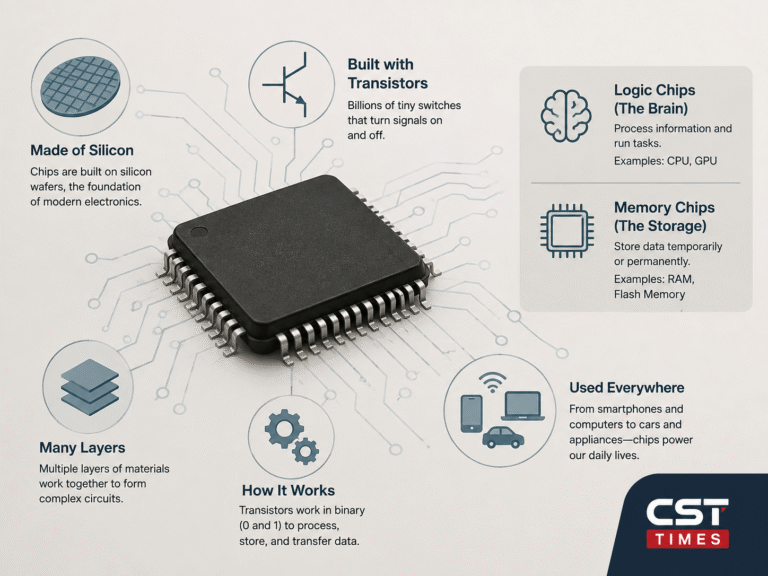
- Transistors are the basic building block inside a chip. They act as tiny on/off switches, and combining billions of them lets a chip run calculations in binary code.
- Chip complexity has grown enormously: Intel’s 4004, the first general-purpose microprocessor, was introduced in 1971 and contained about 2,300 transistors; Apple’s M4 chip (2024) holds around 28 billion.
- Chips generally split into two functional groups: logic chips (the “brain,” like CPUs and GPUs) and memory chips (the “storage,” like RAM and flash memory).
- Global chip sales hit a record $791.7 billion in 2025, up 25.6% year over year, largely driven by AI hardware demand.
Table of Contents
- What is a Chip?
- Who Invented the First Chip?
- What is a Chip Made Of?
- What is Inside a Chip?
- How Does a Chip Work?
- Where Are Chips Used in Electronics?
- Final Thoughts
What is a Chip?
A chip is a small, flat piece of semiconductor material — almost always silicon — with an electronic circuit built directly into its surface. Engineers use “microchip,” “computer chip,” and “integrated circuit” (IC) interchangeably for the same thing.
According to ASML, which builds the machines used to print circuits onto silicon, a microchip is a set of electronic circuits on a small flat piece of silicon, where transistors act as miniature switches that turn current on or off. That switching, repeated across billions of transistors, is what lets a chip run an app, store a file, or process an image.
Most chips are smaller than a fingernail, yet a single one can pack in more components than a small city has residents. Intel describes semiconductors — the more technical term for the material and the devices built from it — as some of the most complex products ever manufactured.
It helps to separate two terms often used loosely: a semiconductor is the material itself, with electrical properties between a conductor like copper and an insulator like glass, while a chip is the finished piece of hardware built from it.
Who Invented the First Chip?
The first electronic chip, known as the integrated circuit (IC), was independently developed by Jack Kilby and Robert Noyce in the late 1950s. Jack Kilby demonstrated the first working integrated circuit in 1958, while Robert Noyce later developed a practical version using silicon. Their inventions helped start the modern chip industry.
What is a Chip Made Of?
Every chip starts as a cylinder of ultra-pure silicon crystal, grown in a lab and sliced into thin discs called wafers. Silicon is chosen because it’s a semiconductor: on its own it barely conducts electricity, but adding tiny, precisely controlled amounts of other elements changes that, letting engineers decide exactly where current flows across the chip.
From there, manufacturers build the circuit in layers on top of the wafer: a base layer of transistors formed inside the silicon, insulating layers (usually silicon dioxide) that keep parts of the circuit electrically separated, and metal wiring layers (typically copper or aluminum) that connect the transistors into a working circuit — much like wires linking components in a larger machine.
According to a chip manufacturing overview published by Intel, a finished chip can have more than 30 of these layers, even though the whole thing looks perfectly flat to the eye. Building each layer involves coating the wafer with a light-sensitive material, projecting the circuit pattern onto it with intense light in a process called photolithography, then chemically etching away everything outside the design, as outlined in a technical breakdown of chip fabrication by TechSpot. This cycle repeats dozens of times until the circuit is complete, and the wafer is then cut into individual chips, tested, and sealed inside the small protective package you’d actually see inside a laptop or phone.
What is Inside a Chip?
The core building block inside a chip is the transistor: a microscopic switch that flips between “on” and “off,” billions of times per second. Group enough transistors together in the right pattern and they form logic gates, small circuits that carry out basic operations like AND, OR, and NOT. Combine enough logic gates, and a chip can perform addition, comparisons, and eventually far more complex tasks.
The scale of modern chips is hard to picture. Intel’s 4004 processor, released in 1971 and widely regarded as the first commercially available microprocessor, packed about 2,300 transistors. By comparison, Apple’s M4 chip (2024) contains roughly 28 billion transistors on a 3-nanometer process, and Nvidia’s Blackwell B200 GPU, built for AI data centers, packs around 208 billion — among the densest chips in commercial production. That growth roughly follows Moore’s Law, the 1965 observation by Intel co-founder Gordon Moore that transistor counts on a chip tend to double every couple of years as manufacturing techniques improve.
Beyond transistors, a chip’s interior includes the metal interconnects described above, plus dedicated regions for different jobs — many modern chips set aside separate areas for processing, memory access, and input/output, all on one piece of silicon.
How Does a Chip Work?
At its core, a chip works by controlling the flow of electricity through millions or billions of transistors to represent and manipulate information as binary code: strings of 1s and 0s, where an “on” transistor represents a 1 and an “off” transistor represents a 0.
The basic sequence looks like this:
- Data enters the chip as an electrical signal — a keystroke, a tap on a touchscreen, or a value read from memory.
- The chip’s logic gates process that signal by switching transistors on and off in specific combinations.
- The result gets stored, passed to another part of the chip, or sent out to another component, like a display or a memory chip.
A chip’s internal clock coordinates all of this, pulsing billions of times per second so transistors switch in sync — the faster the clock (measured in gigahertz), the more operations the chip completes per second.
Different chip types handle this differently. A CPU works through instructions one after another, very quickly, which suits general tasks like running an operating system. A GPU switches enormous numbers of transistors at once, which suits the repetitive, parallel math behind graphics rendering and AI computation.
Where Are Chips Used in Electronics?
Chips are so embedded in daily life that most people rely on dozens of them before breakfast. Broadly, they fall into a few functional categories:
Chip Type | What It Does | Common Examples |
|---|---|---|
| CPU (Central Processing Unit) | General-purpose “brain” that runs instructions in sequence | Laptops, desktops, smartphones |
| GPU (Graphics Processing Unit) | Runs thousands of calculations in parallel | Gaming, video editing, AI training |
| Memory chip (RAM, ROM, flash) | Stores data temporarily or permanently | System memory, SSDs, USB drives |
| SoC (System on a Chip) | Combines a CPU, GPU, memory controller, and more on one chip | Smartphones, tablets, smartwatches |
| Microcontroller (MCU) | Small, low-power chip built for one repetitive task | Washing machines, thermostats, rice cookers |
In practice, these show up across nearly every category of electronics:
- Computing and communication: Smartphones, laptops, and routers rely on logic and memory chips to run apps, browse the web, and connect over Wi-Fi and mobile networks.
- Home appliances: Per Hitachi High-Tech, semiconductors give everyday appliances precision older mechanical parts couldn’t — temperature sensors in air conditioners, timing circuits in rice cookers, control boards in washing machines and refrigerators.
- Automotive: Cars increasingly depend on chips for driver-assistance systems and infotainment, with EVs also relying on them for battery and motor management, per Keysight.
- Healthcare: Keysight also points to medical equipment such as MRI scanners and pacemakers, where chips provide the precision patient safety depends on.
- Industrial systems: Factories, power grids, and transportation networks use chips in sensors and control systems to keep operations running safely.
That demand shows up in the size of the chip industry itself. Global semiconductor sales reached a record $791.7 billion in 2025, up 25.6% over 2024, according to the Semiconductor Industry Association — with AI infrastructure now the industry’s single biggest growth driver.
Final Thoughts:
A chip is, at its core, a very small, very organized collection of electrical switches. What makes it remarkable isn’t any single transistor — it’s how billions of them, wired together across dozens of microscopic layers, can be coordinated to run an app, render a game, or keep a car’s safety systems alert in real time. Understanding these basics makes it easier to follow bigger tech stories built on top of them, since nearly all of them trace back to the same small piece of silicon.
Is a chip the same thing as a semiconductor?
Not exactly. A semiconductor is the material — usually silicon — while a chip is the finished device built from it. Casually, “semiconductor” often just means “chip,” and Intel itself notes the term commonly refers to the integrated circuit rather than the raw material.
What’s the difference between a CPU and a chip?
A CPU is one specific type of chip: the general-purpose processor that runs a device’s instructions. “Chip” is the broader term that also covers GPUs, memory chips, and system-on-a-chip designs.
How small is a transistor in a modern chip?
Current advanced chips, including Apple’s M-series, are built on a 3-nanometer process, putting features at a scale smaller than most viruses — too small to see without an electron microscope.
Why do chips keep getting more powerful
Manufacturers keep shrinking transistors and refining fabrication techniques, letting more fit on the same size chip. This trend, known as Moore’s Law, has pushed transistor counts from a few thousand in the 1970s to tens of billions today.
Do all electronic devices contain a chip
Nearly all modern electronic devices contain at least one chip. A basic microcontroller is enough to run a digital thermostat, while smartphones contain dozens of specialized chips working together.
Follow us on Social media :
About The Author

Haseeb Jabbar
Haseeb Jabbar writes about crypto, finance, technology, and AI at CST Times, sharing research-based guides, timely news, and free tools and calculators to help readers make informed decisions.
