
What Is an AI Chip? How AI Chips Work and Why They Matter
What is an AI Chip?
Quick Summary:
An AI chip (also known as an AI accelerator or AI processor) is a specialized silicon processor engineered to perform the complex mathematical operations behind machine learning and deep learning. Unlike traditional CPUs that process general tasks sequentially, AI chips excel at performing massive parallel calculations—such as matrix multiplication and tensor processing—at high speeds and lower power consumption. Common types include GPUs, TPUs, and NPUs.
Table of Contents
ToggleIntroduction:
Figures and product names in this guide are current as of 2026. This is a fast-moving industry, so some specifics may shift over time.
Nvidia became one of the most valuable companies in the world not by selling graphics cards for video games, but by selling AI chips: specialized processors built to run the parallel mathematics behind modern artificial intelligence.
If you have chatted with an AI assistant, unlocked your smartphone with facial recognition, or seen an autonomous vehicle navigate traffic, an AI chip handled the heavy computational load behind the scenes.
In this guide, you will learn what an AI chip actually is, how it differs from a standard laptop processor, the main hardware types (GPU, TPU, NPU), key manufacturers, and why this piece of silicon drives modern technology.
Key Takeaways
- AI chips are specialized processors — not general-purpose CPUs — built to run the parallel math behind machine learning at high speed and comparatively low power.
- The main types are GPUs (flexible, currently dominant), TPUs and custom ASICs (efficient, purpose-built), NPUs (small, low-power chips in phones and laptops), and FPGAs (reprogrammable, used in niche roles).
- AI chips generally do one of two jobs: training a model on massive datasets, or inference, running an already-trained model to answer a question or make a decision.
- Nvidia holds the largest share of the data-center AI chip market by a wide margin, though estimates vary; AMD and in-house chips from Google, Amazon, Microsoft, and Meta are steadily gaining ground.
- Most flagship phones and a growing share of laptops released in 2026 ship with a dedicated on-device AI chip, usually called an NPU or Neural Engine.
- Nearly every advanced AI chip is manufactured by one company, Taiwan’s TSMC, making it a genuine chokepoint in global technology supply chains.
- The AI chip boom now factors into global electricity demand, trillion-dollar stock valuations, and US-China trade policy all at once.
Table of Contents
- What Is an AI Chip?
- How Do AI Chips Actually Work?
- The Main Types of AI Chips
- Who Makes AI Chips? The Key Players in 2026
- Why AI Chips Matter
- Quick Checklist: Spotting an AI Chip in Products You Already Own
- Final Thoughts
What is an AI Chip?
An AI chip is a computer processor built specifically to handle the mathematical workload of artificial intelligence — mainly the matrix and tensor calculations behind machine learning and deep learning — instead of the general, one-task-at-a-time processing a standard computer chip handles.
A CPU (central processing unit) is designed to handle a huge variety of tasks, one after another, very quickly. An AI chip is designed to do one narrow category of math — multiplying and adding huge grids of numbers — millions of times simultaneously. That narrow focus is what makes it so much faster and more efficient at AI workloads specifically, and so much less useful for everyday computing tasks like running an operating system.
“AI chip” is really an umbrella term rather than one specific product. It covers several kinds of hardware, including graphics processing units (GPUs), tensor processing units (TPUs), neural processing units (NPUs), and application-specific integrated circuits (ASICs). What they all share is a design built around parallel processing rather than sequential processing — doing thousands of simple calculations at once instead of one complex calculation at a time.
How Do AI Chips Actually Work?
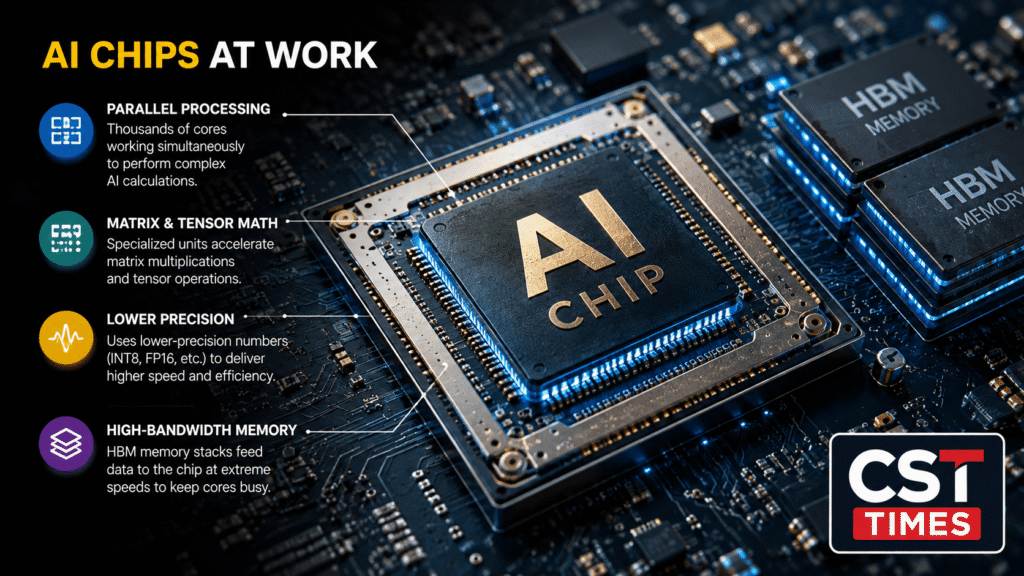
Four design choices separate an AI chip from the processor inside a typical laptop.
Parallel Processing, Not Sequential
A CPU works like an extremely capable single employee — it can switch between different tasks quickly, but it mostly handles one calculation, then the next, then the next. An AI chip works more like a stadium full of people all doing simple arithmetic at the same time. Training or running a neural network involves multiplying and adding enormous grids of numbers, called matrices, and an AI chip performs thousands of these operations in parallel instead of in sequence. That parallelism is the single biggest reason AI chips outperform CPUs on AI tasks, often by a wide margin.
Matrix and Tensor Math
Deep learning models are, underneath the hood, layers of matrix multiplication. AI chips build dedicated circuits — often called tensor cores or matrix engines — specifically to accelerate this kind of math, rather than relying on the general-purpose arithmetic circuits a CPU uses.
Lower-Precision Numbers, Higher Speed
Traditional computing often uses 32-bit numbers to preserve accuracy. Most AI chips instead calculate using shorter, lower-precision formats — 16-bit, 8-bit, or even 4-bit numbers — trading a small amount of numerical precision for a large gain in speed and energy efficiency. For most AI tasks, that trade-off barely affects the accuracy of the final result, and newer chips add hardware specifically to compensate for it.
High-Bandwidth Memory (HBM)
A chip’s processing cores can only work as fast as data reaches them. AI chips pair their processors with high-bandwidth memory (HBM) — memory stacked in vertical layers physically next to the chip — to feed data in and out fast enough to keep those cores busy. Memory bandwidth, not raw processing power, is now one of the biggest bottlenecks in advanced AI chip design, and a large share of a modern AI chip’s cost goes into HBM and the packaging that connects it to the processor.
The Main Types of AI Chips
“AI chip” is a category, not a single product. Here are the types you’re most likely to encounter, from most flexible to most specialized.
| Chip Type | Full Name | Best Suited For | Examples |
|---|---|---|---|
| GPU | Graphics Processing Unit | Training large models; general-purpose AI | Nvidia Blackwell, AMD Instinct MI350 |
| TPU / ASIC | Tensor Processing Unit / Application-Specific Integrated Circuit | Large-scale cloud AI built for one company’s workloads | Google TPU, AWS Trainium, Microsoft Maia |
| NPU | Neural Processing Unit | On-device AI in phones and laptops | Apple Neural Engine, Qualcomm Hexagon |
| FPGA | Field-Programmable Gate Array | Reconfigurable, specialized inference tasks | Networking hardware, select inference roles |
GPUs: The Generalists
The graphics processing unit was originally designed for rendering video game graphics — a task that also involves doing the same simple calculation across millions of pixels at once. That parallel design turned out to be extremely well suited to AI. GPUs from Nvidia and AMD remain the default choice for training large AI models today, largely because of their flexibility and mature software ecosystem. Nvidia’s CUDA software platform in particular has close to a two-decade head start that rivals are still working to close.
TPUs and Custom ASICs: Built for One Job
An application-specific integrated circuit (ASIC) is a chip designed for one narrow purpose. Google’s tensor processing unit (TPU), first built in 2016 for its own AI workloads, is technically an ASIC. Because a custom ASIC only ever needs to do one job, it can be more efficient and cheaper to run at scale than a general-purpose GPU — the trade-off is far less flexibility for anything outside that job. This logic is why Amazon (Trainium), Microsoft (Maia), and Meta (MTIA) have all built custom AI chips for their data centers rather than relying solely on merchant GPUs. Amazon’s Trainium chips, for instance, are used heavily by AI lab Anthropic to train its Claude models.
NPUs: AI in Your Pocket
A neural processing unit (NPU) is a small, energy-efficient AI chip built into the same package as your phone or laptop’s main processor. Rather than training massive models, an NPU is built for inference — running an already-trained AI model locally, without sending your data to the cloud. NPUs are what let a phone recognize your face, transcribe speech in real time, or process an AI photo edit without an internet connection. By 2026, most newly released flagship phones ship with a dedicated NPU, and Microsoft’s “Copilot+ PC” program has made NPUs a standard feature of new Windows laptops too.
FPGAs: The Reconfigurable Option
A field-programmable gate array (FPGA) sits between a GPU and an ASIC: it can be reprogrammed after manufacturing to handle different tasks, unlike a fixed ASIC, but it generally isn’t as fast or power-efficient as either a GPU or a purpose-built ASIC. FPGAs play a smaller role in mainstream AI today, but they’re still used for specialized jobs like network processing and certain inference workloads where flexibility matters more than raw speed.
Training vs. Inference: Two Different Jobs
Nearly every AI chip is optimized more heavily for one of two jobs. Training is the process of teaching a model by having it process enormous datasets repeatedly while adjusting billions of internal parameters — an extremely compute-intensive job typically handled by the most powerful GPUs and TPUs. Inference is what happens every time someone actually uses a trained model, such as asking a chatbot a question, and it prioritizes low latency and low cost per query over raw power. As AI products have moved from research labs into everyday apps used by billions of people, inference now accounts for a larger and faster-growing share of total AI computing than training does — which is a big reason cheaper, more specialized inference chips have become such a competitive battleground.
Who Makes AI Chips? The Key Players in 2026
Nvidia: The Market Leader
Nvidia designs the GPUs that still power most AI training worldwide, currently built around its Blackwell architecture and transitioning toward its newer Vera Rubin platform through the rest of 2026. Estimates of Nvidia’s exact share of the AI accelerator market vary by source and methodology — whether they count revenue or unit shipments, and whether they include hyperscalers’ in-house chips — but most put it somewhere between roughly 75% and 90% as of 2026. That share has been gradually declining from a peak above 85–90% in 2024, even as Nvidia’s dollar revenue keeps setting records, simply because the total market is growing even faster than any single competitor can catch up.
AMD: The Closest Merchant Rival
AMD is Nvidia’s main publicly available, or “merchant,” competitor, selling its Instinct line of AI GPUs — the MI300 and MI350 series currently shipping, with the MI400 and MI450 generation arriving through 2026. AMD’s data-center business has grown quickly, and its share of the merchant AI chip market has roughly doubled since 2024, though most estimates still place it in the high single digits to around 10%.
The Hyperscalers’ Custom Silicon
Google, Amazon, Microsoft, and Meta — the four companies that run most of the world’s cloud data centers — have all built their own in-house AI chips: Google’s TPU (now in its seventh generation), Amazon’s Trainium, Microsoft’s Maia, and Meta’s MTIA. None of these chips are sold to outside customers the way Nvidia’s or AMD’s are; they exist to cut costs and reduce each company’s dependence on outside suppliers for its own AI workloads. Broadcom and Marvell do much of the underlying design engineering on these custom chips as technical partners.
Mobile and Edge Chipmakers
A separate group of companies — Apple, Qualcomm, MediaTek, and Samsung — builds the NPUs found in smartphones and laptops. Apple’s Neural Engine, Qualcomm’s Hexagon NPU (inside its Snapdragon chips), and MediaTek’s Dimensity NPUs compete mainly on how much AI processing they can do locally per watt of battery power, rather than on raw computing power alone.
The Company Behind Almost All of Them: TSMC
Nearly every advanced AI chip mentioned above — Nvidia’s, AMD’s, Google’s, Amazon’s, Apple’s — is actually manufactured by the same company: Taiwan Semiconductor Manufacturing Company (TSMC). Chip designers like Nvidia are “fabless,” meaning they design chips but don’t own the factories that build them. TSMC’s advanced packaging process, called CoWoS, which connects a chip’s processing die to its high-bandwidth memory, has become one of the tightest bottlenecks in the entire AI industry. Demand has outpaced supply for several years running, and companies including Google have reportedly had to scale back chip production targets because of it.
Why AI Chips Matter
They’re Reshaping the World’s Most Valuable Companies
Nvidia became the first company in history to reach a $5 trillion market valuation in October 2025, and remains the world’s most valuable public company, worth roughly $5.3 trillion as of early August 2026 — a position built almost entirely on AI chip demand. Amazon, Google, Microsoft, and Meta are together projected to spend somewhere around $650 billion or more on AI infrastructure, much of it chips, in 2026 alone, according to analyst estimates.
They’re Straining the Global Power Grid
Training and running AI models at scale takes enormous amounts of electricity, and AI chips sit at the center of that demand. The International Energy Agency projects that global data center electricity consumption will roughly double, from about 485 terawatt-hours in 2025 to around 950 terawatt-hours by 2030, with electricity demand from AI-focused data centers specifically expected to triple over the same period. That is pushing tech companies toward new power sources, including nuclear and natural gas, and straining electrical grids in regions with heavy data center concentration, including parts of the United States and Ireland.
They’ve Become a Geopolitical Bargaining Chip
Because the most advanced AI chips are designed by a small number of US companies and manufactured almost entirely by TSMC in Taiwan, the US government treats them as a national security asset and restricts their export to China. That policy has shifted repeatedly through 2025 and 2026 — from a strict ban, to a partial loosening that allowed limited sales of certain chips to China in exchange for a share of the revenue, to renewed restrictions in mid-2026 that closed loopholes and tightened controls on Nvidia’s most advanced chips. This is a fast-moving area of policy, and the specific rules in place may have changed again by the time you’re reading this — Nvidia’s investor disclosures and official notices from the US Department of Commerce are the most reliable places to check the current status.
Quick Checklist: Spotting an AI Chip in Products You Already Own
- Check your phone or laptop’s spec sheet for “NPU,” “Neural Engine,” or a “TOPS” (trillion operations per second) rating — all signal a dedicated on-device AI chip.
- Look for a “Copilot+ PC” badge on a Windows laptop; it means the machine meets Microsoft’s minimum NPU performance requirement.
- On a desktop or gaming PC, any modern dedicated graphics card (Nvidia GeForce RTX or AMD Radeon) is technically an AI-capable GPU, even if you only use it for gaming.
- If you use cloud AI tools, the provider’s pricing or documentation pages often name the underlying hardware — such as “H100,” “TPU,” or “Trainium” — a quick way to see which chip is actually doing the work.
- Camera features like real-time portrait mode, offline voice transcription, and on-device translation are strong hints that an NPU is running in the background.
Final Thoughts:
CST Times’ View:
AI chips have moved from a niche component to genuine infrastructure in less than a decade. Whether it’s a data-center GPU training the next large language model or a small NPU inside your phone recognizing your voice, the same underlying idea drives all of them: purpose-built silicon beats general-purpose silicon when the workload is this specific and this large. Expect the company names and chip families in this guide to keep changing — new architectures arrive almost every year — but the core distinctions covered here, GPU versus ASIC versus NPU, and training versus inference, should stay useful for understanding whatever comes next.
FAQs
Is a GPU the same thing as an AI chip?
A GPU is one type of AI chip, not the only type. GPUs are the most widely used AI chip today because their parallel design, originally built for graphics, translates well to AI workloads — but TPUs, NPUs, and other ASICs are AI chips too.
What’s the actual difference between an AI chip and a regular CPU?
A CPU is built to handle many different kinds of tasks well, one after another, very quickly. An AI chip is built to do one narrow type of math — the matrix calculations behind machine learning — across thousands of data points at the same time. That specialization makes AI chips far faster and more efficient for AI specifically, but far less useful for general computing tasks like running an operating system.
Does my smartphone already have an AI chip in it?
Almost certainly, if it’s a phone released in the last few years. Most flagship phones now include a neural processing unit built into the main chip, handling tasks like camera processing, voice recognition, and on-device AI features without needing an internet connection.
Which company makes the best AI chips?
It depends on the job. Nvidia’s GPUs remain the default choice for training large AI models because of their flexible, mature software ecosystem. Google’s TPUs and Amazon’s Trainium chips can be more cost-efficient for specific cloud AI workloads. Apple and Qualcomm lead on power-efficient, on-device AI chips for phones. There isn’t a single “best” chip, only a best chip for a given task and budget.
Can an individual buy an AI chip?
Yes, to an extent. Consumer graphics cards like Nvidia’s GeForce RTX series and AMD’s Radeon series use the same underlying AI-capable architecture as their data-center chips, just at a smaller scale, and can run many AI tools locally. The most powerful data-center chips, such as Nvidia’s Blackwell-based systems, are generally sold only to large businesses, typically through cloud providers rather than as a retail product.
Will AI chips get cheaper over time?
Prices for a given performance level have historically fallen as manufacturing improves, similar to most computer chips. However, overall spending on AI chips has been rising, not falling, because demand for AI computing is growing faster than the cost per chip is dropping. Current shortages in advanced memory and packaging capacity mean the newest, most powerful chips are likely to stay expensive and hard to obtain in the near term.
Disclaimer
This article is for general informational purposes and does not constitute personalized security or financial advice. Account security needs vary;
Follow us on Social media :
About The Author

Haseeb Jabbar
Haseeb Jabbar writes about crypto, finance, technology, and AI at CST Times, sharing research-based guides, timely news, and free tools and calculators to help readers make informed decisions.

Pingback: Who created artificial intelligence? The 1956 Story Explained