
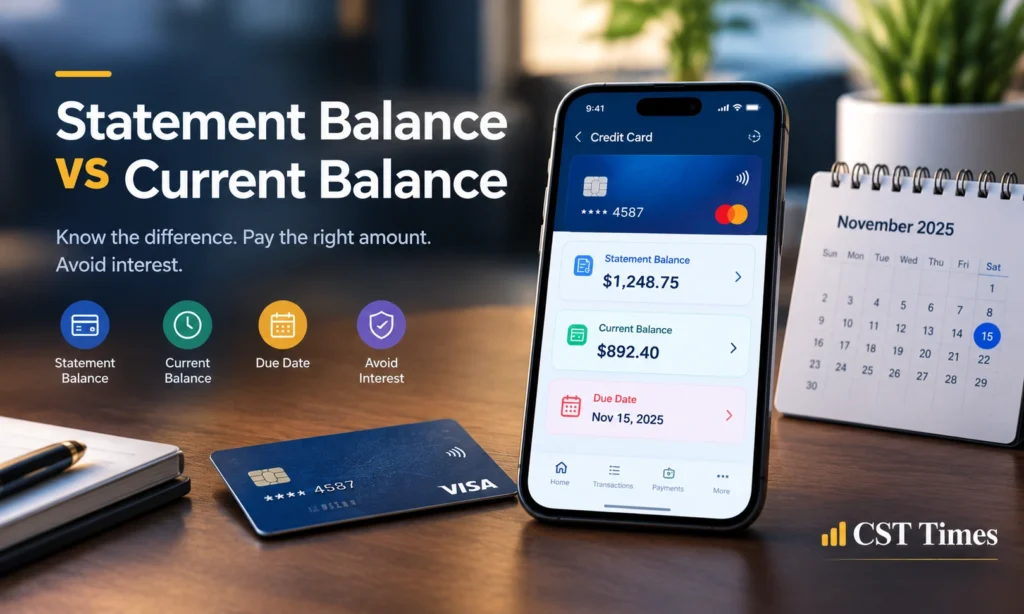
Statement Balance vs Current Balance: What Should You Pay?
Quick Summary:
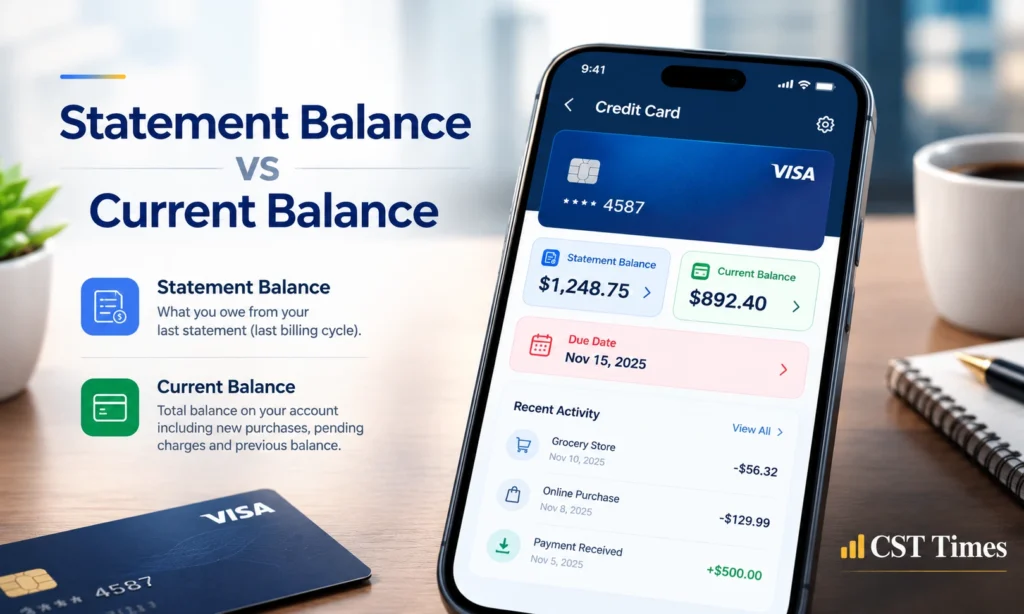
Statement balance vs current balance comes down to timing. Your statement balance is what you owed when your last billing cycle closed, and your current balance is what you owe right now. For avoiding interest, the statement balance is usually the number that matters. This guide explains which amount to pay, when to pay it, and how to read the numbers in your card app.
Table of Contents
ToggleKey Takeaways
- Paying your full statement balance by the due date generally avoids interest on purchases, if your card has a grace period and you carried no balance from last month.
- Your current balance also counts purchases and payments made since the statement closed.
- The minimum payment avoids a late fee, not interest on what you leave unpaid.
- After a partial payment, what you still owe is the remaining statement balance, not necessarily the current balance.
- Reported credit utilization usually follows your balance around the closing date, not the due date.
The Short Answer
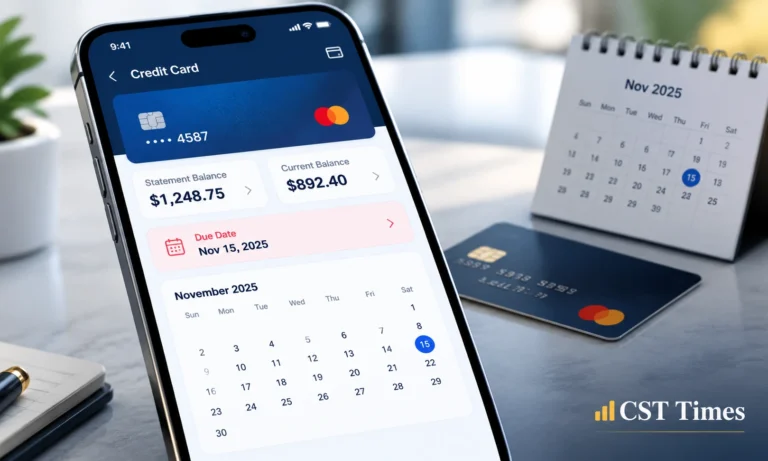
Pay your statement balance in full by the due date to avoid interest on purchases. The current balance is a running total of everything posted since the statement closed. Paying it also works and brings your balance to zero, but you don’t need to pay it to avoid interest.
| Term | What it means | Do you have to pay it? |
|---|---|---|
| Statement balance | Amount owed when the billing cycle closed | Pay in full by the due date to avoid interest on purchases |
| Current balance | Posted transactions to date, including new purchases and payments | No. Pay it only if you want a $0 balance |
| Remaining statement balance | The part of the statement balance still unpaid after a partial payment | Yes, by the due date, to avoid interest |
| Minimum payment | The smallest amount your issuer requires | Required to stay in good standing, but unpaid balances accrue interest |
Labels vary by issuer. American Express uses “total balance” for the current balance. Chase describes the current balance as a running tally that may not include pending charges.
Which Balance to Pay, and When
Pay by the payment due date, not the closing date. The closing date ends the billing cycle, and the due date is your deadline. The CFPB defines the grace period as the time between the two, during which you may avoid interest by paying in full.
Issuers must deliver your bill at least 21 days before the due date. Card companies generally can’t treat a payment as late if it’s received by 5 p.m. on the due date. They may set reasonable cut-off times for online payments, and a payment counts when it’s received, not when you send it. Paying a few days early removes the risk.
Real-Life Examples
These examples use round numbers. They assume you carried no balance from the prior month and your card has a grace period.
Example 1: New purchases after the statement closes. Your statement balance is $350, then you spend $200. Your current balance is $550. Paying $350 by the due date avoids interest on that amount, and the $200 simply shows up on your next statement.
Example 2: A partial payment. You pay $200 toward a $350 statement balance. Your remaining statement balance is $150, and that is what you must still pay by the due date. If you also spent $200 since the statement, your current balance shows $350, which looks like the original statement balance. It isn’t. You owe $150 from the statement, and the other $200 belongs to the next one.
Example 3: $0 statement balance, but a current balance. You paid your statement in full, then spent $75. Your statement balance is $0 and your current balance is $75. Nothing is due now, and the $75 appears on your next statement.
In short, your current balance runs higher than your statement balance after new purchases and lower after payments or credits, as Chase explains.
Does Paying Only the Minimum Avoid Interest?
No. The minimum payment keeps your account in good standing, but the unpaid part of your statement balance accrues interest. Per the CFPB, if you lose your grace period, you’re charged interest on the unpaid balance and on new purchases from the date each is made.
Example 4: Your statement balance is $350, and we’ll assume a $35 minimum and a 24% APR. Paying $35 leaves $315, which costs roughly $6 over 30 days (0.24 ÷ 365 × $315 × 30, simplified). That is small, but it also puts your grace period at risk. The CFPB warns that paying in full some months and not others can cost you the grace period for that month and the nex
Why Interest Can Appear After You Pay the Statement Balance
Usually it’s residual (trailing) interest from a balance you carried earlier. Interest accrues daily between your statement date and the day your payment posts, then appears on the next statement. Chase and Citi both describe it this way.
Example 5: You carried $400 at 24% APR, and your statement closed on the 1st. You pay it off on the 16th. About $4 of interest builds up over those 15 days (0.24 ÷ 365 × $400 × 15). It shows on your next bill, even though you thought you were done.
Other transactions follow different rules. Cash advances generally start accruing interest on the transaction date. With promotional balances, the CFPB says you must pay the entire statement balance, including the promotional amount, to avoid interest on new purchases. If you’re carrying a balance, ask your issuer for an exact payoff amount that includes residual interest.
Pending Charges, Refunds, Processing Delays, and Autopay
App numbers can differ because of timing. Pending charges reduce your available credit before they raise your balance. Refunds help only once they post, payments take time to process, and autopay pays only the amount you chose.
- Pending charges: They may not appear in your current balance yet.
- Refunds: A refund that posts after the statement closes typically lowers your current balance, not the statement balance. Check the remaining statement balance before relying on it.
- Processing: The CFPB notes that mailed payments and online bill pay can be delayed, so send payments early.
- Autopay: Confirm it’s set to the statement balance. A minimum-only setting leaves the rest to accrue interest.
Statement Balance, Current Balance, and Your Credit Score
Paying either balance doesn’t directly raise your score. What counts is the balance your issuer reports. Issuers typically report around the statement closing date, so a balance can be reported even if you pay it in full days later. Timing varies by issuer.
Example 6: Your limit is $5,000, and you spend $1,500 in a cycle. If the statement closes at $1,500, 30% utilization may be reported, even if you pay in full by the due date. Paying $1,000 before the closing date means $500 (10%) gets reported. Both routes avoid interest if you pay by the due date, but no payment guarantees a score change.
These are two separate goals. The due date protects you from interest, and the closing date influences what gets reported.
What If You Can’t Pay the Full Statement Balance?
Pay at least the minimum by the due date, and as much above it as you can. This avoids late fees and limits how much interest builds. Treat the minimum as a safety net, not an interest-free option. A sample CFPB statement warns that a late payment can also trigger a penalty APR.
Contact your issuer before the due date to ask about options. While carrying a balance, the CFPB suggests considering cash, debit, or a different card for new purchases so they don’t pile on interest.
Quick Checklist: 5 Rules for Choosing What to Pay
- Find your statement balance, any remaining statement balance, and the due date in your app.
- If you carried a balance last month, expect residual interest and ask your issuer for the exact payoff amount.
- Pay a few days before the due date to beat the 5 p.m. cutoff and processing delays.
- Check that autopay is set to the statement balance, not the minimum.
- To lower reported utilization, make a separate payment before the closing date.
The costliest mistakes are paying only the minimum out of habit, treating a partial payment as “close enough,” and assuming a $0 balance means no interest will follow.
Final Thoughts:
The simplest answer to statement balance vs current balance is to pay the full statement balance by the due date and use the minimum only as a safety net. Grace-period and reporting rules vary by issuer, so check your card agreement. If your numbers don’t add up, ask your issuer for the exact amount before you pay.
FAQs
Should I pay my statement balance or current balance?
Pay at least the statement balance in full by the due date to avoid interest on purchases, assuming your card has a grace period and you carried no balance. Paying the current balance is optional; it just clears new purchases early. In the statement balance vs current balance choice, the statement amount protects you from interest.
Why does my app still show a statement balance after I paid?
Your statement balance is a snapshot from the closing date, so it may not change when you pay. Many apps show a remaining statement balance or update after the payment posts. Check that figure and your payment status. If it’s $0 remaining, you’ve covered what the statement requires.
Can I pay only the minimum payment without interest?
No. Paying the minimum avoids a late fee, but the unpaid portion of your statement balance accrues interest, and you may lose your grace period on new purchases. The only common way to avoid interest on purchases is paying the full statement balance by the due date, subject to your card agreement.
Does paying my current balance help my credit score?
Not directly. Scores reflect the balance your issuer reports, which is usually the statement balance around the closing date. Paying the current balance on the due date doesn’t change a balance already reported. To lower reported utilization, pay before the statement closes, though no payment guarantees a score change.
What if my current balance is lower than my statement balance?
That happens when you’ve made payments or received credits since the statement closed. You still owe the remaining statement balance by the due date to avoid interest, so check that amount, not just the current balance. If both look lower than expected, confirm the payment has posted.
Disclaimer
This article is for educational and informational purposes only and is not financial, investment, or legal advice. Credit card terms vary by issuer, so always check your card agreement and confirm details with your issuer.
Follow us on Social media :
About The Author

Haseeb Jabbar
Haseeb Jabbar writes about crypto, finance, technology, and AI at CST Times, sharing research-based guides, timely news, and free tools and calculators to help readers make informed decisions.
