
What is NVIDIA Nemotron? Models, Pricing & How to Use It (2026 Guide)
NVIDIA Nemotron Explained:
Quick Summary:
NVIDIA Nemotron is a family of open AI models built to power AI agents rather than a single chatbot product. If you have seen the name attached to reasoning benchmarks, coding tools, or NVIDIA’s GTC keynotes and wondered what it actually is, this guide answers that directly, then walks through how the models work, what they cost, and how to start using one today.
Table of Contents
ToggleKey Takeaways
- NVIDIA Nemotron is a family of open, multimodal AI models — not one product — covering reasoning, vision, speech, retrieval, and safety, all designed to work well inside AI agents.
- It uses a hybrid Mamba-Transformer architecture combined with Mixture-of-Experts (MoE) routing, which is why very large Nemotron models can still run fast and relatively cheaply.
- The model weights are free to download, modify, and use commercially, including in production, under NVIDIA’s open license.
- NVIDIA also gives free trial API credits so you can test Nemotron models in your browser or through code with no GPU of your own.
- Running Nemotron at real scale is not free: you either pay for your own compute, pay a third-party host per token, or buy an NVIDIA AI Enterprise license for managed production support.
- The newest and largest model, Nemotron 3 Ultra, launched in June 2026 and is currently rated the most capable open-weight model built by a US lab, according to the independent benchmarking firm Artificial Analysis.
Table of Contents
- What is NVIDIA Nemotron?
- How Does NVIDIA Nemotron Work?
- The NVIDIA Nemotron Model Family
- How to Use NVIDIA Nemotron
- Is NVIDIA Nemotron Free?
- NVIDIA Nemotron Pricing
- Nemotron vs. Other Open Models
- Which Nemotron Model Should You Use?
- Final Thoughts
- FAQs
- References
Table of Contents
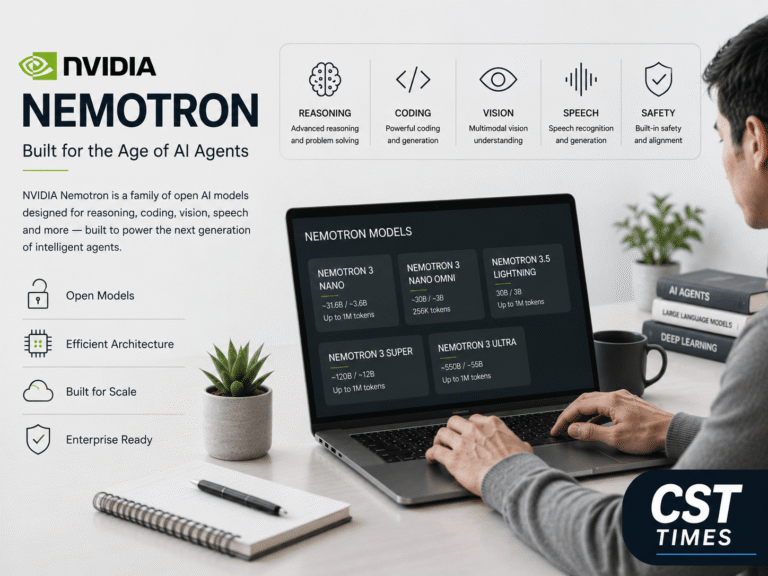
| Model | Parameters (Total / Active) | Context Window | Best For |
|---|---|---|---|
| Nemotron 3 Nano | ~31.6B / ~3.6B | Up to 1M tokens | Lightweight, fast specialized agents |
| Nemotron 3 Nano Omni | ~30B / ~3B | 256K tokens | Document, video, and audio understanding |
| Nemotron 3.5 Lightning | 30B / 3B | Up to 1M tokens | High-volume, routine steps inside agents |
| Nemotron 3 Super | ~120B / ~12B | Up to 1M tokens | Multi-agent orchestration, complex tasks |
| Nemotron 3 Ultra | ~550B / ~55B | Up to 1M tokens | Frontier-level reasoning, mission-critical workflows |
What is NVIDIA Nemotron?
NVIDIA Nemotron is NVIDIA’s family of open large language models, along with related multimodal, speech, retrieval, and safety models, built specifically for AI agents — systems that reason, use tools, and carry out multi-step tasks rather than just answering a single question. Instead of one model, Nemotron is a lineup of sizes and specialties, similar in spirit to how Meta offers different sizes of Llama.
What sets Nemotron apart from most competitors is transparency. NVIDIA publishes not only the model weights but also much of the training data, training recipes, and technical reports behind each release, and it releases the models under a permissive open license that allows commercial use. That combination is why some outlets, including Reuters, described Nemotron as open-source, while others, including Wired, used the more cautious term open-weight, since not every technical detail of every model is published.
Nemotron did not appear overnight. NVIDIA introduced the first Nemotron-branded model, an 8-billion-parameter chatbot-focused model, in November 2023. It expanded through the dense Nemotron-4 15B and 340B models in 2024, then the Llama-based “Llama Nemotron” reasoning models announced at CES in January 2025. During 2025, NVIDIA shifted architecture with Nemotron-H and Nemotron Nano 2, before launching the current Nemotron 3 generation in December 2025 and expanding it through mid-2026 with Nano Omni, Super, Ultra, and most recently Nemotron 3.5 Lightning.
How Does NVIDIA Nemotron Work?
At a high level, Nemotron combines two efficiency ideas that most large language models use separately, plus one idea NVIDIA has pushed further than most competitors.
A hybrid Transformer-Mamba backbone. Most well-known LLMs are built entirely from Transformer attention layers, which are excellent at understanding relationships between words but get computationally expensive as text gets longer. Mamba layers, based on state-space models, process sequences more like a conveyor belt, carrying forward a compressed summary of everything seen so far instead of re-examining every previous word each time. Nemotron mixes both layer types in the same model, aiming for Transformer-level accuracy with Mamba-level efficiency on long documents and long agent conversations.
Mixture-of-Experts (MoE) routing. Rather than activating every parameter in the network for every word, an MoE model contains many smaller “expert” sub-networks and a router that sends each token to only a handful of the most relevant experts. This is why Nemotron 3 Super can have 120 billion total parameters while only around 12 billion are active for any given token: you get the knowledge capacity of a much larger model at closer to the compute cost of a small one. NVIDIA’s newer models add a refinement called LatentMoE, which compresses the token representation before the router makes its decision, improving both speed and accuracy.
Multi-token prediction. Instead of generating one word at a time, newer Nemotron models predict several upcoming tokens at once and verify them together, a built-in form of speculative decoding that speeds up response generation without a separate helper model.
After this architecture is pretrained on trillions of tokens, NVIDIA post-trains each model with supervised fine-tuning, reinforcement learning, and techniques such as multi-teacher distillation to sharpen reasoning, tool use, and instruction-following, the skills agentic applications depend on most.
The NVIDIA Nemotron Model Family
Nemotron is organized by size and specialty rather than a single flagship product.
Nemotron 3 Nano
Is the smallest reasoning model in the current generation, built for specialized sub-agents that need to run cheaply and quickly at high volume.
Nemotron 3 Nano Omni
Extends that efficiency to multiple input types at once — text, images, video, and audio — and is aimed at document intelligence, video analysis, and voice-driven agents.
Nemotron 3 Super
Targets multi-agent systems that need higher accuracy and strong tool-calling reliability without the cost of the largest model.
Nemotron 3 Ultra
Launched in June 2026, it is the largest and most capable model in the family at roughly 550 billion total parameters with about 55 billion active. It is aimed at mission-critical, multi-step planning tasks where accuracy matters more than raw speed, though NVIDIA also optimized it for strong throughput relative to its size.
Nemotron 3.5 Lightning
Released in August 2026, it is a 30-billion-parameter model with only 3 billion active parameters, purpose-built for the repetitive, high-volume steps inside a long-running agent, such as tool calls, formatting, and routine validation. NVIDIA pairs it with NeMo Switchyard, an open-source routing library that automatically sends each step of an agent’s workflow to whichever model — Lightning, a larger Nemotron, or even a non-NVIDIA model — is the best fit for that specific step. NVIDIA says Lightning is small enough to run on a single GPU, including workstation and laptop hardware.
Beyond the core reasoning line, NVIDIA also publishes Nemotron-branded speech models for transcription and text-to-speech, retrieval models for document search and embeddings, and safety models that screen for harmful or off-topic content in real time — all designed to slot into the same agentic pipelines as the language models.
How to Use NVIDIA Nemotron
There is no single “download Nemotron” button; the right starting point depends on how much infrastructure you want to manage yourself.
1. Test a model instantly through NVIDIA’s API Catalog. Visit build.nvidia.com, create a free account, and search for a Nemotron model. Each model page includes a browser-based playground where you can send prompts and see responses before writing any code.
2. Call it with a free developer API key. Join the free NVIDIA Developer Program (no credit card required) and generate an API key from your account settings. NVIDIA’s hosted endpoint is OpenAI-compatible, so existing OpenAI-style code usually needs only a few lines changed:
python
from openai import OpenAI

client = OpenAI(
    base_url="https://integrate.api.nvidia.com/v1",
    api_key="YOUR_NVIDIA_API_KEY"
)

response = client.chat.completions.create(
    model="nvidia/llama-3.3-nemotron-super-49b-v1.5",
    messages=[{"role": "user", "content": "Explain mixture-of-experts in one paragraph."}],
    max_tokens=200
)

print(response.choices[0].message.content)
3. Download the weights and self-host. Every current Nemotron model is published on Hugging Face. You can run it yourself using open-source tools such as Hugging Face Transformers or vLLM for general use, or NVIDIA’s own TensorRT-LLM for optimized performance on NVIDIA GPUs. This route has no licensing fee, but you supply and pay for the hardware.
4. Deploy it as an NVIDIA NIM microservice. For production systems that need enterprise support, guaranteed API stability, and security certifications, NVIDIA packages Nemotron models as NIM containers that you can run in your own data center or on a cloud provider, backed by an NVIDIA AI Enterprise license.
5. Use a third-party hosted provider. Services such as OpenRouter, DeepInfra, Hugging Face Inference, and cloud marketplaces including AWS Bedrock, Google Cloud, and Microsoft Foundry host Nemotron models with simple pay-per-token billing, so you skip infrastructure management entirely.
Is NVIDIA Nemotron Free?
Yes, in the ways that matter for most people: the model weights are free to download, free to modify, and free to use commercially, even in production, under NVIDIA’s open model license. NVIDIA also gives every developer free trial API credits to test the models without owning a GPU.
What is not automatically free is running Nemotron at real scale. Once you move past prototyping, you will pay for one of three things: your own GPU compute if you self-host, a per-token bill if you use a hosted API provider, or an NVIDIA AI Enterprise license if you want NVIDIA’s own managed, production-grade NIM deployment with formal support.
NVIDIA Nemotron Pricing
NVIDIA’s own build.nvidia.com catalog works on a free-credit trial model rather than a simple price list: new accounts typically start with around 1,000 free API credits, with the option to request more, intended for prototyping and evaluation rather than production traffic. Exact credit amounts and rate limits change over time, so confirm the current allowance on your account page before planning around a specific number.
For production use through NVIDIA’s own supported route, an NVIDIA AI Enterprise license is required, with published list pricing around $4,500 per GPU per year, or roughly $1 per GPU-hour through cloud marketplaces. NVIDIA has also offered a free 90-day enterprise evaluation license, which is worth checking for current availability if you are planning a production deployment.
Outside NVIDIA’s own catalog, several third-party inference providers host Nemotron models with straightforward per-token pricing. Rates below are representative figures gathered from provider pricing pages in 2026 and change frequently, so treat them as a starting point rather than a quote:
| Model | Approx. Input Price (per 1M tokens) | Approx. Output Price (per 1M tokens) |
|---|---|---|
| Nemotron Nano 9B V2 | $0.04 – $0.20 | ~$0.20 |
| Nemotron 3 Nano (30B-A3B) | ~$0.05 | ~$0.20 |
| Nemotron 3.5 Lightning | ~$0.08 | ~$0.20 |
| Nemotron 3 Super (120B-A12B) | ~$0.085 – $0.09 | ~$0.40 |
| Nemotron 3 Ultra (550B-A55B) | Free on some routers at launch (promotional) | Expect standard per-token pricing as availability widens |
| Llama 3.1 Nemotron 70B Instruct (older, dense) | ~$1.20 | ~$1.20 |
The general pattern: smaller, MoE-based Nemotron models are inexpensive per token because only a fraction of their parameters activate for each request, while the older, fully dense 70B model costs noticeably more to run. Always check the model’s official page or your chosen provider’s current pricing before budgeting for a production workload, since these figures move as new models launch and promotions end.
Nemotron vs. Other Open Models
Independent benchmarking firm Artificial Analysis rates Nemotron 3 Ultra at roughly 48 on its Intelligence Index, depending on which quantization is tested. That places it ahead of other prominent open-weight models built by US labs, including Gemma 4 31B and gpt-oss-120b, and makes it the top-rated US-built open-weight model on that particular benchmark as of mid-2026. It still trails the leading Chinese-developed open-weight models, such as Kimi K2.6, which scored higher on the same index.
Coverage of Nemotron has been mixed on what its openness actually means strategically. Reuters and Wired both framed the Nemotron 3 launch as evidence NVIDIA is becoming a serious AI model developer, not just a chip supplier, with Wired reporting NVIDIA plans to spend roughly $26 billion over five years on open-weight models. Other commentators, including AI Business and Igor’s Lab, have been more skeptical, arguing the open release strategy also reinforces demand for NVIDIA’s own hardware, since the models are heavily optimized for it. Both perspectives are worth keeping in mind: Nemotron’s openness is real and independently verifiable, but it also serves NVIDIA’s broader business interests.
Which Nemotron Model Should You Use?
- Just exploring or learning → Start with Nemotron 3 Nano; it is small, fast, and cheap to test on the free tier.
- Building a high-volume agent (tool calls, formatting, routine steps) → Nemotron 3.5 Lightning, ideally paired with NeMo Switchyard for automatic routing.
- Running multi-agent systems or complex workflows → Nemotron 3 Super balances accuracy and cost for orchestration-heavy tasks.
- Frontier reasoning or mission-critical planning → Nemotron 3 Ultra, if your budget and latency requirements allow for the largest model.
- Document, video, or audio understanding → Nemotron 3 Nano Omni.
- Voice interfaces or transcription pipelines → NVIDIA’s dedicated Nemotron speech (ASR/TTS) models.
- Enterprise production with formal support and SLAs → Any of the above, deployed as an NVIDIA NIM microservice under an AI Enterprise license.
Final Thoughts:
NVIDIA Nemotron is best understood as NVIDIA’s answer to a specific question: what does an AI model need to look like when it is going to run inside a long, multi-step agent rather than answer one chat message at a time? The hybrid Mamba-Transformer, MoE architecture is the technical answer, and the open licensing and free trial access are the business answer, designed to make Nemotron the easiest high-performance option to start experimenting with.
For most readers, the practical takeaway is simple: you can try Nemotron for free today, the models themselves are genuinely free to use and modify, and the real cost decision only arrives once you are ready to scale — at which point self-hosting, a hosted API provider, and an NVIDIA Enterprise license are all reasonable paths depending on how much infrastructure work you want to take on yourself.
FAQs
What is NVIDIA Nemotron in simple terms?
NVIDIA Nemotron is a family of open AI models from NVIDIA, ranging from smaller efficient models to the 550-billion-parameter Nemotron 3 Ultra. The models are designed particularly for AI agents that can reason, use tools, and handle complex multi-step workflows.
Is NVIDIA Nemotron open source or just open weight?
NVIDIA describes its latest Nemotron releases as fully open, including weights, data, and recipes. Nemotron 3 Ultra uses the permissive OpenMDW-1.1 license, which allows developers to use, modify, and deploy the model under its terms.
Is NVIDIA Nemotron free to use?
The model weights can be downloaded and used under their applicable licenses, including for commercial and non-commercial use for Nemotron 3 Ultra. However, running large models still has infrastructure or API costs.
How much does NVIDIA Nemotron cost to run?
The cost depends on the model and where you run it. Smaller models can require significantly less infrastructure, while large models such as Nemotron 3 Ultra require substantial GPU resources. NVIDIA lists a minimum of 4x GB200/B200/GB300/B300 or 8x H100 GPUs for its NVFP4 deployment.
How do I start using NVIDIA Nemotron?
The easiest way to start is through build.nvidia.com, where NVIDIA provides Nemotron models for API-based experimentation. NVIDIA also provides deployment guides and usage examples for developers who want to run the models on their own infrastructure.
Which Nemotron model is the most powerful?
Nemotron 3 Ultra is currently NVIDIA’s largest and most capable Nemotron 3 model. It has 550 billion total parameters, 55 billion active parameters, and supports context lengths of up to 1 million tokens.
Can I run Nemotron models on my own computer?
Some smaller Nemotron models are designed for much lighter deployment requirements, but Nemotron 3 Ultra is a very large model. NVIDIA’s current deployment information shows that even its optimized NVFP4 version requires multiple high-end GPUs, so it is not realistically a normal single-PC model.
Disclaimer
This article is for general information only and does not constitute financial, investment, or legal advice. CST Times is not affiliated with or endorsed by Revolut.
References
Follow us on Social media :
About The Author

Haseeb Jabbar
Haseeb Jabbar writes about crypto, finance, technology, and AI at CST Times, sharing research-based guides, timely news, and free tools and calculators to help readers make informed decisions.
