
What is a Microchip? How It Works, Types, and Uses
What is a Microchip? How It Works, Types, and Uses
Quick Summary:
A microchip is a small piece of silicon packed with an entire electronic circuit — transistors, resistors, and the microscopic wiring that connects them. It’s also called a computer chip, a silicon chip, or, more formally, an integrated circuit (IC).
Table of Contents
ToggleYou’re almost certainly within arm’s reach of one right now. Microchips run the phone in your pocket, the car in your driveway, the pacemaker keeping someone’s heart on rhythm, and the servers behind the internet. This guide explains, in plain terms, what a microchip is, how it actually works, the main types you’ll come across, how one gets made, and why this fingernail-sized piece of silicon has become one of the most closely watched pieces of technology in the world.
Key Takeaways
- A microchip (or integrated circuit) is a piece of semiconductor material, almost always silicon, etched with millions or billions of tiny electronic switches called transistors.
- Chips fall into a few broad functional types: logic chips, memory chips, microcontrollers, ASICs, FPGAs, and systems-on-a-chip (SoCs) that combine several of these.
- Making a chip involves growing pure silicon, slicing it into wafers, and printing circuit patterns onto it with light in a process called photolithography, often across hundreds of steps and several months.
- Microchips show up in nearly every powered device: phones, cars, medical implants, appliances, payment cards, and industrial equipment.
- The global chip industry is approaching $1 trillion in annual sales, and access to advanced chips has become a matter of national economic and security policy, not just technology.
Table of Contents
- What is a Microchip?
- How Does a Microchip Actually Work?
- Types of Microchips
- How Are Microchips Made?
- What Microchips Are Used For
- Why Microchips Are Important
- Final Thoughts
What is a Microchip?
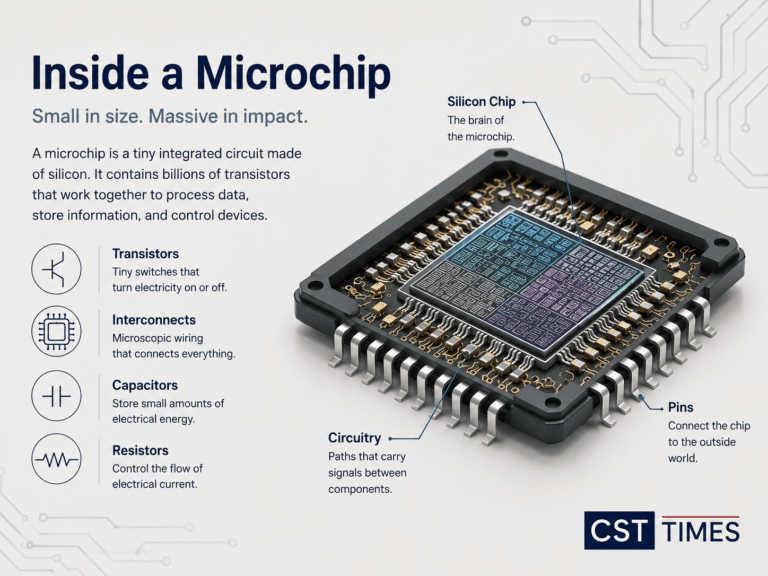
A microchip is a small, flat piece of semiconductor material — usually silicon — engineered to hold an entire electronic circuit. Manufacturers etch electronic components directly into the material in layers: transistors that switch current on and off, resistors that control the flow of electricity, capacitors that store small charges, and the microscopic wiring that connects them all.
“Microchip,” “chip,” “computer chip,” and “integrated circuit” all refer to the same thing, and people use the terms interchangeably. The “integrated” part is the key idea: instead of wiring separate components together by hand, the way early electronics did, a microchip has all of those components built into a single piece of material.
Silicon is the material of choice because it’s a semiconductor — its ability to conduct electricity sits between that of a true conductor, like copper, and an insulator, like glass. That in-between behavior can be precisely controlled, which is what makes it possible to build a switch out of it. Silicon is also cheap and abundant, since it’s refined from ordinary sand.
Scale is what makes modern chips remarkable. A single chip, often smaller than a fingernail, can now hold tens of billions of transistors. The chip inside a current flagship smartphone contains well over 15 billion of them.
How Does a Microchip Actually Work?
At its core, a microchip works by controlling the flow of electricity through millions or billions of tiny switches called transistors. Each transistor can be either “on” or “off,” which corresponds to the two digits of binary code: 1 and 0. Arranging billions of these on/off switches into specific patterns lets a chip perform calculations, move data, and store information. Everything a computer does ultimately comes down to combinations of these two states.
Pure silicon barely conducts electricity on its own. To make it useful, manufacturers use a process called doping: they introduce tiny, controlled amounts of other elements, such as phosphorus or boron, into specific regions of the silicon. Phosphorus creates an “n-type” region with extra free electrons; boron creates a “p-type” region with a shortage of electrons, known as holes. Placing n-type and p-type silicon next to each other creates the basic building block of a transistor, letting engineers control exactly where and how current flows.
Most modern digital chips use a design called CMOS (complementary metal-oxide-semiconductor), which pairs n-type and p-type transistors so that only one type is switched on at any given moment. That pairing is a big reason modern chips can pack in so many transistors while keeping power use manageable — a detail worth knowing if you’ve ever wondered how a phone runs for a full day on a small battery.
Layer these transistors together with metal wiring, and you get a circuit that can add numbers, store a bit of memory, or send a signal to another component. Multiply that by billions of transistors working in a coordinated pattern, switching on and off billions of times per second, and you get the processing power behind a modern computer, phone, or car.
Types of Microchips
Not every microchip does the same job. The industry generally groups chips into a handful of functional categories:
| Type | What It Does | Common Examples |
|---|---|---|
| Logic chips | Process information and make decisions — the “brains” of a device | CPUs, GPUs |
| Memory chips | Store data, either temporarily or permanently | RAM (working memory), NAND flash (storage) |
| Microcontrollers | Combine a small processor, memory, and input/output on one chip for a specific task | Appliance controls, car sensors, hobbyist boards |
| ASICs | Custom-built for one specific job; can’t be reprogrammed after manufacturing | Bitcoin mining hardware, barcode scanners |
| FPGAs | Reprogrammable after manufacturing, so their logic can change in the field | 5G equipment, aerospace and defense systems |
| Systems-on-a-chip (SoCs) | Combine a processor, memory, graphics, and wireless radios on a single chip | Smartphone chips, smartwatches |
Logic and memory chips are digital: they process binary, on/off signals. Some chips are analog instead, working with continuous signals rather than binary ones — common in things like audio equipment and sensors. Many real-world chips, especially SoCs, blend both.
The trade-off between these types usually comes down to flexibility versus efficiency. An ASIC is extremely efficient at its one job but can’t be repurposed. An FPGA can be reconfigured as needs change, at the cost of being less efficient per transistor. A general-purpose microcontroller sits in between, offering a stripped-down, ready-made processor for products that don’t need cutting-edge performance — which is why something as simple as a washing machine or a coffee maker runs on a microchip today.
How Are Microchips Made?
Making a microchip is one of the most precise manufacturing processes in the world. It can take hundreds of individual steps and up to several months to go from a raw silicon wafer to a finished chip.
- Design. Engineers lay out the chip’s circuitry using specialized software, planning where every transistor and wire will sit. This design becomes a set of blueprints called photomasks.
- Growing and slicing the wafer. Manufacturers purify silicon from sand into a large, cylindrical crystal, then slice it into thin, polished discs called wafers, typically about 300 millimeters (12 inches) across.
- Building up layers. The wafer goes through repeated rounds of depositing thin films of material, then removing the parts that aren’t needed. Modern chips can have up to 100 layers stacked on top of each other, each aligned to the last with nanometer-level precision.
- Photolithography. This step actually prints the circuit pattern. The wafer is coated with a light-sensitive chemical called photoresist, then exposed to light through a patterned mask. The most advanced chips use extreme ultraviolet (EUV) light, with a wavelength of just 13.5 nanometers, to print features far smaller than visible light could achieve.
- Etching and doping. Chemicals remove the unexposed material to leave the circuit pattern behind, and dopant atoms are implanted to give the transistors their electrical properties.
- Testing, dicing, and packaging. Once complete, each wafer holds dozens or hundreds of identical chips. Automated equipment tests every one electrically, cuts (“dices”) the wafer into individual chips, and seals each one in a protective package with metal connectors that let it plug into a circuit board.
All of this happens in a cleanroom, an environment kept far cleaner than a hospital operating room, because a single speck of dust can ruin a chip’s microscopic circuitry.
Not every company that designs a chip also builds it. The industry splits into three broad roles: integrated device manufacturers (IDMs) like Intel and Samsung design and manufacture their own chips; foundries like TSMC manufacture chips designed by other companies under contract; and fabless companies like Nvidia, AMD, and Qualcomm design chips but outsource the actual manufacturing. As of 2026, TSMC holds roughly two-thirds of the global contract foundry market and leads the industry’s transition to 2-nanometer manufacturing, with Samsung and Intel both racing to catch up on the same node.
What Microchips Are Used For
Microchips are so embedded in daily life that it’s easier to list where they aren’t than where they are. A few of the biggest categories:
- Computing and consumer electronics. Every laptop, desktop, smartphone, tablet, smart TV, and game console runs on a combination of logic chips (to process instructions) and memory chips (to store data and running programs).
- Communications. Cell towers, home routers, satellites, and the phones themselves all rely on chips to encode, transmit, and decode signals, which is what makes calls, texts, video streaming, and Wi-Fi possible.
- Automotive. A modern car can contain dozens of separate chips, handling everything from engine timing and anti-lock brakes to airbag deployment, infotainment screens, and the sensors behind driver-assistance features like adaptive cruise control.
- Healthcare. Pacemakers, insulin pumps, blood glucose monitors, and MRI machines all depend on microchips for precise, continuous operation — in some cases, quite literally keeping a patient’s heart beating on schedule.
- Home and industrial automation. Thermostats, washing machines, security systems, and factory robotics all run on microcontrollers or ASICs built for their specific, narrow task.
- Identification and payments. The chip in a credit card, a passport, or a building access badge, and the identification microchips implanted in millions of pets, all use small, low-power chips to store and transmit a unique ID.
- Aerospace and space exploration. Chips built to survive extreme temperatures and radiation run the navigation, communication, and instrumentation systems on satellites, rockets, and rovers.
Any device you’d call “smart” — a smart speaker, a smart thermostat, a smartwatch — is smart specifically because a microchip inside it can process instructions rather than simply responding to a basic mechanical input.
Why Microchips Are Important
Microchips matter for reasons that go well beyond convenience. The global semiconductor industry is projected to bring in close to $975 billion in sales in 2026, with some industry estimates pointing toward the $1 trillion mark, driven heavily by demand for AI processors alongside the steady, high-volume demand for chips in phones, cars, and appliances. Industry analysis from Deloitte notes that AI chips now account for roughly half of that revenue while representing less than 0.2% of the total number of chips sold — a sign of how expensive and complex the most advanced chips have become, even as billions of simpler, cheaper chips continue to ship every year for everyday products.
That concentration of value has turned chipmaking into a matter of national policy, not just business. A small number of companies — chiefly TSMC in Taiwan, Samsung in South Korea, and Intel in the United States — are capable of manufacturing the most advanced chips, and governments around the world have responded with major investment programs, such as the U.S. CHIPS Act and India’s Semiconductor Mission, aimed at building up domestic manufacturing capacity and reducing dependence on any single country or company.
The 2021 global chip shortage made the stakes visible to the public. Factory shutdowns and a surge in demand for electronics left automakers and electronics manufacturers waiting months for basic chips, idling production lines and driving up prices for everything from cars to game consoles. That episode was a reminder that something as small as a fingernail-sized piece of silicon can bring an entire industry to a halt if the supply runs short.
Beyond economics, microchips are the foundation other major technologies are built on. Artificial intelligence, 5G networks, electric vehicles, and modern medicine all depend on continued progress in chip design and manufacturing, which is why chip technology, despite being largely invisible to the people who rely on it every day, remains one of the most closely watched industries in the world.
Final Thoughts:
A microchip is, in the end, a remarkably simple idea taken to an extreme: a switch, repeated billions of times over, arranged precisely enough to think, remember, and communicate. That idea now sits inside your phone, your car, your kitchen appliances, and quite possibly inside a family member’s chest. As chipmakers push toward even smaller, denser designs, and as artificial intelligence drives fresh demand for processing power, the humble microchip is likely to become even more central to daily life in the years ahead, not less.
FAQs
What’s the difference between a semiconductor and a microchip? / Link
A semiconductor is a material, usually silicon, whose electrical conductivity sits between that of a conductor and an insulator. A microchip is a finished product built from that material — the semiconductor is the ingredient, and the microchip is the dish made from it.
Why did the world experience a chip shortage?
A mix of pandemic-related factory shutdowns, a surge in demand for electronics, and the long lead times required to build new chip factories created a supply crunch in 2021 that took roughly two years to fully resolve.
Who makes the world’s most advanced microchips?
As of 2026, TSMC leads the industry in advanced manufacturing, holding the largest share of the global contract foundry market and leading the transition to 2-nanometer chip production. Samsung and Intel are the other two companies currently capable of manufacturing at this level.
How small can microchip components get?
Chipmakers now build transistor-level features measured in a handful of nanometers. For scale, a human hair is roughly 80,000 to 100,000 nanometers wide, and researchers continue pushing toward even smaller, denser designs.
Are “microchip” and “processor” the same thing?
Not quite. A processor (or CPU) is one specific type of microchip, built to handle logic and calculations. “Microchip” is the broader term that also covers memory chips, sensors, and other types that don’t process instructions the way a processor does.
Disclaimer
This article is for general information only and does not constitute financial, investment, or legal advice.
References
Follow us on Social media :
About The Author

Haseeb Jabbar
Haseeb Jabbar writes about crypto, finance, technology, and AI at CST Times, sharing research-based guides, timely news, and free tools and calculators to help readers make informed decisions.
