
What is machine learning? Meaning, History, Importance and Uses Explained
What is machine learning: A Simple Guide
Introduction:
Machine learning (ML) is a branch of artificial intelligence that helps computers learn from data instead of following fixed rules. It powers many tools we use every day, from smart recommendations to fraud detection. This article explains what machine learning means, when it started, why it matters, and how it is used in the real world.
Table of Contents
ToggleKey Takeaways
- Machine learning lets computers learn patterns from data and improve over time.
- The term “machine learning” was coined in 1959 by Arthur Samuel.
- ML is important because it helps us find value in huge amounts of data quickly.
- It is used in fraud detection, recommendations, translation, and more.
- ML models need good data, clear goals, and regular updates to work well.
- You do not need to be a coder to understand the basic idea of ML.
- Trustworthy ML uses accurate data, fair rules, and human oversight.
Table of Contents
What Machine Learning Means
When Machine Learning Started
Why Machine Learning Is Important
Why Machine Learning Is Used
How Machine Learning Works (Simple View)
Real-World Examples
Practical Tips for Beginners
Quick Checklist
Final Thoughts
Summary Table
| Question | Short Answer |
|---|---|
| What does machine learning mean? | A type of AI where systems learn from data to make predictions or decisions. |
| When did it start? | Early ideas in the 1940s–50s; the term was coined in 1959. |
| Why is it important? | It finds patterns in large data sets faster than humans can. |
| Why is it used? | For tasks like recommendations, fraud detection, translation, and forecasting. |
What Machine Learning Means
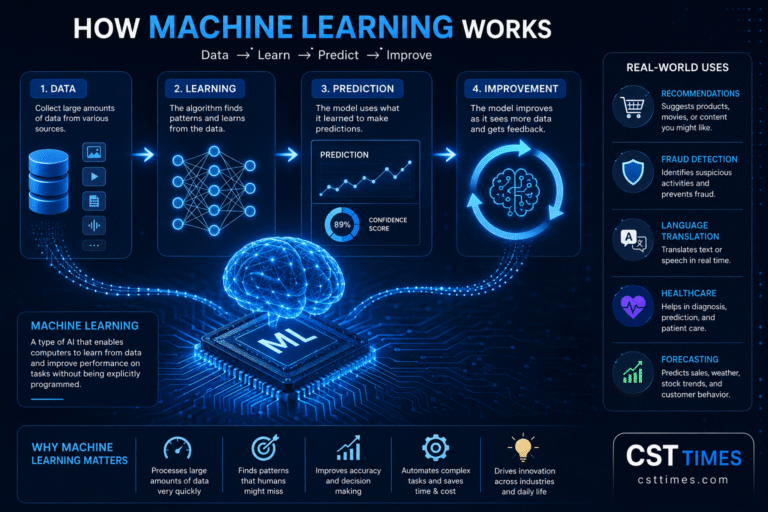
Machine learning means using data and algorithms to help computers learn from experience and improve at tasks without being told exactly what to do at every step. Instead of programming every rule by hand, you give the system examples (training data) and let it find patterns.
In simple terms:
You show the computer many examples.
The computer finds patterns in those examples.
The computer uses those patterns to make predictions or choices on new data.
This is different from traditional programs that only do what they are explicitly told. ML systems can adapt as they see more data.
Simple Definition for Beginners
Machine learning is a part of artificial intelligence that helps computers learn from data so they can make better predictions and decisions over time.
When Machine Learning Started
The roots of machine learning go back to the 1940s and 1950s, when researchers began building simple models inspired by how the human brain works.
1940s–1950s: Early neural network models and learning programs appear.
1959: Computer scientist Arthur Samuel coined the term “machine learning.
1960s–1990s: More algorithms are developed, but data and computing power limit progress.
2000s–present: Big data, faster computers, and better algorithms lead to rapid growth in ML and deep learning.
So, while the idea started in the mid-20th century, modern machine learning as we know it has grown quickly in the last two decades.
Why Machine Learning Is Important
Machine learning is important because it helps us handle the huge amount of data created every day and turn it into useful insights. Humans cannot manually analyze billions of data points, but ML can.
Key reasons it matters:
Speed: ML can process large data sets much faster than people.
Accuracy: Good models can find subtle patterns humans might miss.
Automation: ML can automate repetitive decisions, saving time and money.
Innovation: It enables new products like voice assistants, self-driving cars, and smart recommendations
In short, ML makes it possible to use data at a scale that was not practical before.
Why Machine Learning Is Used
Businesses and organizations use machine learning to solve real problems more efficiently.
Common uses include:
- Fraud detection: Spotting unusual transactions in banking and payments.
- Recommendations: Suggesting products, movies, or news based on your past behavior.
- Customer support: Powering chatbots and automated replies.
- Language tools: Translation, speech-to-text, and text summarization.
- Forecasting: Predicting sales, demand, or risk in finance and logistics.
- Healthcare support: Assisting in image analysis and early diagnosis (with human oversight).
ML is used because it can handle complex, changing data and improve as more information becomes available.
How Machine Learning Works (Simple View)
You do not need advanced math to understand the basic flow.
- Collect data: Gather examples relevant to the task (e.g., past sales, customer clicks).
- Prepare data: Clean and organize the data so the model can learn from it.
- Train a model: An algorithm looks for patterns in the training data.
- Test the model: Check how well it performs on new data it has not seen before.
- Deploy and monitor: Use the model in real life and keep updating it as needed.
This loop repeats to keep the model accurate as conditions change.
Real-World Examples
Here are everyday examples of machine learning in action:
- Streaming services: Suggesting shows or music you might like.
- Online shopping: Showing products related to what you viewed or bought.
- Email: Filtering spam and highlighting important messages.
- Maps and navigation: Estimating travel time and suggesting faster routes.
- Banking: Flagging suspicious transactions to prevent fraud.
These examples show how ML quietly supports many daily tasks.
Practical Tips for Beginners
If you are new to machine learning, these tips can help:
- Start with the basics: Learn what problems ML can and cannot solve.
- Focus on data quality: Good data is more important than complex models.
- Use trusted tools: Try beginner-friendly platforms from major cloud providers or universities.
- Think about ethics: Consider bias, privacy, and fairness when using ML.
- Keep humans in the loop: Use ML to support decisions, not replace judgment in critical areas.
Final Thoughts
Machine learning means using data-driven systems that learn from experience to make better predictions and decisions. It started in the mid-20th century and has grown rapidly with more data and better computing. ML is important because it helps us find value in large data sets, and it is used across industries for tasks like fraud detection, recommendations, translation, and forecasting
CST Times perspective, understanding what machine learning means, when it started, why it is important, and why it is used gives readers a strong foundation for following the fast-changing world of technology. Machine learning is no longer limited to research or large technology companies; it is becoming part of everyday tools, businesses, and services.
FAQs
1. What does “machine learning” mean in simple words?
Machine learning means using data and algorithms so computers can learn patterns and improve at tasks without being programmed for every single rule.
2. When did machine learning start?
Early ideas began in the 1940s–1950s, and the term “machine learning” was officially coined in 1959 by Arthur Samuel.
3. Why is machine learning important today?
It is important because it can analyze huge amounts of data faster than humans and find patterns that help with decisions, automation, and innovation.
4. Why is machine learning used in business?
Businesses use it for fraud detection, recommendations, customer support, forecasting, and other tasks where data-driven decisions add value.
5. Do I need to be a programmer to understand machine learning?
No. You can understand the main ideas and uses of ML without coding, though building models usually requires technical skills.
6. Can machine learning make mistakes?
Yes. ML models can be wrong if the data is poor, the problem is unclear, or conditions change. Human review is still important.
Disclaimer:
This article is for general information and education only. It is not financial, legal, medical, or professional advice. Always verify with experts before making important decisions based on machine learning tools or data-driven insights.
Resources:
Follow us on Social media :
About The Author

Haseeb Jabbar
Haseeb Jabbar writes about crypto, finance, technology, and AI at CST Times, sharing research-based guides, timely news, and free tools and calculators to help readers make informed decisions.
