
What Is a Semiconductor? The Complete Guide to How Chips Work
what is a Semiconductor? A Complete Guide
Quick summary:
Look around right now. Your phone, your laptop, your car key fob, even your microwave depend on the same tiny piece of technology: the semiconductor.
Table of Contents
ToggleSo what is a semiconductor, exactly? It’s a material — usually silicon — that can act as either a conductor or an insulator, depending on how engineers treat it. That flexibility is what makes modern electronics possible in the first place.
Without semiconductors, there would be no smartphones, no internet infrastructure, no AI chatbots, and no electric cars. The global semiconductor industry sold $791.7 billion worth of chips in 2025, and sales are on pace to approach $1 trillion in 2026 as AI systems demand more computing power than ever before.
This guide breaks down what a semiconductor is, how it works, the different types you’ll encounter, and why a shortage of these small components can shake entire industries.
Key Takeaways
- A semiconductor is a material — almost always silicon — whose conductivity sits between a conductor and an insulator, which lets engineers control electric current with precision.
- A semiconductor chip (or integrated circuit) is the finished device built from that material. The semiconductor is the raw ingredient; the chip is the product.
- The main types of semiconductor devices are diodes, transistors, integrated circuits, memory chips, microprocessors, and sensors.
- Semiconductors run smartphones, computers, cars, AI systems, data centers, medical equipment, and industrial machines — there’s barely a modern device without one.
- Global semiconductor sales hit a record $791.7 billion in 2025 and are projected to approach $1.5 trillion in 2026, largely because AI data centers need enormous numbers of advanced chips.
- Building a leading-edge chip factory costs tens of billions of dollars, which is why only three companies — TSMC, Samsung, and Intel — currently manufacture the most advanced chips.
- A new round of chip tightness in 2026, driven mainly by AI’s demand for memory chips, is a reminder that semiconductor supply affects everyday prices, not just tech headlines.
Table of Contents
- What Is a Semiconductor?
- How Does a Semiconductor Work?
- Why Is Silicon Used in Semiconductors?
- What Is a Semiconductor Chip?
- Types of Semiconductors
- Where Are Semiconductors Used?
- Semiconductors and AI — Why AI Needs Powerful Chips
- Why Are Semiconductors Important for the Global Economy?
- What Happens During a Chip Shortage?
- Semiconductor Manufacturing: From Silicon to Chip
- Semiconductor vs Conductor vs Insulator
- Practical Tips: Making Sense of Chip Specs
- Quick Checklist
- Final Thoughts
Semiconductor at a Glance
| Aspect | Quick Fact |
|---|---|
| What it is | A material (usually silicon) with electrical conductivity between a conductor and an insulator |
| Main material | Silicon — also gallium nitride, silicon carbide, and germanium for specialized uses |
| Common devices | Diodes, transistors, integrated circuits, memory chips, microprocessors, sensors |
| Where it’s used | Smartphones, computers, cars, AI systems, data centers, medical devices, industrial machines |
| Leading manufacturers | TSMC, Samsung Foundry, Intel |
| 2025 global sales | $791.7 billion (Semiconductor Industry Association) |
| 2026 projected sales | Approaching $1 trillion |
What is a Semiconductor?
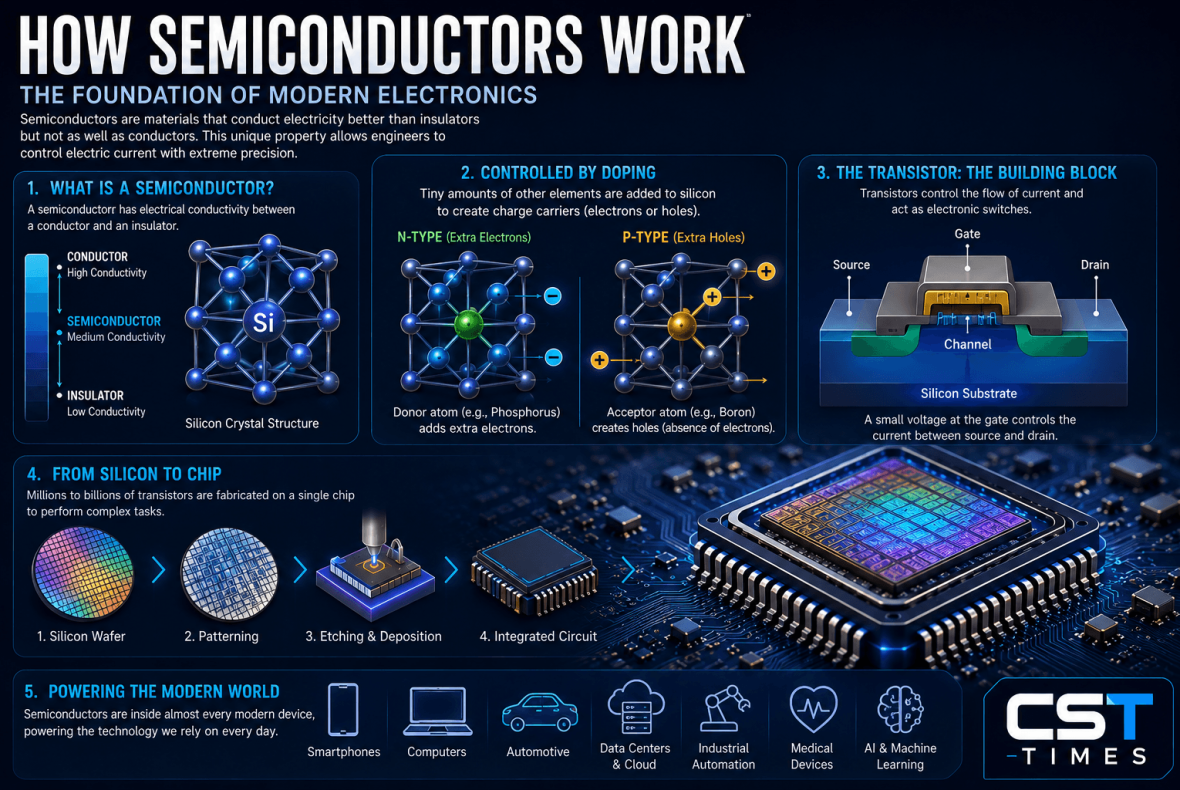
A semiconductor is a material whose ability to conduct electricity falls between a conductor, like copper, and an insulator, like rubber — and unlike either extreme, that conductivity can be deliberately controlled.
Pure conductors let electricity flow almost freely. Pure insulators block it almost completely. A semiconductor sits in the middle, and that middle ground is exactly what makes it useful.
Engineers exploit this property through a process called doping — adding tiny, precisely measured amounts of other elements to a semiconductor to make it conduct more or less electricity on command. That control is what lets a semiconductor act as a switch, an amplifier, or a gate for electrical signals.
Silicon is the semiconductor almost everyone means when they use the word, though gallium nitride, silicon carbide, and germanium show up in specialized applications like EV chargers and radio equipment.
This one property — adjustable conductivity — is the reason semiconductors sit at the center of every computer chip ever built.
How Does a Semiconductor Work?
A semiconductor works by using controlled impurities to create regions that either carry extra electrons or extra “holes,” and joining those regions to control how current flows.
At the atomic level, silicon atoms have four electrons in their outer shell and bond neatly with four neighboring atoms to form a crystal lattice. In this pure state, silicon is a fairly poor conductor.
To make it useful, manufacturers dope it with trace amounts of other elements:
- Adding phosphorus (which has five outer electrons) creates extra free electrons. This is called n-type silicon, since it carries a negative charge carrier.
- Adding boron (which has three outer electrons) creates “holes” where electrons are missing. This is called p-type silicon, since it behaves as if it carries a positive charge.
On their own, n-type and p-type silicon aren’t very exciting. But place them next to each other, and you get a p-n junction — the basic building block of nearly every semiconductor device. A p-n junction lets current flow easily in one direction and blocks it in the other.
Stack a few of these junctions together in different arrangements, and you can build a diode, a transistor, or a full logic circuit. A modern chip contains billions of these junctions, packed into a space smaller than a fingernail, switching on and off billions of times per second.
Why Is Silicon Used in Semiconductors?
Silicon dominates the chip industry because it’s abundant, forms a stable natural insulator, behaves well at normal temperatures, and decades of manufacturing infrastructure are already built around it.
A closer look at each reason:
- It’s abundant. Silicon is the second most common element in the Earth’s crust, found mostly in sand and quartz, so raw material supply isn’t a bottleneck.
- It forms a natural, stable oxide. When exposed to oxygen, silicon forms silicon dioxide — a rock-solid insulating layer that’s essential for building precise, reliable transistors.
- It has the right conductivity at room temperature. Silicon’s semiconductor properties work well under normal operating conditions, without needing exotic cooling systems.
- Decades of engineering are built around it. Every major chip factory, tool, and process on Earth is optimized for silicon. Switching materials would mean rebuilding the industry from scratch.
Other materials do have a role. Gallium nitride (GaN) and silicon carbide (SiC) handle higher voltages and temperatures more efficiently than silicon, so they show up in EV chargers, solar inverters, and fast phone chargers. But for general-purpose logic and memory chips, silicon remains the default — and will likely stay that way for years to come.
What Is a Semiconductor Chip?
A semiconductor chip — also called an integrated circuit or IC — is the finished electronic device manufactured from semiconductor material, not the raw material itself.
This distinction trips people up, so here it is in plain terms:
- A semiconductor is the raw material — the silicon.
- A semiconductor chip is the finished product built from that material.
A chip is a tiny slice of silicon, called a die, etched with millions or billions of microscopic transistors and wires, then sealed inside a protective package with metal pins or contacts that let it connect to a circuit board.
Think of it like flour and bread. Silicon is the flour — the base ingredient. A chip is the finished loaf, shaped and processed into something you can actually use.
When people talk about a “computer chip,” a “processor,” or a “microchip,” they’re talking about a semiconductor chip — not raw semiconductor material.
Types of Semiconductors
Semiconductor devices aren’t all the same. Depending on how engineers arrange doped silicon layers, junctions, and circuits, a semiconductor can become any of several different devices, each suited to a specific job. Here are the six you’ll encounter most often.
Diodes
A diode is the simplest semiconductor device — essentially a single p-n junction. It lets current flow in one direction and blocks it in the other, acting like a one-way valve for electricity.
Diodes show up in phone chargers (converting AC power to DC), LEDs (where the junction releases light as current passes through), and circuit protection (stopping current from flowing backward and damaging components).
Transistors
A transistor is a semiconductor’s version of a light switch, except it can flip on and off billions of times per second, and another electrical signal switches it rather than a human finger.
Transistors are the fundamental building block of digital logic — every “1” and “0” a computer processes comes down to transistors switching on and off. A modern smartphone processor can pack in more than 15 billion transistors onto a chip smaller than a coin.
Integrated Circuits (ICs)
An integrated circuit combines many transistors, diodes, resistors, and capacitors onto a single piece of silicon. Instead of wiring separate components together by hand, engineers etch an entire circuit directly into the chip.
This invention is what made modern electronics possible. A single IC today can contain the equivalent of what would have filled an entire room of vacuum-tube electronics in the 1950s.
Memory Chips
Memory chips store data, either temporarily (RAM, which loses its contents when power is switched off) or permanently (flash storage, like the memory in an SSD or USB drive).
Memory has become one of the most fought-over categories in the industry. AI data centers need enormous amounts of high-speed memory, and that demand has pushed prices for both DRAM and NAND flash sharply higher through 2026.
Microprocessors
A microprocessor is the “brain” chip. It fetches instructions, performs calculations, and coordinates every other component in a device. The CPU in your laptop and the application processor in your phone are both microprocessors.
Microprocessors are the most complex semiconductor product on the market, often combining billions of transistors, multiple processing cores, and dedicated AI-acceleration units on a single chip.
Sensors
Semiconductor sensors convert a physical signal — light, pressure, motion, or temperature — into an electrical one that a chip can process.
Your phone’s camera sensor, its fingerprint scanner, and the airbag-trigger accelerometer in your car are all semiconductor sensors.
Where Are Semiconductors Used?
It’s easier to list what doesn’t contain a semiconductor than what does. Chips have quietly become the control system for nearly every category of modern technology. Here’s where they’re doing the heaviest lifting.
Smartphones
A single modern smartphone can contain dozens of different chips: an application processor, a modem, memory, a camera sensor, and a battery-management chip, among others. The application processor alone can pack in over 15 billion transistors.
Computers
Laptops and desktops rely on a CPU for general processing, a GPU for graphics and AI workloads, memory chips for short-term storage, and an SSD controller for long-term storage — each one a separate semiconductor product doing a specialized job.
Cars
A modern car contains anywhere from 1,000 to 3,000 chips, controlling everything from the engine and brakes to infotainment, parking sensors, and airbags. Electric vehicles use even more, especially power semiconductors like silicon carbide chips that manage battery charging and motor control.
AI Systems
AI models run on specialized chips — mainly GPUs and custom AI accelerators — built to perform huge numbers of calculations in parallel. This is arguably the fastest-growing use case for semiconductors today, and it’s covered in more depth in the next section.
Data Centers
Every cloud service, streaming platform, and AI chatbot runs on servers packed with processors, memory, and networking chips inside massive data centers. A single large AI data center can contain hundreds of thousands of chips.
Medical Equipment
MRI machines, pacemakers, insulin pumps, and diagnostic devices all depend on semiconductors for precision sensing, signal processing, and reliable control — often in devices where a chip failure simply isn’t an option.
Industrial Machines
Factory robots, industrial sensors, and automated production lines use semiconductors to monitor conditions and control machinery with a level of precision no human hand could match.
Semiconductors and AI — Why AI Needs Powerful Chips
AI didn’t just create demand for more chips — it created demand for a fundamentally different kind of chip, built to run millions of calculations in parallel rather than one after another.
Traditional processors (CPUs) handle tasks sequentially, extremely fast. AI workloads — especially training and running large language models — instead need to perform millions of similar calculations simultaneously. That’s a job for GPUs (graphics processing units) and custom AI accelerators.
This shift has reshaped the chip industry. Nvidia, whose GPUs power most AI labs, reported data center revenue of $193.7 billion for its fiscal year ending in January 2026 — up 68% year over year — and now holds more than 80% of the AI accelerator market. Nvidia’s market value passed $4.8 trillion in 2026, making it the world’s most valuable chip company.
Nvidia isn’t the only player. AMD and Broadcom have both built substantial AI chip businesses — Broadcom by designing custom AI silicon for hyperscalers like Google and Meta, reporting a $73 billion backlog of committed AI chip orders in early 2026.
Demand isn’t limited to the US and China, either. Gulf states have become major AI infrastructure buyers: in late 2025, the US approved the export of tens of thousands of Nvidia’s advanced Blackwell chips to Saudi Arabia’s HUMAIN and the UAE’s G42, part of a broader wave of sovereign investment in AI computing capacity across the region.
None of this would be possible without advances in chip manufacturing. AI accelerators need cutting-edge process nodes — the 2-nanometer-class chips covered later in this guide — and enormous amounts of high-speed memory, which is a major reason memory chip prices have climbed through 2026.
Why Are Semiconductors Important for the Global Economy?
Semiconductors matter to the global economy because they’re the input behind nearly every other industry, the market itself is enormous, and governments now treat chip supply as a matter of national security.
A closer look at why:
They’re the input behind almost every other industry. Cars, phones, medical devices, defense systems, banking infrastructure, and AI services all depend on a steady chip supply. When chip production slows, the ripple effects hit dozens of unrelated industries at once.
The industry itself is enormous and growing fast. Global semiconductor sales hit a record $791.7 billion in 2025 — up 25.6% from 2024 — and the Semiconductor Industry Association expects the market to approach $1 trillion in 2026, driven largely by AI infrastructure spending.
Governments now treat chips as a national security issue, not just a business. The US CHIPS Act (2022) committed $52.7 billion toward domestic chip manufacturing and R&D. According to the Semiconductor Industry Association, that push has helped spur more than $920 billion in announced US semiconductor supply chain investment as of mid-2026. The European Union and Japan have launched similar strategies, and Gulf states — particularly Saudi Arabia and the UAE — are investing tens of billions of dollars to build AI computing infrastructure and secure their own chip supply.
Chip manufacturing is geographically concentrated. The most advanced chips in the world — 2-nanometer-class processors — are currently made by only three companies: TSMC (Taiwan), Samsung (South Korea), and Intel (United States). That concentration is precisely why so many governments are racing to build domestic capacity.
In short, whoever controls chip supply has real influence over the global economy, and every country with ambitions in AI, defense, or advanced manufacturing now treats semiconductor access as a strategic priority.
What Happens During a Chip Shortage?
A chip shortage happens when demand for semiconductors outpaces the industry’s ability to produce them — and because chip factories take years to build and can’t easily switch between products, a shortage can’t be fixed quickly.
The most well-known example was the 2020–2022 global chip shortage. A few things collided at once:
- Pandemic lockdowns shut down factories just as remote work sent demand for laptops and electronics soaring.
- Automakers, expecting a downturn, cancelled chip orders early in the pandemic — then had to get back in line behind consumer electronics companies once car demand rebounded faster than expected.
- Chip production is concentrated among a handful of companies and countries, so even a small disruption, like a drought affecting a fab’s water supply, had an outsized global impact.
The result: car factories idled for lack of chips, electronics prices rose, and wait times for some products stretched past a year.
That shortage eased by 2023, but a new kind of tightness has emerged in 2026 — this time centered on memory chips. AI data centers require enormous amounts of high-speed DRAM and NAND flash memory, and that demand has pulled supply away from consumer devices. Analysts at IDC and Gartner both flagged tightening memory and advanced-node inventory heading into 2026, and companies including Apple and Dell have publicly acknowledged rising memory component costs affecting their pricing.
What a chip shortage means for you as a consumer:
- Longer wait times for laptops, gaming consoles, and cars
- Higher prices, especially for memory-heavy products like laptops and smartphones
- Fewer configuration options as manufacturers prioritize their best-selling models
Semiconductor Manufacturing: From Silicon to Chip
Turning raw silicon into a working chip takes hundreds of precise steps across several months, inside one of the most demanding manufacturing environments on Earth.
Here’s the simplified version:
- Purify silicon. Raw silicon, from sand or quartz, is refined to extreme purity — 99.9999999% — then melted and grown into a single crystal called an ingot.
- Slice into wafers. The ingot is sliced into thin, round wafers, typically 300 millimeters across, then polished to a mirror finish.
- Pattern with lithography. Using ultraviolet light and precision masks, manufacturers etch microscopic circuit patterns onto the wafer — some features on today’s leading-edge chips are smaller than a virus.
- Dope and deposit layers. The wafer goes through repeated cycles of doping and depositing thin layers of different materials, building the transistor structure layer by layer.
- Test. Every individual chip on the wafer — there can be hundreds — is electrically tested before it ever leaves the factory.
- Cut and package. The wafer is cut into individual chips (dies), which are then sealed into a protective package with the metal connectors you’d recognize on a finished chip.
This entire process happens inside a cleanroom facility called a fab, where the air is thousands of times cleaner than a hospital operating room — a single dust particle can ruin a chip.
Building a leading-edge fab costs tens of billions of dollars, which is why only three companies currently manufacture the most advanced chips. TSMC began high-volume production of its 2-nanometer (N2) node in late 2025 and counts Apple, Nvidia, and AMD among its customers. Samsung’s SF2 process powers its own Exynos chips. Intel’s 18A node is used in its latest Panther Lake processors. Each new generation costs more to develop than the last, which is part of why so few companies can compete at the cutting edge.
Semiconductor vs Conductor vs Insulator
This is one of the most-searched semiconductor questions, so here’s a direct, side-by-side comparison.
| Property | Conductor | Semiconductor | Insulator |
|---|---|---|---|
| Electrical conductivity | Very high | Adjustable (in between) | Very low |
| Common examples | Copper, silver, gold, aluminum | Silicon, germanium, gallium nitride | Rubber, glass, plastic, wood |
| Can conductivity be controlled? | No — always conducts | Yes — via doping and voltage | No — always blocks |
| Typical use | Wiring, electrical contacts | Chips, transistors, diodes | Cable coating, circuit board bases |
| Behavior at higher temperature | Conductivity slightly decreases | Conductivity increases | Stays non-conductive (usually) |
The key difference isn’t just where each material sits on the conductivity scale — it’s that a semiconductor’s conductivity can be switched and controlled, while a conductor and an insulator are essentially fixed. That controllability is the entire reason semiconductors, not conductors or insulators, became the foundation of computing.
Quick Checklist: Where Semiconductors Show Up in Your Life
🟢 ✓ Smartphone — application processor, modem, camera sensor
🟢 ✓ Laptop or desktop — CPU, GPU, memory, storage controller
🟢 ✓ Car — engine control unit, infotainment, sensors, battery management
🟢 ✓ Kitchen appliances — microwave, smart fridge, induction stove
🟢 ✓ Wearables — smartwatch, fitness tracker, wireless earbuds
🟢 ✓ Home network — router, modem, smart speaker
🟢 ✓ Medical devices — pacemaker, glucose monitor, hearing aid
If you checked more than three boxes, you’ve already relied on semiconductor technology today — probably before you finished breakfast.
Final Thoughts:
Semiconductors are easy to overlook because they’re small, hidden inside plastic casings, and rarely mentioned by name in the products that use them. But almost nothing in modern life — communication, transportation, healthcare, or AI — works without them.
Understanding what a semiconductor is, and how a shortage, price increase, or manufacturing breakthrough can ripple through global supply chains, makes technology news that might otherwise feel abstract much easier to follow. It can help explain why a new phone costs more, why a car faces production delays, or why a major chipmaker’s results can affect markets around the world.
As AI infrastructure spending accelerates and countries compete to build stronger domestic chip capacity, semiconductors are likely to remain in the headlines for years to come. The semiconductor industry is already at the center of the AI expansion, with global sales projected to reach about $1.5 trillion in 2026.
CST Times Perspective:
At CST Times, we believe understanding semiconductors is no longer just for engineers or technology professionals. Chips are becoming increasingly important to the everyday stories behind AI, smartphones, electric vehicles, data centers, manufacturing, and the global economy. When you understand how semiconductors work and why chip supply matters, it becomes much easier to understand the technology and business news shaping the world around you.
FAQs
What is a semiconductor in simple words?
A semiconductor is a material — almost always silicon — that conducts electricity better than an insulator but not as well as a metal conductor, and whose conductivity can be controlled. That control is what allows semiconductors to work as switches inside computer chips.
Is silicon a semiconductor or an insulator?
Silicon is a semiconductor. In its pure form, it conducts electricity poorly, but adding trace amounts of other elements, a process called doping, lets engineers precisely control how much current it carries.
What is the difference between a semiconductor and a microchip? / link
A semiconductor is the raw material. A microchip, or integrated circuit, is the finished device manufactured from that material, containing millions or billions of transistors etched onto a small piece of silicon.
Why are semiconductor chips in such high demand right now?
AI data centers need enormous numbers of advanced processors and huge amounts of high-speed memory, and demand has grown faster than manufacturers can expand production — a major driver of the renewed chip and memory tightness seen through 2026.
Which companies make the most advanced semiconductors?
As of 2026, only three companies manufacture the most advanced, leading-edge chips: TSMC (Taiwan), Samsung (South Korea), and Intel (United States). TSMC currently leads in both market share and process technology with its 2-nanometer N2 node.
Can electronics work without semiconductors?
No modern electronic device — smartphones, computers, cars, medical equipment — can function without semiconductors. They are the physical foundation of digital computing and signal control.
Disclaimer
This article is for general educational and informational purposes only. It is not financial, investment, or professional engineering advice. Chip prices, company market share, and industry figures change quickly, so verify current numbers against the official sources below before making a purchasing or investment decision.
References
- Global Annual Semiconductor Sales Increase 25.6% to $791.7 Billion in 2025 – Semiconductor Industry Association
- Semiconductor Supply Chain Investments — Semiconductor Industry Association
- Semiconductor Fabrication Facilities Funded by the CHIPS Act — Congress.gov, Congressional Research Service
- FSCS — “Deposit limit protection increase” — CNBC
Follow us on Social media :
About The Author

Haseeb Jabbar
Haseeb Jabbar writes about crypto, finance, technology, and AI at CST Times, sharing research-based guides, timely news, and free tools and calculators to help readers make informed decisions.
