
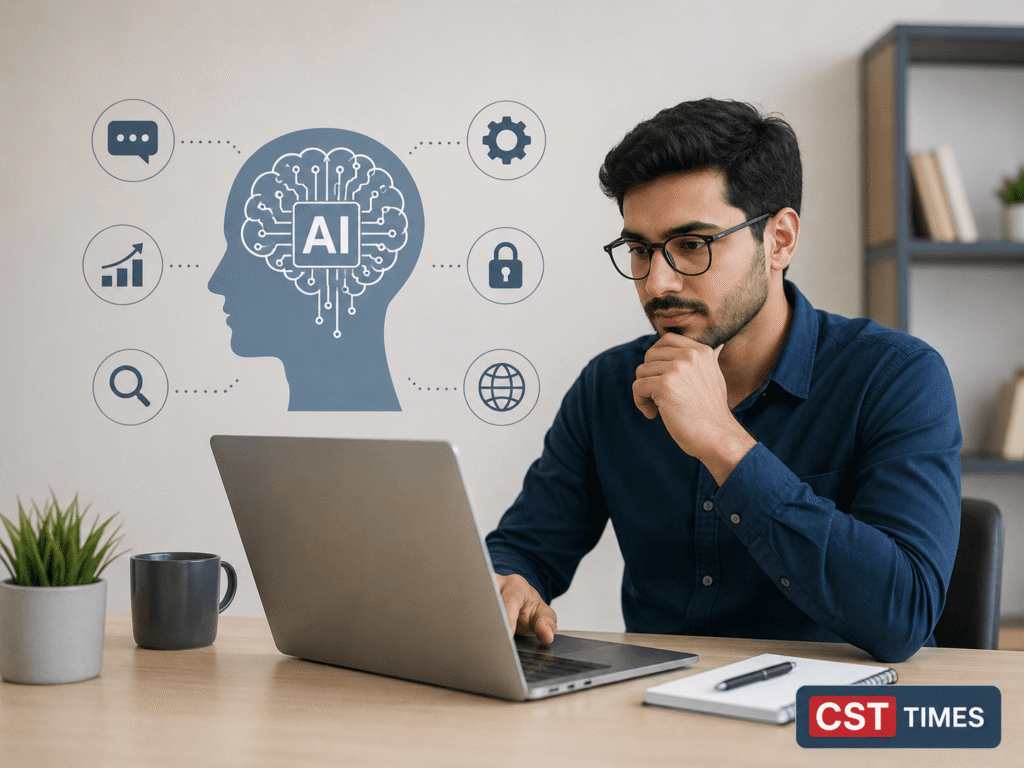
What is Artificial Intelligence? A Complete Beginner’s Guide
What is Artificial Intelligence?
Quick Summary:
Artificial intelligence (AI) is technology that lets computers learn from data and perform tasks that normally require human thinking, such as recognizing speech, spotting patterns, and making predictions. Most people already use AI every day without noticing it, from a phone’s autocorrect to a bank’s fraud alert to a streaming app’s “recommended for you” list. This guide explains what AI actually is, how it works, where you’ll find it in daily life, and whether it deserves the hype, the worry, or a bit of both.
Table of Contents
ToggleKey Takeaways
- AI is software that learns from data to make predictions or decisions, rather than only following fixed, pre-written rules.
- Machine learning and deep learning are not separate technologies — they are subsets of AI.
- Almost every AI product in use today is “narrow AI,” built for one job. General AI with human-level versatility does not exist yet.
- AI already touches finance, healthcare, transportation, and everyday apps, with organizational adoption reaching 88% in 2025.
- AI brings real benefits, like faster analysis and fraud detection, alongside real risks, like bias, privacy exposure, and confidently wrong answers.
- Today’s AI systems simulate reasoning through statistics and pattern-matching. The scientific consensus is that they are not conscious or self-aware.
Table of Contents
- What is Artificial Intelligence?
- How Does Artificial Intelligence Work?
- Artificial Intelligence Examples in Everyday Life
- Is Artificial Intelligence Good or Bad?
- Can Artificial Intelligence Think Like a Human?
- Using AI Responsibly: A Quick Checklist
- Final Thoughts
What is Artificial Intelligence?
The Short Definition
Artificial intelligence is the field of computer science focused on building systems that can perform tasks typically associated with human intelligence — understanding language, recognizing patterns, and making decisions from data. International bodies like the OECD define AI along similar lines: a technology capable of human-like understanding, pattern recognition, and decision-making.
The key difference from ordinary software is flexibility. A calculator or a basic app only follows the exact instructions a programmer wrote for it. An AI system, by contrast, is trained on data and adjusts its own internal behavior to get better at a task, within the boundaries set during that training. That shift, from hand-written rules to learned patterns, is what separates AI from traditional computing.
Term | What It Means |
|---|---|
| Artificial Intelligence (AI) | The broad field: any system designed to perform tasks that typically require human intelligence. |
| Machine Learning (ML) | A subset of AI where systems learn patterns directly from data instead of following manually coded rules. |
| Deep Learning | A subset of ML that uses layered artificial neural networks, loosely modeled on the brain, to handle complex tasks like image recognition and language generation. |
Every deep learning system is machine learning, and every machine learning system is AI — but not every AI system uses machine learning. Some older AI, like rule-based chess engines, ran on hand-coded logic rather than learned patterns.
How Does Artificial Intelligence Work?
Most modern AI, including the chatbots and generative tools people use daily, follows a similar three-step process.
Step 1: Feeding in Data
Every AI system starts with data — text, images, numbers, or audio. The quality and volume of this data matters enormously: a system trained on limited or skewed data will make limited or skewed predictions, regardless of how sophisticated its underlying design is.
Step 2: Finding Patterns
Most of today’s AI relies on artificial neural networks: layers of connected “nodes,” loosely inspired by neurons in the human brain, that pass signals to one another. During training, the network processes large amounts of example data and repeatedly adjusts internal numerical weights until its predictions land closer to the correct answer. This adjustment process is called backpropagation, and it is how a system “learns” without a human manually programming every rule.
Step 3: Making Predictions and Improving
Once trained, the model applies what it learned to new, unseen input. A spam filter flags an email it has never seen before because it recognizes patterns similar to spam it was trained on. A language model predicts the next word in a sentence based on statistical patterns learned from enormous volumes of text. This isn’t understanding meaning the way a person does — it’s pattern recognition at a scale no human could match manually.
Narrow AI vs. General AI
Nearly every AI product in use today, including Siri, Alexa, Netflix’s recommendation engine, and chatbots like ChatGPT or Claude, is narrow AI (also called “weak AI”). Narrow AI is built to do one job, or a limited set of related jobs, well. Artificial general intelligence (AGI), a hypothetical system with human-level versatility across any topic or task, remains a research goal rather than something that exists today.
Artificial Intelligence Examples in Everyday Life
AI shows up across far more of daily life than most people realize:
- Virtual assistants: Siri, Alexa, and Google Assistant use narrow AI for speech recognition and task automation.
- Recommendation engines: Netflix, Spotify, and Amazon use AI to analyze past behavior and suggest what to watch, listen to, or buy next.
- Finance and crypto: Banks and exchanges use AI for real-time fraud detection, screening transactions and behavior for anomalies. Algorithmic trading tools and robo-advisors also process market data far faster than a person could.
- Healthcare: AI-assisted medical imaging tools help radiologists spot patterns in scans, and predictive models are increasingly built into electronic health records at hospitals.
- Transportation: Driver-assist and self-driving systems use AI to interpret camera and sensor data in real time.
- Generative AI and chatbots: Tools that draft text, write code, or generate images are now used widely enough that Stanford’s 2026 AI Index found generative AI reached 53% of the population within three years of its public debut, faster adoption than either the personal computer or the internet.
Is Artificial Intelligence Good or Bad?
Neither, on its own. AI is a tool, and its impact depends heavily on how it is built, trained, and deployed. The clearest way to see this is to weigh the two sides directly.
Benefits | Risks |
|---|---|
| Speeds up repetitive analysis and data processing | Can inherit and amplify bias present in training data |
| Improves fraud detection and medical diagnostics | Raises privacy and surveillance concerns |
| Available continuously for support and automation | Can produce confident but incorrect answers (“hallucinations”) |
| Lowers costs for some services over time | Disrupts some jobs while creating demand for new skills |
| Accelerates scientific research and discovery | Regulatory and legal frameworks are still catching up |
The Case For AI
The scale of adoption reflects real, measurable value. Stanford’s 2026 AI Index found organizational AI adoption reached 88% in 2025, and global corporate AI investment hit $581.7 billion, a 130% year-over-year jump. Businesses aren’t spending at that scale on something that doesn’t work — AI genuinely speeds up fraud screening, document processing, and research tasks that would otherwise take humans far longer.
The Case Against AI
The same speed and scale that make AI useful also make its failures bigger. IBM’s research on AI risk highlights bias in applicant tracking and lending systems as a recurring, documented harm, alongside growing legal exposure: employment discrimination cases involving AI hiring tools are active in U.S. courts, and states including Colorado and New York now require bias audits for hiring algorithms. Privacy, “hallucinated” misinformation, and job disruption round out the concerns regulators and researchers are actively addressing in 2026.
Can Artificial Intelligence Think Like a Human?
Not in the way people usually mean it. Today’s most advanced AI, including so-called “reasoning models” that show their step-by-step thinking, works by predicting the statistically most likely next piece of output based on patterns learned from training data. That is different from understanding meaning, holding beliefs, or having a subjective experience.
As of 2026, the scientific and academic consensus remains that large language models and other AI systems are not conscious, regardless of how fluent or self-aware their output can sound. MIT Technology Review, covering the debate, cautions that framing AI systems as “conscious” can obscure what they actually are: software trained on human-written text, which explains why their output can convincingly mimic self-reflection without any underlying experience behind it. An AI can describe emotions because it was trained on text where humans describe emotions — not because it feels anything itself.
That doesn’t make current AI simple. Reasoning models can break problems into steps, evaluate multiple approaches, and coordinate multi-step tasks with real practical value. But “sophisticated” and “conscious” are not the same thing, and most AI researchers draw a firm line between the two.
Using AI Responsibly:
- Verify any important fact, date, or figure an AI tool gives you before relying on it.
- Avoid sharing sensitive personal, financial, or medical information with AI chatbots.
- Treat AI-generated investment, medical, or legal information as a starting point, not a final answer.
- Check whether a platform discloses when AI is involved in a decision that affects you, such as a loan or job application.
- Remember that an AI tool’s confident tone is not proof that its answer is correct.
Final Thoughts:
Artificial intelligence is, at its core, software that learns from data instead of following only fixed instructions, and nearly all of it in use today is narrow, task-specific AI rather than anything resembling general human intelligence. It already shapes finance, healthcare, transportation, and daily apps in ways most people don’t consciously register, and its footprint is expanding faster than the internet did in its early years. Understanding what AI actually is, and isn’t, makes it easier to use these tools well and to stay reasonably skeptical of both the hype and the fear surrounding them.
FAQs
Is AI the same as robotics?
No. AI is the software or decision-making system; robotics is the physical hardware. A robot can operate without AI, and AI can run entirely in software with no physical robot involved.
Will AI take away all jobs?
Most research points to AI reshaping jobs more than eliminating them outright, automating repetitive tasks while shifting demand toward judgment, oversight, and skills AI can’t easily replicate. Some roles will shrink or disappear, while new AI-related roles continue to emerge.
What’s the difference between AI and automation?
Traditional automation follows fixed, pre-written rules and does the same thing every time. AI-driven automation can adjust its behavior based on new data, making it more flexible but also less predictable.
Is artificial general intelligence (AGI) real yet?
No. AGI, a system with human-level versatility across any task, remains a research goal. Every AI product available in 2026 is narrow AI, built for a specific job or set of jobs.
Disclaimer
This article is for general educational purposes and reflects publicly available research and reporting as of August 2026. It is not financial, medical, or legal advice. If you’re evaluating AI tools for trading, healthcare, or other high-stakes decisions, verify claims independently and consult a qualified professional.
Follow us on Social media :
About The Author

Haseeb Jabbar
Haseeb Jabbar writes about crypto, finance, technology, and AI at CST Times, sharing research-based guides, timely news, and free tools and calculators to help readers make informed decisions.

Pingback: Before OpenAI Delay GPT-6 Astra: Now GPT-6.1 Astra Cancelled