
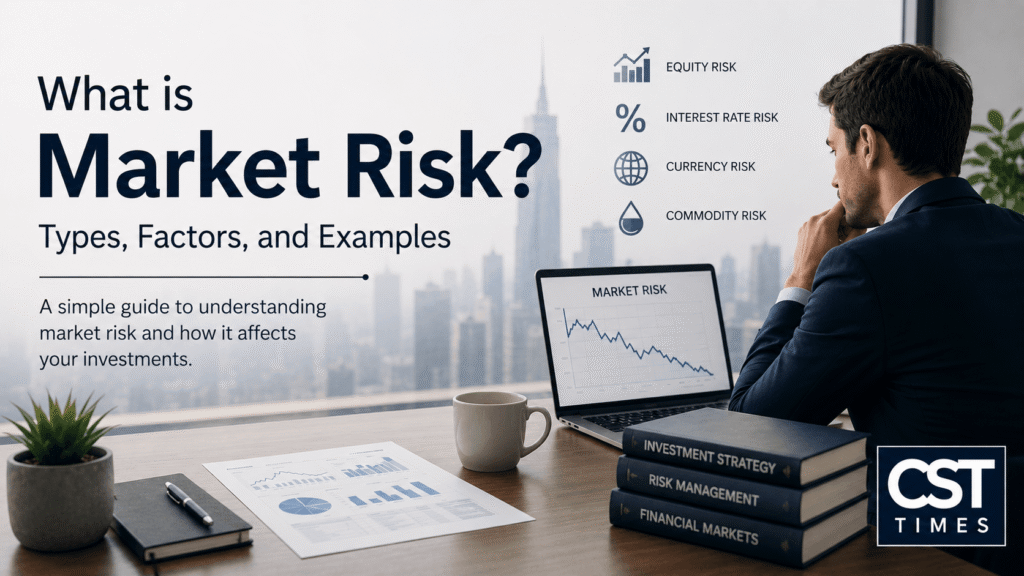
What is Market Risk? Types, Factors, and Examples
What is Market Risk?
Quick Summary:
Market risk is the possibility that an investment loses value because of broad, economy-wide forces — not because of anything specific to the company or asset itself. A recession, a change in interest rates, a currency swing, or a geopolitical shock can drag down prices across an entire market at once, even for well-run companies with strong earnings.
Table of Contents
ToggleThis is what separates market risk from other investment risks. You can research a company thoroughly, pick strong management, and still lose money if the broader market turns against you. That’s why market risk is also called systematic risk or undiversifiable risk — it touches nearly every investment at the same time, so simply owning a wider mix of stocks doesn’t make it go away.
Key Takeaways
- Market risk is the chance of losses caused by market-wide events, not a single company’s performance.
- It’s also known as systematic or undiversifiable risk because it affects almost every investment simultaneously.
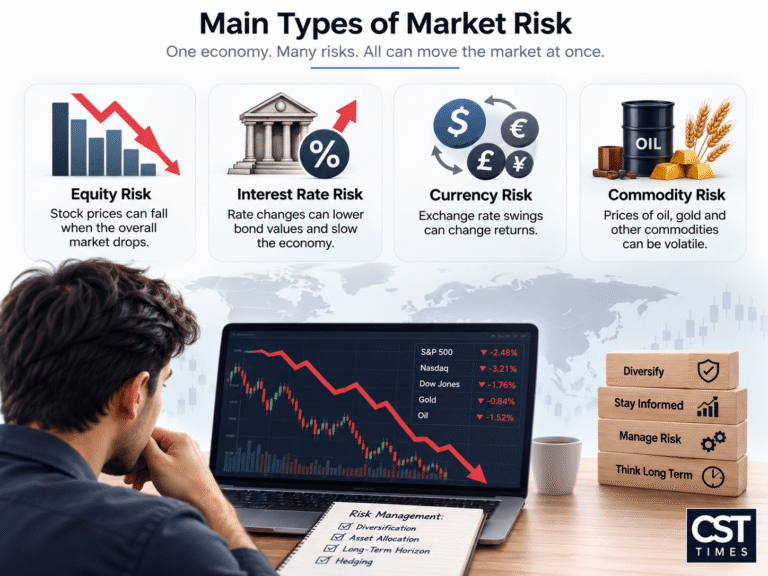
- The four main types are equity risk, interest rate risk, currency risk, and commodity risk.
- Diversification can’t eliminate market risk, but hedging, asset allocation, and time horizon planning can soften its impact.
- Investors and banks commonly measure it using tools like beta and Value at Risk (VaR).
Market Risk vs. Specific Risk: What's the Difference?
Every investment carries two broad categories of risk.
Market risk (systematic risk) comes from factors that affect the whole market — things like inflation, interest rate changes, recessions, and political instability. Because these forces hit nearly every company and asset class, diversifying across many different stocks doesn’t protect you from them.
Specific risk (unsystematic risk) is tied to one company, sector, or asset — a bad earnings report, a product recall, a lawsuit, or a management scandal. This type of risk can be reduced by diversification, since a problem at one company usually doesn’t spread to unrelated ones.
| Market Risk | Specific Risk | |
|---|---|---|
| Source | Economy-wide or market-wide events | A single company, sector, or asset |
| Can diversification reduce it? | No | Yes |
| Example | A recession drags down most stocks | A CEO resigns and the stock drops |
| How it’s managed | Hedging, asset allocation, hedged positions | Diversification |
The 4 Main Types of Market Risk
Analysts typically group market risk into four categories, based on which market variable is driving the potential loss.
1. Equity Risk
Equity risk is the chance that stock prices fall due to broad market conditions rather than anything the company did. If investor sentiment sours or the overall market sells off, even fundamentally sound stocks tend to decline along with everything else. This is generally considered the single biggest source of market risk in most investment portfolios, since stocks make up a large share of most people’s holdings.
2. Interest Rate Risk
Interest rate risk is the risk that changes in benchmark interest rates hurt the value of an investment. It affects bonds most directly: when interest rates rise, existing bond prices generally fall, because newer bonds now offer better yields. The longer a bond’s maturity, the more sensitive its price tends to be to rate changes.
Interest rate risk doesn’t stop at bonds, though. Higher borrowing costs can also slow corporate spending and investment, which can weigh on stock prices too. As of mid-2026, the U.S. Federal Reserve has held its benchmark federal funds rate in a range of 3.5% to 3.75%, a level that continues to shape borrowing costs, bond yields, and stock valuations across the market.
3. Currency Risk
Currency risk (also called exchange rate risk or FX risk) arises when exchange rates shift between currencies. If you hold international stocks or a fund with overseas assets, a stronger U.S. dollar can shrink your returns even if the underlying foreign investment performed well in its local currency. Multinational companies face this risk too: a stronger dollar can make their exports more expensive for foreign buyers, which can hurt sales and profit margins.
4. Commodity Risk
Commodity risk is the risk that changes in the prices of raw materials — oil, natural gas, gold, wheat, and similar goods — affect investment values. Because commodities like oil and grain feed into the cost of producing almost everything else, sharp price swings can ripple through the wider economy, affecting company costs, consumer spending, and inflation all at once.
What Factors Actually Drive Market Risk?
Market risk doesn’t appear out of nowhere. It’s usually driven by a combination of:
- Macroeconomic conditions — inflation, GDP growth, unemployment, and consumer spending trends
- Monetary policy — central bank decisions on interest rates and money supply
- Geopolitical events — wars, elections, sanctions, and trade disputes
- Government policy shifts — tax changes, regulation, and trade tariffs
- Investor sentiment — herd behavior, where investors move together based on fear or optimism rather than company fundamentals
- Systemic shocks — events like pandemics or banking crises that disrupt the entire financial system at once
Often, several of these factors overlap. A single policy announcement, for example, can move interest rate expectations, currency values, and stock prices all in the same week — which is exactly what happened in the example below.
How Is Market Risk Measured?
Investors and financial institutions rely on a few standard tools to estimate how much market risk they’re carrying:
- Beta measures how much a stock’s price tends to move relative to the overall market. A beta above 1 means a stock has historically been more volatile than the market; below 1 means less volatile.
- Value at Risk (VaR) estimates the maximum amount a portfolio could lose over a set time period, at a given confidence level (for example, “95% confident we won’t lose more than $10,000 in a day”). VaR became an industry standard after JPMorgan introduced it in the 1990s, and banking regulators built capital rules around it.
- Expected Shortfall is a newer, more conservative measure that estimates the average loss in the worst-case scenarios beyond the VaR threshold. Global banking regulators adopted this approach — part of a framework called the Fundamental Review of the Trading Book (FRTB) — because VaR alone tended to understate risk during extreme market stress, such as the 2008 financial crisis.
- Standard deviation and volatility indexes, such as the Cboe Volatility Index (VIX), track how much prices are swinging, which is often used as a real-time gauge of market anxiety.
None of these tools predict the future. They estimate risk based on historical patterns, which means they can understate the danger of events that haven’t happened before.
A Real-World Example: The April 2025 Tariff Shock
One of the clearest recent examples of market risk in action came in early April 2025.
On April 2, the U.S. announced a sweeping new round of tariffs on imports from most trading partners. Markets reacted immediately. Over the following two trading sessions, the S&P 500 lost close to 11% of its value — one of the worst two-day drops of the century — while the Dow Jones Industrial Average fell more than 2,200 points in a single session. The Nasdaq officially entered a bear market after dropping roughly 22% from its peak. The Cboe Volatility Index (VIX), which tracks expected market turbulence, spiked above 50, a level rarely seen outside of major financial crises.
This is a textbook case of market risk: the sell-off wasn’t caused by any single company’s earnings or a scandal. It hit nearly every sector and spread to bond markets and currencies as well, as investors reassessed the risk of a broader trade war.
The story didn’t end there. On April 9, the administration paused the tariff increases, and markets staged one of their sharpest rallies in years. By May 13, 2025, the S&P 500 had recovered all its losses and turned positive for the year — a reminder that market risk cuts both ways and can reverse quickly.
A second, smaller example followed later that year. In November 2025, the VIX jumped roughly 50% over the course of the month, driven by growing investor concern over stretched valuations in AI-related technology stocks. Unlike the April episode, this wasn’t triggered by a single policy announcement — it built up gradually from shifting sentiment about how much AI-driven growth was already priced into stock valuations. Both episodes illustrate the same underlying point: market risk can come from a sudden shock or from slower-building unease, but either way, it affects the whole market rather than one company.
How to Manage Market Risk
Because market risk can’t be diversified away, managing it means reducing its impact rather than eliminating it. Common approaches include:
- Asset allocation — spreading money across asset classes (stocks, bonds, cash, commodities) that don’t always move in the same direction at the same time
- Hedging — using instruments like options, futures, or inverse funds to offset potential losses in a portfolio
- Holding cash or short-term bonds — keeping a portion of a portfolio in lower-risk assets to cushion against sudden downturns
- Matching time horizon to risk tolerance — investors with longer time horizons can typically absorb short-term market swings that would be damaging to someone who needs the money soon
- Avoiding reactive decisions — the April 2025 example shows how quickly markets can reverse; selling during a panic can lock in losses that a recovery would have erased
Institutional investors and banks also use formal risk limits, stress testing, and regulatory capital requirements to keep their exposure to market risk within manageable bounds.
Market Risk vs. Other Types of Financial Risk
| Risk Type | What It Measures | Example |
|---|---|---|
| Market risk | Losses from broad market price movements | A recession drags down stock prices across sectors |
| Credit risk | The chance a borrower or bond issuer fails to repay | A company defaults on its corporate bonds |
| Liquidity risk | The risk of being unable to sell an asset quickly without a loss | A thinly traded stock can’t be sold at a fair price during a sell-off |
| Operational risk | Losses from internal failures, fraud, or errors | A bank suffers losses from a technical system failure |
Final Thoughts:
Market risk is the price of being invested at all — it’s not something any single stock pick or research process can fully avoid, because it comes from forces bigger than any one company. Understanding its four main types, what drives it, and how it’s measured won’t let you predict the next downturn, but it can help you build a portfolio and a mindset that can withstand one when it comes.
CST Times:
Market risk is something investors cannot completely avoid, but they can prepare for it. At CST Times, we believe the key is not trying to predict every market move, but understanding what drives risk and building a portfolio that can handle different market conditions. Diversification, sensible asset allocation, and appropriate hedging can help reduce the impact of major market swings. For long-term investors, understanding market risk is often more valuable than reacting emotionally to every short-term price movement.
FAQs
Is market risk the same as systematic risk?
Yes. “Market risk,” “systematic risk,” and “undiversifiable risk” all refer to the same concept: risk from broad, market-wide factors that affect nearly all investments at once.
Can market risk be eliminated completely?
No. Diversification reduces company-specific risk, but market risk affects the entire market, so it can only be reduced through strategies like hedging and asset allocation — never fully removed.
Is market risk the same thing as volatility?
They’re related but not identical. Volatility measures how much prices move up and down; market risk refers specifically to the potential for loss caused by market-wide forces. High volatility often signals elevated market risk, but the two terms aren’t interchangeable.
Does market risk affect bonds as well as stocks?
Yes. Bonds are particularly exposed to interest rate risk, one of the four main types of market risk, along with equity, currency, and commodity risk.
How do professional investors hedge against market risk?
Common tools include options and futures contracts, inverse or short positions, and diversifying across asset classes and geographies that don’t move in perfect sync with each other.
Disclaimer
This article is for educational purposes only and does not constitute financial or investment advice. Investing involves risk, including the potential loss of principal. Readers should consider consulting a licensed financial advisor before making investment decisions.
References
- Financial Market Volatility in the Spring of 2025 — Federal Reserve Bank of St. Louis
- FOMC Statement, July 29, 2026 — Federal Reserve
- Explanatory Note on Minimum Capital Requirements for Market Risk — Bank for International Settlements
Follow us on Social media :
About The Author

Haseeb Jabbar
Haseeb Jabbar writes about crypto, finance, technology, and AI at CST Times, sharing research-based guides, timely news, and free tools and calculators to help readers make informed decisions.

Pingback: Spot Trading vs Futures Trading: 7 Key Differences (Guide)
Pingback: Revolut Supported Countries 2026: Full List (Updated Oct)