
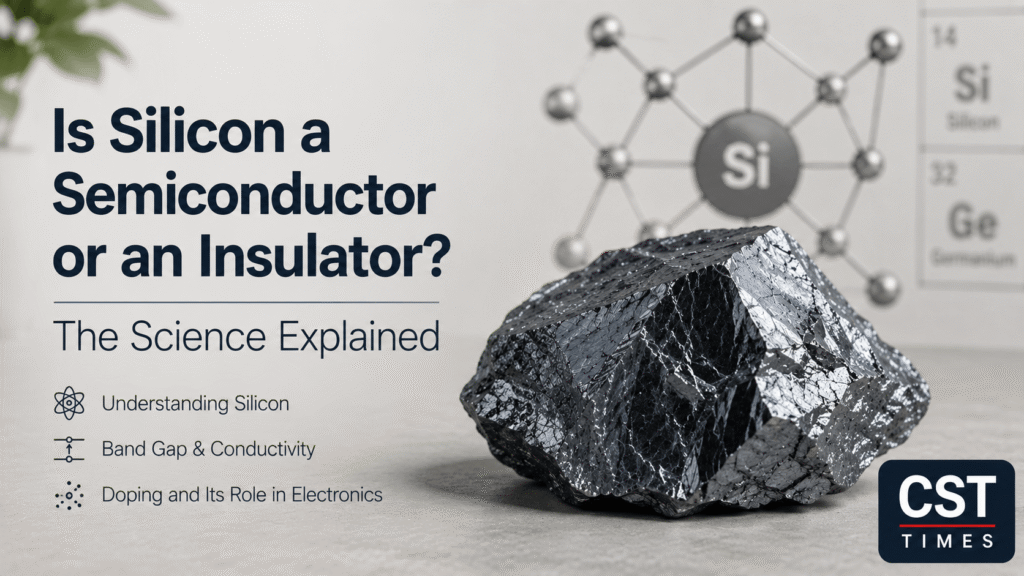
Is Silicon a Semiconductor or an Insulator? The Science Explained
Is Silicon a Semiconductor or an Insulator?
Quick Summary:
Silicon is a semiconductor, not an insulator. It sits in the electrical middle ground between materials that conduct easily, like copper, and materials that block current almost entirely, like glass or rubber. That in-between behavior isn’t a flaw — it’s the exact property that makes silicon the material behind almost every computer chip in use today.
Table of Contents
ToggleThe confusion is understandable. Pure silicon doesn’t conduct electricity nearly as well as a metal, which can make it seem more like an insulator at first glance. Here’s why silicon actually falls firmly into the semiconductor category, what a “band gap” is, and how a tiny bit of doping turns inert silicon into the switch that runs modern electronics.
Key Takeaways
- Silicon is a semiconductor. Its electrical conductivity sits between conductors (like copper) and insulators (like glass).
- The reason comes down to its band gap — about 1.1 electron-volts (eV) — small enough that some electrons cross it at room temperature, but too large for silicon to conduct as freely as a metal.
- On its own (“intrinsic” silicon), it’s a weak conductor. It only becomes useful in electronics after being “doped” with trace amounts of elements like phosphorus or boron.
- Unlike metals, silicon conducts better as it heats up, because more electrons gain the energy needed to jump the gap.
- Glass and sand are made of silicon dioxide, not pure silicon. That compound is a genuine insulator — a common source of confusion.
Table of Contents
- What Divides Conductors, Semiconductors, and Insulators
- Where Silicon Fits: A Band Gap of About 1.1 eV
- Silicon’s Atomic Structure Explains Its Behavior
- Why Pure Silicon Alone Isn’t Very Useful
- How Doping Turns Silicon Into a Working Component
- Why This Makes Silicon the Backbone of Modern Electronics
- Silicon vs. Glass: A Common Mix-Up
- Final Thoughts
- CST Times view
Quick Comparison
| Property | Conductors (e.g., copper) | Semiconductors (e.g., silicon) | Insulators (e.g., glass) |
|---|---|---|---|
| Typical resistivity | ~10⁻⁶ to 10⁻⁴ Ω·cm | ~10⁻³ to 10³ Ω·cm (varies with doping) | ~10¹⁰ to 10²² Ω·cm |
| Band gap | None — bands overlap | Moderate (~1.1 eV for silicon) | Large (several eV or more) |
| Effect of heat on conductivity | Conductivity falls | Conductivity rises | Stays effectively non-conductive |
| Can conductivity be engineered? | Barely | Yes, precisely, through doping | Not in any practical way |
| Everyday examples | Copper, silver, aluminum | Silicon, germanium, gallium arsenide | Glass, rubber, most plastics |
What Divides Conductors, Semiconductors, and Insulators
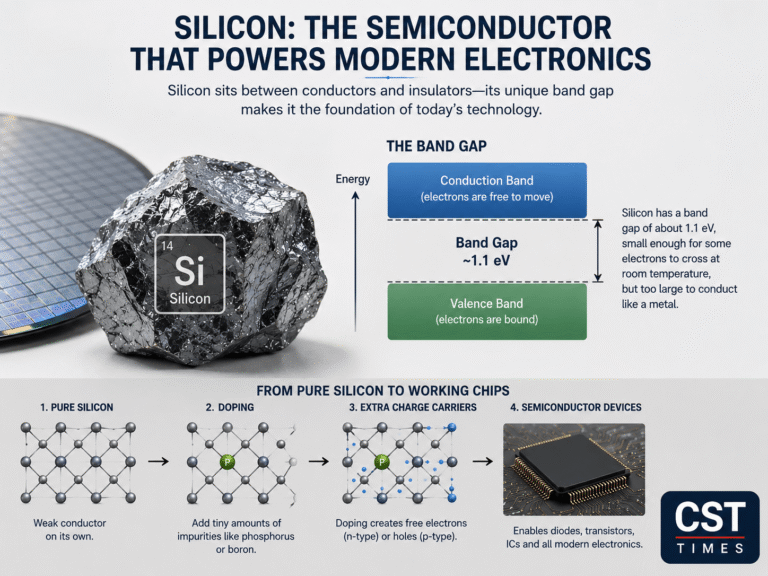
Every solid material has electrons sitting in “bands” of allowed energy. The valence band holds electrons that stay bound to their atoms. The conduction band holds electrons that are free to move and carry current. Between them sits the band gap — an energy range electrons simply cannot occupy, and one they must cross before a material can conduct electricity.
That gap decides which of the three categories a material falls into:
- Conductors have no real gap at all — the valence and conduction bands overlap, so electrons flow freely even without any extra push. Resistivity typically falls between about 10⁻⁶ and 10⁻⁴ ohm-centimeters.
- Insulators have such a wide gap that almost no electron can cross it under normal conditions, so essentially no current flows. Resistivity can reach 10¹⁰ to 10²² ohm-centimeters — trillions of times higher than a conductor.
- Semiconductors have a gap that exists but is narrow enough for some electrons to cross it, especially with added heat, light, or engineered impurities. Resistivity for common semiconductors runs roughly 10⁻³ to 10³ ohm-centimeters, comfortably between the other two.
Where Silicon Fits: A Band Gap of About 1.1 eV
Silicon’s band gap measures about 1.1 to 1.12 electron-volts (eV) at room temperature. That number is the minimum energy an electron needs to absorb, usually from ambient heat, to jump from the valence band into the conduction band and start carrying current.
At room temperature, that gap is wide enough that only a small fraction of silicon’s electrons have enough thermal energy to make the jump on their own. That’s why pure silicon conducts electricity far more weakly than a metal. But the gap is also narrow enough that the jump does happen at a meaningful rate — which is exactly what separates silicon from a true insulator.
Context helps here. Germanium, silicon’s neighbor in the same part of the periodic table, has a smaller band gap of around 0.7 eV, which makes it more sensitive to temperature swings as a semiconductor. Diamond, built from pure carbon in a very similar crystal arrangement, has a band gap around 5.5 eV — wide enough that some materials scientists still debate whether to call it a semiconductor or an insulator. What tends to settle the argument isn’t the raw size of the gap on its own, but whether a material’s conductivity can be deliberately controlled through doping. Silicon does that exceptionally well, which is a large part of why it, and not diamond, ended up running the electronics industry.
Silicon's Atomic Structure Explains Its Behavior
Silicon sits in Group 14 of the periodic table, the same column as carbon, and carries four electrons in its outer shell. In a silicon crystal, every atom bonds to four neighboring atoms, sharing electrons so each atom effectively completes a stable outer shell of eight. That arrangement is called a diamond cubic lattice — the same geometric pattern carbon forms in an actual diamond.
At very low temperatures, all of silicon’s electrons stay locked inside these covalent bonds, and the material behaves almost like an insulator. As temperature rises, thermal vibration occasionally knocks an electron loose from its bond. That freed electron can then move through the crystal and carry current. It also leaves behind a “hole” — a gap in the bond that behaves like a mobile positive charge and adds to the current as neighboring electrons shift to fill it.
This also explains why semiconductors behave the opposite of metals as they heat up. A metal’s conductivity drops when it warms, because vibrating atoms get in the way of moving electrons. A semiconductor’s conductivity rises instead, because heat is exactly what frees more electrons to carry current in the first place.
Why Pure Silicon Alone Isn't Very Useful
In its purest form — called intrinsic silicon — the material is a mediocre conductor. At room temperature, only a tiny fraction of its atoms have a freed electron at any given moment, so very little current flows compared to a metal. That’s nowhere near reliable enough to build a working transistor or diode on its own.
How Doping Turns Silicon Into a Working Component
Manufacturers solve that problem through doping: deliberately introducing trace amounts of other elements into the silicon crystal, often at a rate of roughly one dopant atom for every million silicon atoms or fewer.
- N-type silicon comes from adding phosphorus or arsenic, elements with five valence electrons — one more than silicon’s four bonds require. That spare electron is only loosely held and moves easily, adding a negative charge carrier.
- P-type silicon comes from adding boron or gallium, elements with three valence electrons — one short of what silicon’s bonding needs. The missing electron leaves behind a hole, which acts as a mobile positive charge carrier.
Placing n-type and p-type silicon next to each other creates a p-n junction, the basic building block behind diodes, transistors, and every logic gate on a microchip. By controlling exactly how much of each dopant goes where, manufacturers can switch specific sections of a silicon wafer on and off electrically — something a plain conductor or a plain insulator simply cannot do.
Why This Makes Silicon the Backbone of Modern Electronics
Silicon didn’t win out over other materials because of its band gap alone. A few things came together:
- Abundance. Silicon is the second most abundant element in Earth’s crust after oxygen, found throughout ordinary sand, quartz, and rock. That keeps raw material costs low at industrial scale.
- A convenient natural oxide. Silicon forms a stable oxide layer, silicon dioxide, directly on its own surface. That layer is an excellent electrical insulator, which chipmakers rely on to build transistor gates and isolate circuit elements without needing a separate material.
- A workable operating range. Silicon devices function reliably across roughly -55°C to 150°C, a wide enough window for everyday electronics without exotic cooling.
That combination — abundance, a naturally forming insulating oxide, and a band gap that’s both stable and tunable through doping — is why silicon replaced germanium (used in the earliest transistors) and became the default material for chips, not any single property in isolation.
Silicon vs. Glass: A Common Mix-Up
This is where a lot of the “isn’t silicon an insulator?” confusion comes from. Glass, sand, and quartz are made largely of silicon dioxide (SiO₂), also called silica — a compound of silicon and oxygen, not the pure element. Silica’s chemical bonding is very different from elemental silicon’s, and it has a far wider band gap, which makes it a genuine insulator. In fact, chipmakers deliberately grow a layer of silicon’s own oxide on top of silicon wafers specifically because it insulates so well.
So both statements are true at the same time: pure, elemental silicon is a semiconductor, while silicon dioxide — the glass and sand around us — is an insulator. They are different materials that simply happen to share an element.
Final Thoughts:
Silicon isn’t an insulator. It’s the defining semiconductor, precisely because of its moderate band gap, its unusual temperature behavior, and — most importantly — its ability to be finely tuned through doping. That controllability, more than any single physical property, is what turned a fairly ordinary element into the foundation of the digital world.
CST Times View:
Silicon’s real importance is not simply that it can conduct electricity under the right conditions. Its value comes from how precisely engineers can control that behavior. That controllability is what makes silicon so important to modern chips, computers, smartphones, and other digital technologies.
FAQs
Is Silicon a Good Conductor of Electricity?
Not on its own. Pure silicon conducts far more weakly than a metal like copper at room temperature, which is exactly why it’s classified as a semiconductor rather than a conductor.
Is Silicon a Metal, Insulator, or Semiconductor?
Silicon is a metalloid element that behaves electrically as a semiconductor — its conductivity sits between that of a true metal and a true insulator.
Why Is Silicon Used in Computer Chips?
Because its conductivity can be precisely controlled through doping. A true conductor can’t be switched off, and a true insulator can’t be switched on — silicon can be engineered to do both, which is what makes transistors possible.
Is Glass, Which Contains Silicon, Also a Semiconductor?
No. Glass is made from silicon dioxide (silica), a compound with a much wider band gap than pure silicon. That makes glass an insulator, even though it shares an element with the semiconductor silicon.
Does Silicon Conduct Electricity Better When Heated?
Yes. Unlike metals, which conduct worse as they heat up, silicon conducts better because rising temperature frees more electrons to cross its band gap and carry current.
Disclaimer
This article is for general educational purposes and explains established principles of solid-state physics and materials science. It is not intended as engineering, safety, or product-design guidance for specific electronic devices.
References:
Follow us on Social media :
About The Author

Haseeb Jabbar
Haseeb Jabbar writes about crypto, finance, technology, and AI at CST Times, sharing research-based guides, timely news, and free tools and calculators to help readers make informed decisions.
