

Crypto Market Cap: Essential 2026 Guide to Avoid Mistakes
Quick Summary:
Crypto market cap is the total value of a cryptocurrency, calculated by multiplying its current price by the number of coins in circulation. It shows how big a coin really is, which a price tag alone cannot tell you. This guide explains the formula, compares live Bitcoin and Ethereum figures, and covers the mistakes that trip up beginners.
Table of Contents
ToggleKey Takeaways
- Crypto market cap equals price × circulating supply. It measures a coin’s size, not money invested.
- A $0.10 coin can be worth far more in total than a $1,000 coin, so compare market caps, not prices.
- Data sites disagree: on October 20, 2026, CoinGecko showed about $2.82 trillion for the whole market and CoinMarketCap about $2.73 trillion.
- Market cap says nothing about liquidity or fake volume, so check both before judging a small coin.
- A large market cap is no safety guarantee: Bitcoin trades about 35% below its October 2025 record.
What is Crypto Market Cap?
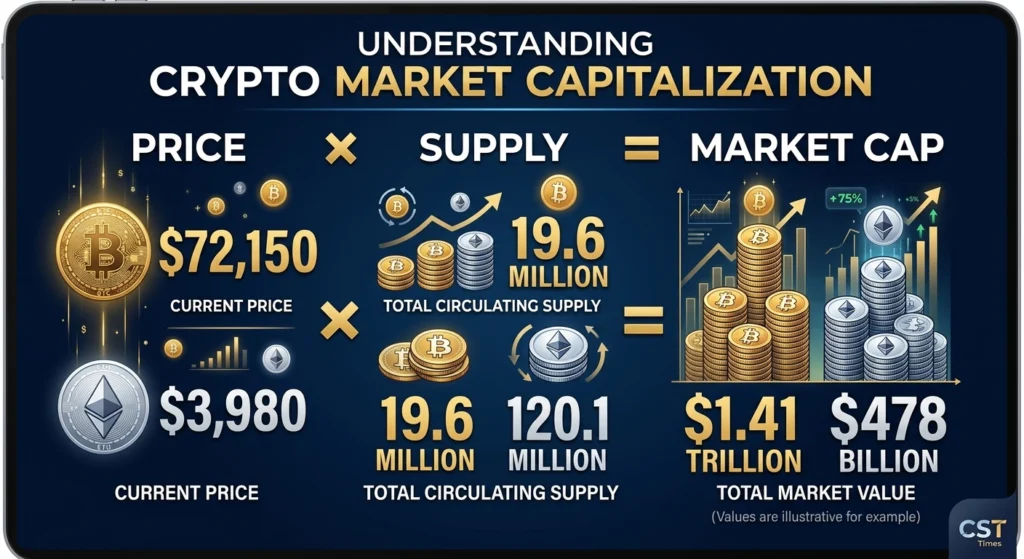
Crypto market cap is the total market value of a cryptocurrency’s circulating coins at the current price. You find it by multiplying the price of one coin by the number of coins in the market. It lets you compare assets that trade at very different prices on a single scale.
The idea comes from stock markets. CoinMarketCap says it counts only coins that can affect the price, which mirrors the “public float” approach used for company market caps, according to its FAQ.
One caution: market cap is a price-based estimate, not a record of money invested. A $1 billion market cap does not necessarily mean investors put $1 billion into the project, Spaziocrypto warns, because in thin markets a modest amount of capital can move the price.
How to Calculate Crypto Market Cap
The formula is market cap = current price × circulating supply. CoinMarketCap defines circulating supply as the best approximation of the coins circulating in the market and in the public’s hands. Locked, reserved or unsellable coins are excluded because they cannot affect the price.
Here are two live examples, using CoinMarketCap’s Bitcoin and Ethereum pages as of October 20, 2026:
Asset | Price | Circulating supply | Market cap |
|---|---|---|---|
| Bitcoin (BTC) | about $82,209 | 20,098,843 BTC | about $1.65 trillion |
| Ethereum (ETH) | about $2,410 | 122,151,332 ETH | about $294 billion |
Bitcoin’s market cap is roughly 5.6 times Ethereum’s. Every coin page also lists three supply terms:
- Circulating supply: coins available in the market now.
- Total supply: coins in existence, minus verifiably burned coins.
- Max supply: the most coins that will ever exist, as best estimated.
Bitcoin’s max supply is 21 million, and about 95.7% is already in circulation. Ethereum has no max supply.
Why Price Alone Is Misleading
A coin’s price does not show its size, because every coin has a different number of units. A cheap coin with a huge supply can be worth more in total than an expensive coin with a small supply.
Two made-up tokens show the effect:
| Token | Price | Circulating supply | Market cap |
|---|---|---|---|
| Token A | $100 | 1,000,000 | $100 million |
| Token B | $0.10 | 5,000,000,000 | $500 million |
Token B is 1,000 times cheaper per coin, yet five times larger. “Cheap” does not mean “undervalued.” For Token B to reach $1, its market cap would have to climb to $5 billion.
Large-Cap, Mid-Cap and Small-Cap Crypto
Crypto borrows its size labels from the stock market. A common rule of thumb calls coins above $10 billion large-cap, those from $1 billion to $10 billion mid-cap, and those under $1 billion small-cap, with a micro-cap tier below $100 million. No official standard exists.
| Tier | Typical market cap | What it usually means |
|---|---|---|
| Large cap | Above $10 billion | High liquidity, lower volatility, widely listed |
| Mid cap | $1 billion to $10 billion | Moderate liquidity, growth potential |
| Small cap | $100 million to $1 billion | Lower liquidity, higher volatility |
| Micro cap | Below $100 million | Very low liquidity, high risk |
Tier ranges follow the table published by Kryptex.
Kryptex notes that large-cap coins are easier to sell in volume without moving the price, while small caps are harder to liquidate. Treat tiers as risk hints, not guarantees.
Crypto Market Cap Today: Live Numbers
Total crypto market cap is the sum of every tracked asset’s market cap. On October 20, 2026, it stood between roughly $2.73 trillion and $2.82 trillion, depending on the data provider.
| Source (checked October 20, 2026) | Total market cap | Bitcoin dominance | Ethereum dominance |
|---|---|---|---|
| CoinGecko | $2.822 trillion | 58.0% | 10.3% |
| CoinMarketCap | $2.73 trillion | 60.2% | 10.7% |
| Coinbase | not captured | 61.68% | not captured |
The snapshots were not taken at the same second, so part of the gap is timing.
Methodology matters too. CoinGecko says it pulls circulating supply from project endpoints and subtracts locked or vested holdings. Coinbase states its Bitcoin market cap uses total supply. For Bitcoin both supply figures are 20,098,843 BTC, but for other coins they can differ.
Bitcoin dominance is Bitcoin’s market cap divided by the total market cap. At 60%, roughly 60 cents of every dollar of crypto value sits in Bitcoin.
Market Cap vs. Fully Diluted Valuation (FDV)
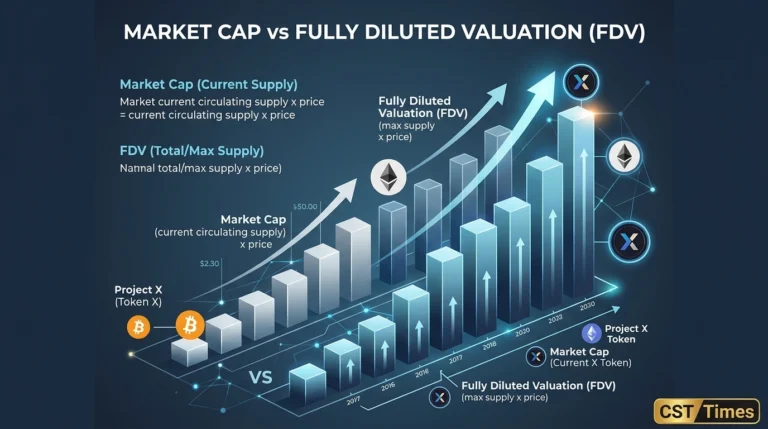
Fully diluted valuation (FDV) is the theoretical market cap if a larger supply, such as the max or total supply, were already circulating at today’s price. Comparing it with market cap shows how many tokens are still locked or unissued.
Bitcoin’s gap is small. CoinMarketCap lists a market cap of about $1.65 trillion and an FDV of about $1.72 trillion. Ethereum has no max supply, so its FDV equals its market cap at about $294 billion.
For newer tokens the gap can be huge. Spaziocrypto’s example is a $100 million market cap with a $1 billion FDV, a tenfold difference. An unlock does not automatically mean a sale, it says, but if supply grows much faster than demand, price pressure can emerge. Check the unlock schedule before buying.
Providers also define FDV differently: CoinMarketCap uses maximum supply, while CoinGecko generally uses total supply. The guide advises using the same source when comparing assets.
What Market Cap Does Not Tell You
Market cap shows size. It does not show liquidity, ownership or whether trading volume is genuine. Four blind spots matter most:
- Liquidity. On October 20, Bitcoin’s 24-hour volume was about $24.9 billion (1.51% of its market cap) and Ethereum’s about $8.5 billion (2.9%). Both trade in deep markets. Koinly notes that in low-cap tokens a relatively small amount of buying can have a large impact on price.
- Missing supply data. CoinMarketCap shows a question mark instead of a market cap when it has not sufficiently verified a coin’s circulating supply.
- Manipulation. Koinly cites a 2024 study of 1,457 pump events linking low market cap, low volume and social media buzz to a higher chance of a pump. A 2021 study of 29 exchanges estimated wash trading above 70% of reported volume on average across unregulated ones. CoinMarketCap excludes zero-fee markets from price and volume because traders can create fake volume there without penalty.
- Concentrated ownership. Koinly lists a handful of wallets controlling most of the supply as a warning sign. Market cap alone will not show it.
Common Mistakes to Avoid
- Judging a coin by its price. Compare market caps and FDV instead.
- Treating a large market cap as safe. Bigger coins tend to be steadier, but Bitcoin trades about 35% below its October 6, 2025 record of $126,198.07, per CoinMarketCap.
- Ignoring token unlocks. A wide gap between market cap and FDV means more supply is coming.
- Mixing data sources. Use one site when comparing two coins.
- Quoting a number without a date. Figures change within minutes, so always note the date and source.
Final Thoughts:
Crypto market cap is the quickest way to see how big a coin is, but it is a starting point, not a verdict. Before you rely on any crypto market cap, check the supply, the trading volume and the data source, and note the date. Next time you compare two coins, open both on the same site and read market cap, FDV and volume side by side.
If the CLARITY Act Becomes Law: What It Means for Exchanges
What Is the Biggest Risks in Crypto? (Professional Report-Based Analysis)
Will Bitcoin Replace Gold ? Which One Will Stay Strong in the Future?
What is Market Risk? Types, Factors, and Examples
Fake Payment Screenshot Scam on Binance P2P: How to Spot and Avoid It
Why Is My Crypto Transaction Pending? How to Check and Fix It
Statement Balance vs Current Balance: What Should You Pay?
FAQs
Is a higher crypto market cap better?
Not automatically. A higher crypto market cap usually means deeper liquidity and a more established asset, but it does not remove risk. Bitcoin, the largest asset, still trades about 35% below its October 2025 record. Check supply, volume and your own risk tolerance instead of ranking coins by market cap alone.
Why do CoinGecko and CoinMarketCap show different market caps?
They list different coins, apply their own supply and volume rules, and refresh at different moments. CoinGecko subtracts locked or vested holdings from circulating supply, while CoinMarketCap excludes zero-fee markets from price and volume. On October 20, 2026, they showed about $2.82 trillion and $2.73 trillion for the total market.
What is the difference between market cap and FDV?
Market cap uses circulating supply. FDV applies today’s price to a larger supply, such as max or total supply. A big gap means many tokens are still locked or unissued. Platforms define that larger supply differently, so compare FDV figures only when they come from the same source.
Can a cheap coin have a high market cap?
Yes. Market cap depends on both price and supply, so a coin priced at $0.10 with billions of coins in circulation can be larger than a $1,000 coin with few units. Price alone never shows size. In our made-up example, a $0.10 token with five billion coins reaches $500 million.
Disclaimer
This article is for educational and informational purposes only and is not financial, investment, or legal advice. Crypto assets are volatile, and you can lose some or all of your money. Always do your own research.
Follow us on Social media :
About The Author

Haseeb Jabbar
Haseeb Jabbar writes about crypto, finance, technology, and AI at CST Times, sharing research-based guides, timely news, and free tools and calculators to help readers make informed decisions.
