
Who Created Artificial Intelligence? The Real History of AI’s Origins
Who Created Artificial Intelligence? "When was invented?" "Who's the Father?"
Quick Summary:
No single person invented artificial intelligence. The theoretical groundwork was laid by British mathematician Alan Turing in the 1930s and 1940s, but AI became an actual field of study in the summer of 1956, when computer scientist John McCarthy organized the Dartmouth Summer Research Project on Artificial Intelligence — the event where McCarthy coined the term “artificial intelligence” itself. He worked alongside Marvin Minsky, Claude Shannon, and Nathaniel Rochester to plan it, and it’s this small group, not one lone inventor, that historians usually credit with founding AI as a discipline.
Table of Contents
ToggleIf you searched for history of AI Like “who created AI,” “when was AI invented,” or “who is the father of AI,” you’ve probably noticed the answers online don’t always agree. That’s because AI wasn’t built by one person in one moment — it was assembled, piece by piece, out of mathematics, wartime code-breaking, cognitive psychology, and a few audacious research proposals. This guide walks through exactly how that happened, who did what, and why “who really created AI” doesn’t have a one-word answer.
Key Takeaways
- Artificial intelligence has no single inventor. It emerged from decades of work in logic, mathematics, and early computing.
- Alan Turing built the theoretical foundation: the Turing Machine (1936) and the Turing Test (1950), which asked whether a machine could convincingly imitate a human.
- The term “artificial intelligence” was coined by John McCarthy for a 1956 workshop at Dartmouth College — the event widely recognized as the official birth of AI as a field.
- McCarthy organized Dartmouth with Marvin Minsky, Claude Shannon, and Nathaniel Rochester. Along with Turing, Allen Newell, and Herbert A. Simon, they’re commonly called AI’s “founding fathers.”
- The Logic Theorist, written by Allen Newell and Herbert Simon just before the Dartmouth Conference, is generally considered the first true AI program.
- AI’s history has moved in boom-and-bust cycles, including two “AI winters,” before deep learning and generative AI (like ChatGPT, Google Gemini, Claude.ai) brought it into everyday use.
Table of Contents
- Before AI Had a Name: The Foundational Work (1936–1950)
- 1956: The Dartmouth Conference — Where AI Got Its Name
- Who Are AI’s “Founding Fathers”?
- Is There Really One “Father of AI”?
- How AI Was Actually Built: The First AI Program
- A Complete Timeline: When Did AI Begin?
- Why AI’s Boom-and-Bust History Matters
- Final Thoughts
Before AI Had a Name: The Foundational Work (1936–1950)
Long before anyone said the words “artificial intelligence,” a handful of thinkers were already asking whether a machine could reason.
Alan Turing and the Idea of a Thinking Machine
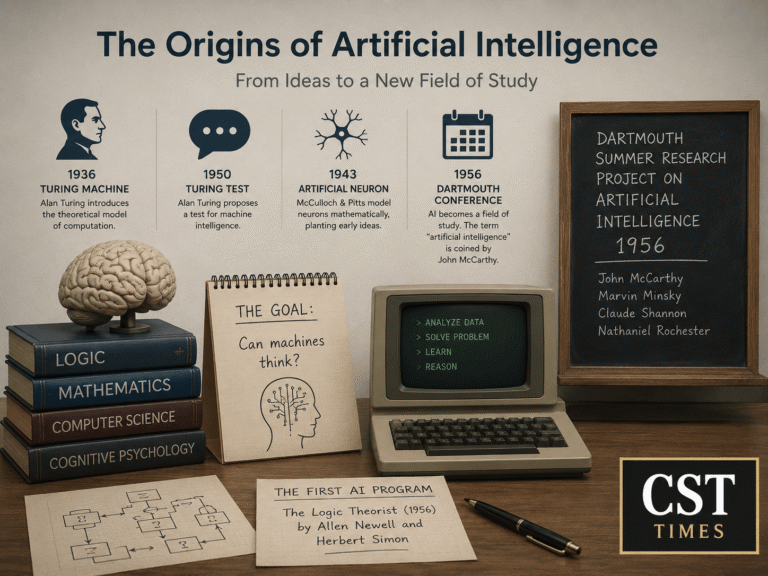
In 1936, British mathematician Alan Turing described what’s now called the Turing Machine — a simple theoretical model of a device that reads and writes symbols on a tape, following a set of rules. It wasn’t a real computer, but it proved that computation itself could be defined and reasoned about mathematically. That idea underpins every digital computer built since, which is why Turing is often called a father of both computer science and AI.
The Turing Test: “Can Machines Think?”
In October 1950, Turing published a paper titled “Computing Machinery and Intelligence.” Rather than try to define “thinking,” he proposed a practical alternative, later known as the Turing Test: if a human judge, chatting by text with a hidden human and a hidden machine, can’t reliably tell which is which, the machine can be said to be exhibiting intelligent behavior. The test is still referenced today, though modern researchers largely treat it as a historical starting point rather than a genuine measure of intelligence.
Early Attempts at Artificial Neurons
In 1943, neurophysiologist Warren McCulloch and logician Walter Pitts published a mathematical model of how a simplified “artificial neuron” might work, inspired by biological brain cells. It didn’t lead to a working machine at the time, but it planted an idea that would resurface decades later in neural networks and deep learning.
By the mid-1950s, the pieces were in place: a theory of computation, a test for machine intelligence, and an early model of the brain as a kind of circuit. What was missing was a name — and a plan.
1956: The Dartmouth Conference — Where AI Got Its Name
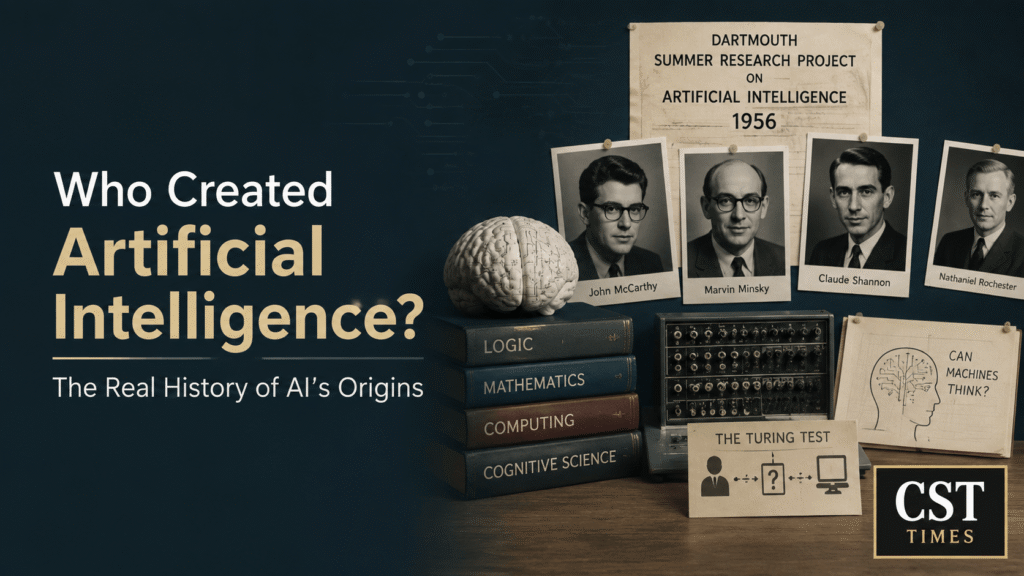
In the summer of 1956, four researchers — John McCarthy (then a young math professor), Marvin Minsky, Claude Shannon (the founder of information theory), and Nathaniel Rochester (an engineer at IBM) — organized an eight-week workshop at Dartmouth College in New Hampshire. They asked the Rockefeller Foundation to fund it, and roughly 20 researchers attended over the course of the summer, some staying the whole eight weeks and others dropping by for just a few days.
Their 1955 funding proposal made a bold claim: that every feature of learning or intelligence could, in principle, be described precisely enough for a machine to simulate it. To describe this new area of study, McCarthy needed a name — and he chose “artificial intelligence.”
That single decision is why the Dartmouth Workshop is usually described as the moment AI was “invented” or “born,” even though nothing resembling modern AI came out of the room that summer. What came out of it was a field: a shared name, a shared set of questions, and a small community of researchers who would go on to found the first AI labs at MIT, Stanford, and Carnegie Mellon.
Who Coined the Term “Artificial Intelligence”?
John McCarthy coined the term specifically to describe the Dartmouth proposal, and later defined AI simply as “the science and engineering of making intelligent machines.” The phrase had reportedly been used informally once before, by computing pioneer John Mauchly around 1955, but it was McCarthy’s use of it at Dartmouth that made it the accepted name for the field.
Who Are AI’s “Founding Fathers”?
Historians of computer science usually group five people together as AI’s founding generation:
- Alan Turing — laid the theoretical groundwork with the Turing Machine and Turing Test, years before the field had a name.
- John McCarthy — organized the Dartmouth Conference, coined the term “artificial intelligence,” invented the Lisp programming language, and founded Stanford’s AI Lab.
- Marvin Minsky — co-organized Dartmouth, co-founded the MIT AI Lab with McCarthy, and did foundational work on how machines might represent knowledge.
- Allen Newell — a Carnegie Mellon researcher who, with Herbert Simon, built some of the earliest working AI programs.
- Herbert Simon — a political scientist and later a Nobel laureate in economics, who partnered with Newell on AI’s first problem-solving programs.
McCarthy and Minsky each won the A.M. Turing Award — computing’s highest honor — for founding the field: Minsky in 1969, McCarthy in 1971. Newell and Simon shared the award in 1975 for their work on human problem-solving and AI.
Later generations added their own key names — Geoffrey Hinton, often called the “godfather of deep learning” for his work on neural networks, and Fei-Fei Li, sometimes called the “godmother of AI” for building ImageNet, the dataset that helped trigger the deep learning boom of the 2010s.
Is There Really One “Father of AI”?
Not exactly — and that’s the honest answer. Different sources point to different names, depending on what they mean by “created”:
- If you mean who laid the theoretical foundation, that’s Alan Turing.
- If you mean who named the field and organized its founding event, that’s John McCarthy.
- If you mean who built the first working AI program, that’s Allen Newell and Herbert Simon.
- If you mean who pushed AI toward the neural networks that power today’s tools, that credit usually goes to later researchers like Geoffrey Hinton, decades after the field began.
Most reputable sources hedge on this question for good reason: AI wasn’t invented by one mind. It was assembled by a small research community over roughly two decades, then rebuilt several more times as computing power, data, and ideas caught up with the original ambition.
How AI Was Actually Built: The First AI Program
While McCarthy was organizing Dartmouth, two of the attendees, Allen Newell and Herbert Simon (working with programmer Cliff Shaw), had already written what’s widely regarded as the first true AI program: the Logic Theorist. Completed in late 1955 and presented at Dartmouth in 1956, it was designed to prove mathematical theorems the way a human logician would, rather than through brute-force calculation. It went on to prove 38 of the first 52 theorems in Principia Mathematica, a landmark work of mathematical logic — in at least one case, finding a shorter, more elegant proof than the original.
A year later, Newell and Simon followed it with the General Problem Solver (1957), an attempt to build a program that could tackle a wide range of problems, from logic puzzles to the Tower of Hanoi, by mimicking general human problem-solving strategies rather than task-specific tricks.
These two programs mattered because they moved AI from a proposal on paper into something a computer could actually run — proof that the Dartmouth group’s ambitions weren’t purely theoretical.
A Complete Timeline: When Did AI Begin?
Year | Milestone | Key People / Organizations |
|---|---|---|
| 1936 | Turing Machine formalizes the idea of computation | Alan Turing |
| 1943 | First mathematical model of an artificial neuron | Warren McCulloch & Walter Pitts |
| 1950 | “Computing Machinery and Intelligence” introduces the Turing Test | Alan Turing |
| 1955–56 | Logic Theorist — widely considered the first true AI program | Allen Newell & Herbert Simon |
| 1956 | Dartmouth Conference — the term “artificial intelligence” is coined and the field is founded | John McCarthy, Marvin Minsky, Claude Shannon, Nathaniel Rochester |
| 1957 | General Problem Solver | Allen Newell & Herbert Simon |
| 1969 / 1971 | Minsky and McCarthy each win the Turing Award for founding AI | Marvin Minsky, John McCarthy |
| 1974–1980 | First “AI winter” — funding collapses after inflated expectations | — |
| 1980 | R1/XCON expert system proves AI’s commercial value | Digital Equipment Corporation |
| 1987–1993 | Second AI winter — expert systems prove brittle and costly | — |
| 1997 | Deep Blue beats world chess champion Garry Kasparov | IBM |
| 2011 | Watson wins Jeopardy!, popularizing data-driven AI | IBM |
| 2012 | AlexNet wins the ImageNet competition, kicking off the deep learning boom | University of Toronto researchers |
| 2016 | AlphaGo beats Go champion Lee Sedol | DeepMind |
| 2017 | Transformer architecture introduced in “Attention Is All You Need” | Google researchers |
| 2020 | GPT-3 released, scaling large language models to 175 billion parameters | OpenAI |
| 2022 | ChatGPT launches, bringing generative AI to the mainstream | OpenAI |
Why AI’s Boom-and-Bust History Matters
AI’s story after 1956 wasn’t a straight line upward. Twice — in the mid-1970s and again in the late 1980s — funding and enthusiasm collapsed after the technology failed to live up to its own hype, periods researchers call “AI winters.” Each recovery came from a genuinely new approach: expert systems in the 1980s, statistical machine learning in the 1990s and 2000s, and then deep learning after 2012, when a neural network called AlexNet dramatically outperformed older methods at recognizing images.
That deep learning shift — built on ideas that trace back to McCulloch and Pitts’ 1943 neuron model — is what eventually led to the transformer architecture in 2017, and from there to the large language models that most people now think of when they hear “AI.”
It’s easy to read about a 1956 summer workshop and wonder what it has to do with tools like ChatGPT. The answer is: almost everything that came after traces back to the questions that group of researchers agreed to ask together. Dartmouth didn’t produce a working intelligent machine — the attendees were wildly optimistic about how fast that would happen — but it produced something more durable: a name, a research community, and a set of problems (learning, reasoning, language, perception) that AI is, in many ways, still working through today.
Final Thoughts:
The honest answer to “who created artificial intelligence” is a small group of mathematicians and computer scientists who spent a summer in New Hampshire deciding the field deserved a name — building on ideas Alan Turing had already been developing for over a decade. AI didn’t arrive fully formed. It’s been rebuilt several times since 1956, and the version most people use today, through chatbots and generative tools, is the product of a 2017 breakthrough (the transformer) layered on top of a 2012 one (deep learning), layered on top of that original 1956 workshop. Knowing that history makes it a lot easier to understand why AI looks the way it does now — and why the field is still, in a real sense, the same open-ended experiment it was in 1956.
- Dartmouth College — “Artificial Intelligence (AI) Coined at Dartmouth,” home.dartmouth.edu
- ACM — A.M. Turing Award
https://amturing.acm.org/
Particularly useful for John McCarthy (1971) and Marvin Minsky (1969). - International Science Council — “AI was born at a US summer camp 68 years ago,” council.science
Who created artificial intelligence?
No single person did. Alan Turing supplied the theoretical foundation in the 1930s–40s, and the field itself was founded in 1956 by John McCarthy, Marvin Minsky, Claude Shannon, and Nathaniel Rochester at the Dartmouth Conference.
When was artificial intelligence invented?
AI is generally dated to 1956, when the Dartmouth Conference gave the field its name. Its theoretical roots go back further, to Turing’s 1936 Turing Machine and his 1950 Turing Test.
Who is considered the father of AI?
There’s no single agreed answer. Alan Turing is often called the father of AI for his theoretical work; John McCarthy is credited for coining the term and founding the field at Dartmouth.
How was artificial intelligence created?
It developed in stages: Turing’s theory of computation (1936), his Turing Test (1950), the Dartmouth Conference that named the field (1956), and the first working AI programs — the Logic Theorist (1956) and General Problem Solver (1957) — that followed shortly after.
When did artificial intelligence begin?
As a named field of research, AI began in the summer of 1956 at Dartmouth College. As an idea, it began earlier, with Turing’s 1950 question of whether machines can think.
Who were the founders of artificial intelligence?
The Dartmouth Conference was organized by John McCarthy, Marvin Minsky, Claude Shannon, and Nathaniel Rochester. Together with Alan Turing, Allen Newell, and Herbert Simon, they’re generally regarded as AI’s founding generation.
Follow us on Social media :
About The Author

Haseeb Jabbar
Haseeb Jabbar writes about crypto, finance, technology, and AI at CST Times, sharing research-based guides, timely news, and free tools and calculators to help readers make informed decisions.
