
What is an Integrated Circuit? A Simple Beginner’s Guide
What is an Integrated Circuit?
Quick Summary:
An integrated circuit (IC) is a tiny electronic circuit built on a single piece of semiconductor material, usually silicon, with all its parts joined together inside one package. Instead of wiring thousands of separate components by hand, manufacturers build the whole circuit on a slice that can be smaller than a fingernail. This guide explains what an integrated circuit is, what is inside it, how it works, its main types, and where you use one every day.
Table of Contents
ToggleKey Takeaways
- An integrated circuit is a complete electronic circuit built on one small piece of semiconductor.
- “IC,” “chip” and “microchip” are used for the same thing in everyday language.
- Inside an IC are transistors, resistors, capacitors, diodes and the tiny connections between them.
- The three main types are analog, digital and mixed-signal.
- A semiconductor is a material. An integrated circuit is a finished product made from it.
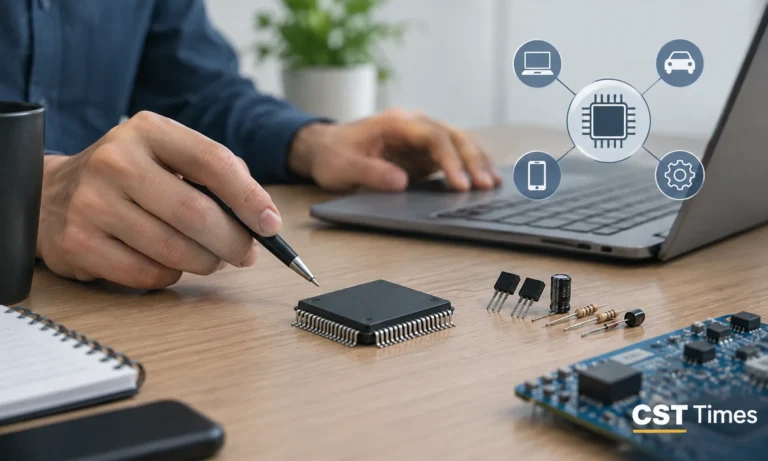
What is an Integrated Circuit?
An integrated circuit is a semiconductor wafer, or chip, on which thousands or millions of tiny resistors, capacitors, diodes and transistors are built and connected together, as TechTarget explains. In simple terms, it is a complete electronic circuit shrunk onto a speck of silicon. What once filled a whole circuit board can now sit on a piece of material smaller than a coin.
IC, IC Chip and Chip: What Is the Relationship?
The same device is also called a chip, a microchip or a microelectronic circuit. In everyday use, all these names mean the same thing. Strictly speaking, the “chip” is the small piece of semiconductor, and the “IC” is the working circuit built on it. “IC chip” simply joins the two words. You rarely need to separate them unless you are reading an engineering document.
What is Inside an Integrated Circuit?
Think of an IC as a tiny city on a stamp-sized plot of land. The buildings are electronic components, and the roads are thin metal connections between them. Everything is built on the same piece of material instead of being assembled from separate parts.
The main parts are:
- Transistors: tiny switches or amplifiers. They turn current on and off or make weak signals stronger.
- Resistors: parts that limit how much current flows.
- Capacitors: parts that store a small amount of electrical charge and smooth out signals.
- Diodes: parts that let current flow in one direction only.
- Connections: microscopic metal pathways, laid down in thin layers, that link everything together.
A modern computer processor can contain millions or billions of these parts. In digital chips, most of them are transistors.
How Does an Integrated Circuit Work?
An IC takes an electrical signal in, changes it in a useful way, and sends a signal out. The components inside work together to do that job.
In a digital IC, transistors act as switches that are either on or off. These states represent the binary values 1 and 0. Groups of switches form logic gates, which make simple decisions. Millions of gates working together can add numbers, store data or run software instructions.
In an analog IC, the signal is not just on or off. It changes smoothly. For example, a weak signal from a microphone can be strengthened by transistors and resistors until it is powerful enough to drive a speaker.
Either way, the IC needs power and a way to reach the outside world. Metal legs or pads on its package carry power and signals in and out, so it can sit on a circuit board next to other ICs.
What is the Main Function of an Integrated Circuit?
The main function of an IC is to perform an electronic task, such as amplifying a signal, switching, storing data, calculating or controlling another device. It does this in a package that is small, cheap, fast and reliable.
This mattered because early electronics used separate parts wired together by hand, which made equipment bulky and expensive. Jack Kilby demonstrated the first working integrated circuit to managers at Texas Instruments on 12 September 1958, the first time electronic components were combined on a single base. Robert Noyce at Fairchild Semiconductor independently built his own version later, with important improvements, and both men are now recognised as inventors. Kilby later won the 2000 Nobel Prize in Physics for his part in the invention. See the IEEE milestone record and the Linda Hall Library profile for details.
Since then, the number of transistors on a chip has grown from a handful in the 1960s to billions by the 2010s, according to the Computer History Museum. That growth is why a phone in your pocket does what once needed a room full of equipment.
Types of Integrated Circuits
ICs are usually divided into three groups: analog, digital and mixed-signal, based on the kind of signal they handle, as NordVPN’s glossary notes.
| Type | What it handles | Simple examples |
|---|---|---|
| Analog (linear) | Smoothly changing signals such as sound, temperature or voltage | Audio amplifiers, temperature sensors, voltage regulators |
| Digital | On/off (binary) signals | Microprocessors, memory chips, logic gates |
| Mixed-signal | Both analog and digital on one chip | Phone chips, IoT devices, analog-to-digital converters |
ICs are usually divided into three groups: analog, digital and mixed-signal, based on the kind of signal they handle, as NordVPN’s glossary notes.Analog ICs usually have only a few components and are fairly simple, while digital ICs are built from logic gates that work with binary data. Mixed-signal chips exist because the real world is analog and computers are digital. A sensor or microphone produces an analog signal, which must be converted into digital data before a processor can use it.
Where Are Integrated Circuits Used?
Almost any device that does more than produce light or heat contains at least one IC. Microchips appear in smart personal devices and in household appliances such as microwaves and washing machines. Common examples include:
- Smartphones: the main processor, memory, camera, wireless and battery-management chips.
- Computers and laptops: processors, memory, graphics and storage controllers.
- Cars: engine control, braking and safety systems, infotainment and driver-assistance sensors.
- TVs: image processing, sound and smart-TV features.
- Routers: chips that direct network traffic and handle Wi-Fi.
- Medical devices: digital thermometers, blood-pressure monitors and patient monitors.
- Home appliances: timers, motor controls and sensors in kitchen and laundry machines.
Role of Integrated Circuits in a Computer
A computer is, in practice, a collection of ICs on a circuit board. The processor (CPU) is an IC that runs instructions. Memory ICs hold the data the computer is working on right now, and storage controllers manage drives. A graphics chip (GPU) handles images and video, while other chips manage Wi-Fi, Bluetooth, sound and USB ports.
Many modern devices combine several of these jobs on one chip, called a system on a chip (SoC). Apple, for example, describes its M5 as a system on a chip for the 14-inch MacBook Pro, iPad Pro and Apple Vision Pro. You can read the official announcement on Apple Newsroom.
Integrated Circuit vs Chip vs Semiconductor
Beginners often mix up these three words, but each means something different.
| Term | Meaning | Example |
|---|---|---|
| Semiconductor | A material that conducts electricity better than an insulator but not as well as a metal, and whose behaviour can be controlled | Silicon, germanium |
| Integrated circuit | A complete circuit with many components built on one piece of semiconductor | A processor, a memory chip |
| Chip / microchip | The everyday name for an IC, or for the small piece of semiconductor it is built on | “The chip in my phone” |
The word “semiconductor” is also used for the whole industry (“the semiconductor industry”) and for single components such as one transistor or diode. Those are semiconductor devices, but they are not ICs. So every IC is made from semiconductor material, but not every semiconductor device is an IC.
Real-World Integrated Circuit Examples
- Microcontroller: a small programmable IC that controls simple devices. The Microchip ATtiny817 is one example.
- Operational amplifier (op-amp): a common analog IC, such as the LM358, used in audio and sensor circuits.
- 555 timer: a classic low-cost IC used in timers and blinking-light circuits.
- Memory chips: DRAM and flash memory chips store data in phones, laptops and USB drives.
- System on a chip: the main processor in a phone or tablet, combining CPU, graphics and other blocks.
- Power-management IC: the chip in a charger or laptop that controls voltage and charging.
Final Thoughts:
An integrated circuit puts a whole electronic circuit onto one small, durable and affordable piece of semiconductor. That simple idea is why modern phones, computers, cars and medical devices are compact, powerful and widely available. If you remember one thing, remember this: “semiconductor” is the material, “IC” is the circuit, and “chip” is the everyday name for the result.
Semiconductor vs Microchip: What’s the Real Difference?
GPT-6 Astra vs Claude Fable 5.1: Which AI Model Should You Choose?
Will Semiconductor to OmniVision Group: What Changed and Why
Is Silicon a Semiconductor or an Insulator? The Science Explained
What Is an AI Chip? How AI Chips Work and Why They Matter
FAQs
What is an integrated circuit in simple words?
An integrated circuit is a tiny electronic circuit, with transistors, resistors, capacitors and connections, built on one piece of silicon so a device can perform a specific job.
Is an IC the same as a chip?
In everyday use, yes. Technically, the chip is the small piece of semiconductor, and the IC is the working circuit built on it.
What are the three types of integrated circuits?
Analog ICs handle smoothly changing signals, digital ICs handle on/off signals, and mixed-signal ICs combine both on one chip.
Who invented the integrated circuit?
Jack Kilby at Texas Instruments and Robert Noyce at Fairchild Semiconductor, working independently, are both credited with the invention.
Why are integrated circuits important?
They make electronics smaller, cheaper, faster and more reliable, which is why they sit inside almost every modern device.
Follow us on Social media :
About The Author

Haseeb Jabbar
Haseeb Jabbar writes about crypto, finance, technology, and AI at CST Times, sharing research-based guides, timely news, and free tools and calculators to help readers make informed decisions.

Pingback: Crypto Mining vs Crypto Staking: Costs, Risks (Oct 2026)
Pingback: Tech Stocks Dominate Markets: 5 Powerful Drivers (Oct 2026)
Pingback: 5 AI Stocks Under $10 to Buy in 2026 - High Growth List