

Why Tech Stocks Continue to Dominate Markets in 2026
How tech stocks dominate markets in 2026
Quick summary
Technology is the largest sector in the S&P 500 by a wide margin, at roughly 40% of the index, CNBC reported on October 7. The S&P 500 closed at a record 7,818.93 and the Nasdaq Composite at 27,599.79 on October 6, according to CNBC. In early October, Yahoo Finance’s sector data showed tech up about 30% this year, against about 13% for the S&P 500.
The rally is also narrow. Nvidia, Apple and Microsoft make up more than 21% of the S&P 500, the most concentrated the index has ever been in three stocks, per Creative Planning data cited by Yahoo Finance. Bloomberg reported Nvidia’s market value was approaching $6 trillion, while the equal-weight S&P 500 ETF fell 3.6% over the past month as the regular index gained 0.7%.
Table of Contents
Toggle-30%
Tech sector return, 2026 YTD
$96.2B
Nvidia Q2 FY2027 revenue
~$730B
Big Tech capex est., 2026
~35%
Mag 7 share of S&P 500
01. The Numbers Don’t Lie
Tech stocks did much better than the rest of the market. In 2025, the Information Technology sector grew by 24%, and Communication Services grew by 34%. These numbers were much higher than the S&P 500’s 18% gain and the Nasdaq Composite’s 21% return. This means people who invested in broad tech funds earned better results than most other investors, even without choosing individual stocks.
So far in 2026, the pattern has continued but become more selective. The S&P 500 technology sector is up about 30% year to date as of early October, according to Yahoo Finance sector data, versus about 14% for the S&P 500, with semiconductors up about 44%. Software tells a different story: application software is down about 8% and IT services about 21%, as investors worry AI could eat into traditional software revenue. Energy has actually been the best-performing sector this year, up about 40% as of October 1, according to S&P sector return data.
Sources:Yahoo Finance, Macrotrends, Novel Investor.
Haseeb Jabbar Insight
What stands out about these numbers is that they are not based on hype alone. These companies are showing record revenue and real profit, not just asking investors to trust their future plans. The market is rewarding real results. This is much healthier than the dot-com bubble of the late 1990s, when investors put money into companies that had no earnings at all.
02. AI: The Main Driver of Tech Stocks
The biggest reason tech stocks are growing today is artificial intelligence (AI). Almost every major technology company is either creating AI tools, providing AI infrastructure, or using AI to improve its products and services. Because of this, investors are putting more money into companies that are leading the AI industry.
Nvidia is one of the clearest examples. Three years ago it earned about $4.4 billion in annual net income; in its latest quarter (ended July 26, 2026) it earned roughly $60 billion, so it now makes that old annual figure in about a week. Nvidia reported record fiscal 2026 revenue of $215.9 billion, up 65%, and fiscal 2026 net income of about $120 billion, making it only the fourth U.S. company with more than $100 billion in annual profit, alongside Alphabet, Apple and Microsoft. In the second quarter of fiscal 2027, revenue hit $96.2 billion, up 106% from a year earlier, with data center revenue of $89.0 billion, and Nvidia guided to about $108 billion for the next quarter.
“The more people talk of an AI bubble, the bigger concern is the opportunity cost of not being invested in AI.“
— Beth Kindig, I/O Fund CEO & Lead Tech Analyst, via Fox Business Network
And it’s not just Nvidia. The four biggest tech companies — Alphabet, Amazon, Meta, and Microsoft — together spent over a combined billion dollars a day on capital expenditures in 2025. That’s roughly $400 billion total for the year, most of it going toward AI data centers, chips, servers, and the power infrastructure needed to run AI workloads. For 2026, company guidance now adds up to roughly $715-740 billion across Alphabet, Amazon, Meta and Microsoft, and some estimates run as high as $760 billion, depending on how each firm’s plans are counted. Goldman Sachs has compared this scale of spending to the late-1990s dot-com boom as a share of GDP. The spending is already visible in cash flow: Alphabet’s free cash flow was negative $5.9 billion in the June quarter. — a level that Goldman Sachs says would match the scale of the late-1990s dot-com investment boom as a share of GDP.
The key difference this time: the money is going toward real infrastructure that generates real revenue. Companies buying cloud services, AI tools, and computing power are getting measurable productivity benefits — and they’re paying for it willingly.
Haseeb Jabbar Insight
From our perspective at CST Times, the AI investment cycle looks more like building a new kind of electricity grid than speculating on unproven ideas. When electricity spread across industries in the early 20th century, every sector eventually needed it. AI is following a similar path. The companies building that infrastructure — the “picks and shovels” of the AI era — are in a very strong position. We expect this theme to remain central to market performance for the rest of this decade.
03. Cloud Computing: A Market Moving Toward A Trillion Dollars
AI and cloud computing go hand in hand. You can’t run powerful AI models without massive cloud infrastructure, and cloud providers are the ones selling that infrastructure to businesses worldwide. That combination has made cloud one of the fastest-growing markets on earth.
According to multiple research firms, the global cloud computing market is valued at roughly $917 billion in 2026, on track to cross the $1 trillion milestone before the end of the year. Gartner projects public cloud end-user spending at $850 billion for 2026, a 21.3% increase from 2025. Longer-term forecasts project the market could reach $3.3 trillion by 2033.
Sources: Fortune Business Insights, Precedence Research, Gartner, Morningstar — 2026
Microsoft, Amazon Web Services, and Google Cloud are the three companies most directly benefiting from this expansion. Microsoft’s Azure platform has become one of the primary ways businesses access AI tools. Amazon’s cloud division remains the single largest cloud provider on the planet. Google Cloud is gaining ground fast, fueled by the company’s deep investments in AI research going back over a decade.
The Q2 2026 results back this up. Google Cloud revenue grew 82% to $24.8 billion with a $514 billion backlog, while AWS grew 37% (its fastest pace since 2021) with a $496 billion backlog, and Azure grew 43%. Backlog is signed but not yet recognized revenue, which gives these growth rates unusual visibility.
Sources: Alphabet Q2 results, CNBC.
04. Why Tech Keeps Pulling Away From Other Sectors
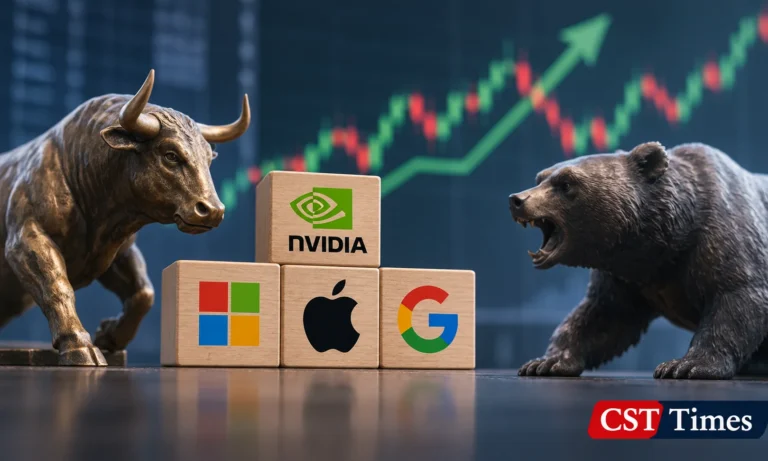
One key reason tech stocks dominate is scale. A company like Microsoft doesn’t just sell one product — it sells Windows, Office, Azure, LinkedIn, Xbox, and now AI tools through Copilot. Each of these is a massive business. And they all share the same foundation of software, which means adding more customers doesn’t cost nearly as much as adding more customers in, say, a factory or a retail chain.
This “scalability” — the ability to grow fast without matching costs — is what makes technology companies so profitable. When revenue doubles but costs only grow by 20%, profits explode. That’s exactly what we’ve seen with Nvidia, Alphabet, and others over the past two years.
The Magnificent Seven alone now make up about 35% of the S&P 500’s market value, so even investors in “diversified” index funds are heavily exposed to tech.That means even investors who hold “diversified” index funds are heavily exposed to tech. This isn’t a bug — it reflects where the economic value in America is actually being created.
Haseeb Jabbar Insight
Here’s something important that doesn’t get said enough: most of 2025’s tech performance came from actual earnings growth, not from investors just getting more excited and pushing prices up. According to BlackRock, earnings multiples for tech stocks actually contracted slightly, meaning valuations became more reasonable even as prices rose. That’s a healthy sign — it means the fundamentals are catching up with and even exceeding investor expectations. In our view, this is one of the strongest arguments for continued confidence in the sector.
05. What Are the Real Risks?
It would be dishonest The biggest new risk since July is interest rates. On September 16 the Fed raised its benchmark rate by a quarter point to 3.75%-4.00%, its first hike since 2023, and most officials expect one more before year-end. Higher rates tend to hit expensive growth stocks hardest. Rotation is also visible: energy has outperformed tech so far this year, and software and IT services stocks have fallen as investors worry about AI disruption. For a closer look, see our guide on the Fed rate hike and tech stocks.
There are also genuine concerns about concentration. When seven companies make up about 35% of the S&P 500’s market value (as of October 7, 2026), one bad quarter from Apple or Microsoft can drag the whole market down. U.S. Bank strategists have noted that AI is also creating disruption within tech itself — some software companies face real questions about whether AI will reduce the number of software licenses businesses need, which could squeeze their revenue.
New listings are also competing for investor money. SpaceX went public on June 12 at $135 a share, raising about $75 billion at roughly a $1.75 trillion valuation, reportedly the largest IPO ever. Anthropic has filed confidentially for an IPO, and OpenAI has done the same. Anthropic’s listing has been reported as shifting from October to November 2026, while OpenAI has reportedly said it will not list this year. None of these dates is officially confirmed.
6. The Bigger Picture: A Market Built on Real Demand
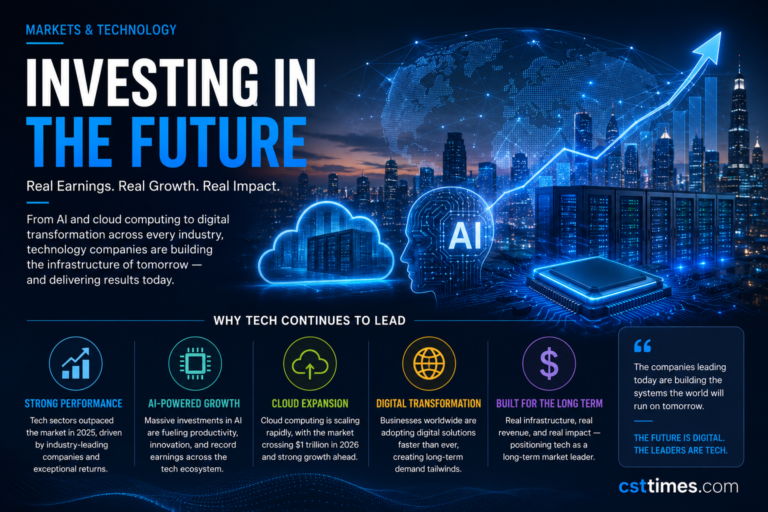
Step back and look at the world we’re living in. Businesses are moving their operations to the cloud. Hospitals are using AI to analyze medical scans. Banks are using machine learning to detect fraud. Logistics companies are using data analytics to cut costs. Every one of these activities requires the tools, chips, and infrastructure that tech companies provide.
This isn’t a trend that disappears when the market gets nervous. It’s a structural shift in how the global economy works. Companies that don’t adopt digital tools will be outcompeted by those that do. That creates a floor of demand for technology products that persists regardless of short-term market conditions.
Looking ahead, LSEG data points to S&P 500 earnings growth of about 31% in the third quarter, down from nearly 54% in the second quarter, with growth expected to ease to about 20% by early 2027. — with technology sectors expected to contribute significantly to that growth. At the same time, the market may broaden beyond the biggest names: small-cap and mid-cap technology companies are currently trading at a meaningful discount to their mega-cap peers, creating potential value opportunities for investors willing to look beyond the obvious names.
What to watch next
- Oct 14: US September CPI inflation report
- Oct 27-28: Federal Reserve meeting
- Late October: Big Tech Q3 earnings (check each company’s investor-relations page for dates)
- Late November: Nvidia’s next earnings report (date to be confirmed)
Haseeb Jabbar Insight
My take: tech’s lead looks backed by real earnings, not just hype. Nvidia’s revenue more than doubled year over year and cloud backlogs are in the hundreds of billions. But the setup is less comfortable than in July: the Fed is raising rates, Big Tech is spending heavily and the index is highly concentrated. Rather than chasing the biggest names, it makes sense to understand what you own and how much of your portfolio already sits in tech through index funds.
Disclaimer + Bottom Line
Tech stocks dominate markets because technology companies are growing faster, earning more profit, and touching more parts of the global economy than any other sector. AI and cloud computing are the twin engines driving this growth — and the numbers behind them are genuinely impressive, not just speculative. The sector carries real risks, and with the Fed raising rates and AI spending at record levels, concentration and valuation deserve attention.. But the underlying case for technology as the defining economic sector of our time remains as strong as ever.
This article is for educational purposes only and is not financial or investment advice. Do your own research or speak to a licensed adviser before investing.
Follow us on Social media for daily Updates:
About The Author

Haseeb Jabbar
Haseeb Jabbar writes about crypto, finance, technology, and AI at CST Times, sharing research-based guides, timely news, and free tools and calculators to help readers make informed decisions.

Pingback: 5 AI Stocks Under $10 to Buy in 2026 - High Growth List