
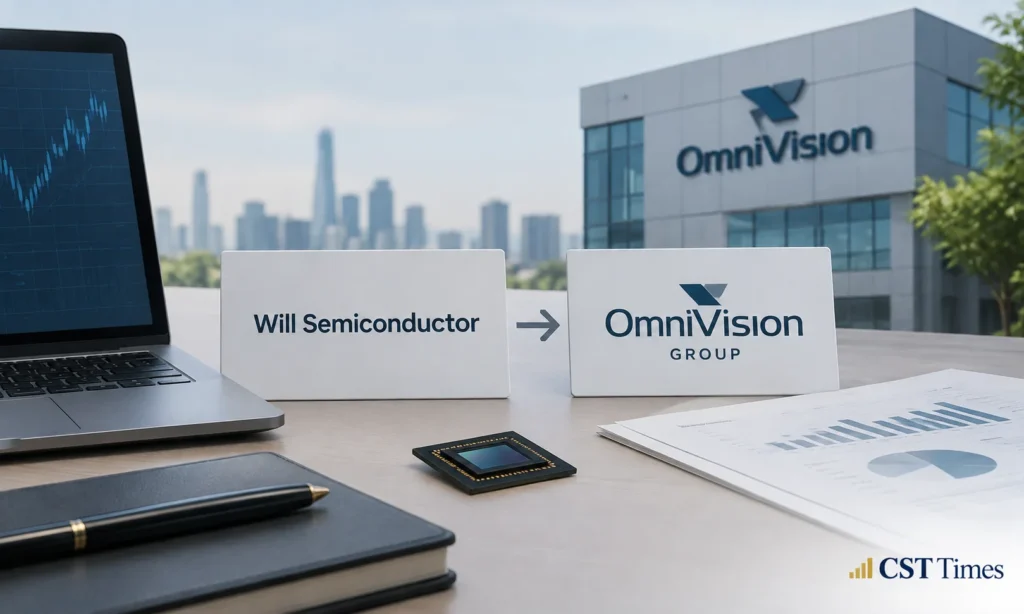
Will Semiconductor to OmniVision Group: What Changed and Why
Will Semiconductor to OmniVision Group:
Quick Summary:
Will Semiconductor is the former name of OmniVision Group, a Shanghai-based chipmaker that renamed itself OmniVision Integrated Circuits Group, Inc. in June 2025 to align its corporate identity with its best-known brand, OmniVision image sensors. The rebrand didn’t change the company’s ownership, stock listings, or debts — only its name and how it presents itself to customers and investors worldwide. This article explains why the change happened, what the company actually makes, and what its 2026 Hong Kong listing and latest earnings say about where it’s headed.
Table of Contents
ToggleKey Takeaways
- Will Semiconductor officially became OmniVision Integrated Circuits Group, Inc., trading as OmniVision Group, on June 20, 2025.
- The company kept its Shanghai Stock Exchange ticker (SSE: 603501) and added a Hong Kong listing (SEHK: 0501) in January 2026, raising roughly HK$4.8–5.3 billion (about $616 million).
- OmniVision Group is the world’s third-largest supplier of digital image sensors and the largest supplier of automotive image sensors by market share.
- The rebrand followed the company’s earlier acquisition of the original OmniVision Technologies, a pioneering U.S. image sensor maker.
- First-half 2026 revenue was roughly flat year-over-year, while net profit fell as a lower-margin distribution business grew faster than the core chip-design business.
OmniVision Group at a Glance
| Company Information | Details |
|---|---|
| Legal Name | OmniVision Integrated Circuits Group, Inc. |
| Former Name | Will Semiconductor Co., Ltd. (Shanghai) |
| Trade Name | OMNIVISION Group |
| Headquarters | Shanghai, China |
| Founded | 2007 |
| Stock Listings | SSE: 603501 (A-shares) · SEHK: 0501 (H-shares) · SIX: WILL (GDRs) |
| Core Business | Image sensors, analog and display ICs, semiconductor distribution |
| Key Subsidiary | OmniVision Technologies |
| FY2025 Revenue | RMB 28.855 billion |
What is "Will Semiconductor and OmniVision Group"?
People search this phrase because the same company shows up under three labels depending on the source: Will Semiconductor (the old name), OmniVision Technologies (a subsidiary brand many already knew from smartphone cameras), and OmniVision Group (the new corporate identity). All three point to one publicly traded company headquartered in Shanghai.
In plain terms: Will Semiconductor bought OmniVision Technologies years ago, and in 2025 it decided the OmniVision name carried more global recognition than its own — so it renamed the entire parent company after its subsidiary.
Why Will Semiconductor Became OmniVision Group
According to the company’s own filings, the rebrand was meant to strengthen brand recognition and better reflect where the business makes its money. By 2024, image sensor solutions made up close to three-quarters of revenue, while the “Will Semiconductor” name still carried associations with its older, smaller distribution business.
The OmniVision brand, by contrast, was already recognized internationally — engineers and buyers across the U.S., Europe, and Asia had known OmniVision Technologies for decades as a maker of camera sensors used in early iPhones, webcams, and medical scopes. Adopting that name company-wide let the parent trade on decades of existing brand equity instead of building new recognition from scratch.
The board approved the change in May 2025, and it took legal effect on June 20, 2025. Existing contracts, debts, and obligations carried over unchanged.
A Short History: From Santa Clara Startup to Chinese Chip Giant
The name change makes more sense with the full timeline:
- 1995 – OmniVision Technologies founded in Santa Clara, California; later goes public on Nasdaq.
- 2007 – Will Semiconductor founded in Shanghai as a semiconductor distributor.
- 2016 – A Chinese-backed consortium takes OmniVision Technologies private, delisting it from Nasdaq.
- 2017 – Will Semiconductor lists on the Shanghai Stock Exchange (603501), shifting from distribution toward chip design.
- 2018 – Will Semiconductor completes its acquisition of OmniVision Technologies, though the deal isn’t widely reported until 2019.
- 2023 – Will Semiconductor lists global depositary receipts on Switzerland’s SIX exchange, one of the largest offshore offerings by a China-based issuer at the time.
- June 2025 – Formally renamed OmniVision Integrated Circuits Group, Inc.
- January 2026 – Secondary listing of H-shares on the Hong Kong Stock Exchange (0501.HK).
What OmniVision Group Actually Makes
OmniVision Group designs chips rather than manufacturing them itself — it’s a “fabless” semiconductor company that outsources production to contract manufacturers. Its main product lines are:
- Image sensors – CMOS sensors for smartphone cameras, security cameras, automotive cameras, medical endoscopes, and machine-vision systems. Still the company’s largest revenue source.
- Analog and power ICs – Chips managing power delivery and signal conversion, increasingly aimed at automotive uses.
- Display solutions – Chips used in display driving and touch integration.
- Semiconductor distribution – A lower-margin legacy business reselling third-party components, which has grown quickly but weighs on profitability.
One recent example: in January 2026, OmniVision’s TheiaCel image sensors became available on Nvidia’s DRIVE Hyperion platform for autonomous and assisted-driving systems, underscoring the push deeper into automotive imaging.
Market Position: How Big Is OmniVision Group?
OmniVision Group is the world’s third-largest supplier of digital image sensors by revenue, holding roughly a 13.7% share of the global market in 2024. It also holds the top spot in automotive image sensors specifically — the fastest-growing part of the market as cars add more cameras for driver-assistance and autonomous-driving features — with close to a third of that segment.
Its main global rivals are Sony and Samsung, which dominate premium smartphone camera sensors. OmniVision has instead leaned into automotive, medical, security, and mid-range mobile segments, competing more on cost and specialized features than flagship-phone prestige.
Financial Performance: 2025 and H1 2026 Results
OmniVision Group’s recent results show a company growing in scale but under margin pressure. Full-year 2025 revenue came in at roughly RMB 28.9 billion, up about 12% from the prior year, with the fourth quarter showing particularly strong momentum in automotive and emerging-market demand.
That momentum cooled in early 2026. First-half 2026 revenue was about RMB 14.0 billion, essentially flat versus the same period in 2025, but net profit attributable to shareholders fell to roughly RMB 1.22 billion, down from about RMB 2.03 billion a year earlier. Gross margin slipped to 28.7% from 30.4%, largely because the distribution business — which carries much thinner margins — grew over 40% year-over-year while the core chip-design business actually shrank.
Not every segment weakened: analog solutions revenue rose about 17%, driven by a 66% jump in automotive analog chips, and display revenue grew nearly 13%. R&D spending also increased, reaching roughly 10.5% of first-half 2026 revenue, as the company kept investing in next-generation sensors despite the softer profit picture.
The Hong Kong Listing and Stock Snapshot
OmniVision Group’s H-shares began trading on the Hong Kong Stock Exchange on January 12, 2026, priced at the top of their marketed range at HK$104.80 per share. The stock jumped 16% on debut, closing at HK$121.80, while its Shanghai-listed shares edged higher the same day. The offering raised gross proceeds in the range of HK$4.8–5.3 billion (roughly $616 million), earmarked largely for R&D.
By late August 2026, the Hong Kong shares had pulled back into the mid-HK$70s, well below the January closing high — tracking the broader profit slowdown above rather than any single negative event. The Shanghai-listed A-shares (603501) continued to trade at a premium valuation, with analyst ratings skewed heavily toward “buy.” As with any single-stock forecast, those ratings are opinions, not guarantees.
What's Next for OmniVision Group
Management’s stated priorities for the rest of 2026 center on automotive and AI-related imaging, where demand should keep growing even as consumer electronics demand stays soft. The company continues investing in ultra-low-power, always-on sensors for facial recognition and gesture control, and higher-resolution stacked-sensor designs for flagship smartphones.
The bigger open question is margin recovery: whether OmniVision Group can grow its higher-margin design and analog business faster than its lower-margin distribution arm will likely decide whether profit growth resumes in the second half of 2026.
Final Thoughts:
The “Will Semiconductor OmniVision Group” search really points to one story: a Shanghai-based chipmaker outgrew its old name. Will Semiconductor built itself into a major image-sensor supplier largely by acquiring the original OmniVision Technologies, and by 2025 the OmniVision brand had become more valuable internationally than the name it was operating under. The rebrand, the 2026 Hong Kong listing, and the push into automotive imaging are all part of the same strategy: compete more directly with Sony and Samsung under a name customers and investors already recognize.
FAQs
Is Will Semiconductor the same company as OmniVision Group?
Yes. Will Semiconductor Co., Ltd. changed its legal name to OmniVision Integrated Circuits Group, Inc. on June 20, 2025 — same entity, same Shanghai ticker, same ownership.
What happened to the original OmniVision Technologies?
It was taken private in 2016 and later acquired by Will Semiconductor. It now operates as a subsidiary brand within OmniVision Group.
Is OmniVision Group a Chinese company?
Yes. It’s headquartered in Shanghai and listed primarily in Shanghai, though it also trades in Hong Kong and has depositary receipts in Switzerland.
What products does OmniVision Group make?
Mainly CMOS image sensors for smartphones, cars, security cameras, and medical devices, plus analog power chips, display driver chips, and a smaller distribution business.
Which stock ticker should I look for?
603501 on the Shanghai Stock Exchange, 0501 on the Hong Kong Stock Exchange, and WILL for its Swiss-listed depositary receipts.
Is OmniVision Group profitable?
Yes, but profit growth slowed in H1 2026 as the lower-margin distribution business grew faster than the core chip-design business.
Disclaimer
This article is for informational purposes only and isn’t investment advice. Figures change frequently; verify current data and consult a licensed financial advisor before investing.

Pingback: Why Did OpenAI Delay GPT-6 Astra? The Cybersecurity Risk Explained