
Crypto Mining vs Crypto Staking: Which One Actually Pays?
Crypto Mining vs Crypto Staking
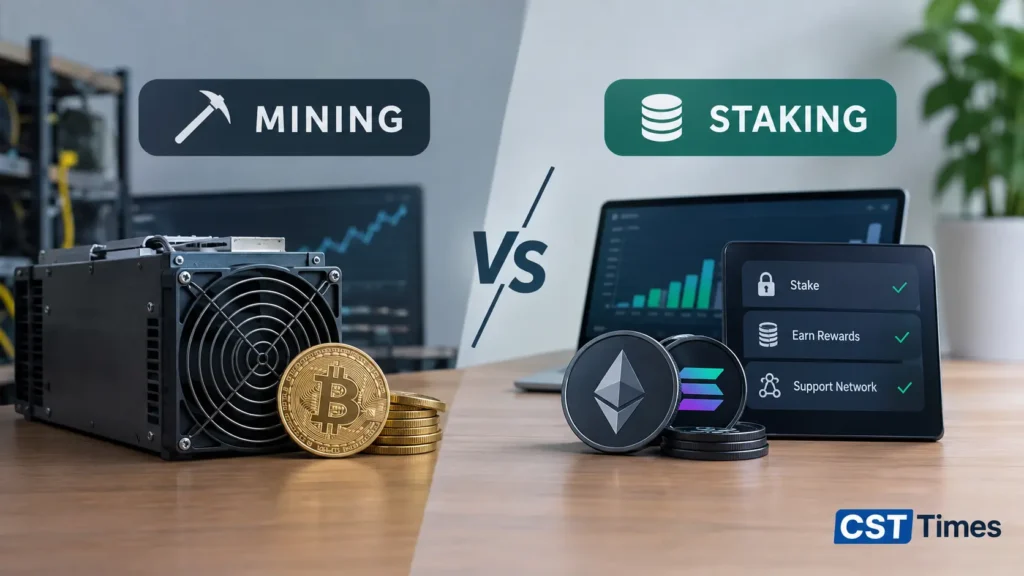
Crypto mining uses specialized hardware and electricity to secure proof-of-work blockchains like Bitcoin, earning new coins as rewards. Crypto staking locks up coins to validate transactions on proof-of-stake networks like Ethereum and Solana, with no mining hardware needed. As of October 2026, ETH staking pays roughly 2.6–2.8% APR, while mining profits depend heavily on electricity costs.
Last updated: October 11, 2026. Yields, hashrate and staking-queue data refreshed.
Table of Contents
ToggleCrypto Mining vs Crypto Staking
Crypto mining uses specialized hardware and electricity to secure proof-of-work blockchains like Bitcoin, earning new coins as rewards. Crypto staking locks up coins to validate transactions on proof-of-stake networks like Ethereum and Solana, with no mining hardware needed. As of October 2026, ETH staking pays roughly 2.6–2.8% APR, while mining profits depend heavily on electricity costs.
Last updated: October 11, 2026. Yields, hashrate and staking-queue data refreshed.
Key Takeaways
- Mining secures PoW blockchains using hardware and electricity; staking secures PoS blockchains by locking up coins as collateral.
- A competitive ASIC miner still costs several thousand dollars depending on model and seller, and profitability depends mostly on electricity: roughly $0.07/kWh is the ceiling for older machines, while the most efficient rigs can stretch somewhat higher.
- Ethereum’s native staking APR has compressed to roughly 2.6–2.8% in 2026 as more ETH joins the validator set, down from over 5% in 2023.
- Both mining and staking rewards count as ordinary income for US tax purposes the moment you receive them, with a separate capital-gains event when you sell.
- In early October 2026, Ethereum’s exit queue jumped to about 786,000 ETH (a wait of roughly two weeks) after MetaMask Staking’s validators exited as a precaution.
Mining vs Staking at a Glance
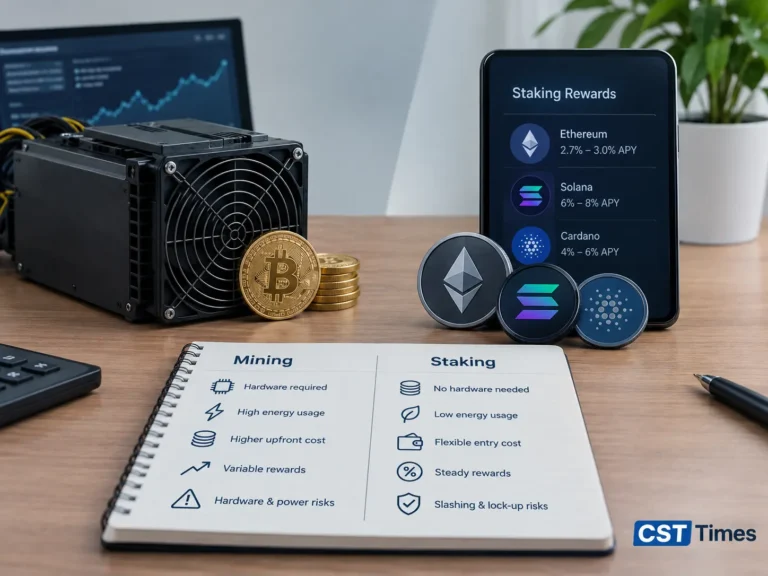
| Factor | Crypto Mining | Crypto Staking |
|---|---|---|
| Consensus model | Proof of Work (PoW) | Proof of Stake (PoS) |
| What you need | ASIC/GPU hardware + electricity | Coins to lock up |
| Typical entry cost (2026) | $4,700 for one ASIC | Any amount, via pools or exchanges |
| Energy use | High — Bitcoin alone draws an estimated 138 TWh/year | Minimal — a validator node runs on ordinary hardware |
| 2026 typical yield | Depends on BTC price, difficulty, and electricity cost (hashprice hit a record low in June 2026 before recovering) | Roughly 2.6–2.8% (ETH) to ~5–6% (SOL) |
| Main risk | Hardware depreciation, rising difficulty, power costs | Slashing, lock-ups, smart-contract risk |
| Can’t-stake / can’t-mine example | Bitcoin (PoW only) | Ethereum (PoS only, since 2022) |
What is Crypto Mining?
Mining is how proof-of-work blockchains like Bitcoin add new blocks and issue new coins. Miners run specialized hardware that repeatedly guesses a number until it finds one that satisfies the network’s current difficulty target. The first miner to find a valid answer gets to add the next block and collects the block reward plus transaction fees.
This process is deliberately expensive. Burning real electricity is what makes it costly to rewrite Bitcoin’s history, since an attacker would need to out-spend the entire honest network. Bitcoin’s network now runs at roughly 950 exahashes per second, meaning miners worldwide make close to a billion trillion guesses every second just to keep the network secure. That is still below the late-2025 peak of over one zettahash per second, with some operators also moving capacity toward AI work.
Modern Bitcoin mining runs almost entirely on ASICs (application-specific integrated circuits) built only to compute this one puzzle; GPUs are still used for some smaller PoW coins. Rewards shrink over time by design. Bitcoin’s block subsidy halves roughly every four years, and the April 2024 halving cut it from 6.25 BTC to 3.125 BTC per block, which squeezed margins across the entire mining industry.
What is Crypto Staking?
Staking is how proof-of-stake blockchains validate transactions without mining hardware. Instead of computing power, validators lock up (stake) coins as collateral and are chosen, roughly in proportion to their stake, to propose and confirm new blocks. Correct participation earns rewards drawn from new coin issuance and, on some networks, a share of transaction fees.
Ethereum is the clearest example of this shift. It ran as a PoW, mineable coin until “The Merge” in September 2022 moved it to PoS, a change Ethereum’s own developers say cut the network’s energy use by about 99.95%. Running a solo Ethereum validator requires 32 ETH, but most people stake through exchanges, staking pools, or liquid staking protocols like Lido or Rocket Pool, which accept far smaller amounts and issue a tradable token (such as stETH) representing the staked position. Since early 2026, US spot Ether ETFs have also started distributing staking rewards, giving investors staking exposure without running anything themselves. As of early October 2026, about 43.7 million ETH, roughly 36% of supply, is staked.
Crypto Mining vs Crypto Staking: Key Differences
1. Energy Consumption
| Crypto Mining | Crypto Staking |
|---|---|
| Mining is energy-intensive by design. In its 2025 industry report, the Cambridge Centre for Alternative Finance estimated Bitcoin’s annual electricity use at about 138 TWh, roughly 0.5% of global consumption, and found that 52.4% of the energy came from sustainable sources including renewables and nuclear. | Staking needs only enough power to run a validator node or laptop, which is why Ethereum’s move away from mining cut its energy use by about 99.95%. |
2. Startup Costs and Barriers to Entry
| Crypto Mining | Crypto Staking |
|---|---|
| Mining requires real capital before you earn anything. A mid-tier ASIC like the Antminer S21 (200 TH/s) typically costs several thousand dollars, while top-efficiency hydro-cooled units cost considerably more, and that’s before hosting, cooling, and electricity contracts. | Staking has a much lower floor: a solo Ethereum validator still needs 32 ETH, worth roughly $86,000 at early-October prices, but pooled and exchange staking let people start with whatever they already hold. |
3. Rewards and Profitability in 2026
| Crypto Mining | Crypto Staking |
|---|---|
| Mining profit depends on three moving parts: coin price, network difficulty, and your electricity rate, which miners often roll into one number called hashprice, the expected daily revenue per petahash of computing power. Electricity is the dominant cost, making up more than 80% of operating expenses in Cambridge’s 2025 survey, so the breakeven power price decides everything: roughly $0.07/kWh for the least efficient machines and over $0.11/kWh for the most efficient ones, based on mid-2026 hashprice levels. The squeeze was real this year: in Q2 2026, public miners as a group fell below breakeven and hashprice hit a record low in June, before Bitcoin’s Q3 recovery brought most of them back to breakeven. | Staking yields have compressed as more coins get locked up. Ethereum’s native staking APR sits at roughly 2.6–2.8% as of early October 2026, with MEV rewards adding another 0.5–1% for validators running MEV-Boost, down from above 4% in 2023 — a direct result of about 43.7 million ETH, roughly 36% of supply, now being staked. Other proof-of-stake coins post higher headline numbers: Solana staking pays a nominal reward of roughly 5.3–5.8%, but new SOL issuance runs at about 3.9% a year, leaving a real return closer to 1.4%. On August 28, 2026, Solana validators voted to double the network’s disinflation rate, which will pull issuance, and nominal yield, down faster toward the 1.5% long-term floor. Cardano offers a steadier 3–5% APY with no lock-up period at all. |
4. Risk Profile
| Crypto Mining | Crypto Staking |
|---|---|
| Mining risk centers on hardware and electricity. ASICs lose value as newer, more efficient models launch, network difficulty swings with hashrate (it is down nearly 12% since January 2026, but adjusts upward whenever more miners join), and a spike in your power bill can turn a profitable rig unprofitable overnight. Several countries, including China, Bangladesh, Egypt, Nepal, Qatar, Algeria, and Iraq, have banned mining outright, and some US states and Canadian provinces now restrict it over strain on the local power grid. | Staking risk centers on lock-ups, validator behavior and operational failures. On Ethereum, validators that sign conflicting messages, such as double-signing a block, can be “slashed,” losing part of their stake and being forced out, while simply going offline is not a slashable event and brings smaller penalties; some other networks do penalize extended downtime. Withdrawing staked funds isn’t always instant either. In early October 2026, Ethereum’s exit queue jumped to roughly 786,000 ETH, a wait of about two weeks, after MetaMask Staking’s validators were exited as a precaution following a security incident. Entering can take even longer: the entry queue sat near 1.5 million ETH (25+ days), and in May 2026 new stakers faced a wait of about 62 days. Liquid staking adds a further layer of smart-contract risk, since your coins sit inside a protocol you don’t fully control, and infrastructure failures can hit stakers too: on August 12, a routing failure at one provider shut down validators responsible for nearly 29% of staked SOL. |
5. Regulation and Taxes
| Crypto Mining | Crypto Staking |
|---|---|
| In the US, both mining and staking rewards count as ordinary income at their fair market value the moment you gain control over them, according to IRS guidance, including Revenue Ruling 2023-14 for staking. Selling those coins later triggers a separate capital-gains event. Running either activity at commercial scale can also shift your reporting from casual “other income” to Schedule C self-employment income. On the securities side, the SEC said in March 2025 that proof-of-work mining generally isn’t a securities activity, and the March 2026 joint SEC/CFTC interpretation went further, describing mining as an administrative activity rather than an investment contract. | Staking rewards are taxed the same way: as ordinary income once you gain control of them, per Revenue Ruling 2023-14, with a separate capital-gains event when you sell. On the securities side, a joint SEC/CFTC interpretation issued on March 17, 2026 treated major tokens such as Bitcoin, Ether and Solana as digital commodities and said protocol staking, including liquid staking, doesn’t involve the offer and sale of a security, as long as providers don’t use discretion, guarantee rewards or use deposits for other purposes. The SEC’s proposed “Regulation Crypto Assets” (announced August 18, 2026) is still only a proposal, with a 60-day comment period after Federal Register publication, so details could still change. For the CFTC side, see our guide to Regulation CTX and CAM. |
Which Coins Can You Mine vs Stake?
Bitcoin is proof-of-work only and can’t be staked natively under its current design. Ethereum is the reverse: since 2022 it’s proof-of-stake only and can no longer be mined. Many large newer networks, including Solana, Cardano, Avalanche, and Polkadot, launched as proof-of-stake from day one. Bitcoin remains the largest crypto asset by market value, at about $1.33 trillion in early October 2026 versus roughly $233 billion for Ethereum, but proof-of-stake’s share keeps growing as new projects choose staking over mining.
Which One Should You Choose?
There’s no universal winner; the right choice depends on what you already have and how you want to spend your time. Mining tends to suit people with access to genuinely cheap, stable electricity and the willingness to manage physical hardware, cooling, and maintenance, and margins are thin: public miners as a group fell below breakeven in Q2 2026. Staking tends to suit people who already hold a proof-of-stake coin and would rather earn a modest, passive yield (around 2.6–2.8% for ETH as of October 2026) than run equipment. Keep that yield in perspective, though: rewards are paid in the coin itself, and ETH is roughly $1,655 lower than a year ago, which outweighs a year of staking income.
Quick Checklist
- Do you have access to electricity at roughly $0.07/kWh or lower (lower still if you don’t run top-efficiency machines)?
- Are you comfortable managing hardware, cooling, and noise?
- Would you rather hold coins passively than run equipment?
- Can you accept a wait before you can sell? Ethereum’s exit queue was about two weeks in early October 2026.
- Do you already hold the specific coin you’d want to stake?
- Can you live with the coin’s price falling by more than the yield you earn?
Is Crypto Mining or Staking Halal for Muslims?
Short answer: scholars differ, and neither crypto mining nor staking is automatically halal or haram.
For Muslims, whether crypto mining or staking is halal depends on how the activity is structured and what the cryptocurrency represents. Crypto mining generally involves providing computing power to secure a proof-of-work network in exchange for rewards, while staking involves locking cryptocurrency to support a proof-of-stake network and earn rewards. Neither activity is automatically halal or haram in every situation; Muslims should consider whether the specific cryptocurrency and earning method comply with Islamic principles, avoid interest (riba), excessive uncertainty (gharar), and prohibited activities. Because Islamic scholars may differ on cryptocurrency and staking, Muslims should consult a qualified Islamic finance scholar before participating.
Final Thoughts:
Mining and staking solve the same problem, securing a blockchain, from opposite directions. Mining trades capital and electricity for a shot at network rewards; staking trades locked-up coins and patience for a steadier, usually smaller, yield. Neither is guaranteed to be profitable: this year showed that mining margins can vanish when prices fall and hashprice drops, while staking yields keep shrinking as more coins are locked up and as networks like Solana cut issuance. As of October 2026, staking is the lower-effort, more predictable option for people who already hold a proof-of-stake coin, and mining only makes sense with cheap power and efficient hardware. Whichever path you’re weighing, treat the numbers above as a starting point for your own research, not a promise of returns, since yields, queues and prices change daily.
FAQs
Can you mine and stake the same coin?
No. A blockchain uses one consensus method at a time. Bitcoin is mining-only, and Ethereum has been staking-only since 2022.
Do you need 32 ETH to stake Ethereum?
Only for a solo validator, which at early-October prices is worth roughly $86,000. Staking pools, liquid staking protocols, and exchange staking let you participate with far less.
Is staking safer than mining?
They carry different risks rather than one being universally safer — mining exposes you to hardware and power-cost risk, while staking exposes you to slashing, lock-up and staking-provider risk.
Is Bitcoin mining still profitable in 2026?
It can be, but margins are thin. Public miners as a group fell below breakeven in Q2 2026 and hashprice hit a record low in June; the Q3 price recovery brought most of them back to breakeven. Operations with electricity around $0.07/kWh or lower and efficient hardware are best placed, while higher power costs generally erase the margin.
Which is more profitable, crypto mining or crypto staking?
Neither is guaranteed. As of October 2026, ETH staking pays roughly 2.6–2.8% in the coin itself with no hardware costs, while mining profit depends on hashprice and your electricity rate. Staking is more predictable; mining can pay more only with cheap power and efficient machines.
How long does it take to unstake Ethereum right now?
It depends on the queue. In early October 2026 the exit queue was about 786,000 ETH, a wait of roughly two weeks, after MetaMask Staking’s validators exited as a precaution. For much of the summer it was close to zero. Check validatorqueue.com for the live number.
What is the current Ethereum staking APY?
As of early October 2026, Ethereum’s native staking APR is about 2.6–2.8%, with MEV rewards adding roughly 0.5–1% for validators running MEV-Boost.
Disclaimer
Figures in this article are as of early October 2026 and change daily.
This article is for educational purposes only and isn’t financial advice. Cryptocurrency mining and staking both carry real financial risk, rewards are not guaranteed, and past performance doesn’t predict future results. Consult a licensed financial or tax professional before making investment decisions.
