
What is a Crypto Wallet? A Beginner’s Guide to Storing Digital Assets
What is a Crypto Wallet? A Beginner's Guide
Quick Summary:
If you’re buying your first Bitcoin or Ethereum, “get a wallet” is usually the first piece of advice you’ll hear. But a crypto wallet doesn’t work the way the leather one in your pocket does, and misunderstanding that difference is how people end up losing money.
Table of Contents
ToggleYour crypto never actually sits “inside” an app or a device. It lives on the blockchain, as an entry in a public ledger. A wallet manages and protects the private keys used to control assets on the blockchain and authorize transactions. This guide explains what a crypto wallet actually does, how it works, the main types available, and how to set one up and keep it secure.
Key Takeaways
- A crypto wallet stores private keys, not coins — the coins themselves stay recorded on the blockchain.
- Wallets split into two main categories by connectivity: hot (connected to the internet) and cold (kept offline).
- They also split by control: custodial (a company holds your keys) and non-custodial/self-custody (you hold your own keys).
- “Not your keys, not your crypto” is the industry’s core security principle. Whoever controls the private key controls the funds.
- Attacks on individual holders are rising even as some hack totals fall: Chainalysis recorded roughly 158,000 personal wallet-compromise incidents in 2025.
- Rules like the FATF Travel Rule are increasingly affecting transfers between exchanges and self-custody wallets, particularly in the EU and the UK.
- No wallet type is risk-free. The right choice depends on how much crypto you hold and how often you need to access it.
Table of Contents
- What a Crypto Wallet Actually Does
- How a Crypto Wallet Works: Keys, Not Coins
- Types of Crypto Wallets
- Crypto Wallets vs. Exchange Accounts
- Why Wallet Security Matters
- How to Set Up and Secure a Wallet
- Regulation and Self-Custody
- Common Mistakes to Avoid
- Quick Checklist
- Final Thoughts
Summary Table
| Wallet Type | Connected to the Internet? | Who Holds the Keys? | Best For |
|---|---|---|---|
| Hardware wallet | No (cold) | You | Long-term holdings, larger amounts |
| Software / mobile app wallet | Yes (hot) | You | Everyday transactions, smaller balances |
| Browser-extension wallet | Yes (hot) | You | Connecting to dApps and DeFi platforms |
| Exchange / custodial wallet | Yes (hot) | The exchange | Beginners, active trading |
| Paper wallet | No (cold) | You | Largely legacy; high risk of user error |
What a Crypto Wallet Actually Does
The word “wallet” is a bit of a misnomer. A physical wallet holds cash directly. A crypto wallet doesn’t hold your Bitcoin or Ethereum at all — those assets exist only as entries on their respective blockchains, and they never leave that ledger.
What a wallet actually stores is a private key: a piece of cryptographic data that proves ownership of a specific blockchain address and authorizes you to spend whatever is recorded there. In that sense, a wallet functions less like a purse and more like a key manager or a signing device for the blockchain.
When you set up a wallet, it generates a key pair using established cryptographic methods. From that key pair comes your wallet address — the long string of letters and numbers you share to receive funds, similar in function to an account number. The private key stays hidden and is never meant to be shared with anyone.
How a Crypto Wallet Works
Every crypto wallet relies on a pair of mathematically linked keys:
- Public key / wallet address — safe to share. This is what you give someone so they can send you crypto.
- Private key — must stay secret. This is what authorizes an outgoing transaction. Whoever holds it controls the funds.
When you send crypto, your wallet uses the private key to create a digital signature for that transaction. The network verifies the signature against your public key without ever exposing the private key itself. If the signature checks out, the transaction is confirmed and recorded on the blockchain.
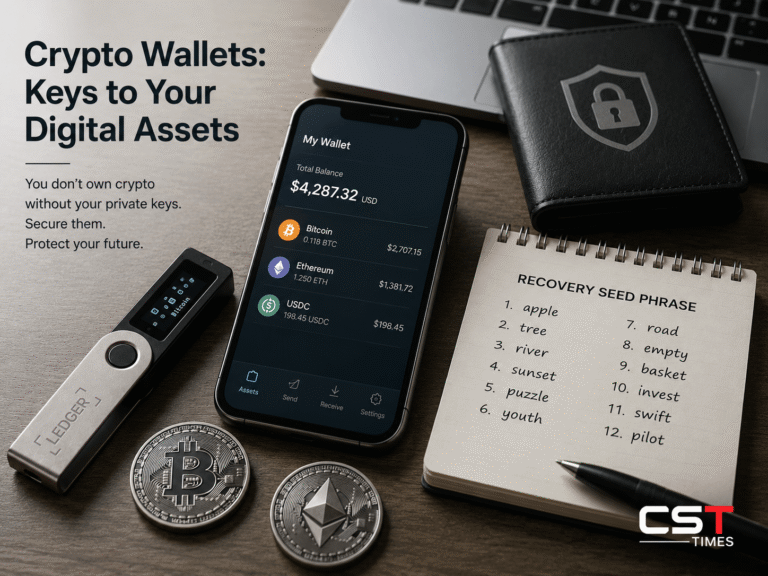
Most modern wallets don’t ask you to manage a raw private key day to day. Instead, they generate a seed phrase (also called a recovery phrase) — typically 12 or 24 plain-English words — the first time you set up the wallet. That phrase can regenerate every private key the wallet controls. It is, in practical terms, the master password to your funds. Anyone who obtains it can drain the wallet from anywhere in the world, and if you lose it with no backup, there is no “forgot password” option: the funds are typically unrecoverable.
Types of Crypto Wallets
Hot Wallets vs. Cold Wallets
Hot wallets stay connected to the internet — a mobile app, a browser extension, or an account on an exchange. They’re convenient for frequent transactions, trading, and interacting with decentralized apps, but the constant connectivity gives attackers more potential ways in.
Cold wallets keep private keys offline entirely, most commonly on a dedicated hardware device or, historically, printed on paper. They’re slower to use for day-to-day transactions but far harder to compromise remotely, which is why they’re generally recommended for larger, longer-term holdings.
Custodial vs. Non-Custodial (Self-Custody) Wallets
This is a separate axis from hot/cold, and it’s arguably the more important distinction for beginners.
- Custodial wallets, such as the wallet built into a crypto exchange, mean a company holds your private keys on your behalf. If you forget your password, customer support can often help you recover access — much like a bank. The trade-off is that you’re trusting that company’s security and solvency.
- Non-custodial (self-custody) wallets mean you generate and control your own private keys. Nobody can freeze or restore access on your behalf. This is the arrangement crypto’s “not your keys, not your crypto” principle refers to: real ownership, but full personal responsibility for security.
Common Wallet Form Factors
Within the hot/cold and custodial/non-custodial categories, wallets show up in several physical forms:
- Mobile and desktop apps — software wallets like Trust Wallet, Exodus, or Crypto.com’s Onchain wallet, installed on a phone or computer.
- Browser extensions — wallets like MetaMask that live in Chrome or Firefox and connect directly to decentralized apps and DeFi platforms.
- Hardware devices — small offline devices, most notably from Ledger and Trezor, that store keys on a secure chip and require physical confirmation to approve a transaction.
- Paper wallets — private keys printed or written down. They remove online exposure entirely but are fragile, easy to lose, and largely considered outdated compared to hardware wallets.
- Exchange-hosted wallets — the default custodial wallet you get when you sign up for a platform like Coinbase or Binance.
Smart Contract and Account-Abstraction Wallets
One of the more notable developments in the wallet space is the growth of smart contract wallets, which are governed by code on the blockchain rather than a single private key. These can support features that traditional wallets can’t, such as multi-signature approval (requiring more than one key to authorize a transaction), spending limits, and social recovery, where trusted contacts can help restore access without a seed phrase. They’re becoming more common in decentralized finance (DeFi), though they add technical complexity and aren’t yet as widely used as traditional key-based wallets.
Crypto Wallets vs. Exchange Accounts
It’s easy to conflate the two, but they’re not the same thing. A crypto exchange, such as Coinbase, Binance, or Kraken, is primarily a place to buy, sell, and trade — it holds your assets in custodial wallets it manages, similar to how a brokerage holds shares on your behalf.
A standalone, non-custodial wallet is for holding and using crypto independently of any exchange. It gives you direct control but also full responsibility: no password reset, no fraud department to call if something goes wrong.
Many crypto users end up using both: an exchange account for buying, selling, and active trading, and a separate self-custody wallet — often a hardware device — for holding larger amounts long-term.
Why Wallet Security Matters
Wallet security isn’t a theoretical concern. According to Chainalysis’s 2026 Crypto Crime Report, cryptocurrency theft from services and personal wallets totaled roughly $3.4 billion in 2025, with a small number of very large breaches accounting for most of the value stolen. Other firms that track crypto crime independently, including CertiK, SlowMist, and PeckShield, put the 2025 total in a broadly similar range, generally between $2.9 billion and $4 billion, depending on what each firm counts.
What stands out for everyday users is the shift toward individual targets. Chainalysis reported around 158,000 personal wallet-compromise incidents in 2025, affecting roughly 80,000 unique victims — and noted that personal wallet compromises have grown from a small share of total stolen value in 2022 to a much larger share by 2024. Interestingly, the total dollar value stolen from individuals in 2025 actually declined compared with the prior year, which researchers attribute to attackers targeting a larger number of victims for smaller amounts each, rather than a handful of large scores.
Large, state-linked actors remain part of the picture too: Chainalysis attributes over $2 billion of 2025’s stolen funds to North Korea-linked hacking groups, which the firm says have stolen more than $6.7 billion in cryptocurrency since 2017.
The practical takeaway isn’t that crypto is inherently unsafe to hold — most blockchain activity is legitimate. It’s that the type of wallet you choose, and how carefully you secure it, has a direct and measurable effect on your personal risk.
How to Set Up and Secure a Crypto Wallet
- Decide how much you need to protect. Small, active-use amounts are reasonable to keep in a hot wallet. Larger or long-term holdings are generally better suited to a hardware wallet.
- Download software only from official sources. Fake wallet apps and browser extensions that mimic legitimate ones are a common scam vector. Install apps only from the official website or verified app store listing.
- Write down your seed phrase offline. Store it on paper or a metal backup plate, never as a screenshot, cloud note, email, or password manager entry. Anyone who finds it can access your funds.
- Never share your seed phrase or private key with anyone. No legitimate exchange, wallet provider, or support agent will ever ask for it.
- Enable additional protections where available, such as a PIN on a hardware device, biometric app locks, and transaction confirmations.
- Verify addresses carefully before sending. Malware that silently swaps a copied wallet address for an attacker’s address is a known threat — double-check the full address, not just the first and last few characters.
- Consider a hardware wallet once your holdings grow. It keeps your private key offline even if your computer or phone is compromised.
Regulation and Self-Custody
Crypto wallets themselves aren’t illegal or unusual to use, but the rules around moving funds between exchanges and self-custody wallets have tightened. The FATF Travel Rule, an anti-money-laundering standard from the Financial Action Task Force, requires regulated crypto businesses (exchanges and other virtual asset service providers) to collect and share sender and recipient information for qualifying transfers.
Because a self-custody wallet has no company behind it to exchange that information, regulators have added extra verification steps instead. In the European Union, transfers above €1,000 to or from a self-hosted wallet generally require the exchange to confirm you actually control that wallet, often through a small test transaction or a signed message. The United Kingdom applies a similar requirement above £1,000. Thresholds, exact methods, and enforcement vary by country and continue to evolve, so it’s worth checking your exchange’s current policy rather than assuming a fixed global rule.
Peer-to-peer transfers directly between two self-custody wallets, with no exchange or service provider involved, generally fall outside the Travel Rule’s scope, since there’s no regulated intermediary to apply it to.
Common Mistakes to Avoid
- Treating an exchange account as a long-term wallet. It’s convenient, but you don’t control the keys.
- Storing a seed phrase digitally — in a photo, note app, or cloud drive — where it can be found in a data breach.
- Reusing the same wallet for everything, mixing small everyday spending with significant savings.
- Approving wallet connections or transactions without reading what they authorize, especially in DeFi apps.
- Ignoring software updates for wallet apps and hardware firmware, which often contain security fixes.
- Buying a used or “discounted” hardware wallet from an unofficial reseller, which can be pre-tampered with.
Quick Checklist
- ✔ I understand a wallet stores keys, not coins
- ✔ I know the difference between hot and cold storage
- ✔ I know the difference between custodial and self-custody
- ✔ My seed phrase is written down offline, not stored digitally
- ✔ I’ve downloaded wallet software only from official sources
- ✔ I’ve matched my wallet type to how much crypto I actually hold
Final Thoughts:
A crypto wallet is simpler than it sounds once you separate it from the idea of a physical purse: it’s a key manager, not a vault of coins. The coins stay on the blockchain; the wallet just proves they’re yours and lets you move them.
For most beginners, that means starting with a reputable app or exchange wallet for small amounts, then moving toward a hardware wallet as holdings grow. The specific brand or app matters less than the habits around it — protecting the seed phrase, verifying software sources, and matching the wallet type to how the crypto will actually be used.
At CST Times, we see a crypto wallet as a key manager, not a place where coins are physically stored. Beginners can start with a reputable app or exchange wallet for small amounts, but as holdings grow, a hardware wallet can offer stronger protection. The most important step is building safe habits: protect your seed phrase, use trusted software, and choose a wallet that fits your needs.
FAQs
Can I lose my crypto if I lose my wallet device or delete the app?
Not necessarily. If you have your seed phrase backed up, you can restore access on a new device. If you lose both the device and the seed phrase, the funds are generally unrecoverable.
Is a crypto wallet the same as a bank account?
No. A bank account is custodial by default and typically insured, with recovery options if you lose access. A self-custody crypto wallet has no central authority to reverse transactions or reset access.
Do I need a separate wallet if I only trade on an exchange?
Not strictly, but many users move at least part of their holdings to a self-custody wallet for anything they intend to hold long term, since exchange accounts are custodial.
What happens if I forget my seed phrase and lose my device?
In most cases, the funds cannot be recovered. There is no central password-reset process for a self-custody wallet, which is why secure, offline backup of the seed phrase is critical.
Are crypto wallets legal to use?
Yes, in the vast majority of jurisdictions, owning and using a crypto wallet is legal. Some countries restrict or heavily regulate cryptocurrency use more broadly, so it’s worth checking local rules where you live.
Disclaimer
This article is for general educational purposes only and does not constitute financial, investment, or legal advice. Cryptocurrency markets and self-custody carry real risks, including the potential for total and irreversible loss of funds. CST Times does not endorse any specific wallet provider, exchange, or product mentioned here. Always do independent research and consider consulting a qualified financial or legal professional before making decisions involving cryptocurrency.
Follow us on Social media :
About The Author

Haseeb Jabbar
Haseeb Jabbar writes about crypto, finance, technology, and AI at CST Times, sharing research-based guides, timely news, and free tools and calculators to help readers make informed decisions.
