
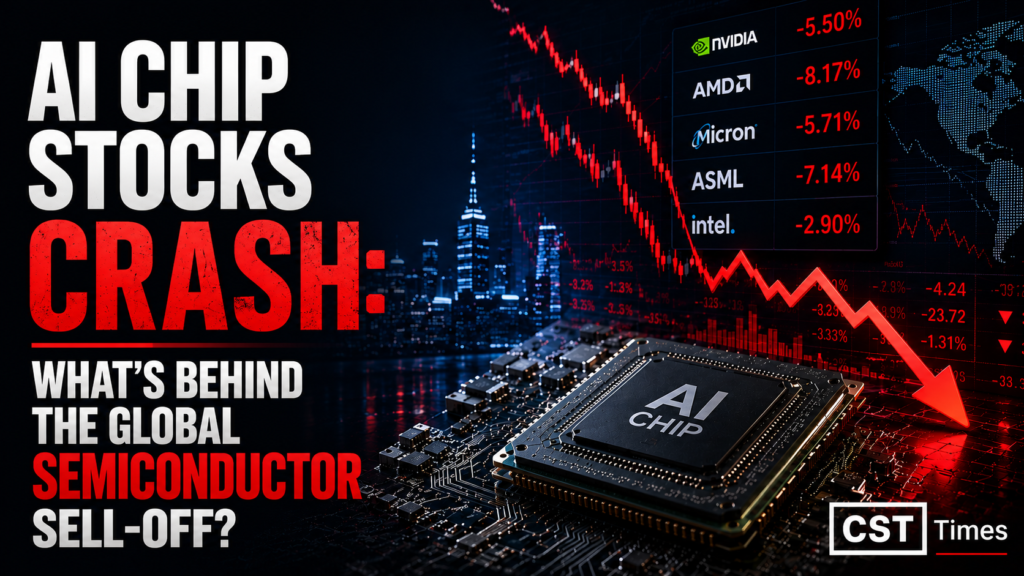
AI Chip Stocks Crash: What’s Behind the Global Semiconductor Sell-Off?
Quick Summary:
Billions of dollars have been wiped off chip stocks in just a few weeks. Nvidia, AMD, Micron, Intel, and ASML have all tumbled — even after some of these companies posted record profits. This guide explains, in plain English, exactly why AI chip stocks are crashing right now and what could happen next.
Table of Contents
ToggleThe AI chip stocks crash has turned the biggest stock market winners of the last two years into the biggest losers of the last two months.
⚡ Key Takeaways
- AI chip stocks have been falling sharply since early July 2026, after a massive year-long rally that some analysts say had gone too far, too fast.
- The sell-off is being driven by several factors converging: Meta’s new cloud computing plans, weak spots in Samsung’s earnings, a slowdown in high-end memory chip production, and a Chinese chip-tool breakthrough.
- A separate worry — the U.S. Federal Reserve’s interest rate decision on July 29, 2026 — is adding extra pressure on tech stocks this week.
- Most experts see this as a sharp correction after an unusually strong rally, not proof that the AI boom itself is over.
What Is Happening to AI Chip Stocks Right Now?
Since early July 2026, semiconductor stocks around the world have been sliding, session after session. The Philadelphia Semiconductor Index (SOX) is now on its third straight losing session as of July 27, after climbing roughly 130% over the previous twelve months. That kind of drop, following that kind of rally, has caught a lot of investors off guard.
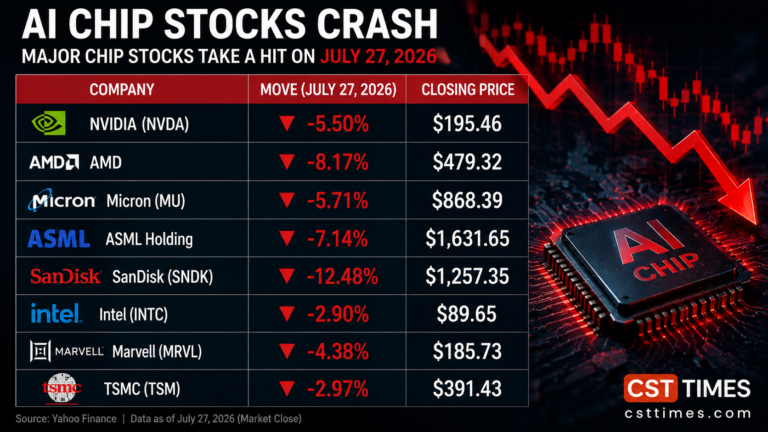
Here’s a snapshot of how major chip stocks closed on July 27, 2026, based on Yahoo Finance market data:
| Company | Move (July 27, 2026) | Closing Price |
|---|---|---|
| Nvidia (NVDA) | −5.50% | $195.46 |
| AMD | −8.17% | $479.32 |
| Micron (MU) | −5.71% | $868.39 |
| ASML Holding | −7.14% | $1,631.65 |
| SanDisk (SNDK) | −12.48% | $1,257.35 |
| Intel (INTC) | −2.90% | $89.65 |
| Marvell (MRVL) | −4.38% | $185.73 |
| TSMC (TSM) | −2.97% | $391.43 |
The pain isn’t limited to the United States. South Korea’s KOSPI index briefly triggered circuit breakers in early July as Samsung Electronics and SK Hynix both slid sharply, and reports on the morning of July 28 pointed to the sell-off deepening further in pre-market trading, with Nvidia, Micron, AMD, and Intel all under pressure again.
Why Are AI Chip Stocks Crashing? The Main Reasons
This isn’t a single-cause story. Several separate issues hit the semiconductor sector within the same few weeks, and together they turned a strong rally into a sharp sell-off.
1. Meta’s Surprise “Meta Compute” Announcement
On July 1, 2026, reports surfaced that Meta Platforms is planning to launch Meta Compute — a new cloud business built to sell its spare AI computing power, along with access to its Llama AI models, to other companies.
Here’s why that spooked chip investors: if large tech companies start renting out their own extra computing capacity instead of only using it themselves, the market may need fewer new chips over time. Meta’s own stock jumped on the news, but AI hardware suppliers and smaller cloud-computing players like CoreWeave and Nebius fell hard, since Meta Compute would compete directly with them for enterprise customers.
2. Samsung’s “Good News, Bad Reaction” Earnings
Samsung Electronics reported preliminary second-quarter operating profit of roughly 89.4 trillion Korean won — close to a 19-fold jump from a year earlier. Under normal conditions, that kind of number would send a stock soaring. Instead, Samsung shares fell around 7%, and South Korea’s benchmark index briefly hit circuit-breaker territory.
There are two simple reasons for this disconnect:
- Samsung’s revenue came in slightly below what analysts had expected, even though profit beat forecasts.
- Reports emerged around the same time that SK Hynix — a major memory chip supplier — might slow down its expansion of High Bandwidth Memory (HBM) production.
This is a good example of a stock being “priced for perfection.” When expectations are already sky-high, even genuinely strong results can trigger selling if they’re not overwhelmingly good.
3. A Possible Slowdown in HBM Memory Production
High Bandwidth Memory, or HBM, is a special, high-performance type of memory chip used inside Nvidia’s most advanced AI processors. It’s one of the more profitable products in the memory business right now.
Reports suggested SK Hynix may shift some manufacturing capacity away from HBM and toward standard DDR5 memory chips instead. For investors, this raised a simple worry: if HBM supply growth slows down, it could eventually become a bottleneck for the entire AI chip supply chain — from Nvidia’s GPUs to the data centers that run them.
4. China’s Chipmaking Breakthrough
The most recent shock came on July 27, 2026. Reports from The Information and Reuters said a state-backed Chinese company has begun mass-producing its own deep ultraviolet (DUV) lithography machines — the specialized equipment used to print microscopic circuits onto silicon wafers. This technology category has been dominated for years almost entirely by the Dutch company ASML.
The machines are reportedly expected to reach major Chinese chipmakers, including SMIC, Hua Hong Semiconductor, and ChangXin Memory Technologies, before the end of the year.
The market reaction was immediate and sharp:
- ASML dropped more than 7%, its worst single day in weeks.
- Chip equipment makers Applied Materials, Lam Research, and KLA Corp all fell alongside it.
- Nvidia, AMD, and Micron sold off too, as the news added to an already nervous market.
Important context: Several industry analysts have urged caution before assuming this changes everything overnight. The Chinese firm reportedly plans to build only around 5 machines this year and 20 in 2027 — compared with ASML’s planned output of roughly 130 machines in 2026 alone. More importantly, DUV is older technology. It cannot produce the cutting-edge chips that power the most advanced AI models; that still requires ASML’s EUV (extreme ultraviolet) machines, which China has not been able to replicate at scale. One equity analyst told CNBC the development should be taken with a healthy dose of skepticism, since it may be limited to lower-end chip production for now.
5. Growing Fears Over a Federal Reserve Rate Hike
Interest rates and high-growth tech stocks have a well-known relationship: when borrowing costs rise, investors typically pay less for shares of companies whose biggest profits are expected years down the road — and that includes most AI chip companies.
The Fed has held its benchmark rate steady at 3.50%–3.75% for four consecutive meetings, most recently on June 17, 2026, under new Fed Chair Kevin Warsh. But heading into the Fed’s next decision on July 29, 2026, inflation concerns — partly tied to rising oil prices amid Middle East tensions — have revived talk of a possible rate hike either this week or later in the year. Some major banks are now forecasting multiple rate increases before December. That uncertainty is landing at the worst possible time for a chip sector that’s already on edge.
6. Doubts About Whether Massive AI Spending Is Paying Off
Big technology companies have poured hundreds of billions of dollars into building AI data centers over the past two years. Investors are now starting to ask a very direct question: is all that spending actually generating returns yet?
TSMC — the world’s largest contract chipmaker — is a good example. It beat Wall Street’s profit and revenue expectations in its most recent earnings report, yet its shares still fell in the days that followed, because the company also announced plans to spend even more on new factories than analysts had expected. Strong earnings plus bigger-than-expected spending plans is starting to make some investors nervous rather than excited.
Timeline: How the Sell-Off Unfolded (July 2026)
Is This the End of the AI Boom, or Just a Correction?
Opinions on Wall Street are genuinely split, and it’s worth hearing both sides rather than picking one.
Some analysts view this as healthy, overdue profit-taking after an extraordinary run — a 130% rally in twelve months is rare, and pullbacks after moves like that aren’t unusual. Bank of America, for instance, has continued recommending Nvidia shares, calling the company’s growth franchise durable. Other prominent investors, however, warn that markets could fall much further if any major tech company announces a real cut to its AI spending plans, since so much of the rally has been built on the assumption that spending keeps climbing.
On the China question specifically, most semiconductor analysts agree the near-term threat is limited. Producing basic DUV tools is a meaningfully different challenge than producing the advanced EUV machines needed for frontier AI chips — a gap that has taken ASML roughly two decades of research to build. That said, it’s a reminder that the long-term competitive landscape in chipmaking equipment is shifting, even if slowly.
The honest answer is that nobody knows for certain yet whether this is a temporary correction or the start of something bigger. It will likely depend on upcoming earnings from major AI spenders, the Fed’s rate path, and whether AI applications start generating clearer revenue for the companies buying all this hardware.
What This Means for Everyday Investors
A few general points worth keeping in mind — this is educational information, not personal investment advice:
- Sharp swings are normal after long rallies. Fast-growing sectors that go up quickly often come down quickly too, even without major bad news.
- Diversification matters. Being heavily concentrated in one sector or one country’s stock market increases your exposure to news like a single earnings miss or a single geopolitical headline.
- Watch the calendar. Events like Fed meetings, major earnings releases, and economic data (such as the PCE inflation report due July 30) tend to trigger the biggest single-day moves.
- Headlines move fast, fundamentals move slowly. A single report — like the China lithography news — can swing prices in hours, even when its real-world business impact will take years to play out.
What to Watch Next
- July 29, 2026: Federal Reserve interest rate decision and press conference.
- Same week: Earnings from Apple, Microsoft, Meta, and Amazon — all major AI infrastructure spenders.
- July 30, 2026: U.S. PCE inflation data, one of the Fed’s preferred inflation gauges.
- Ongoing: Further details on China’s domestic lithography progress and how quickly (or slowly) it scales.
This article is for general information only and is not financial advice. Stock markets can be unpredictable, and anyone considering buying or selling should do their own research or speak with a licensed financial advisor.
Frequently Asked Questions:
1. What caused the AI chip stock crash in 2026?
It wasn’t one single cause. A historic rally had pushed valuations very high, and then several worries hit at once: news that China had started mass-producing its own advanced chipmaking machines, growing concern over circular AI financing deals tied to Nvidia, and a more hawkish Federal Reserve under new Chair Kevin Warsh.
2. Is the AI boom over?
Most analysts don’t think so. Revenue and profit growth at major chipmakers remain very strong, and companies have locked in multi-year customer agreements. Many describe this as a valuation correction after an unsustainable rally, not the end of AI-related demand.
3. Which chip stocks fell the most?
Intel, Micron, Samsung, and SK Hynix saw some of the sharpest declines, with drops of 13% or more in single trading sessions at various points. Nvidia and AMD also fell, generally by smaller percentages than the memory-focused chipmakers.
4. What is “circular AI financing”?
It refers to arrangements where a chip supplier like Nvidia provides money, credit lines, or debt guarantees to AI companies, who then use that funding to buy chips from the same supplier. Critics argue this can make demand look stronger than it really is.
5. Will interest rates go up in 2026?
It’s uncertain. After Fed Chair Kevin Warsh’s first meeting in June 2026, nine of eighteen Fed officials projected at least one rate hike this year, a sharp change from earlier expectations. The Fed hasn’t raised rates yet, and its next move will depend on incoming inflation and jobs data.
6. Is this similar to the dot-com bubble of 2000?
There are some similarities, like high valuations concentrated in a few large stocks, which is why some analysts have drawn the comparison. However, today’s leading AI chip companies report substantial real revenue and profit, unlike many dot-com-era companies that had little to no earnings.
7. Should I sell my semiconductor stocks?
That depends on your own financial goals, risk tolerance, and timeline, and this article can’t tell you what to do with your money. It’s best to review your own situation or speak with a licensed financial advisor before making any decisions.
Conclusion :
The CST Times Take: This sell-off looks less like the AI story falling apart, and more like the market finally asking the hard questions it skipped during the rally. China’s chip progress, Nvidia’s financing web, and a tougher Fed are all genuine issues — but they’re also the kind of pressure-test most big, fast-growing industries eventually face. Whether this settles into a short-term wobble or something longer will likely become clearer once Nvidia and the rest of the sector report their next round of earnings
Sources referenced:
- Bloomberg — Nasdaq 100 Nears a Correction as Semiconductor Selloff Extends (Jul 28, 2026)
- Bloomberg — Japanese, Korean Stocks Tumble as Chip Selloff Intensifies (Jul 28, 2026)
- CNBC — China’s reported chip breakthrough comes with some big caveats (Jul 28, 2026)
- Reuters via US News — China Begins Making Homegrown DUV Chipmaking Tools (Jul 27, 2026)
- Forbes — Intel Stock Down 21%: Inside the July 2026 Semiconductor Selloff
- Bloomberg — Chip Stock Rout Deepens as TSMC Selloff Drives Taiwan Correction (Jul 17, 2026)
Follow us on Social media :
About The Author

Haseeb Jabbar
Haseeb Jabbar writes about crypto, finance, technology, and AI at CST Times, sharing research-based guides, timely news, and free tools and calculators to help readers make informed decisions.
