How to Verify a Crypto Wallet Address Before You Send
Quick Summary:
To verify a crypto wallet address, copy it from the recipient’s own Receive or Deposit screen, confirm that both sides use the same network, compare the full address character by character, and send a small test first if the amount is large or the address is new. A confirmed blockchain transfer generally cannot be undone, so these checks matter more than any fix afterwards.
An address can fail in three ways: it can be misspelled, it can be on the wrong network, or it can belong to the wrong person. A format check catches only the first. This guide covers all three, including address poisoning, a scam that targets the habit of copying addresses from your transaction history. Figures are as of 20 November 2026.
Table of Contents
ToggleKey Takeaways
- A valid-looking address is not proof that it belongs to the right person or network.
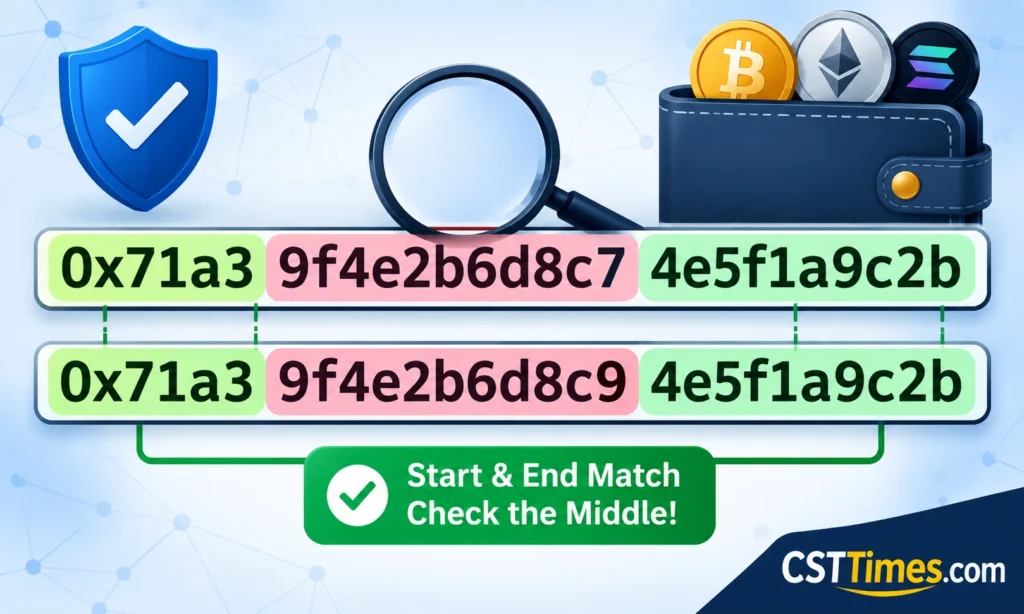
- Compare the whole address. Address poisoning is designed to match the first and last characters.
- Do not copy an address from your transaction history, including your own.
- A small test transaction helps, but it does not protect the next address you copy.
- No wallet warning catches everything, so treat warnings as a backup to your own checks.
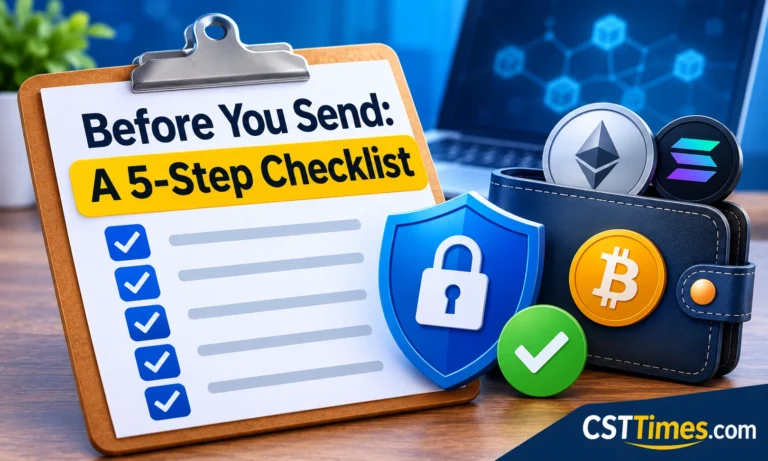
Before You Send: A 5-Step Checklist
1. Get the address from a source you trust
Copy it from the receiving wallet’s Receive screen or the exchange’s deposit page while you are logged in to the official app or site. Avoid addresses from your transaction history, a screenshot, or a message you cannot confirm.
If you are paying a person, confirm the address through a second channel. KoinX suggests verifying the recipient by a reliable method, such as a phone call, and asking which network and token standard their wallet supports.
2. Match the network and token
Most addresses do not show which network they belong to. The same 0x format works across EVM networks such as Ethereum, BNB Smart Chain and Polygon, so the network you choose on the send screen must match the one the receiver expects. Find the network label on the receiving side, choose the same one when you send, and check whether a memo or destination tag is required. Binance.US says that if you leave out a required memo, your transfer may not arrive at the destination address.
If the options do not line up, stop and ask. Our guide to sending crypto to the wrong network explains what can and cannot be recovered. If a transfer shows as confirmed on the block explorer but the receiver cannot see it, a network or memo problem is a common cause. Our guide on why a crypto transaction is pending shows how to read the explorer.
3. Paste, then compare the whole address
Paste or scan the address instead of typing it. After pasting:
- Do not change capitalisation. The Bitcoin Wiki notes that older Bitcoin addresses, the ones starting with 1 or 3, are case-sensitive.
- Compare every character with your trusted source. A practical way is to read both in blocks of four to six characters.
- Check your hardware wallet screen, if you use one. MetaMask notes that most hardware wallets require you to confirm the destination on the device. The screen protects you if malware changes the address after you paste it. It cannot know which address you meant, so compare it with your trusted source, not with what you pasted.
- Watch for clipboard swapping. Some malware replaces a copied address with the attacker’s. MetaMask advises checking every address after you paste it, and suggests pasting into a plain text editor to see whether it changes. It warns that this test will not catch every case.
4. Run a format check (optional)
The CST Times Crypto Wallet Address Checker tests whether an address matches the expected structure and checksum for Bitcoin, Ethereum, BNB Smart Chain, Polygon, Solana or TRON. It runs in your browser and does not send your address to a server.
Its limits matter. It does not verify wallet ownership, balance, recipient identity or whether a transfer is safe. It also cannot spot a poisoned address, because a scammer’s lookalike is a real, correctly formatted address. A pass means “spelled correctly,” not “safe to send.”
Checksums do catch typos. The EIP-55 standard for Ethereum-style addresses puts the chance that a mistyped address still passes at 0.0247%, roughly 1 in 4,000. Our checker applies that test only when the address uses the mixed-case checksum. The Bitcoin Wiki puts the chance for older Bitcoin addresses at about 1 in 4.29 billion. Neither tells you whose address it is.
5. Send a small test first, then be careful what you copy next
For a large or first-time transfer, a small test confirms the address works on that network. An effective check, though you pay the network fee twice.
A test does not protect the next copy. Blockaid describes automated bots that spot a test transaction, generate a lookalike address, plant it in your history with a tiny transfer, and wait for the larger payment. After the test arrives, send the rest from the same trusted source or from a saved address-book entry, not from your history.
Address Poisoning: The Scam Hidden in Your Transaction History
Address poisoning is a scam where an attacker plants an address that looks almost identical to one you have used, hoping you copy it by mistake. Trezor and MetaMask both say it does not drain your wallet or reveal your keys on its own. The loss happens only when you send to the wrong address.
How it works
- You make an ordinary transfer.
- The attacker generates a lookalike “vanity” address that matches the start and end of an address you used.
- They send you a zero-value or worthless transfer from that address, so it appears in your history. Trezor adds that scammers may also send fake tokens that imitate a real coin.
- Later you copy “the address” from your history and send funds to the attacker.
Why checking only the first and last characters fails
Wallets shorten addresses, so people learn to recognise the start and the end. MetaMask says its blocking warning appears when, for example, the first four and last four characters match but the middle characters differ, and it tells users to pay particular attention to the middle. Casa’s Jameson Lopp used the same first-four, last-four pattern when he searched the Bitcoin blockchain for suspected poisoning.
A test transaction did not save this victim
A trader sent 50 USDT as a test to the correct address in December 2025. Etherscan data showed the test about 26 minutes before the victim sent 49,999,950 USDT to a lookalike address. The test came first and the poisoning followed it, which is why step 5 says to send the rest from a trusted source.
How common is it?
A study presented at USENIX Security 2025 measured Ethereum and BNB Smart Chain from July 2022 to June 2024. It found about 270 million attack attempts targeting 17 million victims, and 6,633 transfers worth at least $83.8 million reaching attackers. Blockaid reports flagging more than 65.4 million poisoning transactions since January 2025. Trust Wallet cites over 225 million attacks and $500 million in confirmed losses. Security firms count differently, so treat these totals as estimates and do not add them together.
It is not limited to those chains. Just under 48,000 suspected poisoning transactions on Bitcoin between July 2023 and January 2025, though he found only one likely successful case. Etherscan notes that Ethereum’s Fusaka upgrade on 3 December 2025 lowered transaction costs, which makes high-volume poisoning cheaper.
How to protect yourself
- Never copy from transaction history, in your wallet or on a block explorer. Trezor says this applies to your own address too, for example when moving funds from an exchange to your wallet.
- Save verified addresses to your wallet’s address book (in MetaMask, Contacts) and send from there.
- Check every character, not only the ends.
- Ignore unexpected tiny or zero-value transfers and unknown tokens.
- Use withdrawal whitelists on exchanges. Our Binance security settings guide covers withdrawal address whitelisting.
What Popular Wallets Do, and What Is Still Your Job
| Wallet | Built-in Help | Still Your Job |
|---|---|---|
| MetaMask (mobile and extension) | Blocking warning when a destination resembles an address in your history; also warns before first-time addresses. | Compare the middle characters; use Contacts. |
| Trust Wallet (mobile) | Checks entered addresses against known scam and lookalike addresses, with a side-by-side comparison for high-severity cases. | It launched on 32 EVM chains, so confirm your chain is covered. |
| Trezor Suite | Blurs suspicious transfers and marks them unverified. | Verify the address on the device; never copy from history. |
| Ledger | Secure screen shows the full address on the device. | Compare it with your trusted source. |
Other wallets and exchanges differ. Check your wallet’s own help page, and treat the checklist above as your default.
Wallet Address Formats at a Glance
| Starts With | Network | Format Notes | What It Does Not Tell You |
|---|---|---|---|
0x | Ethereum and other EVM networks (BNB Smart Chain, Polygon) | 0x plus 40 hexadecimal characters | Which EVM network, or whether it is a person’s wallet or a smart contract |
T | TRON | 34-character Base58Check (TRON docs) | Whether the token the receiver supports is the one you are sending |
bc1 | Bitcoin (Bech32) | Case-insensitive (Bitcoin Wiki) | Whether the receiver accepts this address type |
1 or 3 | Bitcoin (older formats) | Base58Check, case-sensitive, most are 34 characters | Same as above |
| No fixed prefix | Solana | Base58 string that decodes to 32 bytes, up to 44 characters (Solana address crate) | Whether it is a wallet or a token account |
An
0x address is valid on several chains, so only the receiving wallet or exchange can confirm which one it expects.How to Check the Wallet Address Network
- Read the network label on the receiving screen.
- Select the same network on your send or withdrawal screen.
- Optionally look the address up on the matching block explorer.
An empty explorer result is not proof of a wrong address. A brand-new address may have no history, and on TRON an address cannot be looked up until it is activated, according to the TRON docs.
Safety Box: Before You Call or Click
Do not call a support number or click a link from a pop-up, ad, social-media reply, direct message or search ad. Type the official website yourself or open the official app, then find support from there.
No genuine support agent needs your recovery phrase; see our
seed phrase guide.
If someone contacts you first offering to recover lost crypto for a fee, treat it as a scam. The
FTC says
nobody legitimate will contact you with that kind of offer.
What If I Already Sent Crypto to the Wrong Address?
A confirmed transfer generally cannot be reversed. If the address belongs to an exchange or another person, only they can help, and recovery is never guaranteed. Save the transaction ID, network and addresses, and read our wrong-network guide for the cases where funds can be reached. Do not pay anyone who offers to recover them.
Final Thoughts:
Verification is three separate checks: is the address spelled right, is it on the right network, and is it the same one you verified? Get the address from a trusted source, match the network, compare every character, and send the rest from a saved entry, not your history. Verifying an address protects the transfer, but it does not tell you whether a token is safe to buy, which our guide on how to check for a rug pull covers.
FAQs
How do I check if a crypto wallet address is valid?
Run it through a format checker such as the CST Times Crypto Wallet Address Checker, which tests structure and checksum. A valid result does not confirm that the address belongs to the right person or network.
Can I tell which network an address belongs to?
Not always. Ethereum, BNB Smart Chain and Polygon share the 0x format, so confirm the network with the receiving wallet or exchange before you send.
Is a small test transaction enough?
It helps confirm the address works, but it is not enough alone. Attackers can poison your history right after a test, so send the main amount from a trusted source, not from your transaction history.
Can address poisoning steal money from my wallet by itself?
No. Trezor and MetaMask both say it does not drain a wallet on its own. You lose funds only if you send to the lookalike address.
What if I already sent crypto to the wrong address?
A confirmed transfer generally cannot be reversed. If the address belongs to an exchange or another person, only they can help, and recovery is not guaranteed. Do not pay anyone who offers to recover it.
Disclaimer
This article is for educational and informational purposes only and is not financial, investment, or legal advice. Crypto assets are volatile, and you can lose some or all of your money. Always do your own research.
