
What is a Crypto Seed Phrase? How It Protects Your Wallet
Quick Summary:
A crypto seed phrase is a list of 12 or 24 ordinary English words that acts as the master key to a cryptocurrency wallet. It’s generated once, when a wallet is first set up, and it can rebuild every private key and address that wallet will ever use. Whoever holds the phrase controls the funds — there’s no password reset, no customer support line, and no second chance if it’s lost or stolen. This guide explains how a seed phrase is created, how it protects a wallet, and the safest ways to store one.
Table of Contents
ToggleKey Takeaways
- A seed phrase (also called a recovery phrase or mnemonic phrase) is a set of 12–24 words that can restore an entire crypto wallet on any compatible device.
- Most modern wallets follow the BIP-39 standard, a 2013 specification that turns random data into a human-readable phrase drawn from a 2,048-word list.
- Whoever has the seed phrase has full control of the wallet — there is no recovery option if it’s lost or handed over.
- A hardware wallet protects against remote hacking, but it can’t protect a phrase that’s been photographed, typed into a website, or given away.
- The safest way to store a seed phrase is offline, on paper or metal, split across more than one secure location.
What is a Crypto Seed Phrase?
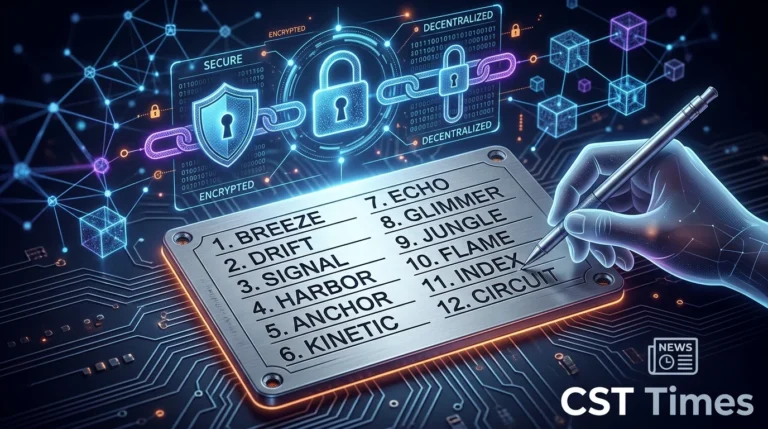
A crypto seed phrase is a sequence of common words — something like velvet, garden, tiger, orange, mountain, feather — that your wallet generates the first time you set it up. It looks like nonsense, but it’s the only thing needed to access every asset in that wallet. If your phone is lost, your laptop crashes, or your hardware wallet breaks, typing this phrase into a new, compatible wallet restores everything exactly as it was.
Unlike a bank password, a seed phrase has no password reset option and no customer support team standing behind it — whoever holds the phrase has complete, permanent control over the wallet and everything in it. That’s the core trade-off of self-custody crypto: total control comes with total responsibility.
How a Seed Phrase Is Created
A seed phrase isn’t random words picked for convenience — it’s a human-readable version of a very large random number. When a wallet is created, it generates a string of random bits called entropy. For a 12-word phrase, the wallet generates 128 bits of entropy; for a 24-word phrase, it generates 256 bits. kucoin
That raw binary data is nearly impossible to copy down accurately by hand, so wallets follow a standard called BIP-39 (Bitcoin Improvement Proposal 39) to turn it into words instead. BIP-39 was proposed in September 2013 and defines how a wallet encodes its seed as 12 to 24 ordinary English words, drawn from a standardized list of 2,048 words, with the same construction used by virtually every major modern wallet. A built-in checksum also lets the wallet catch typos or miswritten words before they cause a problem.
The result feeds into a second standard, BIP-32, which lets a single seed phrase generate an unlimited tree of private keys and addresses. This means one backup phrase protects every asset and address the wallet will ever control — not just the ones that exist today.
How a Seed Phrase Protects Your Wallet
Think of the seed phrase as the root of a tree, and every account, address, and coin in the wallet as a branch growing from it. As long as the root survives, every branch can be regrown on any BIP-39-compatible wallet, from any manufacturer. This interoperability lets someone migrate their funds between compatible wallets without being locked into a single vendor. cypherock
That same design is also the risk. Because one phrase controls everything, protecting it is the single most important security task in owning crypto. A device can be replaced. A seed phrase, if exposed, cannot be “changed” the way a leaked password can — the wallet it protects has to be abandoned and funds moved to a brand-new one.
12-Word vs. 24-Word Seed Phrases
Both lengths are considered secure; the difference is entropy, not real-world safety.
| 12-Word Phrase | 24-Word Phrase | |
|---|---|---|
| Entropy | 128 bits | 256 bits |
| Possible combinations | ≈5.4 × 10³⁹ | ≈3 × 10⁷⁹ |
| Common use | Most software and mobile wallets | Many hardware wallets by default |
| Practical brute-force risk | Effectively zero | Effectively zero (datarecovery) |
Twelve words already sit well beyond any realistic brute-force range; the choice between the two is largely a matter of wallet design and preference, and hardware wallets typically default to 24 for an extra margin of long-term security.
Seed Phrase vs. Private Key vs. Password
These three terms get mixed up often, so here’s the distinction:
- Password — protects access to an app or account on one device. It can usually be reset.
- Private key — a single cryptographic key tied to one specific address. A wallet can hold many of them.
- Seed phrase — the master source all of a wallet’s private keys are generated from. One seed phrase can produce unlimited private keys and addresses.
A password locks a door. A seed phrase is closer to owning the blueprint for every door the building will ever have.
What Happens If You Lose It — or It’s Stolen
Losing a seed phrase with no other backup means permanent, unrecoverable loss of the funds in that wallet. There’s no institution to appeal to and no identity check that restores access.
The reverse is just as final. If someone else obtains the phrase, they gain the same total control the rightful owner had — instantly and irreversibly. This isn’t a theoretical risk: in December 2025, a compromised update to a widely used wallet’s browser extension exposed users who had imported their seed phrases into the affected version, and on-chain analysis traced more than $6.77 million drained across multiple blockchains before the breach was contained. The lesson wasn’t a flaw in the seed phrase system itself — it was that the phrase had been imported into a compromised piece of software in the first place. kerberus
How to Store a Seed Phrase Safely
The consistent advice from wallet providers and security researchers is the same: keep it offline, physical, and private.
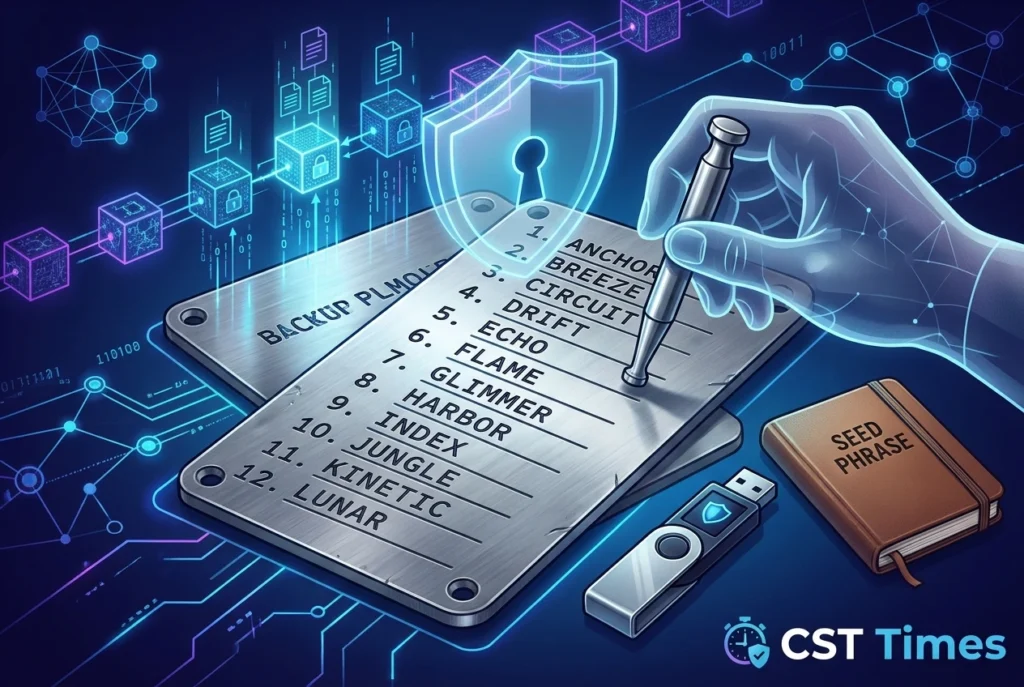
- Write it down on paper or stamp it into metal — metal backups resist fire and water damage better than paper.
- Never store it digitally. Don’t take photos of it, don’t store it in cloud services like Google Drive, iCloud, or Dropbox, and don’t email it to yourself or save it in a password manager. trustwallet
- Keep more than one copy, stored in separate secure locations, so a single fire, flood, or theft can’t wipe out access entirely.
- Never type it into a website, even one that looks like official wallet support. Legitimate services never ask for it.
- Test a new wallet’s backup once, with a small amount, before trusting it with significant funds.
Quick Checklist
- Generated the phrase only on the wallet device itself, not pre-filled or supplied by anyone else
- Written offline on paper or metal — never photographed or typed into a notes app
- Stored in at least two separate secure physical locations
- Never shared with anyone claiming to be “support”
- Never entered into a website, app, or QR code to “verify” a wallet
Common Seed Phrase Scams to Watch For
Most seed phrase theft doesn’t involve hacking — it involves persuading someone to hand the phrase over voluntarily. No legitimate person or service ever needs a wallet’s seed phrase or private key; anyone who asks for one is attempting to take the funds it protects. A few patterns show up repeatedly:
- The “leaked wallet” bait. Scammers post a seed phrase publicly, claiming it unlocks a wallet with a large balance. When a victim imports it and tries to withdraw the funds, they’re asked to send a small “gas fee” first — which the scammer’s script then sweeps away automatically.
- Fake support and phishing sites. A fake support agent asks the owner to “verify” their wallet by entering the seed phrase on a look-alike website — handing over full control while believing the hardware wallet is still protecting them.
- Pre-filled hardware wallets. Some scams involve a hardware wallet that arrives with a seed phrase already generated by the seller, rather than by the buyer’s own device — meaning the seller already knows the phrase. A seed phrase should only ever be generated on the device itself.
Final Thoughts:
A crypto seed phrase is simple in concept — a backup made of words instead of numbers — but it carries the entire weight of a wallet’s security. It’s created through a well-tested standard, BIP-39, that turns randomness into something a person can write down and restore later. The words themselves aren’t the risk; how they’re stored and who sees them is. Treat the phrase with the same care as the funds it protects, and the wallet stays secure regardless of which device or app is used to access it.
If the CLARITY Act Becomes Law: What It Means for Exchanges
What Is the Biggest Risks in Crypto? (Professional Report-Based Analysis)
Fake Payment Screenshot Scam on Binance P2P: How to Spot and Avoid It
Why Is My Crypto Transaction Pending? How to Check and Fix It
Crypto Market Cap: Essential 2026 Guide to Avoid Mistakes
FAQs
What is a crypto seed phrase in simple terms?
It’s a list of 12 or 24 words generated by a wallet that can restore full access to all the funds and addresses in that wallet on any compatible device.
Is a seed phrase the same as a private key?
No. A private key controls one address; a seed phrase is the master source that can generate an unlimited number of private keys and addresses.
Can I recover my wallet without the seed phrase?
Generally, no. If the phrase is lost and there’s no other backup, the funds in that wallet are permanently inaccessible.
How many words are in a seed phrase?
Most wallets use 12 or 24 words, though BIP-39 technically allows 12, 15, 18, 21, or 24, depending on the entropy used.
Is it safe to store a seed phrase in a password manager or cloud note?
No. Security guidance consistently recommends offline, physical storage only — digital copies are far more exposed to hacking and phishing.
Disclaimer
This article is for general educational purposes only and is not financial, investment, or security advice. Cryptocurrency self-custody carries real and irreversible risk. Consider consulting a qualified professional before making decisions about how to store or manage digital assets.
Follow us on Social media :
About The Author

Haseeb Jabbar
Haseeb Jabbar writes about crypto, finance, technology, and AI at CST Times, sharing research-based guides, timely news, and free tools and calculators to help readers make informed decisions.
