
Debit Card Payment Not Showing in Pending Transactions?
Quick Summary:
A debit card payment not showing in pending transactions does not necessarily mean it failed. The merchant may not have submitted the final payment, the transaction may have been processed offline, or your bank may have posted it without displaying it as pending first. Before paying again, check your recent account activity, available balance and merchant confirmation to avoid a possible duplicate charge.
Table of Contents
ToggleKey Takeaways
An empty pending transactions list does not necessarily mean a payment failed.
An authorised transaction is not always the same as a completed or posted payment.
Some retailers submit card payments later, especially for offline purchases and certain transport services.
A declined transaction can sometimes leave a temporary authorisation in your account.
Check your merchant’s payment status before attempting the same purchase again.
Contact your bank immediately if you notice an unfamiliar or unauthorised charge.
What Does It Mean When a Debit Card Payment Is Not Showing as Pending?
When you pay with a debit card, the payment normally involves authorisation followed by processing and settlement.
However, the exact way these stages appear in your banking app depends on your bank and the merchant.
First, understand these four terms:
| Transaction status | What it means |
|---|---|
| Authorised (authorized) | The card issuer has approved the payment request. This does not necessarily mean the final payment has been completed. |
| Pending | The bank displays a transaction that has not yet been fully processed or posted. |
| Declined | The payment request was not approved. A temporary authorisation may still remain after an unsuccessful attempt. |
| Completed/Posted | The transaction has been processed and recorded in the account’s posted transaction history. |
A pending transaction can eventually become a completed payment, be adjusted to a different amount, or disappear when the merchant releases the authorisation.
There is another important detail: a transaction does not always have to appear in the pending list before it gets posted.
For example, Chase explains that some transactions may be posted without being displayed as pending first.
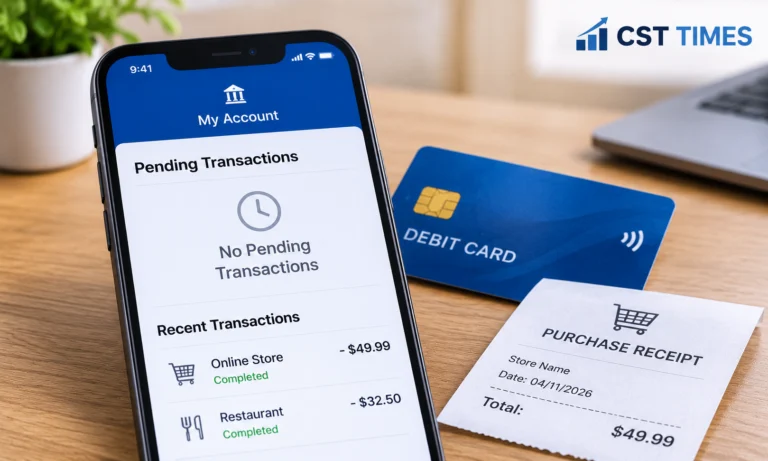
6 Reasons Your Debit Card Payment Is Not Showing in Pending Transactions
1. The Merchant Has Not Submitted the Payment Yet
One possible reason is that the merchant has not sent the completed transaction information to your bank.
A card payment can be authorised first, while the merchant submits the final transaction details later.
Until the relevant information reaches your bank, the transaction may not appear in the place where you expect to see it.
This can happen with different types of purchases, depending on how the retailer processes payments.
NatWest explains that the time a payment appears in its online banking depends on when the merchant sends the transaction information. It says most merchants do this within a day or two, although some take longer.
That is NatWest’s published guidance, not a universal deadline for every bank.
Wells Fargo explains that some debit card transactions may be authorised but not submitted by the merchant within three business days. In such cases, the bank may release the temporary authorisation hold. However, the merchant may still submit the actual transaction later.
This means that funds returning to your available balance do not always guarantee that the merchant cannot collect the payment. This is Wells Fargo’s guidance, not a universal processing deadline for every bank.
2. The Merchant Processed the Payment Offline
Some merchants can accept card transactions when an internet connection is unavailable.
This is sometimes called offline processing, deferred authorisation or store-and-forward processing.
Because the transaction may not be authorised in real time, it might not immediately appear in your bank’s pending transactions.
Examples of situations where delayed processing may occur include:
Certain payments made on flights.
Some parking payments.
Toll-road transactions.
Market stalls and other retailers with delayed processing arrangements.
Some contactless merchants can also process payments offline. In these situations, the payment terminal may store the transaction information and submit it later when the required connection becomes available. As a result, the payment may not appear in your banking app immediately.
Not every merchant uses offline processing, and the time it takes to submit a transaction depends on the payment arrangement.
3. The Payment Is Part of a Pre-authorisation
Some businesses temporarily authorise an amount before submitting the final payment.
This is called a pre-authorisation or authorisation hold.
For example, a business may request a small amount to check whether your card is active, or reserve a larger estimated amount before calculating your final bill.
Common examples include:
Hotel reservations.
Car hire.
Certain online services.
Restaurant payments where an additional tip is added.
The final amount can differ from the initial authorisation.
U.S. Bank explains that a pre-authorisation holds funds until the business submits the final payment. It also notes that additional charges, such as a restaurant tip, can be reflected when the transaction settles.
First Direct also explains that some businesses use a small £1 authorisation or another estimated amount to verify a card.
A temporary authorisation is not necessarily an additional completed charge.
4. The Payment Is Being Processed Through a Transport Service
Transport payments can work differently from ordinary retail purchases.
For example, Transport for London (TfL) calculates the applicable fares for journeys made during a day and charges the combined amount.
This means you might not see an individual transaction for every journey.
According to Barclays, TfL payments usually appear within three days of travel. You may see one combined charge for each day you travel.
Other transport operators can use different payment arrangements, so do not assume that every bus, train or transport payment follows TfL’s process.
For a missing transport payment, check the operator’s official journey history or payment account as well as your bank app.
Processing times can vary between banks. For example, Bank of Scotland advises customers to allow up to four days before contacting the bank about a missing contactless transaction. This is specific bank guidance, not a universal waiting period for every debit card payment.
5. Your Bank Has Not Displayed the Transaction Yet
Sometimes the transaction has reached the banking system but has not appeared in the pending section of your app.
Different banks display and process transactions differently.
For example:
Chase says some debit-card transactions cannot be displayed as pending before posting.
This is why checking only the pending transactions list is not enough.
Also review your recent activity, completed transactions, and available balance.
6. The Payment Was Declined, or the Authorisation Was Released
A payment attempt can fail even when a temporary authorisation appears in your account.
A debit card payment can be declined for several reasons, including insufficient available funds, incorrect card details, an expired card, a frozen or blocked card, spending limits, or a security check by your bank.
Check for a declined or unsuccessful payment message, a notification from your bank, or an email from the merchant. These details can help you understand whether the payment was actually rejected or is still being processed.
For example, a checkout may display a failed payment message while your banking app continues to show an authorisation.
This does not automatically mean the merchant has collected the money.
Chase UK explains that a failed card payment can remain pending until the merchant notifies the bank. The transaction may then be cancelled and the reserved funds returned.
If the merchant confirms that the payment failed, ask whether the authorisation was released or cancelled before attempting the payment again.
What Should You Check Before Attempting the Payment Again?
Before paying again, complete these checks.
Step 1: Check Your Recent Account Activity
Do not check only the pending transactions section.
Review:
Recent transactions.
Completed or posted payments.
Available balance.
Current or account balance.
Any separate card activity section.
Your banking app may have recorded the transaction somewhere else.
Also make sure you are checking the correct debit card and bank account. If you have multiple bank accounts, a joint account or a virtual card linked to another account, the payment may appear somewhere else.
Refresh or reopen your banking app to check whether the transaction has appeared. Also review bank notifications for card authorisations, declined payments or suspicious activity.
Step 2: Check Your Merchant’s Payment Confirmation
Open the retailer’s website or app and check the order status.
Look for:
An order confirmation.
A payment confirmation.
An unsuccessful payment notification.
A cancelled order.
A payment reference or receipt.
A merchant confirmation can help establish whether the purchase was accepted, but it does not by itself prove that the final payment has settled.
Step 3: Check the Available Balance
Compare the available balance with your account balance.
However, some banks do not display every debit-card transaction as pending or adjust the available balance immediately.
Do not assume that unchanged balances prove a payment will never be collected.
Step 4: Check the Merchant Name
The business name on your banking app may not match the name you recognise from the shop or website.
Some merchants use different payment processing or trading names.
Also check whether the charge could relate to an existing subscription or a service you previously signed up for.
Step 5: Contact the Merchant or Bank
For a purchase you recognise, ask the merchant whether the payment was:
Authorised.
Captured or submitted for settlement.
Declined.
Cancelled or reversed.
If necessary, ask for the payment reference or authorisation details that can help your bank trace the transaction.
Step 6: Only Retry After Confirming the First Attempt Failed
This is the most important step.
Do not immediately repeat a payment simply because the first attempt is missing from pending transactions.
Ask the merchant or bank to confirm whether the first payment was unsuccessful and whether it can still be submitted.
Once you have confirmation that the first attempt will not result in a charge, you can safely consider trying again.
Keep enough money in your account to cover the original purchase until its status is clear.
USA vs UK: What Should You Know?
Although the basic card-payment process is similar, individual banks and payment services can have different procedures.
Guidance for USA Debit Card Users
In the United States, banks do not all display pending debit transactions in the same way.
Chase explains that a transaction may not appear as pending but can still be posted to the account.
Bank of America also explains that some debit-card transactions do not appear as pending before posting.
For an unfamiliar or unauthorised debit-card transaction, contact your bank or card issuer immediately.
The Consumer Financial Protection Bureau (CFPB) explains that reporting times can affect your liability under US federal law.
The Consumer Financial Protection Bureau (CFPB) explains that after a customer reports an unauthorised electronic fund transfer, the bank or credit union generally has 10 business days to investigate the reported error. Some cases may take longer, depending on the circumstances and applicable requirements.
For example:
If your card is lost or stolen, reporting within two business days of discovering the loss can limit your liability to the lesser of $50 or the amount of unauthorised transactions.
For an unauthorised electronic debit appearing on your statement, the general reporting period is 60 days after the statement is sent.
These rules have specific conditions, so contact your bank promptly rather than waiting for the transaction to post.
Guidance for UK Debit Card Users
In the UK, debit-card payments are often authorised immediately, but the transaction details may appear later.
NatWest explains that the merchant’s submission of the transaction information affects when the payment appears in online banking.
For Transport for London, daily travel fares are combined into a charge rather than necessarily appearing as separate payments for every journey.
If you notice an unauthorised payment, the Financial Conduct Authority (FCA) advises contacting your bank or payment service provider immediately.
The FCA also advises consumers to notify their bank within 13 months of the unauthorised payment to preserve their ability to make a claim under the relevant rules.
Do not wait for an unfamiliar transaction to become completed before reporting it.
What If the Same Debit Card Payment Appears Twice?
Seeing two identical entries does not always mean you have been charged twice.
There is an important difference between duplicate pending authorisations and duplicate completed transactions.
Situation 1: Two identical pending transactions
A merchant may have authorised the same payment more than once because of a technical or processing issue.
The merchant may eventually collect only one payment and release the other authorisation.
First Direct and Chase UK both explain that duplicate pending authorisations can be resolved when the merchant identifies and releases the extra authorisation.
What to do: Contact the merchant and ask whether both authorisations will be submitted or whether one can be cancelled.
Situation 2: Two completed transactions
If both payments have actually posted to your account, you may have been charged twice.
What to do:
Check your merchant receipt and order history.
Contact the merchant and request a refund for the duplicate payment.
Keep the transaction records and any communication.
Contact your bank to dispute the duplicate charge if the merchant does not resolve it.
Do not assume that two pending entries will automatically become two final charges, but do not ignore two completed payments either
What Should You Do If You See an Unfamiliar Debit Card Charge?
An unfamiliar payment should be treated differently from a missing transaction relating to a purchase you recognise.
Before assuming that an unfamiliar transaction is fraud, check whether another joint account holder or a family member using a card linked to your account made the payment.
Also consider whether the transaction relates to a service used by someone else who has access to the account. If you still cannot identify the payment, contact your bank immediately.
Contact your bank or card issuer immediately if you see a transaction you did not authorise.
Recommended steps:
Contact your bank using its official app, website or the telephone number on your card.
Ask the bank to investigate the transaction.
Lock or freeze your debit card if your bank provides that feature and you suspect misuse.
Follow the bank’s instructions about replacing the card and protecting your account.
Keep records of the transaction and your communication with the bank.
Do not share your full card number, PIN, password or CVV with someone claiming to help investigate the charge.
You should not wait for the transaction to change from pending to completed before reporting suspected fraud.
When Should You Contact the Merchant and When Should You Contact the Bank?
| Situation | Who to contact first? |
|---|---|
| Recognised purchase missing from pending transactions | Merchant |
| Merchant says payment was successful but bank shows nothing | Bank or card issuer |
| Checkout says payment failed but a temporary authorisation remains | Merchant |
| Two identical pending authorisations | Merchant |
| Two completed charges for one purchase | Merchant, then bank if unresolved |
| Unfamiliar or unauthorised payment | Bank immediately |
| Lost or stolen debit card | Bank immediately |
| Transport fare missing from your account | Transport operator or bank, depending on the payment history |
The general rule is simple: contact the merchant when you need to confirm a purchase or ask for an authorisation to be released. Contact your bank immediately when you suspect fraud, and contact the bank if a merchant-confirmed payment cannot be traced.
Final Thoughts
A debit card payment not showing in pending transactions does not automatically mean that the payment failed.
The merchant may not have submitted the final transaction, the payment may have been processed offline, or the bank may display the transaction directly in its posted activity.
Before attempting the purchase again, check your account activity, available balance, and merchant confirmation. Ask the merchant whether the first payment was authorised, captured, or cancelled.
Most importantly, do not repeat a payment until you have established what happened to the first attempt. If you see an unfamiliar charge, contact your bank immediately.
FAQs
Why is my debit card payment not showing in pending transactions?
Your merchant may not have submitted the payment details yet, the transaction may have been processed offline, or your bank may not display it as pending before posting. Check your complete account activity and contact the merchant if the payment status is unclear.
Does a debit card payment always appear as pending?
No. Some banks may post transactions without displaying them as pending first. The way transactions appear depends on the bank, payment method and merchant.
Can a declined debit card payment still show as pending?
Yes. A failed payment attempt may leave a temporary authorisation in the account until the merchant notifies the bank or releases the hold. This does not necessarily mean the merchant has collected the money.
How long does a missing debit card transaction take to appear?
There is no universal processing time. Some merchants submit payment information quickly, while offline or delayed transactions can take longer. Check your bank’s own guidance and ask the merchant for the payment status.
Should I pay again if my first debit card payment is not showing?
Not immediately. First check whether the merchant received the payment, whether the bank authorised it, and whether the original attempt was cancelled. Repeating the payment without checking could lead to duplicate charges.
Can I dispute a pending debit card transaction?
A pending authorisation is temporary and may change or disappear before the payment is posted. Some banks may require a transaction to be posted before accepting a formal dispute. However, if you do not recognise a payment or suspect fraud, contact your bank immediately rather than waiting for it to become a completed transaction.
Disclaimer
This article provides general educational information, not individual financial or legal advice. Banking processes, card protections and payment-processing times vary between institutions and countries. Contact your card issuer for help with a specific transaction.
