
What Is a Multisig Wallet? How Shared Approval Works
Quick Summary:
A multisig wallet (short for multisignature wallet) is a crypto wallet that needs approval from more than one private key before it can send funds. Think of a vault that opens only when enough keyholders turn their keys, so one lost or stolen key cannot empty or lock the account. This guide explains how multisig works, the common setups, the real risks, and a checklist for getting started.
Table of Contents
ToggleKey Takeaways
- Multisig uses an “M-of-N” rule: M approvals are needed from N keys, such as 2 of 3.
- It removes the single point of failure in a normal wallet but adds backup and coordination work.
- Bitcoin and Ethereum handle multisig differently, but the approval idea is the same.
- Multisig cannot protect signers who approve a bad transaction without checking it, as the 2025 Bybit hack showed.
- On Bitcoin, back up the wallet descriptor as well as the seed phrases.
What is a Multisig Wallet?
A multisig wallet, short for multi-signature wallet, is a crypto wallet that requires more than one private key to approve a transaction. Instead of a single key controlling all the funds, the wallet follows a rule such as 2-of-3 or 3-of-5, meaning that many key holders must sign before any money can move. This removes the single point of failure found in regular wallets: if one key is lost or stolen, your funds stay safe, because one key alone cannot authorize a transfer. Because of this added security and shared control, multisig wallets are widely used by businesses, DAOs, and long-term investors who want to protect large holdings.
How Does a Multisig Wallet Work?
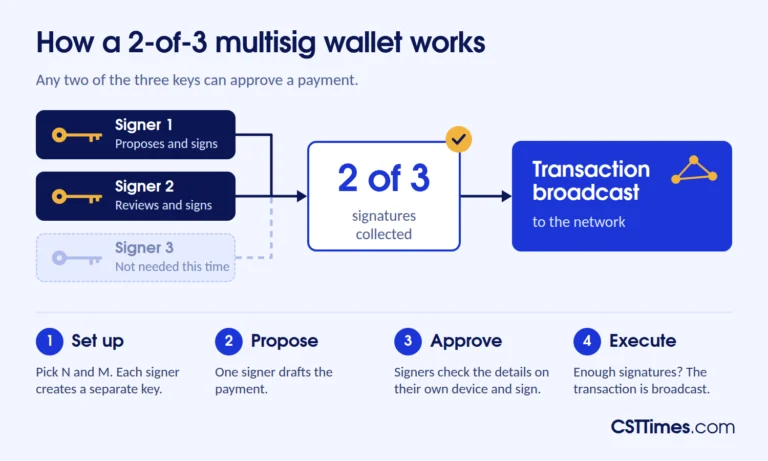
A multisig wallet works by enforcing a spending rule: at least M of N keys must sign before a transaction is accepted. One signer proposes a payment, the other required signers review and approve it, and only then does the network execute it. The keys can sit on different devices or belong to different people.
In a normal wallet, one private key controls everything, so losing or leaking it can be a disaster. In a 2-of-3 setup, an attacker who steals one key still needs a second key to complete a transaction. The typical flow looks like this:
- Set up. The group picks N and M. Each signer creates a separate key, ideally on its own hardware wallet.
- Propose. One signer drafts the payment.
- Approve. The other signers check the details on their own device screens and sign.
- Execute. Once enough signatures are collected, the transaction is broadcast.
The mechanics differ by blockchain. On Bitcoin, the rule is written into the transaction script, and multisig has been part of the protocol since 2012. On Ethereum and other EVM networks, it is usually a smart contract. Safe, one of the best-known examples, stores a list of owners and a threshold on-chain, and its owners can be regular accounts, other smart accounts or even passkeys.
Common Multisig Setups
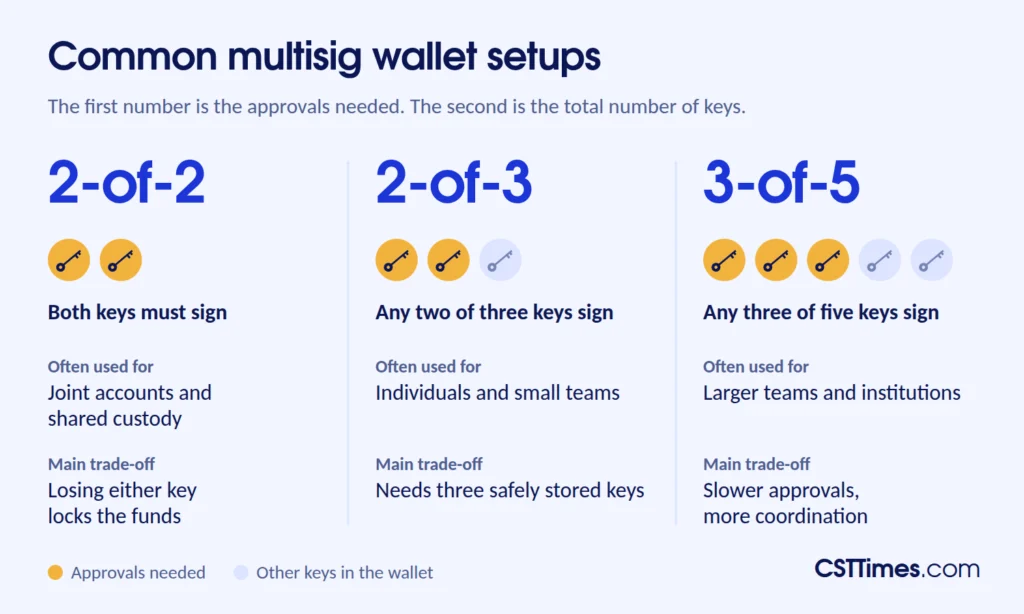
The most common setups are 2-of-2, 2-of-3 and 3-of-5. The right one balances protection against loss with how easily signers can reach agreement.
| Setup | How it works | Often used for | Main trade-off |
|---|---|---|---|
| 2-of-2 | Both keys must sign | Joint accounts and shared custody | Losing either key locks the funds |
| 2-of-3 | Any two of three keys sign | Individuals and small teams | Needs three safely stored keys |
| 3-of-5 | Any three of five keys sign | Larger teams and institutions | Slower approvals, more coordination |
Hardware wallet maker Coinkite calls 2-of-3 the standard for individual Bitcoin holders, because one lost key does not end access and one stolen key cannot enable theft. Larger groups often go wider: CoinDesk notes that multisig is popular with institutions and decentralized autonomous organizations (DAOs).
Some custody companies offer a hybrid. Blockstream explains that they typically hold fewer keys than the threshold, so they cannot move your funds alone. Mixing different hardware wallets in one setup also helps against malware that tries to steal keys or quietly alter transactions.
Multisig vs Single-Key vs MPC Wallets
Multisig uses several complete private keys. A multi-party computation (MPC) wallet instead splits one key into shares that jointly produce a single signature. In MPC, only the final signature goes on-chain while signing happens off-chain, so the network cannot tell it from an ordinary wallet.
| Single-key wallet | Multisig | MPC wallet | |
|---|---|---|---|
| Keys | One full key | Several full keys | One key split into shares |
| Approvals visible on-chain | Not applicable | Usually yes | No |
| Blockchain support | Broad | Depends on the chain | Works with most chains |
| Network fees | Standard | Often higher | Standard |
Neither design is automatically safer. MPC trades some on-chain auditability for privacy and wider chain support, while multisig gives clear, verifiable rules.
Benefits of a Multisig Wallet
The main benefit is that no single key, device or person can move the funds alone. That helps in three ways:
- Theft resistance. A thief who gets one key or one device still cannot spend.
- Loss tolerance. In a 2-of-3 setup, losing one key does not lock the funds if the other two stay safe. On Safe, owners can be replaced through a transaction approved at the threshold.
- Shared control. Teams can require several approvals for large payments. Some Bitcoin custody services also use multisig for inheritance planning, with legal representatives and notaries working alongside the custodian.
Risks and Limits of Multisig
Multisig reduces key-related risk but adds backup, human and technical risks that a single-key wallet does not have. In a self-custody setup, there is also no support desk that can reset access for you.
Lost backups
On Bitcoin, a seed phrase is necessary but not enough to restore a multisig wallet. Recovery also needs the wallet descriptor, which records the script type, the threshold and every signer’s public key. Without it, two seed phrases from a 2-of-3 setup may not reach the funds.
As of October 2026, a draft standard called BIP138 was merged into the Bitcoin Improvement Proposals repository on September 21 to offer an encrypted backup format for this data. It is still a draft, not a network change. Until wallets adopt it, back up every crypto seed phrase and the descriptor separately.
Signers can be fooled
Multisig protects keys, not judgment. In February 2025, attackers drained more than $1.5 billion from the Ethereum multisig cold wallet of crypto exchange Bybit. The FBI attributed the theft to North Korea’s TraderTraitor group. Forensic reports found the attackers first compromised a Safe{Wallet} developer’s machine and altered the interface Bybit’s signers used. The signers saw a routine transfer and approved it. Security firm Certora called it an operational failure rather than a multisig failure: no keys were stolen, and the signers were misled.
The lesson applies to every setup. Verify details on the signing device itself, never approve data you cannot read (known as blind signing), and consider a dedicated signing device used for nothing else.
Collusion, complexity and chain support
If enough signers collude or are compromised, the threshold no longer protects you. Multisig also takes more steps than a normal wallet, can cost more in network fees, and not every blockchain supports it. Coinkite itself notes that a well-executed single-key setup beats a poorly executed multisig one.
5 Essential Checks Before You Set Up a Multisig Wallet
Before moving real funds into a multisig wallet, make five checks: choose the threshold, spread the keys, back up everything, verify every transaction and test with a small amount. These steps cover the most common ways setups fail.
- Choose the threshold deliberately. 2-of-3 is a common starting point for individuals; larger groups often use 3-of-5. Avoid 2-of-2 unless you accept that losing one key locks the funds.
- Spread your keys. Use separate devices, ideally a different hardware wallet for each key, stored in different places.
- Back up the full configuration. Keep every seed phrase backup plus, on Bitcoin, the descriptor. Decide in advance what happens if a signer is lost.
- Verify every transaction. Read the address and amount on the signing device’s own screen before approving.
- Test small first. Send a small amount, then practice spending and recovery. Confirm your wallet and blockchain support multisig.
Final Thoughts:
A multisig wallet is one of the strongest ways to remove single points of failure from crypto storage, but it works only as well as the people and backups behind it. For shared funds or large holdings, a simple 2-of-3 setup with full backups and a tested recovery is a common place to start. For small personal holdings, a single well-protected hardware wallet may be simpler and sufficient.
FAQs
What is a multisig wallet in simple terms?
A multisig wallet is a crypto wallet that needs several approvals to send money, much like a vault that needs more than one key. Instead of one private key controlling everything, it follows an M-of-N rule, such as 2-of-3, so a single lost or stolen key cannot move the funds alone.
Is multisig safer than a regular wallet?
It can be safer against single-key theft or loss, but not against every attack. If signers approve a malicious transaction by mistake, the extra keys do not help, as the 2025 Bybit hack showed. Real safety depends on key separation, complete backups and careful checking of every transaction.
What happens if I lose one key in a 2-of-3 setup?
The other two keys can still approve transactions, so the funds stay accessible. You should then replace the lost key. On Safe-style wallets, owners can be swapped through an approved transaction. On Bitcoin, the signer set is fixed once the wallet is created, so you usually create a new wallet and move the funds.
What is the difference between multisig and MPC wallets?
Multisig uses several complete keys, and the approvals are usually visible on-chain. MPC splits one key into shares and produces a single signature off-chain, so it looks like an ordinary transaction. MPC often works on more blockchains, while multisig offers clearer, verifiable rules.
Can I use multisig on any blockchain?
No. Support varies by blockchain. Bitcoin supports multisig through its scripts, and Ethereum-compatible networks commonly use smart contract wallets such as Safe. Some blockchains offer limited or no multisig support, so check your wallet and network before choosing a setup.
Disclaimer
This article is for educational and informational purposes only and is not financial, investment, or legal advice. Crypto assets are volatile, and you can lose some or all of your money. Always do your own research.
