
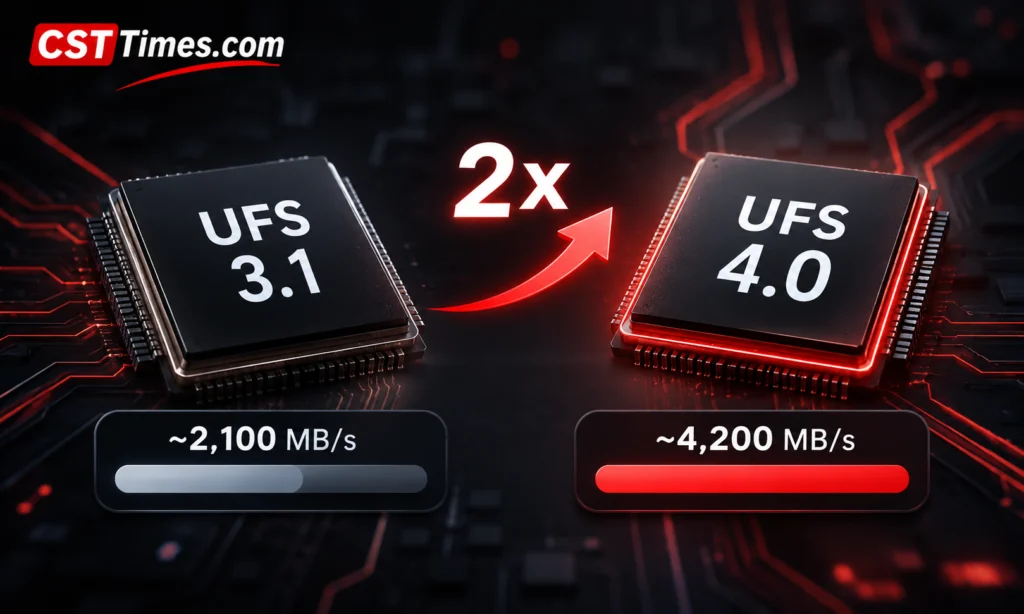
UFS 3.1 vs UFS 4.0: Is the Upgrade Worth Paying For?
Quick Summary:
UFS 4.0 phone storage is about twice as fast as UFS 3.1 on paper, with Samsung rating peak sequential reads at 4,200 MB/s versus 2,100 MB/s. In independent tests, though, everyday random reads (the kind apps use) improved by only about 30%. Pay extra for UFS 4.0 if you move huge files, play very large games, or run on-device AI. Otherwise, UFS 3.1 is still fine.
Table of Contents
ToggleKey Takeaways
- UFS 4.0 doubles peak speeds on paper, but day-to-day app loading improves far less.
- The same phone model can ship with UFS 3.1 or UFS 4.0 depending on the storage size you buy.
- Samsung’s “46% more efficient” figure measures storage reads, not your phone’s battery life.
- UFS 4.1 and UFS 5.0 exist as standards, but they shouldn’t change a buying decision today.
Phone makers love putting “UFS 4.0” on a spec sheet, and it often sits behind a price step. This guide shows what the upgrade really changes, using official specs and independent benchmarks. It covers Android phones only, since iPhones don’t use UFS. Last verified: November 2026.
Fact 1: UFS 4.0 Is Roughly Twice as Fast on Paper
| Spec | UFS 3.1 | UFS 4.0 |
|---|---|---|
| Standard published | 2020 | August 2022 |
| Peak sequential read (Samsung chips) | 2,100 MB/s | 4,200 MB/s |
| Peak sequential write (Samsung chips) | 1,200 MB/s | 2,800 MB/s |
| Efficiency (Samsung’s metric) | Baseline | Up to 46% better |
| Typically found in | Mid-range phones, base flagship tiers | Most flagships, higher storage tiers |
JEDEC says UFS 4.0 doubles the interface bandwidth, enabling up to about 4.2 GB/s. Samsung’s first UFS 4.0 chip is rated at 4,200 MB/s read and 2,800 MB/s write, while Samsung’s 512GB UFS 3.1 chip reached 2,100 MB/s read and 1,200 MB/s write. UFS 3.1 itself added Write Booster, DeepSleep and an optional Host Performance Booster over UFS 3.0.
These are best-case figures from the chip makers. A real phone’s controller, processor and software decide what you actually get.
Fact 2: Everyday Gains Are Much Smaller
Android Authority measured several phones with the same storage test:
| Phone | UFS | Seq. read | Seq. write | Random read | Random write |
|---|---|---|---|---|---|
| Google Pixel 9 | 3.1 | 980 | 214 | 29 | 32 |
| Google Pixel 9 Pro XL | 3.1 | 911 | 357 | 30 | 31 |
| ASUS Zenfone 11 Ultra | 4.0 | 2,130 | 1,130 | 39 | 45 |
| Vivo X100 Ultra | 4.0 | 1,620 | 952 | 38 | 65 |
All figures in MB/s.
Sequential speeds, which matter for copying huge files, were about 2x (read) and 3x (write) faster on the UFS 4.0 phones. But apps mostly do random reads, and those improved only about 30%. Android Authority estimated that loading a typical 200MB app would be about one second faster on UFS 4.0. Two more details put the numbers in context:
- Uncompressed 8K video would need around 750 MB/s, but phones compress it, so roughly 100 MB/s is enough, which UFS 3.1 handles easily.
- A standard 5 Gbps (about 625 MB/s) USB port is already the bottleneck when copying files off a phone. You need a 10 Gbps or faster port to see a bigger benefit.
The pattern repeated with newer phones. Android Authority’s Pixel 10 tests compared a 128GB UFS 3.1 model with a 256GB UFS 4.0 model and called the real-world difference negligible.
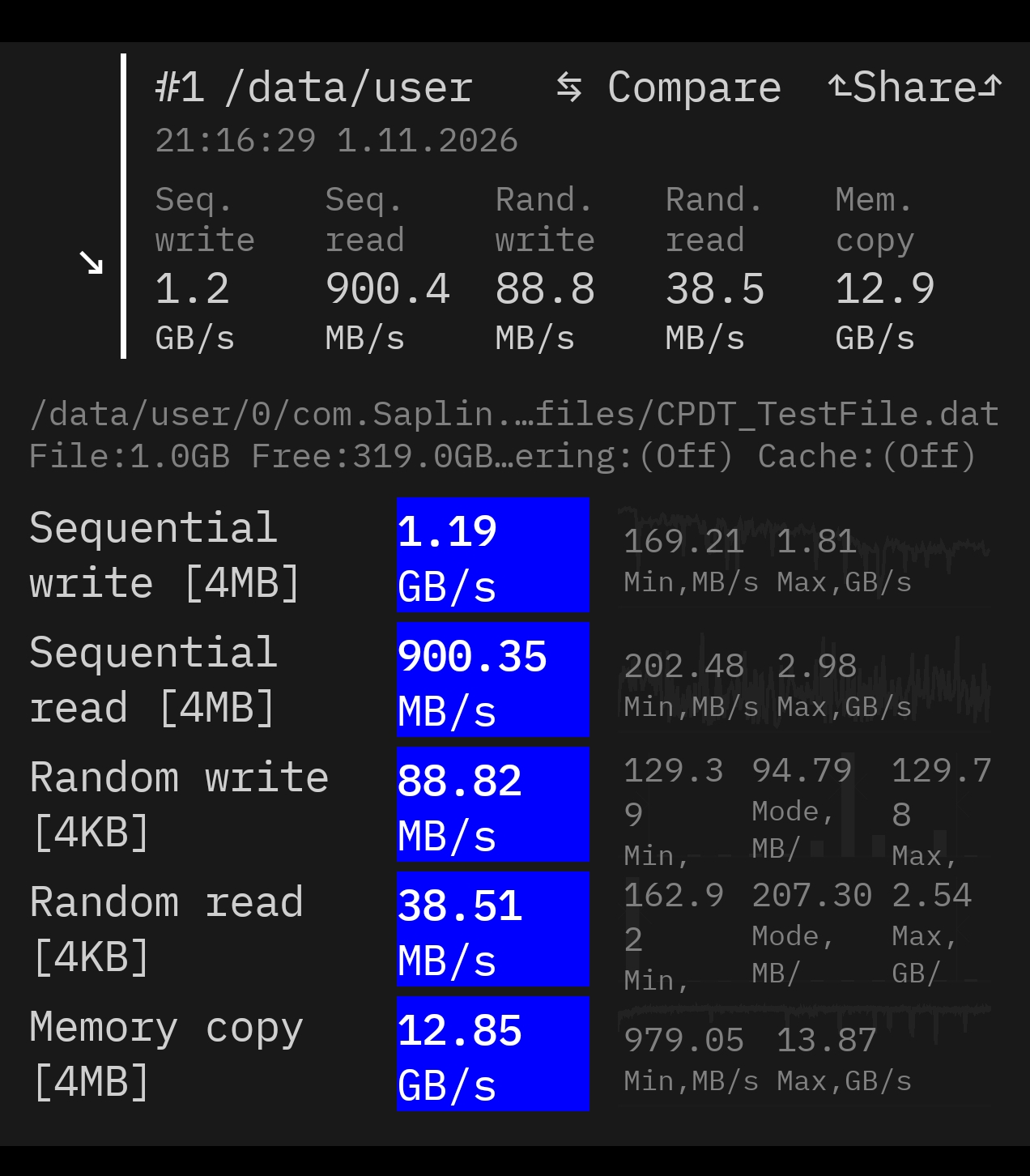
I tested the storage performance of my OnePlus 15R using CPDT Benchmark. The results below show the actual read and write speeds recorded on my device.
Fact 3: The Same Phone Can Ship With Either Version
This is the trap most buyers miss. The UFS version often depends on the storage size you pick, not just the phone model:
- Google Pixel 9: every model shipped with UFS 3.1.
- Google Pixel 10: the 128GB models use UFS 3.1; 256GB and larger use UFS 4.0.
- Samsung Galaxy S24: at launch, the 128GB model used UFS 3.1, while 256GB and above used UFS 4.0.
- OnePlus 12R: it drew criticism for advertising UFS 4.0 on larger-capacity models that did not have it.
So when a headline spec says “UFS 4.0,” confirm it applies to the exact variant you’re buying. Check the manufacturer’s spec page for that storage size, or look up the phone on GSMArena, which lists the storage type next to each capacity option. If you already own the phone, a storage benchmark app will show whether the speeds look like UFS 3.1 or 4.0.
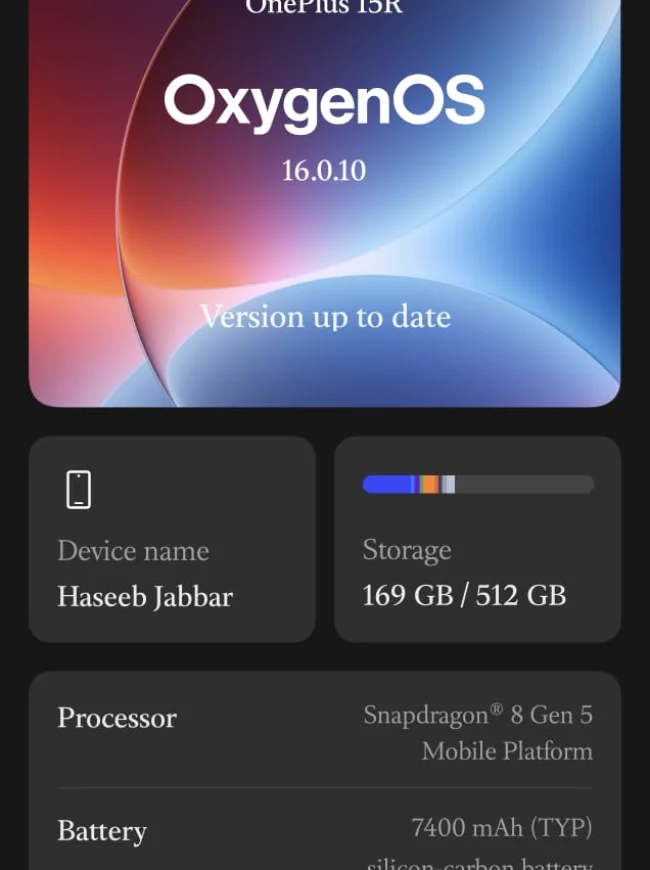
I checked the official specifications of my OnePlus 15R. Both the 256GB and 512GB configurations are listed with UFS 4.1. This shows why buyers should check the exact storage specifications rather than assume the version from the phone’s name alone.
Fact 4: The “46% More Efficient” Claim Is Not a Battery Guarantee
Samsung’s 46% figure describes sequential read speed per milliamp (6.0 MB/s per mA). That is how efficiently the storage chip works while reading data, not how many extra hours your phone lasts. Android Authority points out that other components affect battery life more, and that Micron claimed a smaller 25% efficiency gain for its own UFS 4.0 chips. UFS 4.0 also adds error-correction and data-refresh features that could help the chips age better, though that is a potential benefit, not a proven one. We did not find an independent test that isolates storage’s effect on all-day battery life, so treat battery as a small bonus.
Fact 5: UFS 4.1 and UFS 5.0 Exist, but They Shouldn’t Change Your Decision
According to JEDEC’s UFS standards page, UFS 4.1 was published in December 2024 as an update to UFS 4.0. UFS 5.0 followed in February 2026 and stays compatible with UFS 4.x hardware. Kioxia sampled UFS 5.0 chips rated up to 10.8 GB/s, more than double UFS 4.0’s theoretical speed. The main driver is on-device AI, which needs to load large models from storage quickly (see our guide to CPU vs GPU vs NPU).
A published standard is not the same as phones on shelves. Buy for what you do today, and always confirm the version on the spec sheet.
Who Should Pay for UFS 4.0?
If you mostly… | UFS 3.1 is enough? | Does UFS 4.0 help? |
|---|---|---|
| Chat, browse, stream, use social apps | Yes | Barely noticeable |
| Play very large mobile games | Usually | Loads a bit quicker |
| Copy multi-GB videos to a computer | Yes, if your port is slow | Only with a 10 Gbps+ port |
| Run large on-device AI models | Works | Faster model loading |
Quick Decision Checklist
- Find the exact variant. Confirm which UFS version your storage size gets.
- Compare the price step. If the UFS 4.0 model costs the same, take it. If the only way to get it is a higher storage tier, ask whether you want the extra storage anyway. Android Authority’s advice on the Pixel 10 was that capacity matters more than the speed spec.
- Ignore the label race. Don’t pay a premium just for “UFS 4.1” or “UFS 5.0” on a box.
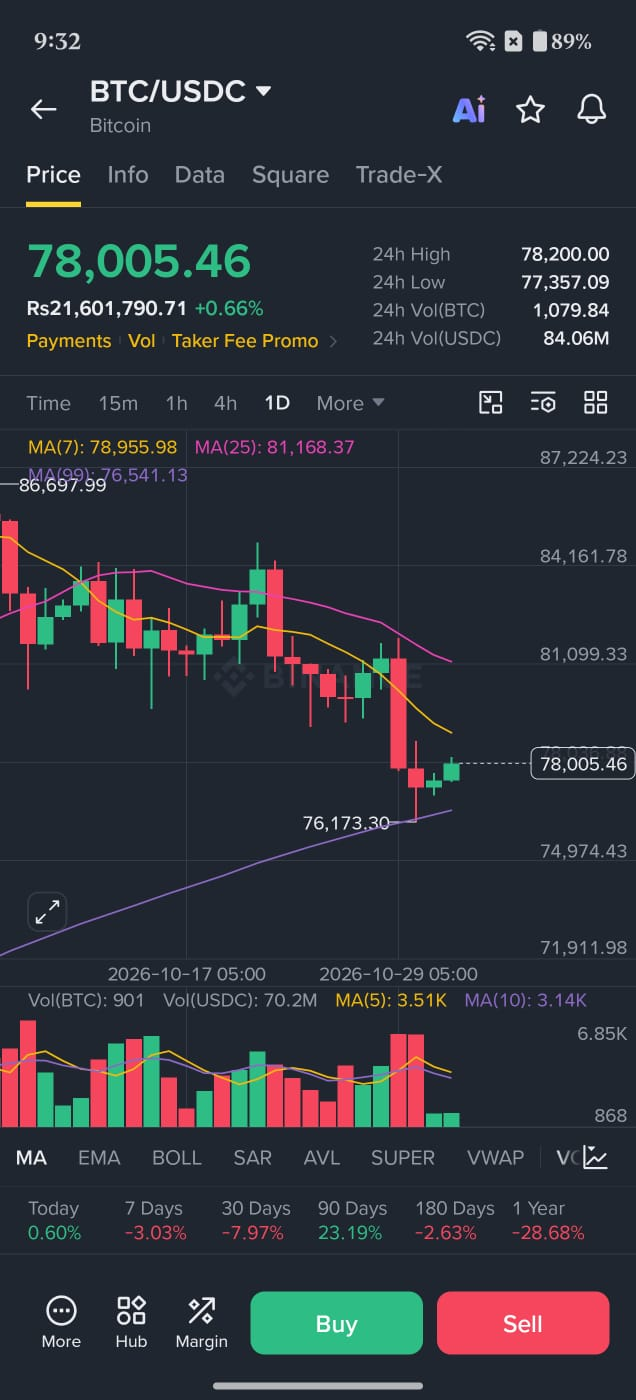
My daily use of Binance on the my Oneplus 15R, the app feels responsive, However, loading times also depend on internet speed, app servers, ram & processor, so i can’t attribute the ecperience to UFS storage alone.
FAQs
Is UFS 4.0 worth it over UFS 3.1?
For most people, not on its own. Peak speeds double, but everyday app loading improves by about 30% in independent tests.
Can I upgrade my phone from UFS 3.1 to UFS 4.0?
No. Phone storage is an embedded chip soldered to the board, so you can’t swap or upgrade it.
Is UFS 3.1 still good in 2026?
Yes. Google shipped the whole Pixel 9 series with it, and Android Authority concluded that it won’t ruin the experience.
Do iPhones use UFS?
No. Apple uses its own storage design, so UFS versions only apply to Android phones.
Does UFS 4.0 make games load faster?
A little. Android Authority notes that the biggest Android games may feel somewhat quicker to load, but the gain is far smaller than the headline speed numbers suggest.
Disclaimer
This article is for educational and informational purposes only and is not financial, investment, or legal advice. Crypto assets are volatile, and you can lose some or all of your money. Always do your own research.
