
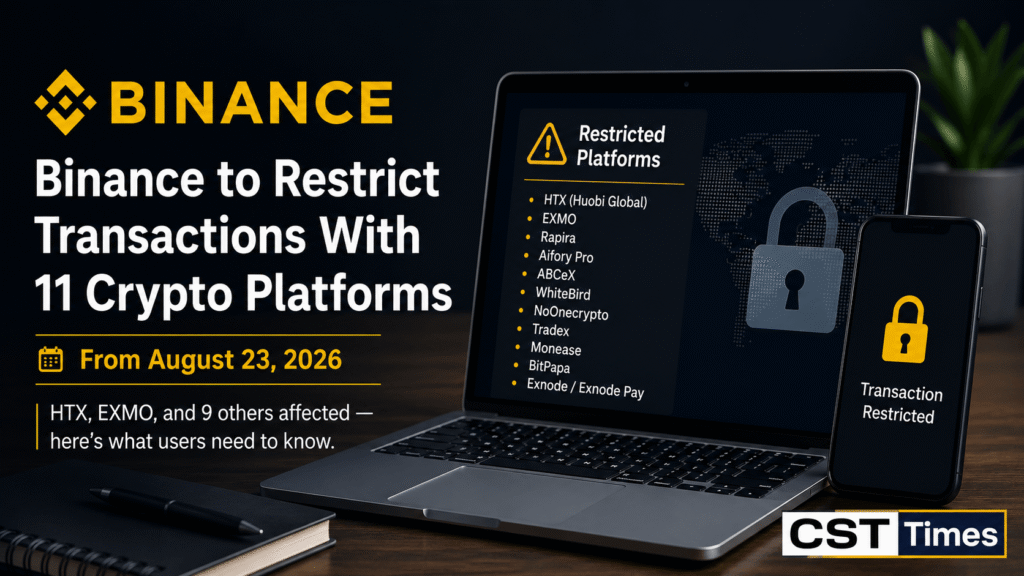
Binance restricts 11 crypto platforms Transactions From August 23, 2026
Binance restricts 11 crypto platforms | Let's find
Quick Summary:
If you’ve ever asked “what is Revolut?”, you’re not alone. This UK-founded app has grown from a simple travel card into one of the world’s biggest digital banking platforms, used by more than 70 million people.
Table of Contents
ToggleBut it still confuses a lot of new users. Is it a bank or just an app? Is your money actually protected? And how does it make money if half its features are free?
This guide answers all of that in plain English — what Revolut is, how it works, where it is (and isn’t) a licensed bank, and how safe it really is to use in 2026.
Key Takeaways
- Binance published the notice on August 14, 2026, titled “Important: Transactions with Certain Crypto Platforms.”
- From August 23, Binance will no longer process transactions involving 11 platforms, led by HTX (formerly Huobi) and EXMO Ltd.
- Five other platforms were already restricted earlier this month: Shelbit and Aban Tether Exchange from August 7, and A7 Nigeria, A7 Africa, and PilotFinance Ltd from August 13.
- Binance says any transaction attempted with these platforms after the cutoff dates may be held for compliance review, and linked wallets could face temporary restrictions.
- The restrictions are tied to expanding EU, UK, and US sanctions on entities accused of helping route funds around Russia- and Iran-related sanctions.
- Binance has stressed this is not a delisting of any cryptocurrency — BTC, USDT, and other assets remain tradable. It is a block on transacting with specific counterparties.
Table of Contents
- What Binance Announced
- The Full List of Restricted Platforms
- Timeline: How the Restrictions Are Rolling Out
- Why Is Binance Doing This?
- What “Restricting Transactions” Actually Means
- What Happens If You Transact With a Restricted Platform Anyway
- What Binance Users Should Do Now
- The Bigger Picture: Binance’s Compliance Push
- What Happens Next
- FAQs

What Binance Announced
In an official announcement published on August 14, 2026, Binance told users it will stop processing transactions tied to a list of crypto-asset service providers, citing “recent regulatory developments.” The company asked users not to send funds to, receive funds from, or otherwise transact through Binance with any of the named platforms once their effective date arrives.
Binance framed the move as a compliance requirement rather than a business decision: “Binance is required to adhere to the regulatory requirements in the jurisdictions in which it operates,” the notice said, adding that the step is meant to help keep the platform and its users’ assets secure.
The Full List of Restricted Platforms
The August 23 batch is the largest of the three phases. Here is the complete list, including the legal entity names Binance listed alongside each platform:
| Platform | Legal Entity (per Binance) |
|---|---|
| HTX | Huobi Global SA |
| EXMO | EXMO Ltd |
| Rapira | — |
| Aifory Pro | Sooty Ltd. |
| ABCeX | Nueva Cryptología S.A.S. DE C.V. |
| WhiteBird | — |
| NoOnecrypto | NoOnecrypto INC. |
| Tradex | Brightum LLC |
| Monease | Monease Ltd |
| BitPapa | — |
| Exnode / Exnode Pay | Arvix |
HTX, the exchange formerly known as Huobi, is by far the best-known name on the list. EXMO, a long-running exchange, has separately said it is winding down its operations.
Timeline: How the Restrictions Are Rolling Out
Binance isn’t cutting off all 16 platforms at once — it is phasing the restrictions in over three effective dates.
| Phase | Effective Date | Platforms |
|---|---|---|
| 1 | August 7, 2026 | Shelbit (Shelbit General Trading LLC), Aban Tether Exchange |
| 2 | August 13, 2026 | A7 Nigeria, A7 Africa, PilotFinance Ltd |
| 3 | August 23, 2026 | HTX, EXMO, Rapira, Aifory Pro, ABCeX, WhiteBird, NoOnecrypto, Tradex, Monease, BitPapa, Exnode / Exnode Pay |
The staggered rollout suggests Binance is working through a list tied to several overlapping sanctions actions rather than a single event.
Why Is Binance Doing This?
Binance’s own notice doesn’t name a specific law or regulator — it points only to “recent regulatory developments.” But the platforms on the list line up closely with several sanctions actions announced in recent months:
- EU sanctions on Russia-linked platforms. Reporting on the announcement has tied the August 23 batch to the European Union’s 21st sanctions package against Russia, adopted in July 2026, which extended transaction bans to offshore crypto platforms EU authorities say have helped evade sanctions on Russia.
- UK sanctions on the “A7” network. The UK’s Foreign, Commonwealth and Development Office designated 18 entities and individuals on May 26, 2026, including HTX, EXMO, BitPapa, and Rapira, in an action targeting what it called the A7 network — a group of platforms UK officials have linked to sanctions evasion.
- US Treasury action on Iran-linked platforms. The two platforms restricted first, Shelbit and Aban Tether Exchange, have been reported as Iran-based services targeted by the US Treasury’s Office of Foreign Assets Control (OFAC) over alleged links to sanctions evasion involving Iran’s Islamic Revolutionary Guard Corps.
Because HTX and EXMO were already under EU and UK sanctions before this notice, their inclusion in the August 23 batch was expected by close observers of the exchange-sanctions space, even though Binance had not previously said when it would act.
What "Restricting Transactions" Actually Means
This is the part readers most often get wrong: Binance is not delisting any cryptocurrency. Bitcoin, USDT, and other assets remain fully tradable on Binance regardless of this notice.
What’s changing is narrower: Binance will stop processing transfers where the counterparty is one of the listed platforms. In practice, that means Binance is screening the other side of a transaction — the wallet or account a user is sending to, or receiving from — rather than restricting an asset itself. If that counterparty is on the list, the transfer will not go through as normal after the effective date.
What Happens If You Transact With a Restricted Platform Anyway
According to Binance’s notice, any transaction attempted with a listed platform on or after its effective date may be:
- Held for a compliance review before it is processed, if it is processed at all.
- Linked to a temporary restriction on the user’s wallet while that review is ongoing.
- Treated as a possible breach of Binance’s Terms of Use, which can carry its own account-level consequences.
Binance has not published a fixed timeline for how long a compliance review might take, so users should expect delays rather than an outright, instant block in every case.
What Binance Users Should Do Now
- Check your transaction history for any recent or recurring transfers involving HTX, EXMO, or the other nine platforms on the August 23 list.
- Stop sending or receiving funds through Binance to or from any of the listed platforms before the relevant effective date.
- Move funds off an affected platform in advance if you hold assets directly on HTX, EXMO, or another listed exchange and plan to bring them to Binance later — do this before August 23, not after.
- Read the full official notice on Binance’s announcement page, since it is the definitive source for which entities and dates apply.
- Contact Binance Support directly if you’re unsure whether a specific transfer or counterparty is affected.
The Bigger Picture: Binance's Compliance Push
This announcement doesn’t stand alone. Binance has spent much of the past two years building out its compliance function amid sustained regulatory pressure in multiple jurisdictions, and the exchange has previously said its sanctions-related exposure fell sharply between January 2024 and July 2025, alongside a compliance team that now numbers in the thousands. Coverage of the August 23 restrictions has framed them as an extension of that broader effort rather than a one-off response to a single sanctions list.
For an exchange as large as Binance, screening counterparties tied to sanctioned entities is now a routine, recurring part of operating across the US, EU, UK, and other regulated markets — and further batches of restricted platforms are plausible if regulators add new names to their lists.
What Happens Next
August 23, 2026 is the date to watch. Once it passes, transactions with all 11 newly listed platforms will be subject to the same compliance-review process Binance already applies to the five platforms restricted earlier this month. Beyond that, whether Binance expands the list further will likely depend on future sanctions actions from EU, UK, or US regulators — none of which Binance controls directly, but all of which it says it must follow to keep operating in those markets.
FAQs
Disclaimer
This article is for informational purposes only and does not constitute financial, legal, or investment advice. Cryptocurrency transactions and regulatory requirements can change quickly; always confirm current details directly through Binance’s official announcements before taking action with your funds.
References
- Binance, “Important: Transactions with Certain Crypto Platforms”, — published August 14, 2026 (primary source)
Follow us on Social media :
About The Author

Haseeb Jabbar
Haseeb Jabbar writes about crypto, finance, technology, and AI at CST Times, sharing research-based guides, timely news, and free tools and calculators to help readers make informed decisions.
