
RaveDAO’s RAVE Token Collapse: Insider Allegations, Exchange Probes, and the Anatomy of a Crypto Shock
When a High-Flying Token Lost Its Momentum
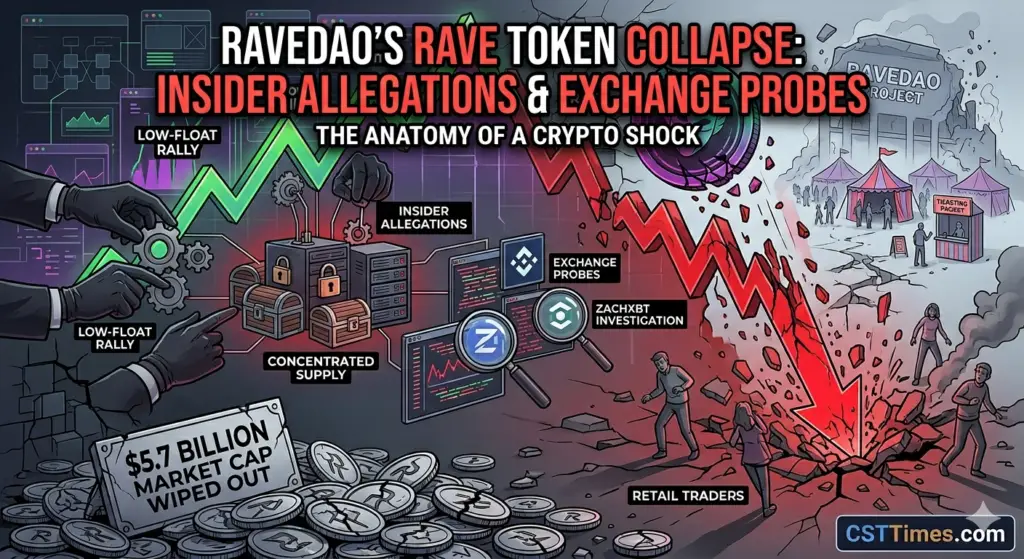
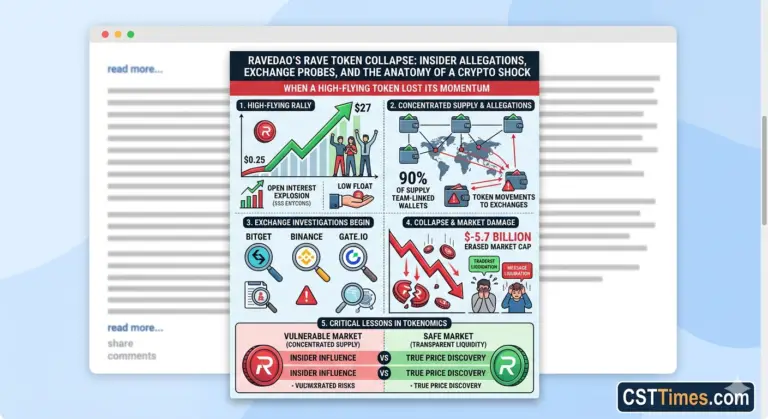
RaveDAO’s native token, RAVE, experienced one of the most dramatic collapses in recent crypto memory. After surging from roughly $0.25 to around $27 within about a week, the token reportedly lost nearly 90% of its value in a single day, erasing billions of dollars in market capitalization and leaving traders, exchanges, and observers scrambling for answers.
Table of Contents
ToggleWhat began as a powerful speculative rally quickly turned into a crisis of confidence. On-chain investigator ZachXBT raised concerns that the rise may have been driven by a pump-and-dump style structure, pointing to heavy supply concentration, suspicious exchange transfers, and a rapid shift from euphoria to liquidation.
A Rally Fueled by Low Float and Extreme Leverage
The speed of RAVE’s ascent was extraordinary. The token’s market price moved vertically as short sellers piled in and derivatives activity intensified. Open interest in futures reportedly exploded, while funding dynamics became increasingly distorted. In that environment, even modest buying pressure could trigger a violent squeeze.
This made RAVE a classic low-float, high-volatility asset: a token with a limited circulating supply, a concentrated ownership structure, and a market setup vulnerable to sharp price dislocations. Once the rally gained momentum, the combination of forced liquidations and thin liquidity pushed the token to levels that were difficult to sustain.
The Allegations That Changed the Narrative
The turning point came when ZachXBT alleged that roughly 90% of RAVE’s 1 billion supply was held across a small number of team-linked wallets. He also flagged large token movements to exchanges shortly before the rally, suggesting a possible setup where traders were baited into taking short positions before the market reversed sharply upward.
According to the public allegations, millions of tokens were moved in and out of exchange wallets in a pattern that looked highly unusual. This raised serious questions about whether the rally was organic, coordinated, or artificially amplified through exchange mechanics and insider positioning.
Exchange Investigations Begin
As the allegations spread, major exchanges publicly acknowledged that they were looking into the activity. Bitget said it had begun investigating the unusual trading behavior, while Binance also confirmed it was reviewing the matter for any signs of misconduct. Gate.io was likewise mentioned in the discussion, adding further attention to the token’s trading history.
These probes arrived just as the market was breaking down. By the time the price reached its peak and began to reverse, the damage had already been done. Traders who entered late were caught in a fast-moving unwind, and the token’s earlier gains evaporated almost as quickly as they had appeared.
Liquidations and Market Damage
The collapse was not only severe in percentage terms, but also in market impact. At its peak, RAVE’s market capitalization reportedly reached around $6 billion, only to fall back sharply and wipe out roughly $5.7 billion in value.
The derivatives market amplified the collapse. As the token soared, short positions accumulated. When the move reversed, forced liquidations accelerated the decline, creating a feedback loop that punished both leveraged traders and late entrants. Reports suggested that total liquidations associated with the move reached tens of millions of dollars, making the event one of the day’s most violent squeeze-and-reversal episodes.
RaveDAO’s Response
RaveDAO responded publicly on X, denying that the founders or team were responsible for the price action. The project framed the accusations as rumors and insisted that it had not engaged in market manipulation.
However, the response did not fully address the central concerns raised by on-chain analysis. Questions about concentrated wallet ownership, token movement patterns, and the timing of exchange deposits remained unresolved. The team also indicated that it may sell portions of unlocked tokens to fund operations such as hiring and marketing, while exploring future lockup structures tied to performance.
That disclosure did little to calm the market. For many observers, it reinforced the idea that the token’s supply structure created a built-in overhang that could pressure price for a long time.
RaveDAO’s Project Story and Business Model
Before the collapse, RaveDAO positioned itself as a Web3 entertainment and event-ticketing project centered on electronic music culture. The project claimed to have generated real-world revenue through events, partnerships, and community-driven experiences. It also promoted a philanthropic angle, including its “Rave for Light” initiative, which funded cataract surgeries in Nepal.
The broader narrative was meant to be more than speculation. RaveDAO presented itself as a cultural infrastructure project, blending live events, digital participation, and token-based engagement. In theory, this gave RAVE a use case beyond trading. In practice, however, the token’s market structure proved far more fragile than the brand story suggested.
Tokenomics: The Hidden Risk Behind the Hype
One of the clearest lessons from the RAVE collapse is that tokenomics matter just as much as narrative. A token can have revenue, partnerships, and a community, but if supply is tightly concentrated and circulating float is thin, the market becomes highly vulnerable to manipulation and panic.
In RAVE’s case, the gulf between circulating supply and total supply created a setup where every unlock, transfer, or exchange deposit could have an outsized effect. That made the token susceptible not only to speculation, but also to confidence shocks. Once trust weakened, the market had little structural support to absorb the sell pressure.
A Cautionary Case for Crypto Markets
The RAVE episode is likely to be remembered as more than just another token crash. It highlights the dangers of concentrated ownership, opaque token release schedules, and the power of leverage in thin markets. It also shows how quickly a strong brand narrative can collapse when trading dynamics are questioned.
Whether the investigations result in formal findings or not, the damage to investor confidence has already been significant. The incident serves as a reminder that in crypto, liquidity is destiny: when supply is tightly controlled and market structure is fragile, even a spectacular rally can end in a violent and punishing reversal.
Conclusion
RaveDAO’s rise and fall combined several of the most dangerous ingredients in crypto trading: a low-float token, explosive leverage, concentrated supply, and allegations of insider-linked behavior. The result was a market event that created massive short-term wealth on paper, then erased it just as fast.
For the wider industry, the collapse underscores a simple but important lesson: strong narratives may attract attention, but transparent tokenomics and fair market structure are what ultimately decide whether a project can survive beyond the hype.
About The Author

Haseeb Jabbar
Haseeb Jabbar writes about crypto, finance, technology, and AI at CST Times, sharing research-based guides, timely news, and free tools and calculators to help readers make informed decisions.
