

5 Risk Management Tips Every Crypto Trader Should Know
70%
$1.5B
1%
1:3
Introduction:
Risk management is the most important thing in crypto trading. Most new traders focus only on one question: “Which coin should I buy?” But experienced traders ask a better question: “How do I protect my money if I am wrong?”
Table of Contents
ToggleThe CFTC and SEC warn that crypto markets are very volatile. The FCA also says that people should be ready to lose all the money they invest. These are not just legal warnings — they are real facts about a market that moves very fast and can be very risky.
Remember Warren Buffett’s first rule: “Never lose money.” In crypto, that means having a plan before every single trade — not after it goes wrong. Below are 5 simple rules to help you do exactly that.
Tip 1.
Only Trade Money You Can Afford to Lose
This is the most important rule in crypto — and it comes from real government regulators, not just trading blogs. The CFTC clearly states you should only speculate with money you can afford to lose completely. The FCA warns that buyers of crypto assets should be prepared to lose all the money they invest.
This is not just legal language. It is practical advice. When you trade with “scared money” — money you need for rent, food, or bills — you make emotional decisions. You panic when prices fall. You hold losing trades hoping they recover. You chase losses with bigger bets. All of this leads to bigger losses.
📌 Simple Rule: Create two separate pots of money. One for real life (rent, savings, bills). One for trading. Only put into trading what you would be completely okay losing. If losing it would hurt your daily life, do not trade with it.
- Keep your trading money completely separate from your savings
- Never trade your emergency fund or money you need this month
- Start with a small amount — learn before you go big
- If you feel stressed watching prices, you are risking too much
🛑 Tip 2
Always Use a Stop-Loss on Every Trade
A stop-loss is an automatic instruction you give to your trading platform. It says: “If this coin drops to a certain price, sell it automatically.” You do not have to watch the market every minute. The platform does it for you — even while you sleep.
Think of it like a seatbelt in a car. You hope you never need it, but it protects you when something goes wrong fast. ESMA warns that crypto-assets remain very risky and highly volatile. Prices can fall 10%, 20%, or more in just a few hours without any warning.
📌 Real Example: You buy Bitcoin at $60,000. You set a stop-loss at $57,000. If the price crashes overnight, the system automatically sells at $57,000. You lose 5% — not 30% or 40%. A manageable loss you can recover from.
Where should you set it? Not too close (normal price swings will trigger it by mistake), and not too far (you will lose too much). A reliable tool is the ATR indicator (Average True Range). It tells you how much a coin normally moves in one day, and you place your stop-loss just outside that normal range.
- Set your stop-loss before you enter the trade — not after
- Never move it lower just to “hope” the price comes back
- Use the ATR indicator for smarter placement
- Remember: a small loss is always better than a huge one
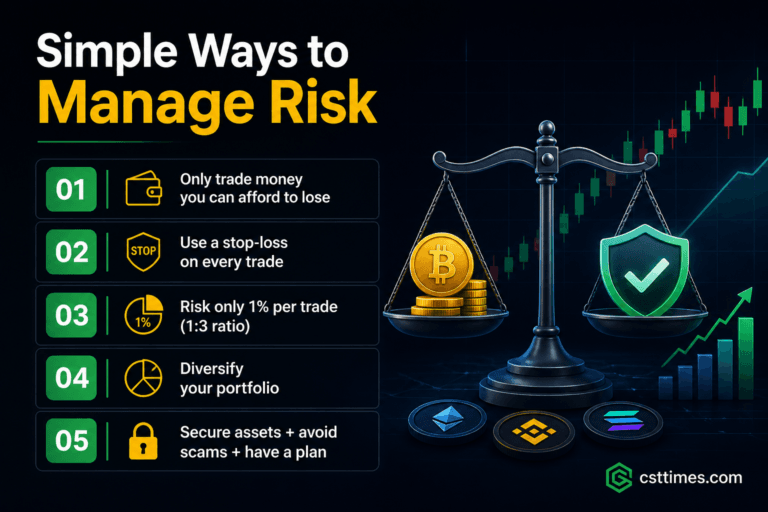
📐 Tip Three
Use the 1% Rule — Never Risk Too Much on One Trade
This is the golden rule of professional trading. It is simple: never risk more than 1% of your total account on any single trade. Some experienced traders go up to 2%, but 1% is the safest starting point for most people.
Why? Because even the best traders in the world are wrong sometimes. If you risk 30% on one trade and you are wrong, you need to gain 43% just to get back to where you started. But if you risk only 1%, you can be wrong ten times in a row and still have 90% of your money.
📐 The 1% Position Size Formula
Risk per Trade = Total Balance × 0.01
Example: $5,000 balance → max risk = $50 per trade
Example: $10,000 balance → max risk = $100 per trade
Also use a smart risk-to-reward ratio. The standard used by most professionals is 1:3 — if you risk $100, you should aim to make at least $300. With a 1:3 ratio, you only need to win 30% of your trades to still be profitable overall.
⚠️ Real Warning: In 2024, a crypto trader known as “qwatio” was fully liquidated — wiped out — 8 times in one single week, losing a total of $12.5 million. The reason? Extreme leverage and risking far too much per trade. The 1% rule exists exactly to prevent this.
- Calculate your risk amount before entering any trade
- Aim for a 1:3 risk-to-reward ratio on every trade
- Stay consistent — apply this rule every single time
- Never increase your risk size after a loss (revenge trading)
🧺 Tip Four
Spread Your Risk — Do Not Put Everything in One Coin
One of the most common mistakes beginners make is putting all their money into one single cryptocurrency. If that coin crashes — and in crypto, any coin can crash — they lose everything at once. The solution is diversification.
The SEC’s Investor.gov recommends diversification as one of the most powerful tools for managing investment risk. The idea is simple: spread your money across different assets so that one bad outcome does not destroy the whole portfolio. As the saying goes — do not put all your eggs in one basket.
✅ A Simple Crypto Portfolio Split:
🟢 Large-cap coins (BTC, ETH) — for stability and lower risk
🟡 Mid-cap projects — for moderate growth potential
🔵 Stablecoins (USDT/USDC) — safe buffer to buy dips
🔴 High-risk altcoins — only a very small percentage
One important fact: most cryptocurrencies move together. When Bitcoin falls, most altcoins fall too. This means true diversification may also mean keeping some of your money outside crypto entirely. Most financial experts suggest allocating no more than 5–10% of your total savings to crypto — especially when you are starting out.
- Spread your portfolio across at least 3–5 different assets
- Always keep some money in stablecoins (USDT or USDC)
- Never go all-in on one token — no matter how confident you feel
- Rebalance your portfolio regularly as market conditions change
🔐 Tip Five
Secure Your Assets, Avoid Scams, and Always Have a Plan
This final tip covers three connected ideas: keeping your crypto physically safe, staying away from scams, and having a clear trading plan before you enter any trade.
1. Secure your assets: Crypto is not like a normal bank. If your exchange is hacked or your account is compromised, there may be no way to recover your money. The CFTC warns that if private keys are lost or stolen, there may be no assurance of recovery. The solution is cold storage — a hardware wallet (physical device not connected to the internet) that stores your coins safely offline.
⚠️ Real Event: In early 2025, the ByBit crypto exchange was hacked and $1.5 billion in user funds were stolen. Users who kept large amounts on the exchange were directly and immediately affected. A hardware wallet would have kept their funds safe.
2. Avoid scams: The CFTC and SEC both warn that crypto is full of fraudulent platforms, fake experts, and guaranteed-profit traps. There is no such thing as a guaranteed return in any investment — ever. If someone promises guaranteed profit, walk away. Do not trust unknown Telegram groups, random DMs, “insider tips,” or websites with overnight returns.
📌 Make a Plan Before Every Trade: Because crypto prices move so fast, ESMA and the SEC both advise traders to have a clear strategy before entering any position. Ask yourself four questions:
➤ What is my entry price?
➤ Where is my stop-loss?
➤ What is my take-profit target?
➤ How much am I willing to lose?
Writing this down before you trade stops emotional decisions like panic selling or “revenge trading” after a loss.
- Move large holdings to a hardware wallet (cold storage)
- Turn on 2-factor authentication on every exchange account
- Never share your seed phrase with anyone — ever
- Only keep actively traded funds on an exchange
- Ignore any message promising guaranteed crypto returns
- Write your trading plan before you enter — not after
Verified Sources
All 5 Tips at a Glance
Save this checklist. Come back to it before every trade.
💸
Trade Affordable Money
Never risk money you actually need in your daily life
🛑
Stop-Loss Every Time
Automatically cut losses before they become disasters
📐
The 1% Rule
Risk only 1% per trade. Use 1:3 reward ratio
🧺
Diversify
Spread across coins. Keep a stablecoin buffer
🔐
Secure + Plan
Cold storage, no scams, written plan before every trade
Simple Ways to Manage Risk
| # | Tip | What It Protects You From | Backed By | Priority |
|---|---|---|---|---|
| 01 | Only trade money you can afford to lose | Emotional decisions, financial damage to your real life | CFTC, FCA, SEC | Critical |
| 02 | Use a stop-loss on every trade | Large unexpected losses while you are not watching | ESMA, Investopedia | Critical |
| 03 | Risk only 1% per trade (1:3 ratio) | Wiping out your whole account on one bad trade | ForTraders, Trakx | Critical |
| 04 | Diversify your portfolio | One coin crash destroying your entire portfolio | SEC Investor.gov, Fidelity | Important |
| 05 | Secure assets + avoid scams + have a plan | Exchange hacks, fraud, panic decisions | CFTC, SEC, FCA, ESMA | Critical |
Conclusion :
Protect Your Capital First. Then Try to Grow It.
In crypto, the goal is not just to make money — it is to keep the money you make. The safest traders are not the ones who take the biggest risks. They are the ones who manage risk with discipline, every single day.
✅ Keep large funds in cold storage
Verified Sources
📚 References & Further Reading
All sources used in this article — government regulators, institutional reports, and trusted research.
🏛 U.S. Regulator
CFTC — Virtual Currency Risk Advisory
Official U.S. government guidance on crypto risks, scams, and safe trading
SEC — Investor.gov Crypto Resources
SEC’s official investor education on crypto assets, custody, and fraud alerts
FCA — Cryptoasset Consumer Warning
UK Financial Conduct Authority’s official guidance on crypto investment risk
ESMA — Crypto-Asset Risk Warning
European Securities and Markets Authority’s official consumer alert on crypto
CoinLaw — Risk Management Stats 2025
Institutional crypto risk statistics and industry benchmarks for 2025
Fidelity Digital Assets — 2025 Outlook
Crypto market outlook and professional portfolio risk management strategy
Related Topic:
The 4 Types of Market Risk Every Investor Must Know (2026)https://csttimes.com/2026/05/01/4-types-of-market-risk/
Follow us on Social media for daily Updates:
About The Author

Haseeb Jabbar
Haseeb Jabbar writes about crypto, finance, technology, and AI at CST Times, sharing research-based guides, timely news, and free tools and calculators to help readers make informed decisions.
