Binance CEO Richard Teng: AI Can Help or Harm Crypto Users 2026
- Binance CEO Richard Teng says AI has no side — it is a neutral technology.
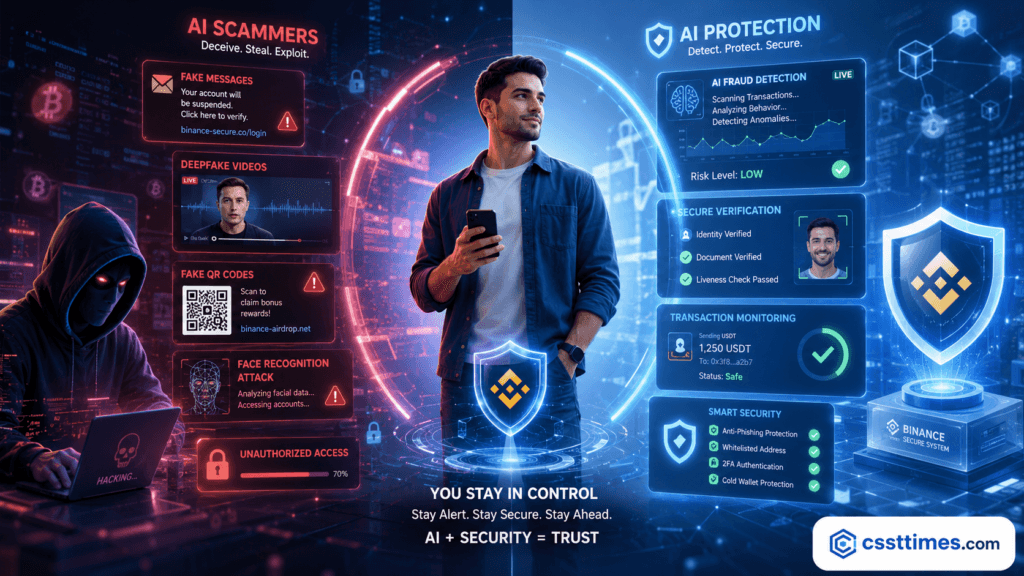
- Scammers are using AI for face attacks, deepfakes, phishing, and fake identities.
- Binance is using AI to fight fraud, verify users, and monitor transactions.
- Industry experts say education and regulation must keep up with AI threats.
- Users must stay alert — even the best AI security can be beaten by human error.
Artificial Intelligence is one of the most powerful technologies ever created. It is already being used in healthcare, banking, and cybersecurity. Now, it is changing the world of crypto — and not always in a good way.
Table of Contents
ToggleBinance CEO Richard Teng recently shared an important insight on this topic. He said that AI, like any other technology, is inherently neutral. It does not choose sides. It does not decide who wins or who gets hurt. People do that.
This statement may sound simple, but it has big consequences for the millions of people who hold, trade, and store crypto every day.
“AI, like any technology, is inherently neutral — it can be used to exploit users, or it can be used to protect them.”
— Richard Teng, CEO, Binance
What Does "Neutral" Actually Mean?
When Richard Teng says AI is “neutral,” he means AI is not good or bad by itself. It depends on how people use it. For example, a kitchen knife can be used to cook food, but it can also hurt someone. The knife itself does not choose what to do — the person using it makes that choice.
The same thing is happening in the crypto industry today.
Some criminals are using AI to scam people with fake identities, smart fraud tricks, and realistic deepfake videos.
At the same time, companies like Binance are also using AI to protect users. They use it to detect scams faster, improve identity checks, and stop suspicious activity quickly.
Both sides are using the same AI technology. The real difference is how they choose to use it.
500%
Surge in AI-Powered Crypto Scams in 2025
The Dark Side: How Scammers Are Using AI Right Now
The threat is real and growing fast. Here are the most dangerous AI-powered attacks that Binance users — and all crypto holders — need to be aware of:
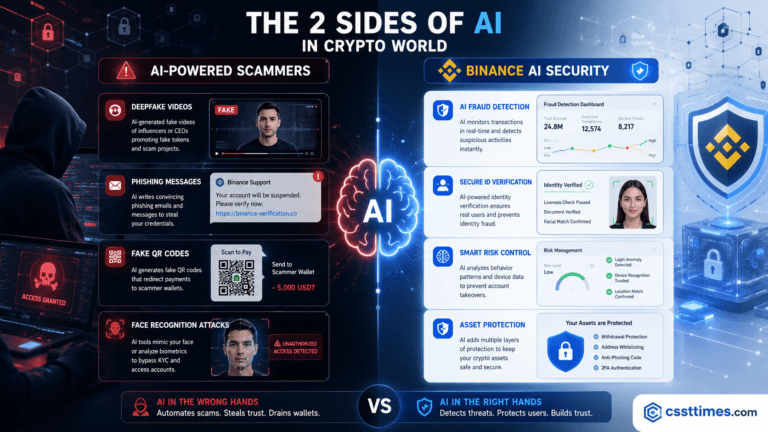
🎭 AI Face Attacks
Hackers collect your photos and videos from social media. They use AI to clone your face and try to trick Binance’s facial recognition system into giving them access to your accoun
🎬 Deepfake Impersonation
Scammers create AI-generated videos of crypto executives or support staff. They use these fake videos to convince users to send money or hand over personal information.
🔑 Share-Seed-Phrase Scams
A scammer pretends to be customer support and gives you their own seed phrase. They ask you to “secure” funds inside a wallet. The moment you send crypto in, they drain it instantly.
📱 Fake SMS & Phishing Links
AI is used to write highly convincing messages that look like they come from Binance. These messages trick users into clicking fake links or entering their login details on fake websites.
📷 Malicious QR Codes
Scammers send fake QR codes disguised as official Binance links. When you scan them, your login details are stolen and your account is accessed remotely without your knowledge.
——————— The Other Side ———————
The Good Side: How Binance Uses AI to Protect You
Teng has been just as clear about how Binance is using AI as a defensive weapon. The exchange is not sitting still while criminals get smarter — it is deploying AI across its entire security infrastructure.
🔍 Real-Time Fraud Detection
🛡️ Upgraded Facial Recognition Defences
🏦 Anti-Money Laundering (AML) Monitoring
🔒 New Withdrawal Lock Feature
🪪 Smarter Identity Verification (KYC)
Teng has acknowledged that Binance — with over 6,000 staff — cannot simply keep hiring more people to manage security at global scale. AI is what allows the platform to grow and stay secure at the same time.
CST Times General View
Richard Teng’s words are important because he spoke honestly. Many tech companies only talk about the good side of their technology, but Teng also accepted that AI can be dangerous. That makes his message more realistic and trustworthy.
At CST Times, we believe this is an important moment not only for Binance, but for the whole crypto and digital finance industry. The biggest problem is not the technology itself. The real problem is that many normal users do not fully understand the risks they face online.
AI-powered crypto scams increased by 500% in 2025 because scammers targeted human mistakes. Even the best security systems cannot protect people who click fake links, share their seed phrases, or trust unknown callers without checking their identity first.
We also believe the crypto industry needs stronger and clearer rules for AI-related threats. Right now, every crypto exchange gives different warnings to users. This is risky because AI scams are growing very quickly.
Technology itself is neutral. It can be used for good or bad purposes. But crypto companies must be honest and transparent about the dangers. Binance warning users about deepfakes, fake face scans, and seed phrase scams is a positive step. Other major crypto exchanges should also follow the same level of transparency.
How to Protect Yourself: What Teng Recommends
Richard Teng has repeatedly said that security is a shared responsibility. Binance can build the best AI defences in the world — but users must also play their part. Here is what he recommends:
🔐
Enable Two-Factor Authentication
Always use 2FA on your account. Use an authenticator app instead of SMS when possible — it is much harder to intercept.
Never Share Your Seed Phrase
No real Binance employee will ever ask for your seed phrase. If anyone does — it is a scam. Full stop.
Limit Your Facial Data Online
Be careful about posting videos and photos of your face. AI face attack scammers build their fakes from your public content.
Verify Every Link Before Clicking
Always check that URLs come from official Binance domains. If a message feels strange or urgent — it is probably a scam.
Secure Your Devices
Keep your phone and computer updated and free from malware. Never use Binance on public Wi-Fi or shared devices.
Use Binance’s Safety Tools
Turn on anti-phishing codes, address whitelisting, and withdrawal locks. Binance built these features for you — use them.
Why This Matters Beyond Binance
Teng’s message is not just for Binance users. It is a warning for everyone in the digital finance world. AI is not a Binance problem — it is a global problem.
In 2025 alone, the crypto industry lost an estimated $3.4 billion to theft and fraud. AI played a major role in a large portion of those losses. Deepfakes, automated phishing, and AI-generated fake identities made scams easier to run and harder to detect.
At the same time, AI-powered fraud detection tools helped exchanges freeze stolen funds and identify attackers before they could disappear. The same technology worked on both sides of the fight.
Industry experts believe that governments, crypto exchanges, and cybersecurity companies will need to work much more closely together in the coming years to establish clear standards and protections against AI-driven crime.
The Bottom Line
Richard Teng is correct that AI itself is neutral. It can be used for good or bad purposes. But that does not mean people should ignore the risks. Everyone — companies, governments, and users — must take action and stay careful.
For Binance, this means continuing to improve AI security systems and honestly warning users about new online threats. For users, it means learning about scams, staying careful online, and not trusting every message or phone call, even if it looks real.
At CST Times, we believe the future will depend on one important question: who will move faster — the people creating better security, or the scammers trying to break it? Right now, the best protection for every crypto user is simple knowledge and awareness.
Follow us on Social media for daily Updates:
About The Author

Haseeb Jabbar
Haseeb Jabbar writes about crypto, finance, technology, and AI at CST Times, sharing research-based guides, timely news, and free tools and calculators to help readers make informed decisions.
