

Why Crypto ETFs Are Attracting Institutional Investors
Introduction :
Over the past few years, cryptocurrencies like Bitcoin and Ethereum have gained popularity. Now a new trend is bringing large financial players – such as pension funds, banks, and hedge funds – into the crypto market: crypto ETFs (exchange-traded funds). Crypto ETFs let investors buy shares that track crypto prices on traditional stock exchanges. This “wrapper” makes crypto familiar and accessible to institutional investors. In January 2024 the U.S. SEC approved 11 Bitcoin ETFs from major firms (BlackRock, Fidelity, Ark, etc.), and in mid-2024 the first Ethereum ETFs followed. As a result, Bitcoin and Ethereum can now be bought via regulated funds, unlocking them for large investors who were previously on the sidelines.
Table of Contents
ToggleCrypto ETFs work like stock ETFs: each fund holds actual crypto (or tracks it) and issues shares that trade on exchanges. For example, a Bitcoin ETF holds Bitcoin, and an Ethereum ETF holds Ether. Investors can buy and sell these ETF shares through regular brokers, without ever managing digital wallets or private keys. This means big institutions can invest in crypto using the same systems they use for stocks or commodities. In fact, the launch of these ETFs “provides Bitcoin access to a new class of investors” (retirement funds, advisors, etc.) and could tap into about $30 trillion of advised U.S. wealth.
What Is a Crypto ETF?
A crypto ETF (exchange-traded fund) is an investment fund that tracks a cryptocurrency (like Bitcoin) and trades on a stock exchange, just like a normal stock or bond fund. Instead of buying crypto coins directly, investors buy shares of the ETF. The ETF issuer actually holds the crypto (using secure storage), and the share price moves up or down with the crypto’s price. Because they trade on stock markets, crypto ETFs must follow strict rules and provide reports, which appeals to institutional investors.
👉 Key Point:
Crypto ETFs let investors “gain exposure to the cryptocurrency market without the need to buy, store, or manage the digital assets directly”. You just buy ETF shares through your regular brokerage account.
Why Big Investors Love Crypto ETFs
Large investors (like pension funds, hedge funds, insurance companies, etc.) are increasingly putting money into crypto through ETFs, for several reasons:
Ease and Familiarity:
ETFs are a well-known tool. Institutions already use ETFs for stocks, gold, bonds, and other assets. Crypto ETFs work the same way, so firms can add crypto to portfolios without learning new systems. This means big investors can tap into Bitcoin or Ethereum simply by buying an ETF share through their usual channels. For example, when the first crypto ETFs launched in 2024, many accounts quickly shifted from “direct ownership” of crypto into funds like BlackRock’s iShares Bitcoin Trust.Professional Custody & Security:
Handling crypto on your own has risks (hacking, lost keys, etc.). Crypto ETFs solve this by using regulated custodians – established financial firms that securely store the crypto for the fund. Major custodians include Coinbase Custody, Fidelity Digital Assets, and BNY Mellon, all overseen by regulators. In fact, Coinbase already serves as the primary custodian for most U.S. Bitcoin ETFs. Institutions trust these custodians and multi-layer security (cold storage, multi-signature access) more than “self-custody.” This setup gives big investors confidence that their crypto holdings are safe and comply with rules.Regulatory Clarity and Trust:
Before ETFs, many institutions avoided crypto because rules were unclear. Now governments and regulators have begun approving crypto ETFs, creating a clear legal framework. The U.S. SEC’s January 2024 approval (after a court ruling) signaled that crypto can fit into regulated finance. Fund issuers must meet strict requirements on reporting, auditing, and segregation of assets. This regulatory oversight makes big investors more comfortable. As one SEC official said, new approvals make crypto products “less costly and more efficient,” which benefits investors. In short, ETFs have turned crypto into a legitimate asset class that advisors and boards can review like any other.No Technical Headaches:
Crypto itself involves technology that many finance professionals find complex (digital wallets, private keys, blockchain transactions, etc.). With an ETF, none of that is needed. Investors simply trade ETF shares on exchanges just as they would trade stocks. They don’t see the blockchain or manage keys – the fund issuer does all that behind the scenes. This simplicity is a major advantage.Portfolio Diversification:
Large portfolios always seek ways to manage risk. Cryptocurrencies often behave differently than stocks or bonds. For example, Bitcoin’s price can rise when inflation is high, similar to “digital gold.” By adding a small percentage of crypto (via ETFs) to a mixed portfolio, institutions can diversify and hedge against economic uncertainty. Industry data show that even 1–3% allocations to crypto can improve a portfolio’s risk/return profile. Many wealth managers now recommend modest crypto allocations for diversification.High Liquidity and Easy Trading:
ETF shares trade on stock exchanges during market hours. This means big investors can buy or sell large positions quickly at transparent prices. High liquidity is crucial when dealing with millions or billions of dollars. For example, BlackRock’s Bitcoin ETF (IBIT) now has tens of billions in assets, and all its trading is backed by large crypto reserves. On March 4, 2026 alone, U.S. Bitcoin ETFs saw a record one-day inflow of $461.8 million. Such volume shows that institutional investors can move big sums into crypto without causing wild price swings.Growth Opportunity:
Finally, crypto ETFs are new and rapidly growing. Billions of dollars have flowed into these funds since 2024. By late 2024, the dozen U.S. Bitcoin ETFs (from firms like BlackRock and Fidelity) had about $58 billion in combined assets. In early 2026, even when Bitcoin prices dipped to $69,000, big investors kept buying ETFs. Analysts expect this “structural demand” to continue: some forecasts predict U.S. crypto ETF assets could double or more by the end of 2026. As more banks (e.g. Morgan Stanley) launch their own Bitcoin ETFs, institutional inflows are likely to rise. Each new ETF means additional buying of real Bitcoin or Ether on the open market, which tends to push crypto prices up over time.
Impact on the Crypto Market
The arrival of large institutional money via ETFs is already changing the crypto market:
✔ More Capital and Stability:
Big investors bring long-term capital. This can smooth out extreme price swings. With large funds buying and holding crypto, the market depth increases. For example, after the 2024 ETF launches, Bitcoin’s market saw its biggest asset inflows ever, and volatility gradually decreased. Over time, this should make crypto prices more stable (though crypto remains riskier than stocks).
✔ Mainstream Legitimacy:
When pension funds or top banks hold crypto ETFs, the asset class gains credibility. This attracts more participants (from smaller institutions to individual investors). Crypto is gradually moving from “fringe” to mainstream in global finance.
✔ Blockchain Integration:
Institutional demand also drives improvements in infrastructure. Custody services, trading platforms, and compliance tools are expanding. Some banks are even issuing their own digital dollars (stablecoins) that can move funds on-chain. These developments help integrate blockchain technology into traditional finance.
Even during market dips or global events, crypto ETFs continue drawing money because investors trust the familiar ETF wrapper. For instance, in March 2026 (a volatile time for Bitcoin), major ETFs still saw hundreds of millions in new inflows. This shows that ETFs have created a solid on-ramp for even cautious players.
Institutional Case Studies
BlackRock iShares (IBIT):
The iShares Bitcoin Trust (IBIT) launched Jan 2024 and rapidly grew to $19.7B AUM by May 2024, making it the world’s largest Bitcoin fund. BlackRock’s wide distribution (advisors, wealth channels) helped capture over half of all new ETF inflows. Its early success shows how a top fund manager can shape market dynamics.
Fidelity Bitcoin ETF (FBTC):
Fidelity launched its spot Bitcoin ETF in Jan 2024 as well. By end-2024 it had gathered billions (Fidelity reported ~$12B by end-2024). Fidelity is notable for low fees (0.39% expected) and leveraging its brand to gain retail and institutional investors.
State of Wisconsin (SWIB):
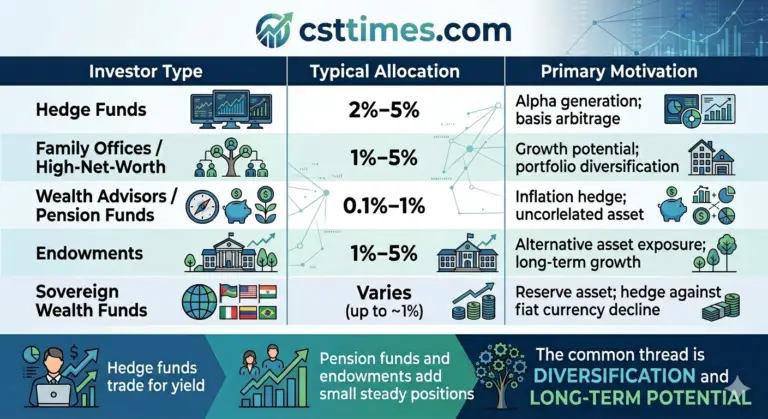
In early 2024, the Wisconsin pension fund quietly bought $99M of BlackRock’s IBIT and $64M of a Grayscale Bitcoin ETF. Though a small part (0.1%) of their $155B portfolio, this move was symbolic: a AAA-rated public pension embracing crypto. Commentators said SWIB’s action “provided institutional validation” and that other pensions “took note”.
Hedge Funds:
Many hedge funds use ETFs for trading strategies. Some engage in the “basis trade,” buying spot ETFs and selling futures (or vice versa) to capture yields. Others allocate 2–5% to crypto for alpha. While specific data is scarce, reports indicate hedge funds established large ETF positions by Q1 2024. They tend to trade actively, unlike longer-term holders.
Endowments and Wealth Managers:
University endowments (e.g. Harvard, Brown) and family offices have started adding BTC/ETH ETFs. (One report noted Harvard bought ~$116M of IBIT in 2025.) Wealth advisers often recommend 1–3% crypto allocations. A 2025 study found 74% of family offices had some crypto exposure or interest. These investors view crypto as a portfolio diversifier and growth asset.
Sovereign Wealth:
Notably, Abu Dhabi’s Mubadala and related funds quietly built large ETF positions. By Q4 2025 Mubadala held 12.7M IBIT shares and its Abu Dhabi Investment Council held 8.2M, each increasing their positions. Bloomberg reported these exceeded $1B combined. This shows that even government-backed funds see Bitcoin as a “neutral” reserve asset.
Risks and Considerations
While crypto ETFs solve many problems, there are still risks:
- Market Volatility: Crypto prices can be very volatile. If Bitcoin or Ethereum prices drop sharply, ETF investors will lose money too. ETFs don’t eliminate the underlying risk of crypto swings.
- Regulatory Changes: Even though regulations are clearer now, future changes could impact ETFs. Stricter rules or bans in some countries could affect flows.
- No Direct Ownership: ETF shareholders don’t own the crypto directly. They rely on the fund. Some investors prefer holding crypto in private wallets. With ETFs, that direct control (and certain benefits like yield from staking) is absent.
- Fees: ETFs charge management fees (often 0.2%–0.5%). Over long periods, fees can eat into returns, especially compared to “free” self-custody of crypto. Institutions consider this cost part of the ease-of-use tradeoff.
- Custody Concentration: Many ETFs use Coinbase. A large breach or regulatory issue at a custodian could disrupt all ETFs. Funds are moving to multi-custodian models to reduce this risk. Institutions also do due diligence on custodian insurance and governance.
- Trading Gaps: Crypto markets trade 24/7, but ETFs only on weekdays. This can cause price gaps (e.g., news hits crypto Saturday, ETF opens Monday). Institutions may use futures or options to hedge weekend moves.
- ESG Concerns: Bitcoin’s Proof-of-Work mining is energy-intensive. European and ESG-focused investors may limit PoW crypto. However, ETH’s move to Proof-of-Stake (and new greener chains) is alleviating some concerns. Some ETFs also invest in staking ETH (owning ETH and earning rewards).
Institutions mitigate these by keeping crypto a small portfolio slice, using ETFs only after thorough review, and staying diversified. As one professor noted, seeing a respected pension join in “alleviates concerns” and encourages cautious adoption.
Conclusion and Takeaways
Crypto ETFs have changed the game. By packaging Bitcoin, Ethereum and others into regulated, easily traded funds, they have brought billions of new dollars into crypto from institutional sources. They offer ease of use, professional security, and legal clarity that institutions require. As a result, crypto is moving from the “wild west” to a standard asset class.
Key takeaways:
- Institutional Gateway: Crypto ETFs act as a bridge for institutional capital. They allow big investors to gain crypto exposure in a familiar way.
- Ongoing Growth: The ETF channel is still in early innings. Assets and inflows are rising rapidly (e.g., $104B AUM by end-2024). Expect more products (new coins, staking ETFs) and wider adoption in 2026 and beyond.
- Diversification and Opportunity: Even modest ETF allocations help portfolios diversify. Institutional allocators (pensions, endowments) view crypto as “digital gold” and a growth asset.
- Maintain Caution: Institutional investing isn’t risk-free. Crypto is volatile and uncorrelated. ETFs help manage custody risk, but price risk remains. Investors should allocate prudently and stay informed on regulation.
Crypto ETFs are here to stay. They have already proven a powerful conduit for “big money” into crypto. For investors or professionals watching this space, understanding crypto ETFs is now as important as knowing any other major asset class. They combine crypto’s potential with traditional finance’s safety, opening the door to even greater institutional involvement.
About The Author

Haseeb Jabbar
Haseeb Jabbar writes about crypto, finance, technology, and AI at CST Times, sharing research-based guides, timely news, and free tools and calculators to help readers make informed decisions.
