
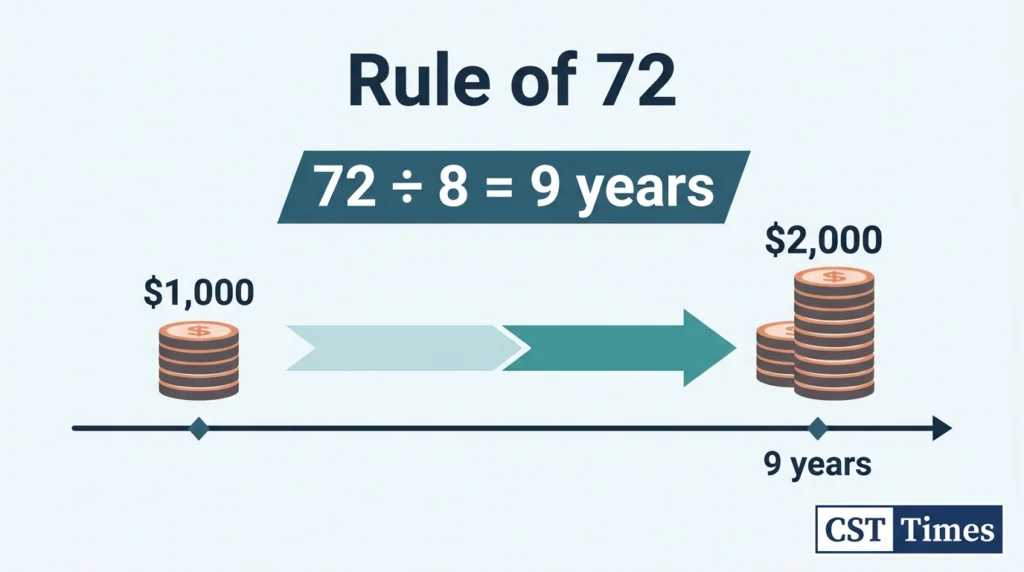
Rule of 72: How Long Does It Take to Double Your Money?
Quick Summary:
The Rule of 72 is a quick mental-math shortcut that estimates how many years it takes for money to double at a fixed annual growth rate. You divide 72 by the rate, so a steady 8% gives roughly 9 years. This guide shows the formula, compares it with exact compound-growth results, and explains why real-life results can differ.
Table of Contents
ToggleHow long would it take to turn $1000 into $2000?
According to the “Rule of 72” your money can double in approximately 12 years at an annual growth rate 6%. However, the annual return on investment may rise or fall from year to year, so your money might not double in excatly 12 years.
This guide explains the use of ‘Rule of 72’, provides example of doubling amounts of $1,000 and £1,000, and describes how factors such as fees, taxes, Inflation, and changes in the rate of return can affect the outcomes.
Key Takeaways
- Divide 72 by the annual rate, as a whole number, to estimate the years to double: 72 ÷ 6 ≈ 12 years.
- The estimate is closest to the exact math at roughly 6% to 10% and drifts a little at very low or very high rates.
- It assumes one steady rate, so treat results as illustrations, not forecasts.
- Fees, taxes, withdrawals and inflation can all stretch the real doubling time.
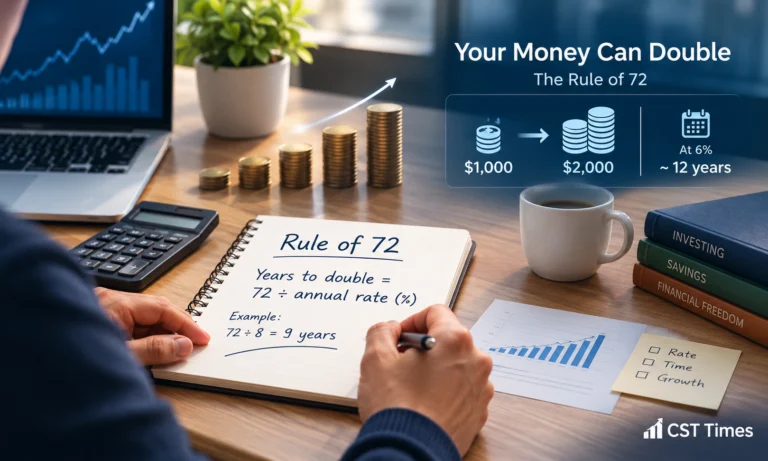
What is the Rule of 72?
The Rule of 72 estimates how long money takes to double when it earns a steady annual rate and the earnings are reinvested. It relies on compound interest, which is interest paid on your original money plus the interest already added. Investor.gov, the U.S. SEC’s investor education site, gives a 9% example: money doubles about every 8 years.
It only works with compounding. If you withdraw the interest each year, your money won’t double on this schedule.
The Formula: How to Calculate Doubling Time
To estimate doubling time, divide 72 by the annual growth rate. The result is roughly how many years it takes for money to double. Enter the rate as a whole number: 8% becomes 8, not 0.08. For example, 72 ÷ 8 = 9, so about 9 years.
Years to double ≈ 72 ÷ annual rate (%)
- Take the annual rate, such as 6%.
- Drop the percent sign: 6.
- Divide 72 by it: 72 ÷ 6 = 12 years.
Run it backwards to find the rate that doubles money in a set time: divide 72 by the number of years.
Examples: $1,000 and £1,000
At 6% a year, $1,000 or £1,000 would take about 12 years to grow to roughly $2,000 or £2,000. At 4% it takes about 18 years, and at 8% about 9 years. The currency doesn’t change the formula. Only the assumed growth rate does.
| Annual rate | Rule of 72 estimate | $1,000 or £1,000 after that time* |
|---|---|---|
| 4% | 18 years | about $2,026 / £2,026 |
| 6% | 12 years | about $2,012 / £2,012 |
| 8% | 9 years | about $1,999 / £1,999 |
Mathematical example with annual compounding and no deposits or withdrawals, not a prediction of real returns. The small gaps from 2,000 show the rule is an estimate.
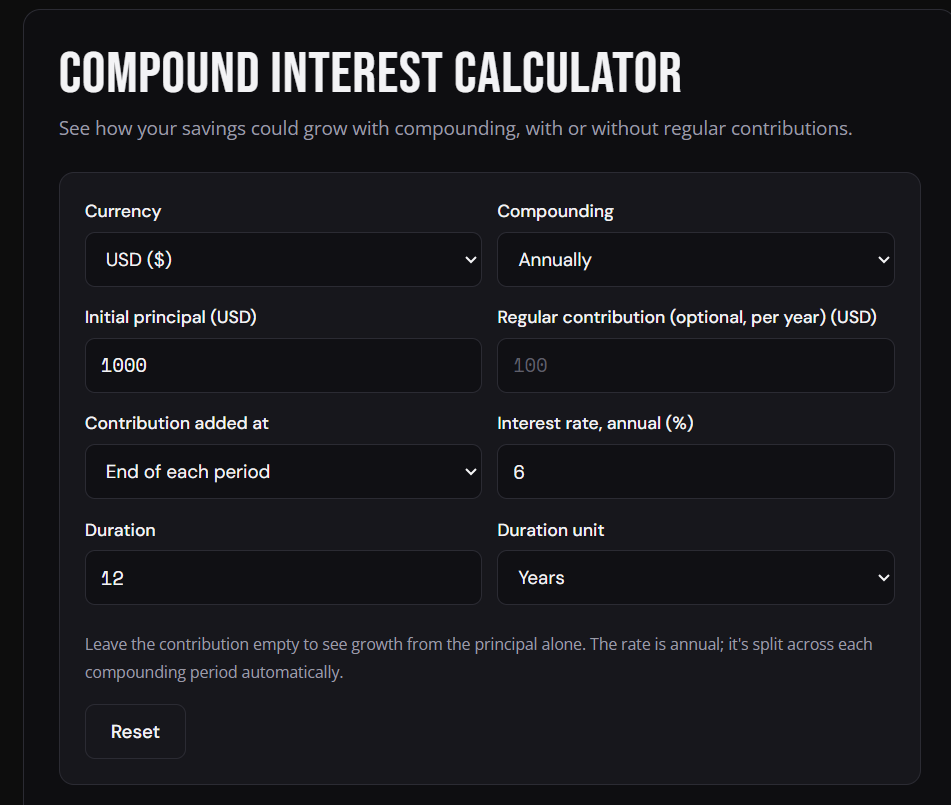
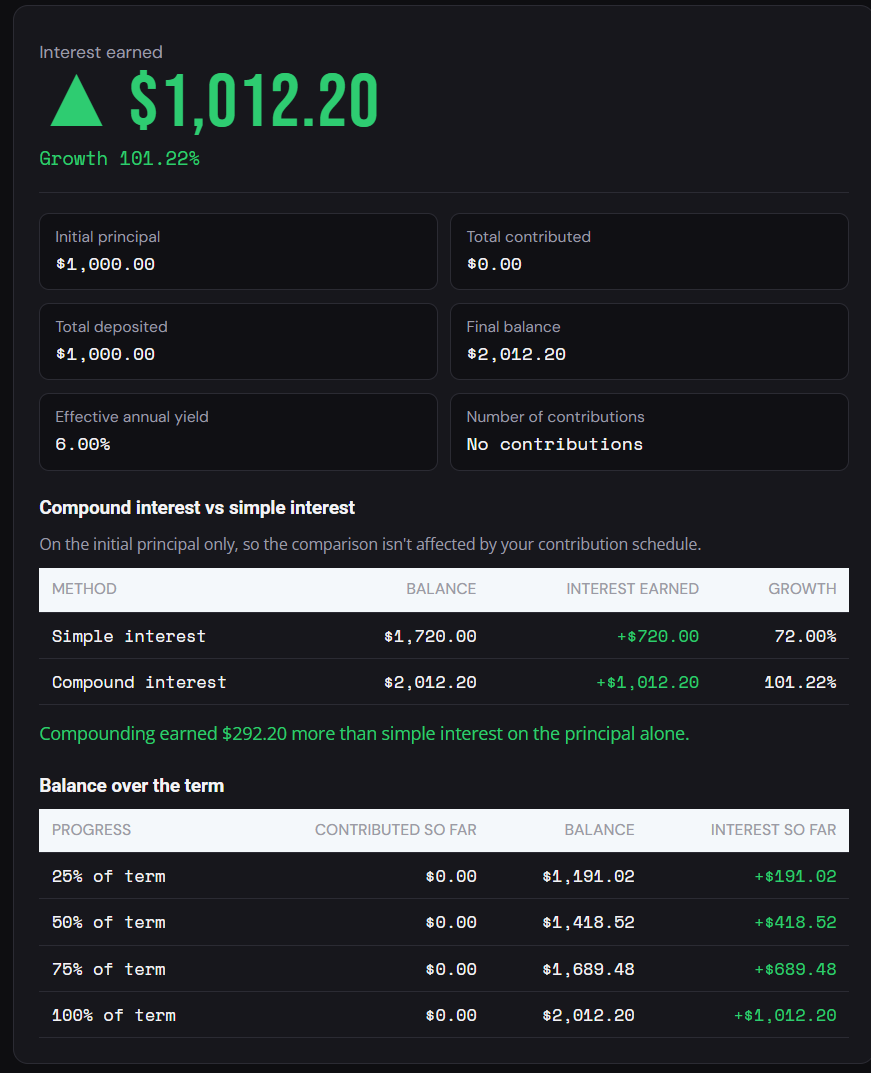
You can easly Calculate “Compound Interest Calculator“
How Accurate Is the Rule of 72?
The Rule of 72 is accurate enough for quick planning. For annual rates from 4% to 12%, its estimate lands within about four months of the exact doubling time. It runs slightly high at lower rates and slightly low at higher rates.
The exact figure comes from the compound-growth formula: years = ln(2) ÷ ln(1 + rate), where the rate is a decimal and ln is the natural logarithm. In a spreadsheet, type =LN(2)/LN(1+0.06) for 6%.
| Annual rate | Rule of 72 estimate (years) | Exact doubling time (years) | Difference |
|---|---|---|---|
| 4% | 18.00 | 17.67 | +0.33 |
| 5% | 14.40 | 14.21 | +0.19 |
| 6% | 12.00 | 11.90 | +0.10 |
| 7% | 10.29 | 10.24 | +0.04 |
| 8% | 9.00 | 9.01 | −0.01 |
| 10% | 7.20 | 7.27 | −0.07 |
| 12% | 6.00 | 6.12 | −0.12 |
Exact values are mathematical results assuming annual compounding and no withdrawals, rounded to two decimals.
Why the Shortcut Works
Doubling means growing by a factor of two, so the exact question is how many years make (1 + rate) raised to that number equal 2. Solving it gives ln(2) ÷ ln(1 + rate). Because ln(2) is about 0.693, the shortcut is roughly 69.3 ÷ the rate, and that is the idea behind it.
Why 72 and not 69.3? It divides evenly by 2, 3, 4, 6, 8, 9 and 12, and at everyday rates the exact constant sits a little above 69.3, at about 72 for 8%. Robinhood Learn traces the number to Luca Pacioli’s 1494 book.
Savings Rates vs Investment Returns
A savings account usually states its rate, which makes the shortcut easy to apply, although many rates can change. Investment returns behave differently. Stocks, funds and crypto assets rise and fall, so there is no single yearly rate to plug in, and no investment is guaranteed to double on schedule.
A fund with a 7% average return may have had big gains and losses along the way, while the formula assumes 7% every single year. A bad early year can delay doubling, which is part of market risk. Even savings rates can move when interest rates shift across the economy, a topic covered in our guide to interest rate risk.
Use it to compare scenarios, not to promise outcomes: 4% takes about 18 years to double money and 7% about 10.3, but neither rate is guaranteed.
Limitations: Fees, Taxes and Changing Returns
The shortcut is a quick estimate, not a forecast. It assumes one constant rate, reinvested growth, and no extra costs or cash movements. Real accounts rarely work that way, so treat any answer as a rough starting point rather than a promise.
- Changing returns. Returns shift from year to year, so the real doubling time can be shorter or longer.
- Fees. Fees reduce the growth you keep. In a hypothetical, 7% before a 1% annual fee nets 6%, which means about 12 years to double instead of 10.3.
- Taxes. Tax on interest or gains lowers your net growth. The rules differ by country and account type.
- Withdrawals and deposits. Withdrawals slow doubling, and deposits speed up reaching a target. The formula models neither.
Doubling Your Balance vs Doubling Your Purchasing Power
Your balance can double while what it buys does not. Inflation is the rate at which prices rise over time, so each pound or dollar buys less, as the Bank of England explains. What matters for real wealth is growth after inflation, which is smaller than the headline rate.
Take a hypothetical 4% savings rate with 3% inflation. The balance doubles in about 18 years, but buying power grows only about 1% a year, so doubling in real terms would take roughly 72 years (72 ÷ 1).
The same method works for losses. At 3% inflation, money loses half its buying power in about 24 years (72 ÷ 3), against an exact result of about 23.4. Inflation is a classic example of systematic risk: it affects the whole market, and diversifying can’t remove it.
What Return Doubles Your Money in 10 Years?
To double money in 10 years you would need about 7.2% a year, because 72 ÷ 10 = 7.2. The exact compound-growth answer is about 7.18%. It is a target to understand, not something any savings account or investment can promise.
Other targets work the same way: 15 years needs about 4.8% (exact 4.73%) and 20 years about 3.6% (exact 3.53%). Shorter time frames need higher rates, and higher potential returns usually come with higher risk, including the risk of loss.
Rule of 72 vs Rule of 70
The Rule of 70 and Rule of 69.3 use the same method with a different top number. The Rule of 72 is easiest to divide and works well near 8%. The Rule of 70 tends to be closer at lower rates, while 69.3 is exact for continuous compounding, where interest is added constantly.
| Annual rate | Exact doubling time (years) | Rule of 72 | Rule of 70 |
|---|---|---|---|
| 3% | 23.45 | 24.00 | 23.33 |
| 6% | 11.90 | 12.00 | 11.67 |
| 8% | 9.01 | 9.00 | 8.75 |
| 12% | 6.12 | 6.00 | 5.83 |
Below about 5%, the Rule of 70 is usually closer. From about 5% upward, 72 usually is. The gaps are small, so use whichever number you can divide faster.
Check Your Numbers with a Compound Interest Calculator
For more precise results than the shortcut gives, use a compound interest calculator. CST Times’ free Compound Interest Calculator lets you enter a starting amount, annual rate, time period, compounding frequency and optional regular contributions, with USD and GBP among its currency options.
Try $1,000 (or £1,000) at 6% for 12 years. Our own calculation gives about $2,012 with annual compounding, close to the 72 ÷ 6 estimate, and about $2,051 with monthly compounding.
Final Thoughts:
The Rule of 72 gives beginners a fast feel for how interest rates shape doubling time: higher rates shorten the wait and lower rates stretch it. Use it to compare scenarios and set realistic expectations, then check important decisions with an exact calculation. Fees, taxes, inflation and changing returns can all move the real result.
FAQs
Does the Rule of 72 work for every interest rate?
It works best for annual rates of roughly 6% to 10%. At very low rates it slightly overestimates the time to double, and at high rates it slightly underestimates it. At 1%, for example, the rule says 72 years, while the exact answer is about 69.7 years.
Does it work with monthly compounding?
Roughly, yes, but monthly compounding doubles money slightly faster. At 6%, annual compounding takes about 11.9 years, monthly compounding about 11.6 years, and the shortcut estimates 12. The gap is small, so it still gives a useful ballpark for most savings accounts.
Can it be used with simple interest?
No. The method assumes compounding, where earnings are reinvested. With simple interest you earn only on the original amount, so doubling takes 100 ÷ the rate. At 6% simple interest that is about 16.7 years, compared with roughly 12 years when interest compounds.
Can I use it to estimate stock market returns?
Only as an illustration. Stock returns vary from year to year, so there is no fixed rate to use. You can test an assumed average, such as 6%, to see how long doubling would take at that pace, but real results could be faster, slower, or negative over any period.
Disclaimer
This article is for educational and informational purposes only and is not financial, investment, or legal advice. Crypto assets are volatile, and you can lose some or all of your money. Always do your own research.
