

What is Net Worth? 5 Easy Steps to Calculate It
Quick Summary:
What is net worth? It is the total value of everything you own minus everything you owe. Think of it as a financial snapshot: one number that shows where you stand on a given day. This guide explains the formula, what counts as an asset or a liability, a five-step method to calculate yours, and what typical figures look like in the United States.
Table of Contents
ToggleKey Takeaways
- Net worth equals total assets minus total liabilities.
- Income is not part of the formula, so a high earner can still have a low or negative net worth.
- Your number is a snapshot that changes as asset values and debts change.
- Use the same method each time, and recalculate at least once a year.
- In 2025, the median US family had a net worth of $215,900, per the Federal Reserve.

What is Net Worth?
Net worth is the value of everything you own (your assets) minus everything you owe (your liabilities). It shows how much would remain if you sold your assets at current values and paid off every debt. The Federal Reserve uses the same idea in its Survey of Consumer Finances, treating net worth as families’ gross assets minus their liabilities.
Net worth is not income. Income is what you earn over time; net worth is what you hold at one moment. J.P. Morgan Wealth Management notes that a high earner can still have a negative net worth, while a modest earner with low debt can have a strong one.
The Net Worth Formula
The formula is Net Worth = Total Assets − Total Liabilities. Add up the current market value of everything you own, add up every debt you owe today, then subtract the second total from the first. The answer is positive, zero, or negative.
- Positive: your assets are larger than your debts.
- Zero: your assets exactly cover your debts.
- Negative: you owe more than you own.
A negative result is not a failure. It is common early in adult life. In the Fed’s 2025 survey, the average net worth of the lowest-wealth quarter of US families was slightly below zero, at about −$4,300.
What Counts as an Asset or a Liability?
An asset is anything of financial value that you own, such as cash, investments, property, or a vehicle. A liability is any debt you owe, such as a mortgage, student loan, or credit card balance. Count both at their value today, not the price you originally paid or borrowed.
| Assets (what you own) | Liabilities (what you owe) |
|---|---|
| Cash in checking and savings accounts | Mortgage balance |
| Stocks, funds, bonds, and crypto at today’s market price | Car loan balance |
| Retirement accounts (for example, a US 401(k) or IRA) | Student loans |
| Home and other property at estimated market value | Credit card balances |
| Vehicles at resale value | Personal loans and buy now, pay later balances |
| Business stakes and cash-value life insurance | Unpaid taxes and overdue bills |
Two details trip people up. First, edX advises leaving out furniture, clothing, and personal items, which rarely convert to cash. Second, the Fed’s measure excludes future Social Security and employer pension payments because their present value depends on assumptions. Skipping them is reasonable in a basic calculation.
How to Calculate Net Worth in 5 Steps
List what you own, value each item realistically, list what you owe, subtract, and repeat on a schedule. A spreadsheet or notes app is enough. What matters most is using the same method every time, so your results can be compared.
Step 1: List your assets
Write down every item from the table above, including bank, brokerage, retirement, and crypto accounts, property, and vehicles.
Step 2: Value each asset realistically
Use balances from today’s statements for accounts. For a home or car, use a realistic selling price based on recent comparable sales, not what you paid. A home’s value is only an estimate until it sells, as Chase points out. If you hold assets in more than one currency, convert them all into one currency on the same date.
Step 3: List your liabilities
Take the current balance from each statement, not the original loan amount. Include credit cards, loans, mortgages, buy now, pay later plans, and taxes you owe. A financial planner quoted by edX says taxes due are a commonly missed item, especially for independent contractors.
Step 4: Subtract
Subtract total liabilities from total assets. The result is your net worth.
Step 5: Record it and repeat
Save the result with the date. edX recommends calculating at least yearly, and more often when you are just starting out. Watch the trend, not only the number.
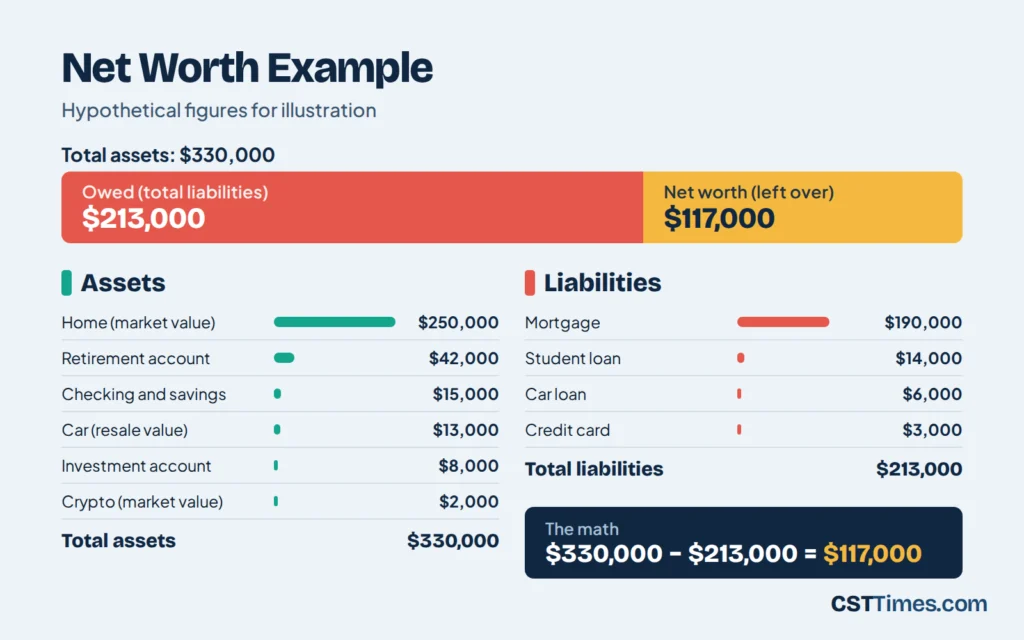
Net Worth Example
This hypothetical example uses invented figures.
| Item | Amount |
|---|---|
| Assets | |
| Checking and savings | $15,000 |
| Retirement account | $42,000 |
| Investment account | $8,000 |
| Crypto (market value on the day) | $2,000 |
| Car (resale value) | $13,000 |
| Home (estimated market value) | $250,000 |
| Total assets | $330,000 |
| Liabilities | |
| Mortgage | $190,000 |
| Car loan | $6,000 |
| Student loan | $14,000 |
| Credit card | $3,000 |
| Total liabilities | $213,000 |
| Net worth | $117,000 |
The math: $330,000 − $213,000 = $117,000.
Common Mistakes When Calculating Net Worth
Most common mistakes fall into three groups: overvaluing assets, forgetting debts, and counting something twice. Checking your list against the five points below takes only a few minutes and helps keep your total honest and comparable from year to year.
- Counting income or future raises. Net worth reflects what you hold today, not what you expect to earn.
- Overvaluing assets. Use realistic selling prices, and skip items you would never sell.
- Double counting the home. Use the full value as an asset and the mortgage as a liability, or use the equity alone (value minus mortgage, $60,000 in the example above). Never do both.
- Treating rent as a debt. Month-to-month rent and subscriptions are expenses, not liabilities, unless you are behind on them.
- Ignoring tax on retirement withdrawals. Some retirement accounts are taxed on withdrawal, so spendable value can be lower than the balance. Counting the full balance is standard; just keep the gap in mind.
What is a Good Net Worth?
There is no universal good number. It depends on your age, location, cost of living, and goals. For context, the Federal Reserve’s 2025 Survey of Consumer Finances, released on October 9, 2026, found a US median family net worth of $215,900 and a mean of about $1.24 million.
The median is the midpoint; the mean is pulled up by a small number of very wealthy families, so the two differ widely. Medians by age, in inflation-adjusted 2025 dollars, show how net worth usually builds over a lifetime:
| Age of family reference person | Median net worth |
|---|---|
| Under 35 | $33,000 |
| 35–44 | $155,600 |
| 45–54 | $253,700 |
| 55–64 | $411,900 |
| 65–74 | $431,300 |
| 75 and older | $504,900 |
These are US family figures from the Fed’s report, not a target or a global benchmark. Your own trend matters more than comparison with others.
How to Increase Your Net Worth
Net worth rises when assets grow faster than debts. The main levers are earning more than you spend, paying down debt, saving consistently, and investing for growth while managing risk. No method guarantees results, and a market drop can lower your number even when your habits are sound.
One point many guides blur: paying off a loan with savings does not change your net worth that day. Your assets and your debt fall by the same amount. The benefit comes later, because you stop paying interest.
- Reduce high-interest debt first. Credit card balances are a common starting point, according to Chase.
- Build a cash cushion. Chase suggests three to six months of expenses.
Final Thoughts:
So, what is net worth? It is one subtraction, assets minus liabilities, that shows where you stand today. Calculate it once with realistic values, repeat it on a schedule, and judge your progress by the direction of change rather than by comparison with others.
FAQs
What is net worth in simple words?
Net worth is what you own minus what you owe. Add up your cash, investments, property, and other valuables, then subtract all your debts. If the result is positive, your assets exceed your debts. If it is negative, you owe more than you own.
Can net worth be negative?
Yes. It is negative when your debts are larger than your assets, which is common after taking student loans or with little savings. A negative number is a starting point, not a verdict. Paying down debt and building assets steadily can move it upward over time.
Is my home part of my net worth?
Yes. Count the home at its estimated market value as an asset and the mortgage as a liability. Or count only your equity, which is value minus mortgage. Do not do both. The Fed reports a median net housing value of $230,000 among US homeowners in 2025.
How often should I calculate my net worth?
At least once a year, according to edX. A certified financial planner quoted there suggests checking more often when you are just starting out, then less often once your finances are more settled. Use the same method each time so the results are comparable.
Does cryptocurrency count toward net worth?
Yes. Crypto is an asset, and the Fed’s survey lists it among financial assets. Value it at the market price on the day you calculate and note the date, because prices can change quickly. The total is a snapshot, not a guaranteed value.
Disclaimer
This article is for educational and informational purposes only and is not financial, investment, or legal advice. Crypto assets are volatile, and you can lose some or all of your money. Always do your own research.
