
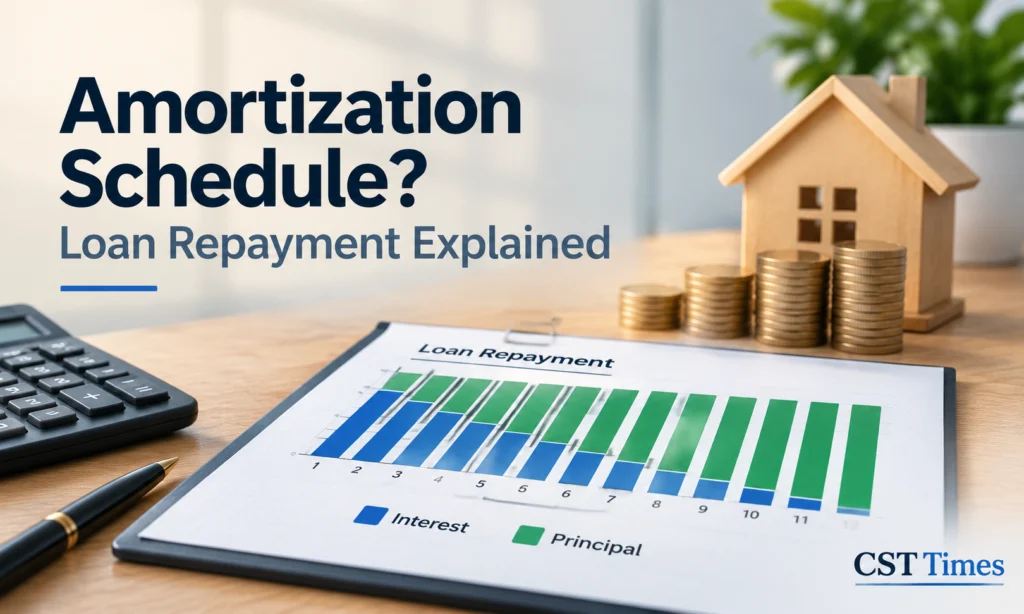
What is an Amortization Schedule? Loan Repayment Explained
Quick Summary:
An amortization schedule is a table that lists every payment on a loan and shows how much of each payment covers interest and how much reduces the money you owe. Think of it as a map of your loan, from the first payment to the last. This guide explains how to read an amortization schedule, how the numbers are calculated, and how extra payments can change the outcome.
Table of Contents
ToggleKey Takeaways
- An amortization schedule splits every loan payment into interest and principal and shows the balance left after each one.
- On a standard fixed-payment loan, early payments are mostly interest and later payments are mostly principal.
- A longer loan term lowers the monthly payment but increases the total interest you pay.
- Extra payments toward principal can shorten a loan, but check your agreement for a prepayment penalty first.
What is an Amortization Schedule?
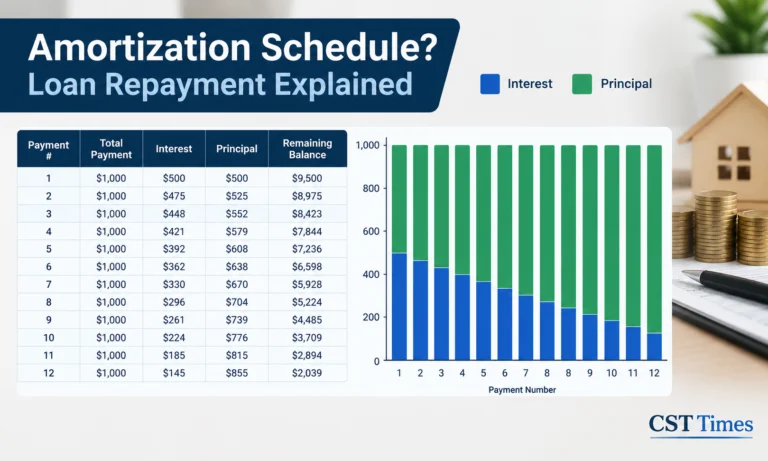
An amortization schedule is a table that shows how a loan is repaid over time. For every payment, it lists the interest, the principal (the amount you borrowed) that is repaid, and the balance still owed. The U.S. Consumer Financial Protection Bureau (CFPB) uses the same term for this chart.
“Amortization” simply means paying off a debt through regular, scheduled payments, as with mortgages, auto loans and personal loans.
What Does an Amortization Schedule Show?
Most schedules show five things for every payment: the payment number or date, the payment amount, the interest portion, the principal portion and the remaining balance. Some versions also add running totals of interest paid.
| Column | What it tells you |
|---|---|
| Payment number or date | When each payment is due |
| Payment amount | The total paid in that period, usually fixed |
| Interest | The cost of borrowing for that period |
| Principal | The part that reduces your debt |
| Remaining balance | What you still owe after the payment |
Read each row left to right: the principal portion is subtracted from the previous balance to give the new balance.
How Does Loan Amortization Work?
The main difference is the supply used. Market cap uses circulating supply, so it shows today’s tradable value. FDV uses total or maximum supply, so it shows the value if every token were released at the current price. The gap between the two shows how much supply is still to come.
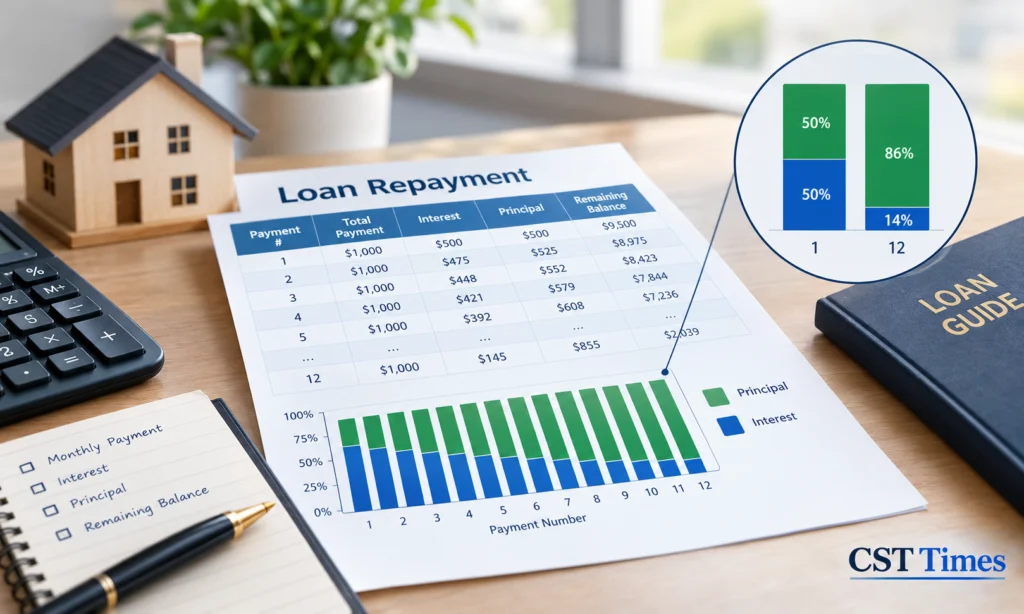
Lenders charge interest on the balance you still owe. Early in the loan that balance is large, so interest takes a big share of each fixed payment. As the balance falls, interest shrinks and more of the same payment goes toward principal.
The CFPB explains that the principal balance falls slowly at first and faster toward the end of the term. It also notes that a longer term lowers your monthly payment but raises the total interest you pay over the life of the loan.
How to Calculate an Amortization Schedule Step by Step
To build a schedule, first find the fixed monthly payment from the loan amount, interest rate and term. Then, for each month, multiply the balance by the monthly rate to get interest, subtract interest from the payment to get principal, and subtract principal from the balance.
The CFPB says lenders use a standard formula, and that the payment depends on the loan amount, the loan term and the interest rate. For a fixed-rate loan, the usual formula is
Payment = P × r ÷ (1 − (1 + r)^−n)
Here P is the loan amount, r is the monthly interest rate (the annual rate divided by 12) and n is the number of monthly payments. In a spreadsheet, the PMT function does this for you.
Then repeat these steps for every month:
- Interest = remaining balance × monthly rate.
- Principal = payment − interest.
- New balance = old balance − principal.
Example (hypothetical): a $10,000 loan at 6% a year, repaid over 12 months. The monthly payment is $860.66.
| Month | Payment | Interest | Principal | Balance |
|---|---|---|---|---|
| 1 | $860.66 | $50.00 | $810.66 | $9,189.34 |
| 2 | $860.66 | $45.95 | $814.71 | $8,374.63 |
| 3 | $860.66 | $41.87 | $818.79 | $7,555.84 |
| 12 | $860.70 | $4.28 | $856.42 | $0.00 |
Source: CST Times calculation. The last payment is adjusted by a few cents to clear the balance.
Total interest is $327.96.
A Bigger Example: Why the Early Years Feel Slow
On a long loan, the first years of payments are mostly interest. In a hypothetical $200,000, 30-year loan at a fixed 6.5%, about 86% of the first payment is interest, and the balance drops by only about $181 in month one.
| Payment # | Payment | Interest | Principal | Remaining balance |
|---|---|---|---|---|
| 1 | $1,264.14 | $1,083.33 | $180.80 | $199,819.20 |
| 60 (year 5) | $1,264.14 | $1,015.47 | $248.67 | $187,221.95 |
| 120 (year 10) | $1,264.14 | $920.27 | $343.87 | $169,552.25 |
| 240 (year 20) | $1,264.14 | $606.60 | $657.53 | $111,330.57 |
| 360 (year 30) | $1,264.14 | $6.81 | $1,257.33 | $0.00 |
Source: CST Times calculation. Taxes, insurance and fees are not included.
After five years, the borrower has paid roughly $75,800 in total but reduced the balance by only about $12,800. Over the full 30 years, interest adds up to about $255,000, more than the amount borrowed.
Term length changes this picture sharply. At the same 6.5% rate:
| Loan term | Monthly payment | Total interest |
|---|---|---|
| 15 years | $1,742.21 | about $113,599 |
| 30 years | $1,264.14 | about $255,089 |
A shorter term means a higher payment but far less interest, so the right choice depends on what payment you can sustain.
How Extra Payments Change the Schedule
Paying extra toward principal lowers your balance sooner, so less interest builds up in later months. The loan then ends earlier than the original schedule shows. The earlier in the loan you pay, the bigger the effect, because more months benefit from the lower balance.
Using the same hypothetical $200,000 loan at 6.5%:
| Extra paid each month | Payoff time | Total interest | Interest saved |
|---|---|---|---|
| $0 | 30 years | $255,089 | none |
| $100 | 24 years 5 months | $199,143 | about $55,946 |
| $200 | 20 years 10 months | $165,012 | about $90,077 |
Source: CST Times calculation. It assumes a fixed rate, extra money applied to principal every month from the start, and no fees.
Check your loan terms before prepaying. The CFPB describes a prepayment penalty as a fee some lenders charge when you pay off all or part of a mortgage early. It typically applies when the whole balance is paid off within the first three or five years, for example when selling or refinancing, and it does not normally apply to small extra principal payments. The CFPB still advises confirming with your lender.
Fully Amortizing, Balloon and Negative Amortization Loans
Not every loan pays off at a steady pace. A fully amortizing loan reaches zero by its final payment. Other structures, such as balloon and negative amortization loans, do not, and they carry extra risk. Knowing which type you have changes how you read the schedule.
| Loan type | How the balance behaves |
|---|---|
| Fully amortizing | Fixed payments cover interest and principal, reaching zero at the end of the term |
| Balloon | Payments are set as if the loan were longer, so a large lump sum is due at the end |
| Negative amortization | Payments are too small to cover interest, so the balance grows |
The CFPB gives a balloon example: a $100,000 mortgage with 30-year payments at 4% costs about $477 a month, but on a five-year balloon loan about $90,448 would still be due at the end of year five.
On negative amortization, the CFPB warns that unpaid interest is added to what you owe, so you can end up owing more than your home is worth.
With an adjustable-rate loan, the CFPB says payments are typically recalculated when the rate changes, so its schedule is only an estimate until the rate resets.
Quick Checklist Before You Rely on a Schedule
- Check total interest, not just the monthly payment.
- Remember the full monthly bill. The CFPB notes that mortgage payments often include homeowners’ insurance and taxes too.
- Check the rate type. A variable rate means the schedule can change.
- Read the prepayment terms. Ask how extra payments are applied, and aim for them to go to principal.
Final Thoughts:
An amortization schedule turns a loan into something you can see: how much interest you pay, how fast the balance falls and when the debt ends. Use it to compare loan terms before you borrow and to test extra payments afterward. Ask your lender for the full schedule and read the prepayment terms before you sign.
FAQs
What is an amortization schedule in simple terms?
It is a table that lists each loan payment and splits it into interest and principal. It also shows the balance left after every payment, ending at zero on the final due date. Lenders can provide one, and online calculators or spreadsheets can generate an estimate.
Why is most of my early payment interest?
Interest is charged on the balance you still owe, and that balance is highest at the start. Because the monthly payment stays fixed, a large share goes to interest at first. As the balance shrinks, the interest portion falls and the principal portion grows.
How can I create an amortization schedule myself?
Find the monthly payment from the loan amount, interest rate and number of payments. Then repeat three steps each month: calculate interest, subtract it from the payment to get principal, and reduce the balance. A spreadsheet PMT function or an online amortization calculator can do this automatically.
Does an amortization schedule include taxes and insurance?
Usually it shows principal and interest only. On many mortgages the total monthly payment is higher because it also includes items such as homeowners’ insurance and property taxes. Check your loan statement to see the full amount your lender collects.
Can extra payments shorten my loan?
Yes, if the extra money is applied to principal. A lower balance means less interest in later months, so the loan can end sooner. Check for a prepayment penalty first, and ask your lender how extra payments are applied.
What is negative amortization?
It happens when your payments do not cover the interest due. The unpaid interest is added to your balance, so the amount you owe rises even though you are paying. It can be risky because you may end up owing more than the property is worth.
Disclaimer
This article is for educational and informational purposes only and is not financial, investment, or legal advice. Loan terms vary by lender and country, so check your own loan agreement and speak to a qualified professional before making borrowing decisions.
