
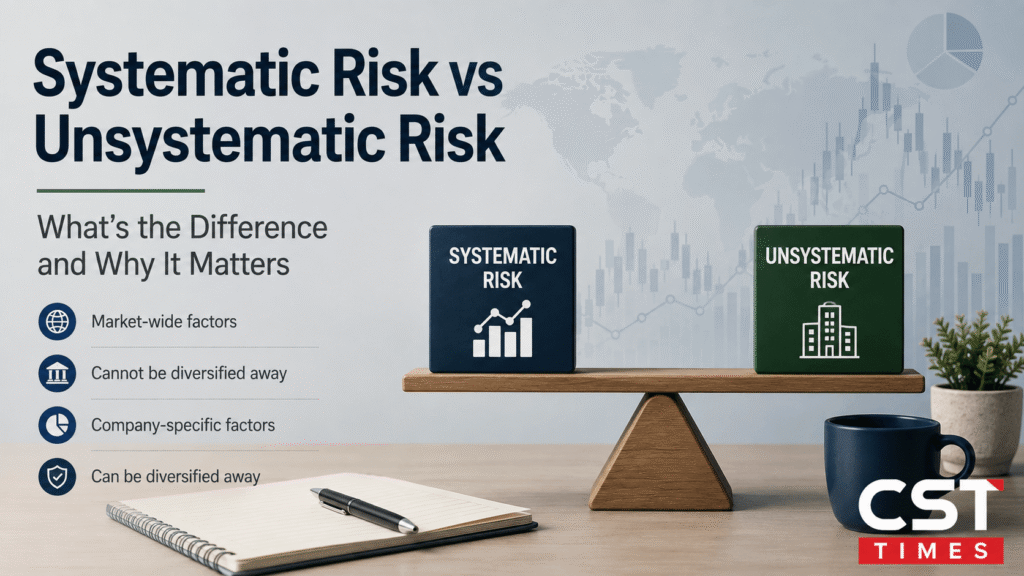
Systematic vs Unsystematic Risk: What’s the Difference and Why It Matters
Systematic vs Unsystematic Risk:
Quick Summary:
Every investment carries risk, but not all risk behaves the same way. Systematic risk is the risk built into the entire market — things like inflation, interest rate changes, and recessions — and no amount of diversification can remove it. Unsystematic risk is specific to one company or industry, such as a lawsuit or a product recall, and it can largely be diversified away by spreading your money across different investments.
Table of Contents
ToggleUnderstanding this distinction matters because it changes how you build a portfolio. You cannot protect yourself from a market-wide downturn by simply buying more stocks — but you can protect yourself from a single company’s bad news. This guide breaks down both types of risk, how they’re measured, and what you can realistically do about each one.
Key Takeaways
- Systematic risk (also called market risk) affects the entire market and cannot be eliminated through diversification.
- Unsystematic risk (also called specific, diversifiable, or idiosyncratic risk) affects one company or sector and can largely be reduced by diversifying.
- Beta is the standard measure of systematic risk — it shows how much a stock tends to move relative to the overall market.
- Diversification does not protect against systematic risk; it only reduces unsystematic risk.
- Research on diversification generally suggests that holding stocks across 15 to 30 different industries captures most of the possible risk reduction, though estimates vary by market and time period.
- Investors are financially rewarded for taking on systematic risk, but not for taking on unsystematic risk, because unsystematic risk can be avoided at little cost.
Table of Contents
- What Is Systematic Risk?
- What Is Unsystematic Risk?
- Systematic vs Unsystematic Risk: Quick Comparison
- How Beta Measures Systematic Risk
- A Real Example: The 2025 Tariff Selloff
- How to Manage Each Type of Risk
- Quick Checklist for Investors
- Final Thoughts
What i s Systematic Risk?
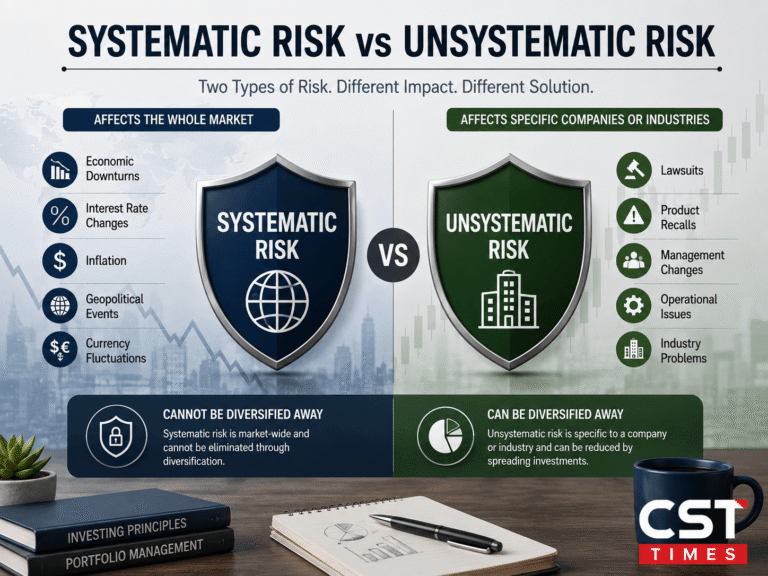
Systematic risk is the risk that comes from forces affecting the entire economy or an entire market, not just one company. It’s sometimes called market risk, and it’s the reason that even a well-run, profitable company can still lose value if the broader market falls.
Common sources of systematic risk include:
- Interest rate risk — when central banks raise or cut rates, it changes borrowing costs and company valuations across the board.
- Inflation (purchasing power) risk — rising prices erode real returns on almost every asset at the same time.
- Recession and economic-cycle risk — a slowdown reduces consumer spending and corporate earnings broadly, not just for one firm.
- Geopolitical and policy risk — wars, trade disputes, and government policy shifts can move entire markets at once.
- Currency (exchange rate) risk — for investors buying foreign assets, for example, a European or Gulf-based investor holding US stocks, currency swings can affect returns regardless of how individual companies perform.
Because these forces touch nearly every business at once, no amount of portfolio diversification can cancel them out. The only ways to manage systematic risk are to adjust your overall asset allocation, use hedging strategies, or accept it as the cost of participating in the market.
What is Unsystematic Risk?
Unsystematic risk — also called specific risk, diversifiable risk, or idiosyncratic risk — is risk tied to one company, one management team, or one industry. It has nothing to do with the broader economy.
Common sources of unsystematic risk include:
- Business and operational risk — a factory shutdown, a supply chain failure, or a failed product launch.
- Financial risk — a company taking on too much debt or missing earnings targets.
- Management risk — poor leadership decisions, a leadership scandal, or a sudden executive departure.
- Legal and regulatory risk — a lawsuit, a regulatory fine, or a product recall specific to one company.
- Industry-specific risk — a new competitor or a technology shift that hurts one sector but not the wider market.
Unlike systematic risk, unsystematic risk can largely be reduced by spreading your money across different companies, sectors, and asset types. If a manufacturing flaw hurts one automaker’s stock, other holdings in your portfolio — a software company, a healthcare provider, a bank — are unlikely to be affected in the same way.
Systematic vs Unsystematic Risk: Quick Comparison
| Systematic Risk | Unsystematic Risk | |
|---|---|---|
| Also known as | Market risk, non-diversifiable risk | Specific risk, diversifiable risk, idiosyncratic risk |
| Source | Economy-wide or market-wide forces | Company- or industry-specific events |
| Examples | Inflation, interest rates, recessions, geopolitics | Lawsuits, product recalls, management changes |
| Can diversification remove it? | No | Largely, yes |
| How it’s measured | Beta (β) | Standard deviation of company-specific returns |
| Investor compensation | Investors are compensated with higher expected returns for bearing it | Not compensated, since it can be avoided at little cost |
| Who’s affected | Nearly all investments at once | One company, stock, or narrow sector |
How Beta Measures Systematic Risk
The most common way to measure a stock’s systematic risk is beta (β), a number used in the Capital Asset Pricing Model (CAPM) that shows how sensitive a stock’s returns are to movements in the overall market.
- Beta = 1: The stock tends to move in line with the market.
- Beta > 1: The stock tends to be more volatile than the market — it amplifies both gains and losses.
- Beta < 1: The stock tends to be less volatile than the market — often true of defensive sectors like utilities or consumer staples.
CAPM uses beta to estimate the return investors should expect for taking on that level of market risk:
Expected Return = Risk-Free Rate + Beta × (Market Return − Risk-Free Rate)
The key insight behind this formula is that the market only rewards investors for the risk they can’t get rid of. Unsystematic risk isn’t part of the equation, because a rational investor could simply diversify it away instead of demanding to be paid for it.
A Real Example: The 2025 Tariff Selloff
A clear recent example of systematic risk in action came in early 2025, when new US tariff announcements triggered a broad market selloff. The S&P 500 — an index that tracks roughly 500 of the largest US companies across every sector — fell by nearly 20% within a few months of the announcement. The decline wasn’t limited to companies with direct tariff exposure; it dragged down technology firms, retailers, banks, and manufacturers alike, because the underlying shock (trade policy and inflation uncertainty) affected the entire economy at once. Markets later recovered as tax relief and resilient corporate earnings offset the initial shock.
That’s the defining feature of systematic risk: it doesn’t ask whether your specific holdings were well managed. A diversified portfolio of 50 unrelated stocks would have felt this shock almost as much as a portfolio of 5, because diversification only protects against company-specific problems, not economy-wide ones.
How to Manage Each Type of Risk
For systematic risk, you generally cannot eliminate it — but you can manage your exposure to it:
- Adjust your mix of stocks, bonds, and cash based on your risk tolerance and time horizon.
- Hold assets that historically move differently from stocks during downturns, such as government bonds or cash.
- Use a longer investment horizon, since markets have historically recovered from downturns over time (though past performance doesn’t guarantee future results).
- Consider hedging tools if you have the expertise and risk appetite for them.
For unsystematic risk, diversification is the primary tool:
- Spread investments across different companies rather than concentrating in one or two.
- Diversify across industries and sectors, not just company names within the same sector.
- Consider diversifying across asset classes and geographies, not stocks alone.
- Be aware that some “diversified” products are less diversified than they appear. In late 2025, the US Securities and Exchange Commission noted that the ten largest companies in the S&P 500 had grown to represent close to 40% of the index’s total value — meaning even a broad index fund can carry more concentrated, company-specific exposure than investors assume.
One of the earliest studies on how much diversification is “enough” was conducted by researchers Evans and Archer in 1968, who found that holding shares in just eight to ten companies removed most of a portfolio’s unsystematic risk. More recent research has generally pushed that estimate higher: most modern studies suggest that spreading investments across roughly 15 to 30 companies in different industries captures around 90% of the available diversification benefit, though the exact number varies by market, time period, and how correlated the chosen stocks are with each other.
Quick Checklist for Investors
- Check a stock’s beta before adding it to your portfolio to understand its sensitivity to market swings.
- Spread holdings across at least 15–20 companies in different industries, not just different tickers in the same sector.
- Diversify across asset classes — stocks, bonds, and cash — not just across individual stocks.
- Review sector concentration in any index fund or ETF you own; some are more concentrated than they look.
- Assess company-specific risks — debt levels, management quality, legal exposure — before buying individual stocks.
- Remember that no amount of diversification protects you from market-wide downturns; that’s what your overall asset allocation and time horizon are for.
Final Thoughts:
The difference between systematic and unsystematic risk comes down to one question: is the risk specific to one company, or does it come from forces affecting the whole market? Unsystematic risk is largely within your control — diversification can substantially reduce it. Systematic risk is not something you can diversify away; it’s simply the price of participating in markets, and it’s why long-term investors are compensated with higher expected returns for staying invested through the cycles. A sound investment approach accounts for both: diversify to manage what you can control, and size your overall exposure to match how much market-wide risk you’re prepared to live with.
FAQs
Is systematic risk the same as market risk?
Yes, “systematic risk” and “market risk” are generally used interchangeably to describe risk that affects the entire market rather than one company.
Can systematic risk ever be eliminated?
No. It can be managed through asset allocation, hedging, or holding less correlated assets like bonds, but it cannot be diversified away entirely.
Is unsystematic risk rewarded with higher returns?
No. Because it can be reduced through diversification at little cost, the market generally does not pay investors extra for carrying unsystematic risk.
How many stocks do I need to diversify away unsystematic risk?
Estimates vary, but most research suggests that 15 to 30 stocks spread across different industries capture the majority of the benefit. A handful of stocks in the same sector will not diversify away much risk at all.
Which type of risk should long-term investors worry about more?
Both matter, but for different reasons. Unsystematic risk is the one you have the most direct control over through diversification. Systematic risk is unavoidable, so it’s managed through your overall asset allocation and risk tolerance rather than stock selection.
Disclaimer
This article is for educational purposes only and does not constitute financial, investment, or trading advice. Investing involves risk, including the potential loss of principal, and past performance does not guarantee future results. CST Times does not recommend any specific security or investment strategy. Readers should conduct their own research and consult a licensed financial advisor before making investment decisions.
References
- U.S. Securities and Exchange Commission, Investor.gov — Asset Allocation and Diversification
- U.S. Securities and Exchange Commission — Diversifying Risk
- U.S. Bank — Stock Market Under the Trump Administration: What Is Driving Markets in 2026?
Follow us on Social media :
About The Author

Haseeb Jabbar
Haseeb Jabbar writes about crypto, finance, technology, and AI at CST Times, sharing research-based guides, timely news, and free tools and calculators to help readers make informed decisions.

Pingback: What Is an Authenticator App? A Beginner’s Guide
Pingback: 5 AI Stocks Under $10 to Buy in 2026 - High Growth List