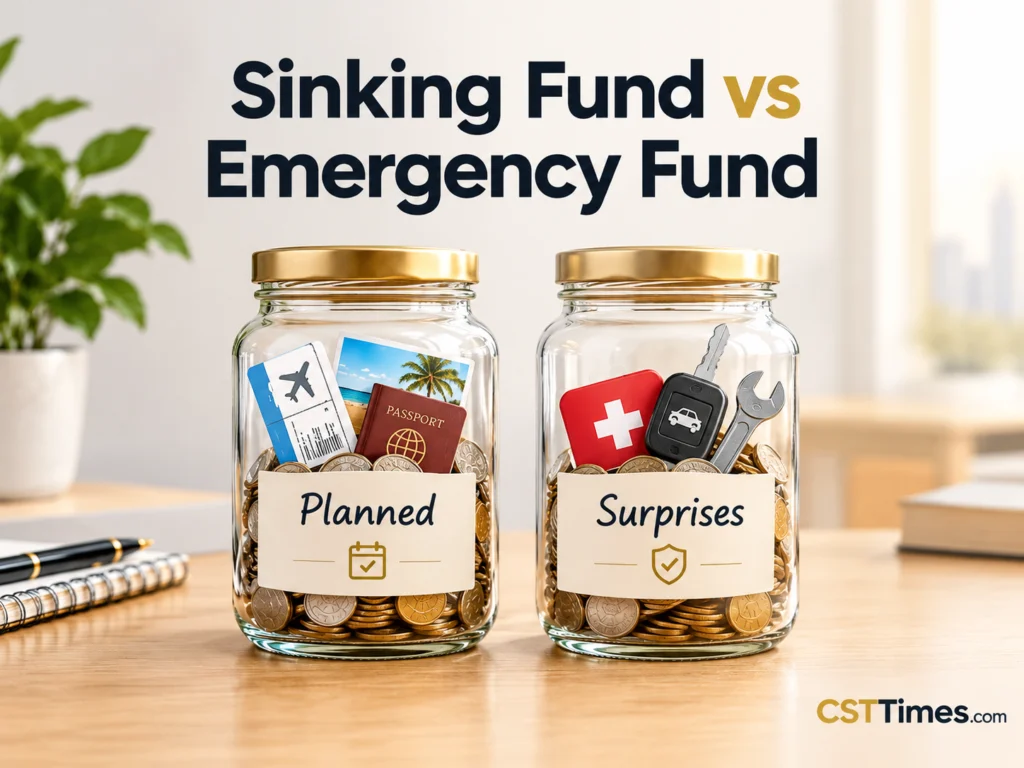
Sinking Fund vs Emergency Fund: What’s the Difference and Which Do You Need?
Quick Summary:
Sinking fund vs emergency fund comes down to one question: did you see the expense coming? A sinking fund is money you save bit by bit for a cost you know is ahead, while an emergency fund is a cash reserve for surprises such as a job loss or a sudden repair. This guide explains how each one works, how to tell which one an expense belongs to, and how to build both without complicating your budget.
Table of Contents
ToggleKey Takeaways
- A sinking fund pays for planned or predictable costs. An emergency fund pays for unplanned shocks.
- A sinking fund’s target is the cost of the goal. An emergency fund is often sized at three to six months of essential expenses, though the right amount varies.
- Separate accounts stop a holiday or a car service from quietly draining your safety net.
- In the Federal Reserve’s 2025 survey, 63% of US adults said they could cover a $400 emergency with cash or its equivalent.
- Keep both funds in safe, accessible accounts rather than volatile assets such as crypto.
What is a Sinking Fund?
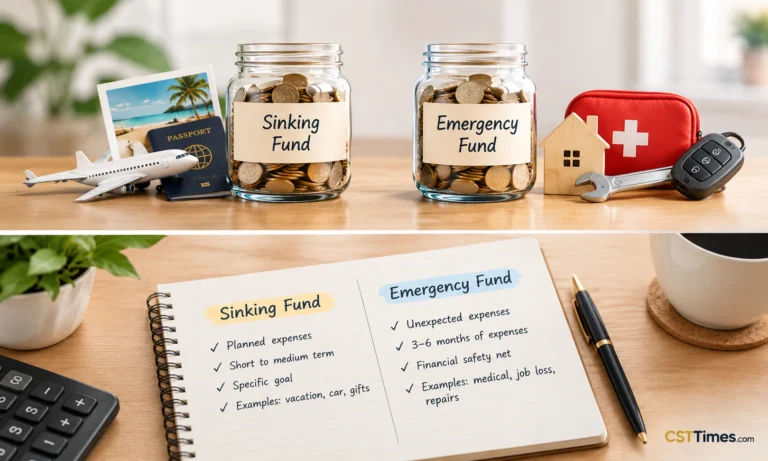
A sinking fund is money you set aside in small, regular amounts for a specific expense you know is coming, such as a vacation, a laptop, or an annual insurance bill. You save until the goal is reached, then spend the money as planned instead of borrowing.
People also use sinking funds to smooth out irregular bills, such as a semiannual insurance premium or a tax payment. Other common examples include holiday gifts, car servicing, and annual subscriptions.
A Separate sinking fund is extremely useful for occasional expenses that require a lump-sum payment- expenses which, if paid all at once, could place a burden on monthly budget.
For Example: if your annual insurance cost are $600 and there are 12 months until the payment is due, you could save $50 each month to reach your goal.
The name has an older meaning. Experian notes that it began in the 18th century as a plan to “sink” the national debt, and in finance it still describes money set aside to repay bonds. This guide covers the personal-finance version.
What is an Emergency Fund?
An emergency fund is a cash reserve set aside for unplanned expenses or a loss of income, such as a medical bill, an urgent home repair, or a job loss. The US Consumer Financial Protection Bureau (CFPB) describes it as money for bills that fall outside your routine monthly spending.
Surprises are common. In the Federal Reserve’s survey of US households, fielded in October 2025, 59% of adults had at least one major unexpected expense in the previous 12 months. A major vehicle repair or replacement was the most common (30%), followed by house or appliance repairs (22%) and major medical bills (21%). Among those who knew the amount, the typical cost of these three was $1,000 to $1,999.
Preparedness is uneven. Only 63% of adults said they would cover a $400 emergency using cash, savings, or a credit card paid off at the next statement, and 12% said they could not pay it by any means.
Sinking Fund vs Emergency Fund: 5 Key Differences
The main difference is predictability: a sinking fund pays for expenses you can see coming, while an emergency fund pays for ones you cannot. The two also differ in target amount, how you use them, and whether you refill them.
| Sinking fund | Emergency fund | |
|---|---|---|
| 1. Purpose | A specific planned or recurring cost | Unplanned expenses or lost income |
| 2. Trigger | A known date or event, like a renewal or trip | A surprise, like a layoff or burst pipe |
| 3. Target amount | The cost of the goal | Often 3 to 6 months of essential expenses |
| 4. How you use it | Spent when the goal arrives; you may run several at once | Only for true emergencies; usually one pot |
| 5. After you spend it | Closes, or restarts for the next goal | Needs to be rebuilt |
Which Fund Does an Expense Belong To?
Ask two questions: do you know roughly when the expense will arrive, and roughly what it will cost? If both answers are yes, use a sinking fund. If the timing or the size is a surprise, it is an emergency.
Car costs show the grey area. A breakdown is a surprise, but servicing, tyres, and annual registration are predictable. Because vehicle repairs topped the Fed’s list of unexpected expenses, a car-maintenance sinking fund can absorb the likely costs, while your emergency fund stays as backup for big, unplanned ones. This is a practical approach rather than a fixed rule.
How Much Should You Save in Each?
A sinking fund target is the cost of the goal divided by the months until you need it. An emergency fund is usually sized in months of essential expenses, with three to six months a common rule of thumb. The example below is illustrative.
| Sinking fund goal | Cost | Time | Monthly saving |
|---|---|---|---|
| Laptop | $1,200 | 12 months | $100 |
| Insurance premium (paid every 6 months) | $480 | 6 months | $80 |
| Holiday gifts | $360 | 12 months | $30 |
| Total | $210 |
For the emergency fund, add up essentials: rent, utilities, groceries, insurance, transport, and minimum debt payments. If that comes to $2,500 a month, three to six months equals $7,500 to $15,000. Single-income households or people with irregular earnings may prefer the higher end.
The CFPB gives no single number. It suggests looking at the unexpected costs you have faced before, and notes that even a small amount offers some security. Experian suggests a first goal of $500 or $1,000 if the full target feels out of reach.
How to Build Both: A Simple Plan
- Start with a small buffer. Save a first emergency goal, such as $500 or $1,000.
- List your known costs. Write down predictable bills and goals for the next 12 months.
- Do the math. Divide each cost by the months left to get a monthly amount.
- Automate. Set recurring transfers on payday. Automatic transfers make it harder to miss contributions or spend the money elsewhere.
- Refill and review. If you use the emergency fund, plan how to rebuild it, and review your amounts as prices change.
A common order is a starter buffer first, then sinking funds for upcoming bills, then growing the emergency fund toward its full target. If a large planned bill is only weeks away, fund that first. This is a general approach, not personal advice.
Where to Keep Each Fund
Keep both in safe, easy-to-access accounts, such as a high-yield savings account or a money market account, ideally separate from everyday checking. Separation makes accidental spending harder, and a better interest rate helps the balance grow.
Experian lists high-yield savings accounts, money market accounts, and certificates of deposit as options, noting that CDs trade some access for higher interest. Rates matter: the FDIC’s national average savings rate was 0.38% as of July 2026, so comparing current APYs is worthwhile.
In the US, FDIC insurance covers deposits up to $250,000 per depositor, per insured bank, per ownership category. Readers elsewhere should check their own country’s deposit protection scheme.
Can Crypto or Stocks Be Your Emergency Fund?
Generally no. An emergency fund must hold its full value on the day you need it, and crypto and stock prices can fall sharply at any time. Selling may also trigger fees or taxes, depending on where you live.
Final Thoughts:
The sinking fund vs emergency fund choice is not either-or: one handles the bills you can predict, the other protects you from the ones you cannot. Start with a small emergency buffer, add sinking funds for your next few known costs, and automate the transfers. Together they reduce the odds of reaching for a credit card.
FAQs
Is a sinking fund the same as an emergency fund?
No. A sinking fund saves for a specific, planned expense, such as a trip or an annual bill, and is spent once the goal arrives. An emergency fund is a general reserve for surprises like job loss or urgent repairs, and you rebuild it after using it.
Sinking fund vs emergency fund: which should I build first?
Most households benefit from a small emergency buffer first, such as $500 to $1,000, because surprises cannot be scheduled. Then add sinking funds for predictable bills while growing the emergency fund toward three to six months of essentials. If a big planned bill is imminent, prioritize it.
How many sinking funds do I need?
Start with two or three of your largest or most irregular costs, such as car upkeep, insurance, or holidays. You can hold them in separate accounts or track them as categories in one account. Too many accounts can become confusing to manage, so add more only when needed.
Can I use my emergency fund for a planned expense?
It is best to avoid it. Using emergency money for a planned purchase leaves you exposed to real surprises. If you do borrow from it, set a clear plan to refill the fund, and consider opening a sinking fund so the next planned cost is covered separately.
What if I can’t afford both right now?
Begin with a small emergency buffer and a single sinking fund for your next big bill. Even a small, regular amount helps, and automating it makes it easier to stick to. Increase the transfers whenever your income rises or an existing expense ends.
Disclaimer
This article is for educational and informational purposes only and is not financial, investment, or legal advice. Crypto assets are volatile, and you can lose some or all of your money. Always do your own research.
