
What Is Inflation and Why It Matters
Understanding Inflation
Most people have heard the word inflation on the news or seen it used to explain why supermarket prices keep going up. But What Is Inflation and Why It Matters? What does it really mean? And more importantly, why should you care?
Table of Contents
ToggleIn simple words, inflation is how fast prices rise over time. When inflation is high, the money in your pocket does not go as far as it used to. When inflation is low and steady, the economy usually runs more smoothly.
So, What Exactly Is Inflation?
Inflation means that the prices of goods and services slowly increase over time across the economy. For example, if a bag of flour cost $1.00 last year and now costs $1.08, that small difference is inflation at work.
But inflation is not just about one item becoming more expensive. It usually means prices are rising in many areas at once — things like food, fuel, rent, healthcare, and education. As more things cost more, the value of your money gradually goes down.
A small and steady level of inflation, usually around 2% a year, is often seen as healthy by central banks because it usually signals a growing economy. The real problem begins when inflation rises too quickly and becomes harder to control.
At CST Times, we have been following cost-of-living trends for years, and one thing has always been clear: inflation hurts low-income households the most. When the prices of food and transport go up, families with limited budgets feel the pressure right away. On the other hand, people with savings or investments often have a little more room to absorb the impact. Inflation is not just a number in an economic report — for millions of people, it is something they deal with in everyday life.
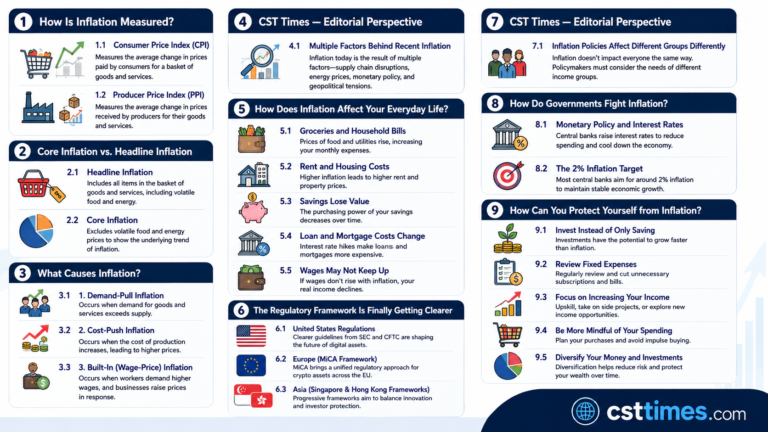
How Is Inflation Measured?
Governments and central banks use a tool called the Consumer Price Index (CPI) to track inflation. The CPI measures the average change in prices paid by consumers for a “basket” of common goods and services — things like food, housing, clothing, healthcare, and transport.
Another commonly used measure is the Producer Price Index (PPI), which tracks how much producers are paying for raw materials and supplies. When input costs for businesses go up, those costs are often passed down to consumers.
Core Inflation vs. Headline Inflation
Headline inflation includes everything — food and energy prices included. Core inflation strips out food and energy because those prices tend to swing wildly due to seasons and global supply shocks. Core inflation gives a cleaner picture of underlying price trends.
What Causes Inflation?
1. Demand-Pull Inflation
This happens when demand for goods and services outpaces the economy’s ability to supply them. Simply put: too much money chasing too few goods. When people are earning and spending more, sellers can charge higher prices.
2. Cost-Push Inflation
This type happens when the cost of production rises. If oil prices spike globally, businesses pay more to make and transport products — and they pass that cost on to you at the checkout. Supply chain disruptions, natural disasters, or geopolitical events can all trigger cost-push inflation.
3. Built-In (Wage-Price) Inflation
Workers expect prices to keep rising, so they demand higher wages. Businesses, facing higher labor costs, raise their prices — which leads workers to demand even higher wages. It becomes a self-feeding cycle that can be hard to break without intervention.
CST Times — Editorial Perspective
Over the past few years, we have seen all three of these factors come together at the same time — pandemic-related supply shocks, massive government spending, and rising wage demands. All of them played a role in pushing inflation higher across major economies. It was a clear reminder that inflation is not caused by just one thing; it usually happens when several pressures build up at once and move in the same direction.
How Does Inflation Affect Your Everyday Life?
- Groceries and household bills — Food and utility prices are usually among the first to rise. Families end up spending more of their monthly income just to maintain the same standard of living.
- Rent and housing costs — Landlords raise rents to keep pace with rising property costs. For renters, this can mean annual hikes that outpace salary growth.
- Savings lose value — If your savings account earns 1% interest but inflation is running at 5%, your money is effectively losing 4% of its purchasing power every year.
- Loan and mortgage costs change — To fight inflation, central banks raise interest rates, making borrowing significantly more expensive.
- Wages may not keep up — Salaries do not always rise as fast as prices. When they lag behind inflation, workers’ real income falls even if the number on their paycheck stays the same.
The Regulatory Framework Is Finally Getting Clearer
For a long time, many institutions stayed away from Bitcoin because the rules were not clear. They did not want to invest when they were unsure what the law would look like a few years later. That excuse is fading now.
In the United States, the SEC approved spot Bitcoin ETFs in January 2024, and the GENIUS Act was signed into law in July 2025, giving stablecoins a clearer federal framework. In Europe, MiCA now gives crypto investors across the EU one common rulebook. In Asia, Singapore has a stablecoin regulatory framework, and Hong Kong has built a regulated system for virtual asset trading platforms.
“Regulatory clarity doesn’t just reduce legal risk — it creates permission. For compliance-driven institutions, clear rules are the prerequisite for participation.”
— CST Times, Digital Finance Correspondent
CST Times — Editorial Perspective
When central banks increase interest rates to control inflation, homeowners with mortgages and small business owners with loans are often affected the most. Their monthly payments can become more expensive. In contrast, large companies and wealthy people may be less affected because they often have fixed-rate loans or own assets that keep their value. This shows that policies used to fight inflation do not affect everyone equally. Some people benefit, while others face more challenges.
How Do Governments Fight Inflation?
One of the most important tools used to control inflation is monetary policy, which is managed by a country’s central bank. When inflation starts rising too quickly, central banks often increase interest rates. Higher interest rates make loans, mortgages, and credit more expensive, which encourages people and businesses to spend less. As demand slows, price increases usually begin to ease.
Keeping inflation under control is a balancing act. If inflation is too high, the cost of living rises and puts pressure on households. If it is too low, economic growth can weaken. That is why major central banks, including the Federal Reserve, the European Central Bank, and the Bank of England, generally aim for an inflation rate of around 2%. Many economists view this level as the right balance between stable prices and healthy economic growth.
How Can You Protect Yourself from Inflation?
Invest instead of only saving. During periods of high inflation, money sitting in a low-interest savings account can gradually lose value. Investing in assets like stocks, real estate, or inflation-protected bonds may help your money grow faster than inflation over the long term.
Take a closer look at fixed expenses. If you have a mortgage or long-term financial commitments, locking in fixed rates before borrowing costs rise further can help you save money in the future.
Focus on increasing your income. Learning new skills, gaining experience, or improving your qualifications can boost your earning potential. In many cases, a higher income is one of the most effective ways to keep up with inflation.
Be more mindful of your spending. Rising prices are a good reason to review your budget, identify unnecessary expenses, and make sure your money is being spent where it matters most.
Don’t put all your money in one place. Diversifying across different types of investments can reduce risk and help protect your finances when economic conditions become uncertain.
The Bottom Line: Why Inflation Matters to All of Us
Inflation is not just something economists debate on TV. It affects everyday life in very real ways — from how far your paycheck goes, to whether buying a home feels possible, to how much you need to set aside for retirement.
A modest and steady level of inflation usually signals a healthy, growing economy. But when inflation becomes too high or unpredictable, it starts eating away at wealth, making saving harder, and hitting lower-income people the hardest.
CST Times — Editorial Perspective
Economic literacy is not a luxury — it is something everyone needs. At CST Times, we believe that when people understand how the economy works, they are better equipped to make decisions for themselves and hold their leaders accountable. Inflation is one of the biggest forces affecting everyday life right now, so it deserves clear, honest reporting — without jargon, without spin. Stay informed, keep questioning, and always ask: who does this policy really benefit?
Follow us on Social media for daily Updates:
Click here for knowledge
Why Bitcoin Is Gaining Institutional Support Worldwide 2026
About The Author

Haseeb Jabbar
Haseeb Jabbar writes about crypto, finance, technology, and AI at CST Times, sharing research-based guides, timely news, and free tools and calculators to help readers make informed decisions.
