
What Is Crypto Staking? How Does Crypto Staking Work?
What is Crypto Staking?
Quick Summary:
Crypto staking is the process of locking up cryptocurrency to help a blockchain verify transactions, in exchange for rewards paid in that same cryptocurrency. It works through a system called proof-of-stake, where the size of a person’s stake determines their odds of being chosen to confirm the next block.
Table of Contents
ToggleThis guide covers how proof-of-stake works, how validators are chosen, how rewards are calculated, and the risks worth understanding before you stake anything.
Key Takeaways
- Staking means locking up crypto to help run and secure a proof-of-stake blockchain, in return for rewards.
- Proof-of-stake (PoS) replaces energy-intensive mining with validators who are chosen based on how much crypto they’ve staked.
- Rewards typically come from new token issuance and transaction fees, and vary widely by network and staking method.
- Staking isn’t risk-free: price volatility, lock-up periods, slashing penalties, and platform risk can all eat into returns.
- You can stake solo by running a validator, through a staking pool, via liquid staking, or through an exchange — each trades off control, convenience, and fees differently.
Table of Contents
- What is Crypto Staking?
- How Does Proof-of-Stake Work?
- How Are Validators Chosen?
- How Are Staking Rewards Calculated?
- Ways to Stake Crypto
- Risks of Crypto Staking
- How to Stake Crypto: Step by Step
- Quick Checklist Before You Stake
- Final Thoughts
Staking Methods at a Glance
| Method | Typical Minimum | Who Holds the Keys | Typical Cut Taken | Risk Profile |
|---|---|---|---|---|
| Solo validator | Network minimum (e.g., 32 ETH on Ethereum) | You | None (you cover hardware costs) | Full slashing exposure, technical upkeep |
| Staking pool / delegation | Often none | Usually you | Small validator commission | Shared slashing exposure via your chosen validator |
| Liquid staking | Often none | Smart contract | Roughly 10% of rewards, varies | Adds smart-contract and depeg risk |
| Exchange staking | Often none | Exchange (custodial) | Often 15%–25% of rewards | Platform/custodial risk |
What is Crypto Staking?
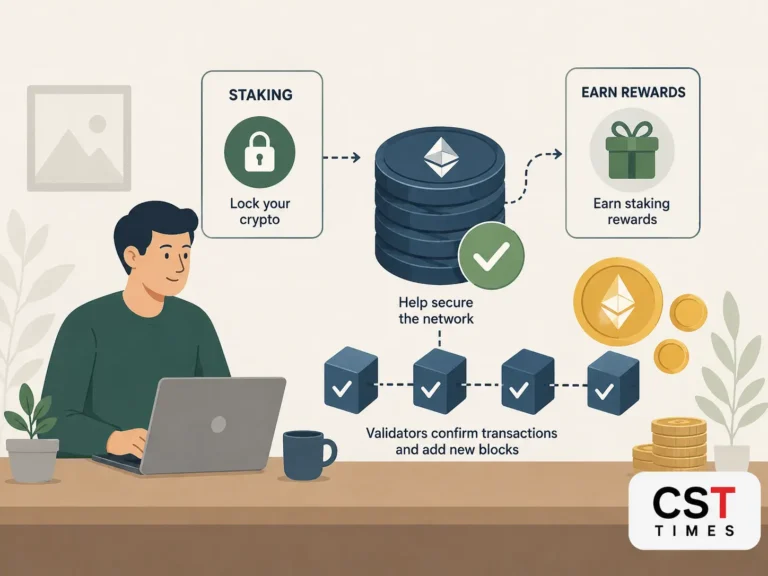
Staking is a way of putting your cryptocurrency to work. Instead of leaving coins idle in a wallet, you commit them to a blockchain network that uses them as collateral to help validate transactions and keep the network secure. In return, the network pays you a share of newly created tokens and, on some chains, a portion of transaction fees.
The idea traces back to 2012, when Sunny King and Scott Nadal proposed proof-of-stake as an alternative to Bitcoin’s energy-intensive mining model; Peercoin, launched the following year, became the first cryptocurrency built around it. Staking stayed niche until Ethereum — the second-largest blockchain by market value — switched from mining to staking in “the Merge” of September 2022, bringing it into the mainstream. Today, Ethereum, Solana, and Cardano all rely on some version of proof-of-stake.
How Does Proof-of-Stake Work?
Proof-of-stake is a consensus mechanism: a set of rules a blockchain uses to agree on which transactions are valid. Its predecessor, proof-of-work, relies on miners racing to solve computational puzzles with specialized hardware, which consumes enormous amounts of electricity. Proof-of-stake replaces that race with a different kind of competition — one based on capital rather than computing power.
In a PoS network, participants called validators lock up (“stake”) a set amount of the native token. The protocol selects a validator to propose the next block; other validators check that block for accuracy before it’s added to the chain. Because a validator’s staked tokens are on the line, they have a direct financial incentive to follow the rules — approve fraudulent transactions or go offline too often, and part of that stake can be destroyed. This design uses a fraction of the electricity mining requires: after Ethereum’s move to proof-of-stake, the network’s energy use dropped by more than 99%.
How Are Validators Chosen?
Validator selection isn’t first-come, first-served. Protocols use a weighted random process: the more a validator has staked, the higher the statistical probability their turn comes up next, but genuine randomness is built in so no one can predict or manipulate whose turn is coming. Ethereum, for instance, uses on-chain randomness to shuffle validator assignments each epoch.
To become a solo validator on Ethereum, you need at least 32 ETH and validator software running continuously — a minimum that hasn’t changed even as recent upgrades let larger stakers consolidate multiple validators together. Other networks set their own thresholds, and some have no practical minimum when staking through a pool.
How Are Staking Rewards Calculated?
Staking rewards generally come from two sources: newly issued tokens (similar to how mining once created new coins) and, on some networks, a cut of transaction fees. The rate you earn depends on a few factors:
- Total amount staked network-wide. More tokens staked across the network means rewards get split further, which tends to push down the percentage return per staker.
- Your staking method. Running your own validator usually earns the most since there’s no middleman. Pools, liquid staking protocols, and exchanges each charge a fee — often roughly 10% to 25% of your rewards — for convenience.
- Validator performance. Missed attestations, downtime, or misconfiguration can reduce rewards even without triggering slashing.
Reported annual yields vary widely by network, roughly in the range of 2% to 15%, and shift over time with participation and network conditions. There’s no fixed, guaranteed number.
Ways to Stake Crypto
Solo staking:
You run your own validator, meeting the network’s minimum stake and hardware requirements yourself. You keep the full reward with no fees, but take on the technical work and full slashing risk.
Staking pools and delegation:
You keep control of your tokens but delegate the validating work to someone else’s validator for a small commission. Common on networks like Cardano and Solana, this lowers the technical barrier to entry.
Liquid staking:
You stake through a protocol (such as Lido) that gives you a tradeable token representing your staked position, so some liquidity remains even while the original tokens are locked. It adds smart-contract risk and the chance the liquid token’s price temporarily drifts from the underlying asset.
Exchange staking:
You stake directly through a centralized exchange in a few clicks. It’s the easiest option for beginners, but the exchange holds your keys, typically takes a larger fee, and you’re trusting its security and solvency.
Risks of Crypto Staking
Staking is often marketed as passive income, but it carries real risks, sometimes bigger than the rewards on offer.
Price volatility.
Staking rewards are usually paid in the same token you staked. If that token’s price falls sharply, a 4% annual reward does little to offset a 30% price drop.
Lock-up and unbonding periods.
Many networks require your tokens to stay locked for a set period after you decide to unstake. This varies by network — roughly a few days on Solana, about a week on BNB Chain, around two weeks on TRON, and a variable exit queue on Ethereum that can stretch further when many validators exit at once. During this window, you can’t sell or move your tokens even if the market moves against you.
Slashing.
If a validator double-signs a block or has extended downtime, the network can destroy part of its staked tokens as a penalty. On Ethereum, an initial slashing penalty is a small fraction of the 32 ETH stake, but it scales up if many validators are slashed at once — and if you delegated to that validator, you can lose part of your stake too, even if you did nothing wrong.
Platform and smart contract risk.
Exchange staking means trusting that exchange’s security and solvency. Liquid staking or DeFi staking means trusting the underlying smart contract code, which can contain bugs or be exploited.
Advantages of Crypto Staking
Earn staking rewards.
You can earn additional crypto by helping secure a proof-of-stake network.
Put idle crypto to work.
Instead of simply holding tokens, staking can generate rewards over time.
Support network security.
Your staked crypto helps validators verify transactions and keep the blockchain secure.
Lower energy use than mining.
Proof-of-stake generally requires far less energy than proof-of-work mining.
Flexible staking options.
You can choose between solo staking, delegation, liquid staking, or exchange staking depending on your needs.
How to Stake Crypto: Step by Step
- Choose a cryptocurrency that supports staking. Confirm the token you hold actually uses proof-of-stake.
- Decide on a staking method. Weigh solo staking, a pool, liquid staking, or an exchange based on your technical comfort and how much control you want.
- Set up a compatible wallet or account. Self-custody staking needs a supporting wallet; exchange staking uses your existing account.
- Lock your tokens. Follow the platform’s steps to delegate or deposit your stake, noting any minimum amount or lock-up terms first.
- Monitor your position. Track your validator’s or pool’s performance and understand the unstaking process before you need it.
Quick Checklist Before You Stake
- Confirm the current lock-up or unbonding period.
- Check the validator’s or pool’s track record, uptime, and fee.
- Understand how slashing works on that network.
- Decide how much you’re comfortable locking up, keeping the rest liquid.
- Check how staking rewards are taxed where you live.
Final Thoughts:
Crypto staking is one of the main ways proof-of-stake blockchains stay secure, and it gives token holders a way to earn rewards for supporting that security instead of simply holding coins in a wallet. But it isn’t a savings account: rewards are variable, tokens can be locked for periods you can’t control, and price swings or validator mistakes can reduce what you walk away with. Understanding a specific network’s lock-up terms, slashing rules, and reward structure matters more than the headline percentage rate.
Binance Academy — Proof of Stake
Ethereum — Staking Pools
Ethereum — Validator FAQs
FAQs
Is crypto staking safe?
It isn’t risk-free. The main risks are price volatility, unbonding periods that delay access to funds, and slashing if a validator misbehaves. A well-established network and reputable validator reduce, but don’t eliminate, these risks.
How much can you earn from staking crypto?
Annual rewards vary widely by network and method, generally falling roughly between 2% and 15%, and shift over time with participation levels.
Can you lose money staking crypto?
Yes. Rewards can be outweighed by a drop in the token’s price, and in rarer cases a validator’s misbehavior or downtime can trigger slashing that permanently destroys part of the staked amount.
What’s the difference between staking and mining?
Mining (proof-of-work) uses computing power to compete for the right to add the next block. Staking (proof-of-stake) uses locked-up crypto as collateral instead, with validators chosen by stake size rather than computing power.
Can you unstake your crypto at any time?
It depends on the network. Some platforms allow near-instant unstaking; others impose a bonding or unbonding period — from a couple of days to a couple of weeks or longer — during which tokens are locked and not earning rewards.
Disclaimer
This article is for general educational purposes only and does not constitute financial, investment, or tax advice. Cryptocurrency staking involves risk, including potential loss of principal through price volatility, slashing, or platform failure. Staking rewards, lock-up terms, and rules vary by network and can change. Do your own research and consult a qualified financial or tax professional before staking any cryptocurrency.
Follow us on Social media :
About The Author

Haseeb Jabbar
Haseeb Jabbar writes about crypto, finance, technology, and AI at CST Times, sharing research-based guides, timely news, and free tools and calculators to help readers make informed decisions.
