
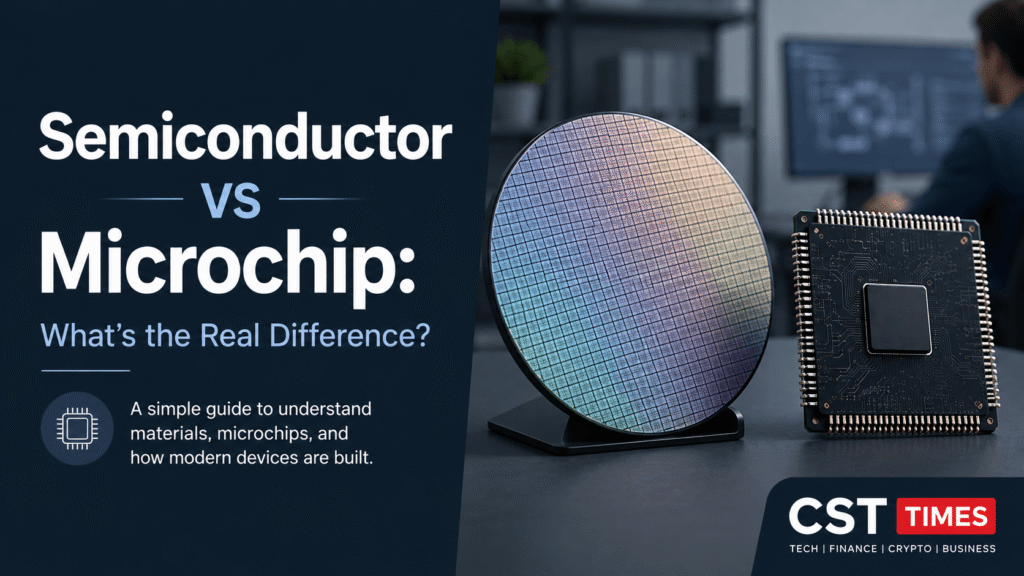
Semiconductor vs Microchip: What’s the Real Difference?
Semiconductor vs Microchip: What's the Real Difference?
Quick Summary:
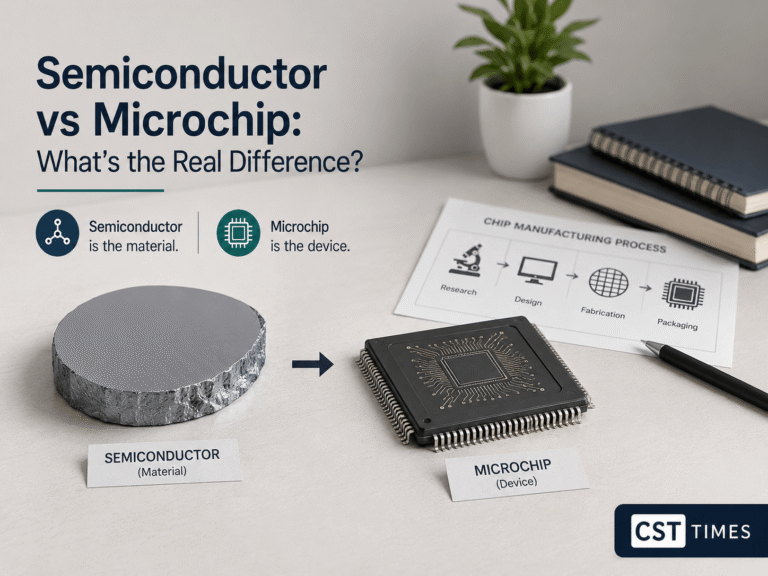
A semiconductor is a material. A microchip is a device built from that material. That’s the short version: semiconductor = raw material, microchip = finished product. Every microchip is made from a semiconductor, but a semiconductor on its own is not yet a microchip.
Table of Contents
ToggleThe two words get used interchangeably in headlines about chip shortages, AI hardware, and export rules, and most of the time that’s harmless — everyone understands roughly what’s meant. But if you want to actually understand how modern electronics are built, or follow semiconductor industry news without getting confused, the distinction is worth knowing. This guide explains what each term really means, how one turns into the other, and why the difference is more relevant than ever in 2026.
Key Takeaways
- A semiconductor is a material with electrical conductivity between a conductor and an insulator. Silicon is the most common example.
- A microchip (also called a chip or integrated circuit) is a finished electronic device manufactured from semiconductor material.
- Every microchip is made of semiconductor material, but not every semiconductor ends up in a microchip — some become individual components like diodes.
- Turning raw semiconductor material into a working chip takes four broad stages: research, design, front-end fabrication, and back-end packaging.
- The distinction matters right now because the global semiconductor industry is on pace to cross $1.5 trillion in sales in 2026, driven heavily by demand for AI hardware.
Table of Contents
- What Is a Semiconductor?
- What Is a Microchip?
- How a Semiconductor Becomes a Microchip
- Semiconductor vs Microchip: Side-by-Side Comparison
- Common Types of Microchips
- Why the Difference Matters in 2026
- A Brief History
- Final Thoughts
A semiconductor is a material whose electrical conductivity sits between that of a conductor (like copper, which lets electricity flow easily) and an insulator (like rubber, which blocks it almost completely). At room temperature, a semiconductor conducts some electricity, but not freely — and that “in-between” behavior is exactly what makes it useful.
The key part is that this conductivity isn’t fixed. Engineers can change it in a precise, controlled way by adding tiny amounts of other elements into the material, a process called doping. Adding elements like phosphorus creates extra free electrons, producing what’s called N-type material. Adding elements like boron creates “holes” where electrons are missing, producing P-type material. Putting N-type and P-type regions next to each other on the same piece of material is what makes transistors, diodes, and every other basic building block of modern electronics possible.
Silicon is by far the most widely used semiconductor material. It’s abundant, relatively cheap to purify to the extreme levels chipmaking requires, and it naturally forms a stable oxide layer that’s useful for building transistor structures. Other semiconductor materials serve more specialized roles: germanium was used in the earliest transistors, gallium arsenide is used in high-speed and radio-frequency applications like satellite communications, and silicon carbide is increasingly used in the power electronics of electric vehicles.
In short: a semiconductor is a substance, not a product. On its own, a block of pure silicon can’t compute anything or store any data.
What is a Microchip?
A microchip — also called a chip or an integrated circuit (IC) — is a finished electronic device manufactured from semiconductor material. It contains many microscopic components (transistors, resistors, capacitors, and diodes) that are all wired together and etched onto a single small piece of semiconductor, usually silicon.
Where a semiconductor is a substance, a microchip is a specific product built from that substance. A single modern chip can pack billions of transistors into an area smaller than a fingernail. That density is what allows a smartphone processor or an AI accelerator to do work that once required rooms full of equipment.
The terms “microchip,” “chip,” and “integrated circuit” are used interchangeably in both technical and everyday conversation. There’s no meaningful difference between them — they all refer to the same kind of finished device.
In short: a microchip is a manufactured product made from a semiconductor, engineered to perform a specific job — processing, storing memory, sensing, or converting signals.
How a Semiconductor Becomes a Microchip
Turning raw semiconductor material into a working chip is one of the most complex manufacturing processes that exists. The Semiconductor Industry Association (SIA), the main U.S. trade group representing the chip industry, breaks the process down into four broad stages.
1. Research and development. Publicly and privately funded research develops the underlying science and production techniques that make new chip designs possible in the first place.
2. Chip design. Engineers use specialized software to lay out the “blueprint” of a chip — mapping how billions of transistors and other components will be arranged and connected to perform a specific function.
3. Front-end manufacturing (fabrication). This is where a semiconductor wafer, a thin, polished disc of ultra-pure silicon, is transformed into a complete integrated circuit. Layers of material are added, removed, and patterned using processes like photolithography and doping, building up the transistor structures layer by layer inside a cleanroom facility called a fab.
4. Back-end manufacturing. The finished wafer is cut into individual chips, which are then assembled, tested, and packaged into the housing you’d recognize if you opened up a computer or phone. This stage confirms each chip works correctly before it ships.
Only after all four stages is the semiconductor material officially a microchip, ready to be soldered onto a circuit board inside a real device.
Semiconductor vs Microchip: Side-by-Side Comparison
| Semiconductor | Microchip | |
|---|---|---|
| What it is | A material | A manufactured device |
| Common examples | Silicon, germanium, gallium arsenide, silicon carbide | CPU, GPU, RAM chip, microcontroller |
| Role | Raw ingredient | Finished product |
| Made of | A single element or compound | Semiconductor material plus metal wiring and insulating layers |
| Function | Conducts electricity partially; conductivity can be engineered | Performs a specific job — computing, storing data, sensing, converting signals |
| Simple analogy | Flour | Bread |
Common Types of Microchips
Not all microchips do the same job. Here are the main categories you’ll come across:
- Logic and processor chips — CPUs, GPUs, and AI accelerators that carry out calculations and run software.
- Memory chips — RAM and flash storage chips that hold data, either temporarily or permanently.
- Sensor chips — Found in phones and cars, these convert physical signals like light, motion, or pressure into electronic data.
- Analog and mixed-signal chips — Handle real-world signals like sound and radio waves, often converting them between analog and digital form.
- Microcontrollers — Small, self-contained chips that combine a processor, memory, and input/output controls, common in appliances and industrial equipment.
A single smartphone contains dozens of these different microchip types, all manufactured from semiconductor material but each doing a completely different job.
Why the Difference Matters in 2026
This isn’t just a vocabulary exercise. Understanding the semiconductor-versus-microchip distinction helps make sense of the news currently shaping the tech and finance world.
The chip industry is in the middle of a historic boom. According to the SIA, global semiconductor sales reached $403.3 billion in the second quarter of 2026, up 35.1% from the first quarter, and the trade group expects full-year 2026 sales to exceed $1.5 trillion — a milestone reached earlier than previously forecast. That growth is being driven largely by demand for AI infrastructure and accelerated computing hardware, meaning the microchips (GPUs and AI accelerators) that power data centers, not the raw semiconductor material itself.
At the same time, chipmakers including TSMC, Samsung, and Intel have been racing to bring 2-nanometer manufacturing to mass production through 2025 and 2026. A smaller “node” size means transistors can be packed more densely onto the same piece of semiconductor material, producing microchips that are faster and more power-efficient without becoming physically larger.
So when you read that there’s a “semiconductor shortage,” it usually refers to constraints somewhere in that whole supply chain: raw material, fabrication capacity, or specialized equipment. When you read that a company just unveiled a new “AI chip,” that’s specifically a microchip — a finished processor built using semiconductor technology. Knowing the difference makes both kinds of headlines easier to actually understand.
A Brief History
The integrated circuit — what we now call a microchip — was invented in 1958 by Jack Kilby, an engineer at Texas Instruments, who built the first working prototype from a small piece of germanium. Robert Noyce at Fairchild Semiconductor independently developed a more practical silicon-based version months later, in early 1959, introducing the manufacturing approach that modern chipmaking still builds on. Both engineers are credited as co-inventors of the integrated circuit, and Kilby was awarded the Nobel Prize in Physics in 2000 for the work.
That first chip held only a handful of components. Chips manufactured today, on process nodes as small as 2 nanometers, pack tens of billions of transistors onto a single piece of silicon — a scale of miniaturization that would have been unimaginable in 1958.
Final Thoughts:
The simplest way to keep the two terms straight: a semiconductor is what a chip is made of, and a microchip is what gets made from it. Silicon and other semiconductor materials are the raw ingredient; microchips, processors, memory, and sensors are the finished products built through a manufacturing process involving design, fabrication, and packaging.
You’ll still see “chip” and “semiconductor” used loosely as synonyms in everyday conversation and in most news coverage, and that’s generally fine. But now you know what’s technically true underneath the shorthand — which is genuinely useful with the semiconductor industry playing such a central role in AI, consumer electronics, and global trade right now.
FAQs
Is Silicon the Same Thing as a Semiconductor? / link
No. Silicon is a specific material that is a semiconductor. A semiconductor is the broader category, while silicon is one of the most widely used semiconductor materials in electronics. Germanium and gallium arsenide are other examples.
Is a CPU a Semiconductor or a Microchip?
A CPU is a microchip designed to process instructions and perform calculations. It is manufactured using semiconductor materials, most commonly silicon. More precisely, a CPU is implemented as an integrated circuit, while “semiconductor” refers primarily to the material or, in industry usage, sometimes the chip itself.
Are “Chip” and “Semiconductor” Really the Same Thing?
Not technically. A semiconductor is a material whose electrical conductivity can be controlled, while a chip is a manufactured electronic component containing integrated circuitry. However, the word “semiconductor” is also commonly used in the industry as shorthand for semiconductor chips and the semiconductor industry.
What’s the Difference Between a Microchip and an Integrated Circuit?
In everyday technology writing, microchip, chip, and integrated circuit (IC) are often used interchangeably. An integrated circuit contains interconnected electronic components such as transistors on a small piece of semiconductor material. “Microchip” is the more general everyday term for this type of device.
Why Is Silicon Used to Make Most Microchips?
Silicon is widely used because it has useful semiconductor properties and can be manufactured at the high purity required for modern electronics. It also forms a stable silicon-oxide layer that is extremely useful for making semiconductor devices such as transistors.
Disclaimer
This article is for general information only and does not constitute financial, investment, or legal advice.
References
Follow us on Social media :
About The Author

Haseeb Jabbar
Haseeb Jabbar writes about crypto, finance, technology, and AI at CST Times, sharing research-based guides, timely news, and free tools and calculators to help readers make informed decisions.
