
Fed Interest Rate Decision July 2026: Rates Held Steady as Hawkish Signals Grow
Fed Interest Rate Decision July Meeting
Quick Summary:
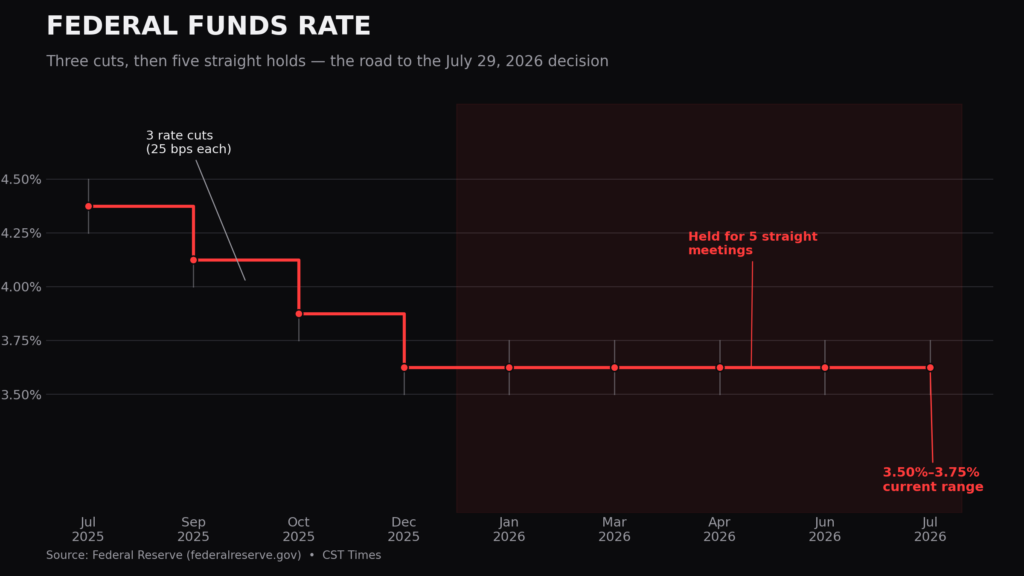
On July 29, 2026, the Federal Reserve announced its latest interest rate decision — and chose to leave rates unchanged. This marks the fifth consecutive meeting where the Fed has held its benchmark rate at 3.50%–3.75%. But the decision wasn’t calm behind closed doors: three senior officials voted against the hold, pushing instead for a hike. Stock markets reacted fast, with the Dow, S&P 500, and Nasdaq all closing sharply lower the same day. Whether you have a mortgage, a savings account, a business loan, or crypto holdings, this decision touches your money. Here’s a simple, clear breakdown of what happened, why it happened, and what could come next.
Table of Contents
ToggleKey Takeaways:
- The Federal Reserve kept the federal funds rate unchanged at 3.50%–3.75% on July 29, 2026.
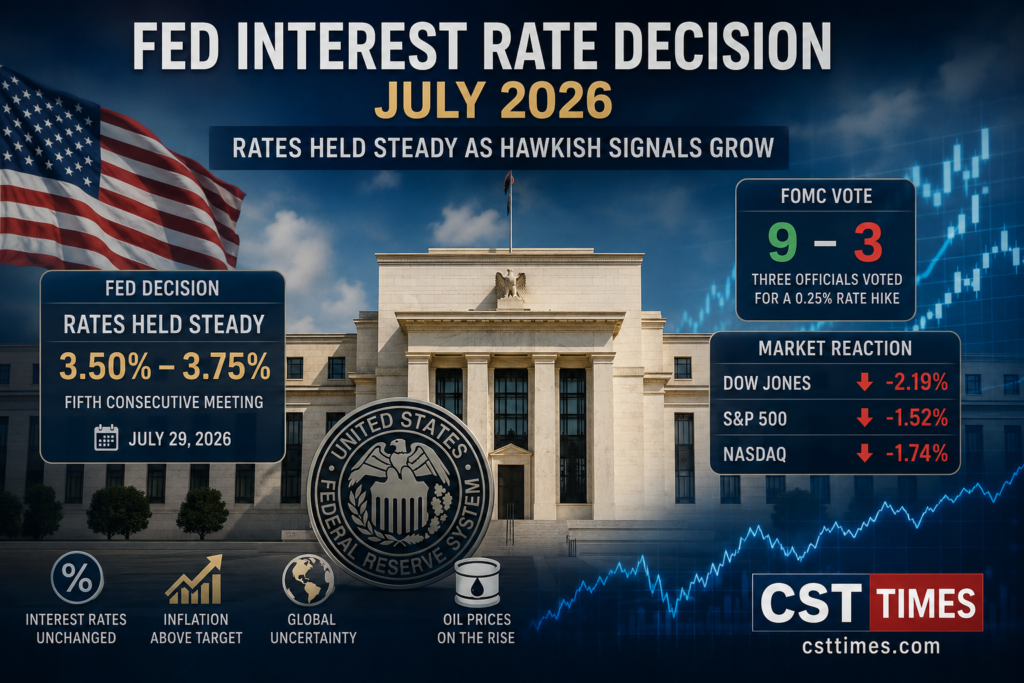
- The FOMC voted 9–3, with three policymakers backing a 25-basis-point rate hike.
- Fed Chair Kevin Warsh said inflation remains above the Fed’s 2% target despite recent progress.
- Stocks fell and Treasury yields climbed as markets viewed the decision as hawkish.
- The next FOMC meeting on September 15–16, 2026, could determine whether the Fed raises interest rates later this year.
What Did the Fed Decide on July 29, 2026?
The Federal Open Market Committee (FOMC) — the Fed’s rate-setting group — met over two days, July 28 and 29, 2026. The decision was released at 2:00 p.m. Eastern Time on the second day, followed by a press conference with Fed Chair Kevin Warsh.
- The federal funds rate stays at a target range of 3.50% to 3.75%
- This is the fifth straight meeting with no change in rates
- The vote was 9 in favor, 3 against
- All three dissenting votes wanted to raise rates, not cut them
- It’s the most one-directional dissent on the committee since September 2016
In plain terms: the Fed decided borrowing costs won’t move for now. But three of its most senior regional presidents think rates should already be higher.
Who Voted Against the Decision?
The three officials who dissented, all in favor of a quarter-point (0.25%) rate hike, were:
- Beth Hammack, President of the Federal Reserve Bank of Cleveland
- Neel Kashkari, President of the Federal Reserve Bank of Minneapolis
- Lorie Logan, President of the Federal Reserve Bank of Dallas
That’s notable. Most Fed dissents in recent memory have pushed for lower rates, not higher ones. This time, the pressure came from the opposite direction — a sign that inflation, not growth, is the bigger worry inside the building.
Why Did the Fed Keep Rates Unchanged?
In its official statement, the Fed pointed to a mixed economic picture:
- The US economy is still expanding at a solid pace
- Business investment and productivity growth remain strong
- Job gains have kept pace with the workforce, and unemployment has barely moved
- But inflation is still running above the Fed’s 2% target
- Part of that inflation is coming from supply shocks, especially in energy prices
The Fed also flagged global uncertainty tied to the ongoing conflict in the Middle East, which has kept oil markets on edge. Renewed fighting in the region, including reports of an escalation involving Iran, pushed oil prices higher going into the decision — adding fresh pressure at a time when the Fed is already trying to bring inflation down.
Kevin Warsh's Second Meeting as Fed Chair
This was only the second meeting led by Kevin Warsh, who took over as Federal Reserve Chair from Jerome Powell earlier in 2026. Warsh has already changed how the Fed communicates:
- His post-meeting statements are noticeably shorter than what markets got used to under Powell
- He has scaled back “forward guidance” — hints about what the Fed might do next
- He has set up several internal task forces, including one focused on how the Fed communicates with the public
At his press conference, Warsh described the Fed’s current approach as a stage of “watchful thinking,” not “watchful waiting” — signaling active internal debate rather than passive patience. Asked about the three dissents, Warsh said he’d wanted “a good family fight” among his colleagues, and that’s what he got.
How Did the Stock Market React?
Markets went into the meeting on edge. Some pricing models had given roughly a 1-in-3 chance of a surprise hike at this very meeting. When the Fed held steady but three officials pushed publicly for higher rates, many investors read it as a signal that a hike could come as soon as September.
By the closing bell on July 29, all three major US indexes were sharply lower:
- Dow Jones Industrial Average: down 1,153 points (2.19%) to 51,594 — its worst day since April 2025
- S&P 500: down 1.52% to 7,316
- Nasdaq Composite: down 1.74% to 24,443, more than 10% below its June record high
- The Nasdaq 100 briefly slipped into technical “correction” territory (a drop of 10%+ from a recent peak)
Semiconductor and chip stocks were hit especially hard, both in the US and in Asian markets, adding to a rough stretch for tech shares. Oil prices jumped the same day as Middle East tensions flared again, with Brent crude topping $90 a barrel — another layer of pressure on markets already digesting the Fed’s tone.
What's Happening with Bond Yields?
Bond yields, which ripple out into mortgage rates and corporate borrowing costs, moved higher too:
- The 10-year Treasury yield rose to around 4.7%
- The 30-year Treasury yield climbed above 5.2% — its highest level since 2007
In simple terms: when yields rise, longer-term borrowing tends to get more expensive — think mortgages, corporate bonds, and car loans. Rising yields alongside a Fed pause usually signal that investors expect inflation, and possibly interest rates, to stay higher for longer than previously hoped.
What Does This Mean for You?
What Does This Mean for You?
This decision reaches into everyday money decisions, wherever you’re reading from:
- Mortgages and loans: Rates on mortgages, auto loans, and credit cards are likely to stay elevated for now — don’t expect quick relief on borrowing costs.
- Savings accounts and CDs: On the flip side, savings accounts, money market funds, and CDs are still paying relatively attractive yields, since the Fed hasn’t cut.
- Crypto and riskier assets: Higher-for-longer rates typically make investors more cautious about riskier assets, including cryptocurrencies. A steady-to-rising rate environment has historically been a headwind for crypto prices, though many other factors move that market too.
- Readers outside the US (Europe, the Gulf, and beyond): A Fed pause with a hawkish tone tends to support the US dollar. That can affect currency conversion, import costs, and the value of dollar-denominated savings or remittances.
This is a general summary of how a Fed pause typically ripples through the economy, not personal financial advice. Speak with a licensed financial advisor for decisions specific to your situation.
What's Next for the Fed?
The next FOMC meeting is scheduled for September 15–16, 2026. Before that, markets will be watching Warsh’s speech at the Jackson Hole Economic Policy Symposium, expected around August 27–29 — an event Fed chairs often use to signal their thinking.
Right after the July decision, futures markets (via the CME FedWatch tool) put the odds of the Fed holding again in September at just under 42% — meaning traders see a real, live chance of a rate hike at the next meeting. These odds shift quickly as new inflation and jobs data comes in, so it’s worth checking back closer to September.
Conclusion :
CST Times Take
This meeting flips the usual script. For most of 2025 and 2026, the conversation was about when the Fed would cut next. Now, with three senior officials openly pushing for a hike and long-term bond yields at their highest since 2007, the bigger question is whether the Fed’s next move is up, not down. For anyone tracking rates, inflation, or risk assets like crypto, the next two events — Jackson Hole in August and the September meeting — are worth watching closely.
Frequently Asked Questions (FAQs):
Did the Fed raise or cut interest rates in July 2026?
No. The Federal Reserve kept the federal funds rate unchanged at 3.50%–3.75% for the fifth straight meeting.
What is the current federal funds rate?
As of July 29, 2026, the federal funds rate target range is 3.50%–3.75%.
Why didn’t the Fed cut interest rates?
The Fed said inflation remains above its 2% target, while the U.S. economy continues to grow at a solid pace.
Who voted against the Fed’s decision?
Beth Hammack, Neel Kashkari, and Lorie Logan dissented, each supporting a 0.25 percentage point rate hike instead of holding rates steady.
Who is the current Fed Chair?
Kevin Warsh is the current Chair of the Federal Reserve and chaired his second FOMC meeting in July 2026.
When is the next FOMC meeting?
The next Federal Reserve meeting is scheduled for September 15–16, 2026.
How does the Fed’s decision affect loans and mortgages?
With rates unchanged, borrowing costs for mortgages, auto loans, and credit cards are expected to remain relatively high.
Does the Fed’s decision affect cryptocurrency prices?
Yes. Higher-for-longer interest rates can reduce demand for riskier assets like cryptocurrencies, although crypto prices are also influenced by many other factors.
The Fed’s next move is genuinely uncertain right now — even the FOMC itself is openly divided. CST Times will keep tracking the data ahead of the September 15–16 meeting.
Sources: Federal Reserve press release (federalreserve.gov), and market reporting from Reuters, Bloomberg, and other outlets cited above.
Follow us on Social media :
About The Author

Haseeb Jabbar
Haseeb Jabbar writes about crypto, finance, technology, and AI at CST Times, sharing research-based guides, timely news, and free tools and calculators to help readers make informed decisions.
