
What is Financial Converter? What It Is and How It Works
What is Financial Converter
Quick Summary:
A financial converter is a tool that translates the value of one currency, cryptocurrency or financial asset into another. It multiplies the amount you enter by an exchange rate, which is simply the price of one unit in terms of another. That looks simple on screen, but behind it sits a global market trading trillions of dollars a day. This guide explains how conversion works, why the rate you see is often not the rate you get, and what matters most in travel, forex, crypto and stocks.
Table of Contents
ToggleKey Takeaways
- A financial converter is a calculator. Its answer is only as good as the rate behind it.
- The mid-market rate is a fair benchmark, but banks, card networks and apps usually add a margin or fee.
- Crypto has no single official price, so converters use averages across exchanges.
- Buying foreign stocks means taking currency risk as well as company risk.
- Always check the timestamp, the rate source and the total cost before converting real money.
What is a Financial Converter?
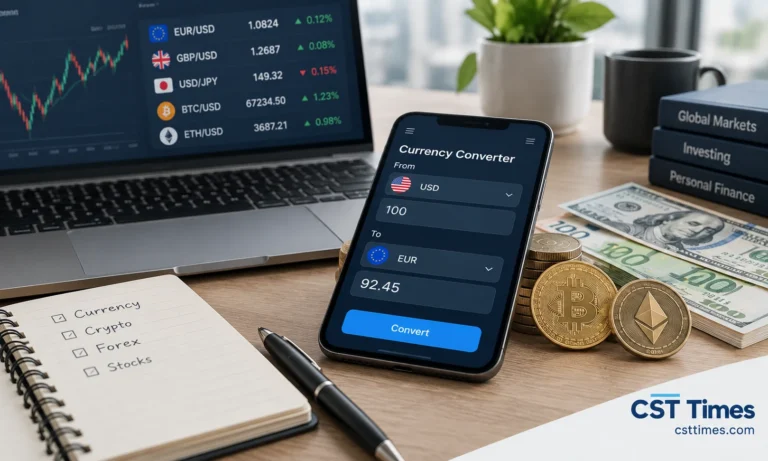
“Financial converter” is an umbrella term. It covers currency converters, crypto converters, forex calculators and tools that show a foreign stock price in your home currency. All of them use the same formula: amount × exchange rate = converted amount.
For example, if 1 euro equals 1.10 US dollars (a hypothetical rate), then 200 euros equal 220 dollars. Rates are quoted in pairs, such as EUR/USD, and they change constantly.
Here is the key point for beginners. The converter does the arithmetic, but the rate does the real work. If the rate is old, averaged or missing fees, the result can mislead you even when the maths is perfect.
Why Financial Conversion Matters
Money is not one global unit. Salaries, prices, invoices and investments are counted in many currencies and, increasingly, in digital assets. Without conversion, you cannot compare a hotel price abroad, check a foreign invoice or know what an overseas investment is worth at home.
The scale is huge. The Bank for International Settlements (BIS) reported that over-the-counter foreign exchange trading averaged $9.6 trillion per day in April 2025, a 28% rise from 2022. Its survey also found that the US dollar was on one side of 89% of all FX trades. That trading activity is what sets the rates every converter shows you. bisBank for International Settlements
Because those prices move all the time, the same amount can be worth more or less within hours.
Where the Rates Come From
Different assets get their prices in different ways.
Currencies.
The benchmark is the mid-market rate, the midpoint between the buy and sell prices in the wholesale market. Central banks publish similar reference rates. The European Central Bank updates its euro reference rates once each working day, at about 16:00 CET. It publishes them for information only and strongly discourages using them for transactions. Italy’s central bank explains that these figures sit midway between buying and selling levels.
Crypto.
No central bank or single market sets the price of Bitcoin. Data platforms collect prices from many exchanges and combine them. CoinGecko states that its coin price is a global volume-weighted average, so busier markets count for more. CoinMarketCap also uses a volume-weighted average of market-pair prices. Individual exchanges can still differ, and CoinGecko notes that regional premiums and decentralized exchanges can explain some gaps.
Stocks.
The converter takes the share price in its local currency and applies the current exchange rate. The value you see depends on both the market price and the currency rate.
“Our free tools refresh at varying speeds based on the CST time zone. Always check the timestamp before relying on any data to ensure you are getting the most up-to-date information.”
Why the Rate You See Is Not Always the Rate You Get
The mid-market rate is a benchmark, not a price offered to most customers. Banks, card networks and transfer apps usually add a margin, either inside the exchange rate or as a separate fee. As a hypothetical example, a rate that is 3% worse on a $1,000 transfer costs you $30 before any fee.
The World Bank tracks this for remittances. It reports that sending money abroad costs an average of 6.36% of the amount sent worldwide, and this figure combines fees and foreign exchange conversion costs. The UN development goals aim for 3% or less by 2030. The World Bank’s Q3 2025 report also shows that digital services averaged 4.59%, compared with 7.30% for non-digital ones.
A second trap appears when you pay by card abroad. Dynamic currency conversion (DCC) lets a shop or ATM show the price in your home currency. Visa explains that this option includes an exchange rate plus additional fees, that you must be given a choice, and that you should decline if you feel pressured. HSBC notes that choosing the local currency typically saves money, though your bank may still charge a fee.
Where Financial Converters Are Used
| Use Case | What Gets Converted | What Matters Most |
|---|---|---|
| Travel and online shopping | Foreign prices into your home currency | Paying in local currency, card fees, timestamp |
| Sending money abroad | Sender’s currency into recipient’s currency | Total cost and the amount that arrives |
| Forex trading | One currency against another | Spread, timing, risk management |
| Crypto | Crypto to fiat, or to another crypto | Exchange price, fees, network costs, tax records |
| Stocks and funds | Foreign share prices into home currency | Currency risk, broker conversion costs |
| Business and accounting | Invoices, revenue and costs in several currencies | One documented rate source, used consistently |
Travel and online shopping
Here the converter answers a simple question: what will this really cost me? Use it as a quick check, then confirm the final charge with your card provider. Choose the local currency at checkout and see whether your card adds a foreign transaction fee.
Sending money abroad
The amount that lands in the recipient’s account matters more than the advertised fee. Compare what each provider will actually deliver against the mid-market rate. A low fee paired with a weak rate can cost more than a higher fee with a fair rate.
Forex trading
Traders use converters to check pair values and estimate profit or loss in their account currency. A converter shows a midpoint, but real trades execute at a buy or sell price, and the gap between them is the spread. Currency trading carries a real risk of loss, and no converter can predict where a rate will go.
Crypto
Crypto users convert for two reasons: to see a portfolio’s value in regular money, and to actually swap assets. The first needs an aggregated price. The second needs the executable price on your chosen exchange, plus trading fees and, for withdrawals, network fees. Many countries treat crypto disposals as taxable events, so keep records of values and dates. Rules vary by country, and crypto prices can swing sharply within a day.
Stock investing
FINRA explains that buying a foreign security means investing in the asset and in its currency, and that funds may still carry currency exposure.
Here is a hypothetical example. An investor buys €10,000 of shares when EUR/USD is 1.10, paying $11,000. The share price stays flat, but the euro weakens to 1.00. The holding is now worth $10,000, a loss of about 9% caused by currency alone.
Investor.gov adds that some countries impose currency controls that can restrict or delay moving money out.
Business and accounting
Companies price, invoice and report in several currencies. They usually choose a documented rate source and apply it consistently, so figures stay comparable over time. Accounting rules differ by country, so finance teams follow their local standards.
Our Tools are designed to help you succeed—feel free to use them whenever you need assistance.
Crypto Converter – Calculate Crypto Value
Crypto DCA Calculator – Calculate Your Crypto Investment Returns
Crypto Profit/Loss Calculator – Calculate ROI
Crypto Mining Calculator – Calculate Mining Profit & Costs
Crypto Staking Calculator – Calculate Rewards
Compound Interest Calculator – Calculate Your Money Growth
Stock Profit & Loss Calculator – Calculate ROI
Quick Checklist Before You Convert Real Money
- Check the rate’s source and timestamp.
- Compare the offered rate with the mid-market rate at the same time.
- Ask for the total cost: fee plus rate margin.
- Choose the local currency when paying by card abroad.
- For crypto, check the price on the exact exchange you will use.
- For foreign stocks, remember currency risk on top of market risk.
Final Thoughts:
A financial converter is a useful starting point, not a final price. It helps you compare, plan and understand value across currencies, crypto and stocks. The habit that protects you most is simple: know where the rate comes from, and know what you will actually pay to use it.
Systematic vs Unsystematic Risk: What’s the Difference and Why It Matters
What is Interest Rate Risk? How It Affects Stocks, Bonds and Loans
Crypto Mining vs Crypto Staking: Which One Actually Pays?
If the CLARITY Act Becomes Law: What It Means for Exchanges
What Is the Biggest Risks in Crypto? (Professional Report-Based Analysis)
FAQs
Is a converter’s rate the same as my bank’s rate?
Usually not. Converters typically show mid-market or reference rates, while banks and apps add a margin. Compare the offered rate with the benchmark at the same moment.
Why do crypto converters show different prices?
Crypto trades on many exchanges at once. Each platform picks different venues and weightings, and regional premiums can push prices apart. Small differences are normal.
Can I use a converter to decide when to trade?
It shows current value, not future direction. When trading, use the live buy and sell prices on your platform.
How often are exchange rates updated?
It depends on the source. The ECB’s reference rates update once per working day, while live market feeds refresh continuously during trading hours.
Disclaimer
This article is educational and is not financial, investment, tax or legal advice. Currency and crypto prices change quickly and can fall as well as rise. Numbers in examples are illustrative unless linked to a source.
Follow us on Social media :
About The Author

Haseeb Jabbar
Haseeb Jabbar writes about crypto, finance, technology, and AI at CST Times, sharing research-based guides, timely news, and free tools and calculators to help readers make informed decisions.
