
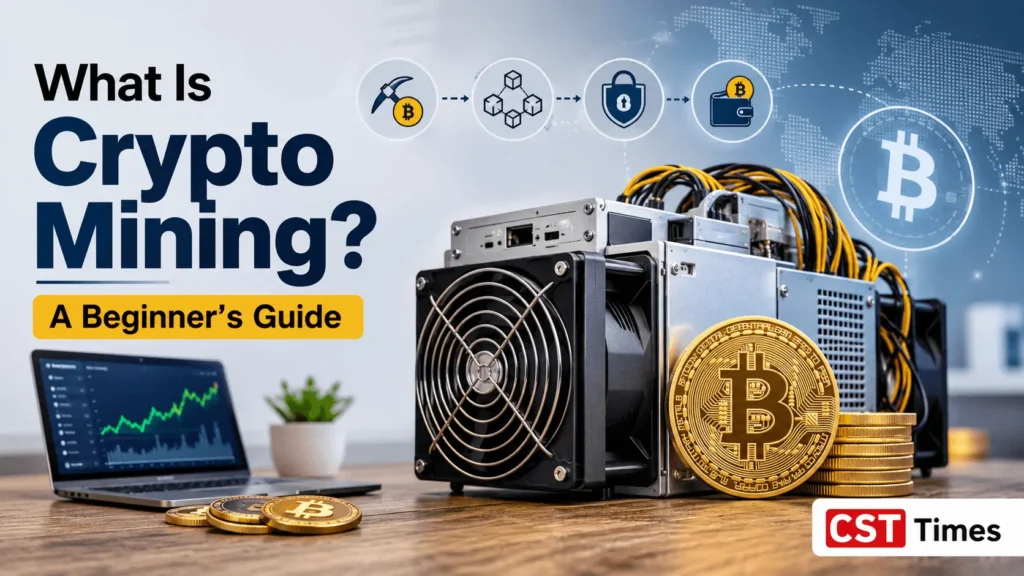
What is Crypto Mining? The Ultimate Beginner’s Guide
What is Crypto Mining? A Beginner's Guide
Quick Summary:
Crypto mining is the process computers use to verify transactions and add new blocks to a blockchain like Bitcoin’s, earning newly created coins as a reward for doing so. It’s how proof-of-work networks stay secure and decentralized without a bank or government in charge. Modern Bitcoin mining runs on specialized machines called ASICs, not laptops, and profitability depends heavily on electricity costs and network competition. This guide breaks down how mining actually works, what it costs, whether it still pays in 2026, and where it’s legal.
Table of Contents
ToggleKey Takeaways
- Crypto mining verifies transactions and secures proof-of-work blockchains like Bitcoin, earning miners newly minted coins plus transaction fees.
- Home laptops and phones can’t mine Bitcoin profitably anymore — it now requires specialized ASIC hardware and cheap, reliable electricity.
- Profitability depends on four factors: hardware cost, electricity price, network difficulty, and the coin’s market price.
- Mining is legal in most countries but banned or heavily restricted in a smaller group, including China.
- “Free” Bitcoin mining apps rarely perform real mining — the legitimate low-cost entry points are cloud-mining contracts and mining pools, not phone-based simulations.
Table of Contents
- What Exactly Is Crypto Mining?
- How Does Crypto Mining Work?
- What You Need to Start Mining
- Is Crypto Mining Profitable?
- Risks of Crypto Mining
- Advantages of Crypto Mining
- Is Crypto Mining Legal?
- Can You Mine Bitcoin for Free?
- Final Thoughts
What Exactly is Crypto Mining?
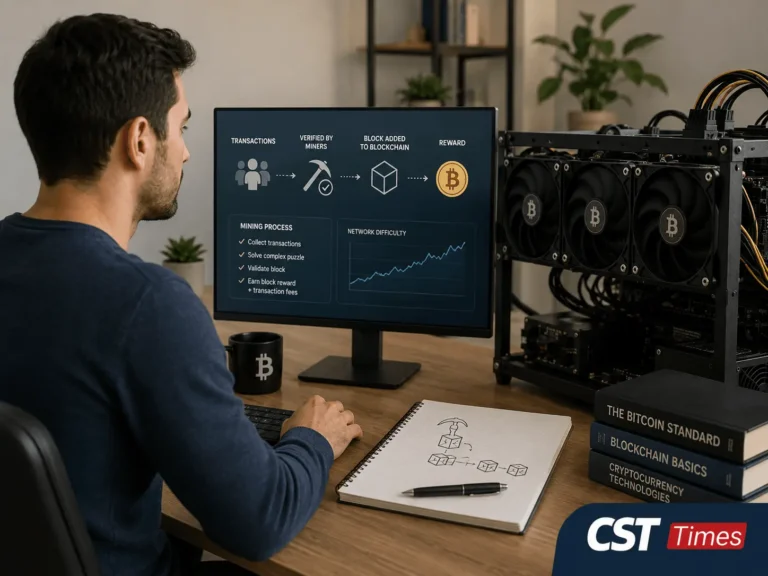
Crypto mining is the process of using computing power to confirm cryptocurrency transactions and add them to a blockchain’s public ledger. It applies specifically to proof-of-work (PoW) cryptocurrencies such as Bitcoin, where miners compete to solve a cryptographic puzzle, and the winner gets to add the next block.
In return, that miner receives a block reward — a fixed number of newly created coins — plus the transaction fees included in that block. Mining does two jobs at once: it introduces new coins into circulation on a fixed, predictable schedule, and it secures the network by making it prohibitively expensive to rewrite transaction history. Without miners, a proof-of-work blockchain would have no way to agree on which transactions are valid, since there’s no central authority keeping the official record.
How Does Crypto Mining Work?
When someone sends Bitcoin, the transaction broadcasts to the network and waits in a pool of unconfirmed transactions called the mempool. Miners pick up pending transactions — usually prioritizing the ones offering higher fees — and group them into a candidate block.
To add that block to the blockchain, a miner’s hardware has to find a specific value (called a nonce) that, combined with the block’s data, produces a hash below a target set by the network’s current difficulty. This isn’t solved through logic; it’s trial and error at enormous scale, with mining rigs running quadrillions of guesses per second.
The first miner to find a valid hash broadcasts it to the network. Other nodes verify the solution almost instantly — even though finding it took enormous computing effort — and the block is permanently added to the chain. That miner collects the block reward, currently 3.125 BTC following Bitcoin’s April 2024 halving, plus every transaction fee in the block.
Difficulty adjusts automatically roughly every two weeks to keep new blocks arriving about every 10 minutes, no matter how much total computing power (hashrate) is competing. As of September 2026, Bitcoin’s network hashrate sits at roughly 960 exahashes per second — meaning a solo miner running a single machine has almost no realistic chance of winning a block alone. That’s why nearly all individual miners join a mining pool instead.
What You Need to Start Crypto Mining
Getting started requires a few things working together, not just a machine:
- Mining hardware — an ASIC for Bitcoin (the only practical option today), or a modern GPU for the shrinking list of altcoins that remain GPU-mineable, such as Kaspa or Alephium.
- Reliable, affordable electricity — usually the single biggest ongoing cost.
- A crypto wallet to receive your payouts.
- Mining software that connects your hardware to the network or pool.
- Mining pool membership — almost essential for anyone without an industrial-scale operation.
Steps to Actually Start
- Confirm the coin still uses proof of work — many major coins, including Ethereum, have switched to proof of stake and can no longer be mined at all.
- Choose hardware suited to your budget, such as an ASIC like the Antminer S21 Pro (234 TH/s) for Bitcoin.
- Set up a wallet to receive mining payouts.
- Join a mining pool so you get smaller, steady payouts instead of a rare lottery-style win.
- Install mining software, point it at the pool, and monitor power draw, temperature, and payouts.
- Add up the real ongoing costs — electricity, cooling, noise, and eventual hardware replacement — before treating any of it as guaranteed income.
Is Crypto Mining Profitable?
Profitability comes down to four variables: hardware cost, electricity price, network difficulty, and the coin’s market price. Get any one of them wrong and a plan that looked profitable on paper can lose money.
As a real example: Bitmain’s Antminer S21 Pro (234 TH/s, 3,510 watts) was generating around $9 a day in mined Bitcoin as of early September 2026, against roughly $5.90 a day in electricity at $0.07/kWh — a thin daily margin before accounting for the machine’s purchase price, cooling, and eventual replacement. Push electricity above roughly $0.12–0.15/kWh and that same machine can slide into a loss.
Electricity Rate | Typical Outcome (Modern ASIC) |
|---|---|
| ~$0.05/kWh | Usually profitable, even during price dips |
| $0.08–0.10/kWh | Thin margin, sensitive to Bitcoin’s price |
| $0.15/kWh+ | Often unprofitable on older or less efficient machines |
This is why serious mining operations cluster in regions with cheap power — hydro capacity in Paraguay, or stranded gas and wind power in parts of the US and Central Asia — rather than running rigs on standard home electricity rates.
Does it really pay? For most people plugging a single machine into home power, mining is closer to a break-even hobby than a reliable income stream. Mid-range ASICs typically take 12 to 24 months to pay for themselves under favorable conditions, and that timeline can stretch or shrink fast if Bitcoin’s price or network difficulty moves against you.
Risks of Crypto Mining
- Hardware obsolescence — newer, more efficient ASICs launch regularly, shrinking your share of network rewards.
- Electricity costs — even small rate increases can erase already-thin margins.
- Price volatility — the dollar value of what you mine swings with the coin’s market price, even if your hashrate stays constant.
- Rising difficulty — as more miners join the network, everyone’s expected share shrinks.
- Heat and noise — industrial ASICs are loud and generate significant heat, making large-scale home mining impractical for most people.
- Regulatory risk — rules on mining, energy use, and taxation can change with little warning.
- Scams — fake mining apps, cloud-mining schemes promising guaranteed returns, and phishing attacks specifically target miners.
Advantages of Crypto Mining
- Directly supports network security and decentralization, rather than just holding or trading coins.
- Can generate coin-denominated income independent of buying at any specific price point.
- Surplus or otherwise-wasted energy — flared gas, curtailed renewable power — can sometimes be put to productive use through mining.
- The block reward itself carries no counterparty risk, since it’s enforced by network consensus rather than a company’s promise.
- At sufficient scale and efficiency, mining can be run as a genuine industrial business rather than pure speculation.
Is Crypto Mining Legal?
Mining is legal in most countries, including the United States, Canada, most of the European Union, and Gulf states like the UAE — though rules on permits, energy use, and taxation vary by jurisdiction and sometimes by state or province. A smaller group of countries prohibit it outright: China’s 2021 ban remains in force and has been reaffirmed since, and several other countries — including Bangladesh, Egypt, Algeria, Morocco, and Nepal — restrict or ban both crypto trading and mining.
Some regions that welcomed miners after China’s 2021 crackdown, such as Kazakhstan, now impose licensing requirements, energy caps, or special power tariffs on mining operations. Because regulations can change quickly and vary widely by location, always check current local laws — including electricity and tax rules — before setting up any mining operation, rather than relying on a general guide.
Can You Mine Bitcoin for Free?
Not in any meaningful sense. Real Bitcoin mining requires industrial ASIC hardware and paid electricity — there’s no way to mine a meaningful amount of BTC using just a phone’s or laptop’s processor. Apps claiming to let you “mine Bitcoin” for free on a smartphone typically aren’t performing real proof-of-work mining at all; security researchers have repeatedly flagged such apps for showing fake balances, harvesting personal data, or charging hidden “withdrawal fees” that never actually pay out.
A few lower-cost, more legitimate entry points do exist. Some exchanges offer cloud-mining contracts backed by real infrastructure — for example, Binance Cloud Mining sells Bitcoin mining contracts tied to its mining pool rather than promising free hardware access. Faucets pay tiny, ad-funded amounts of crypto for completing simple tasks, but the amounts are negligible. Neither produces income worth relying on, and any platform advertising “guaranteed returns,” compulsory referrals, or upfront fees to unlock a withdrawal should be treated as a serious warning sign.
Final Thoughts:
Crypto mining is no longer the laptop hobby it was in Bitcoin’s early years — it’s a competitive, capital-intensive industry shaped by hardware efficiency, electricity prices, and network difficulty. Understanding how it works is still useful even if you never plan to mine yourself, since it explains where new coins actually come from and why proof-of-work networks are considered secure. If you do want to get involved, start by running the numbers honestly with real electricity rates and current hardware specs before spending money on equipment or cloud-mining contracts.
FAQs
What’s the difference between mining and buying crypto?
Mining creates new coins and earns rewards by performing computational work that secures the network. Buying crypto simply exchanges money for coins someone else already holds or mined.
Can I mine Bitcoin on my laptop?
No. Bitcoin’s network difficulty is far too high for CPUs or GPUs to compete profitably — mining requires purpose-built ASIC hardware.
What is a mining pool?
A group of miners who combine their hashpower and split block rewards proportionally, so members receive smaller but steadier payouts instead of relying on rarely winning a block alone.
Why did Ethereum stop being mineable?
Ethereum switched from proof of work to proof of stake in 2022 (an upgrade known as “The Merge”), replacing mining with staking as its consensus method.
How often does Bitcoin’s mining reward get cut in half?
Roughly every four years, every 210,000 blocks. The most recent halving was in April 2024, cutting the reward to 3.125 BTC; the next is expected around 2028.
Is crypto mining bad for the environment?
Proof-of-work mining does use significant electricity, which is why it draws environmental criticism — and why some miners specifically seek out renewable, stranded, or otherwise underused power sources.
Disclaimer
This article is for educational purposes only and does not constitute financial, investment, or legal advice. Cryptocurrency mining involves hardware, electricity, market, and regulatory risks, and profitability is never guaranteed. Always verify current local laws and run your own cost calculations before mining or investing.
Follow us on Social media :
About The Author

Haseeb Jabbar
Haseeb Jabbar writes about crypto, finance, technology, and AI at CST Times, sharing research-based guides, timely news, and free tools and calculators to help readers make informed decisions.
