
What Are Stablecoins? How They Work, Whether They’re Safe, and How to Buy Them
What Are Stablecoins? The Complete 2026 Guide
Quick Summary:
A stablecoin is a cryptocurrency built to hold a steady price, almost always $1, instead of floating freely like Bitcoin or Ethereum. Most stablecoins do this by keeping cash and short-term US Treasury bills in reserve, one dollar for every token in circulation, so anyone holding the token can redeem it for a real dollar.
Table of Contents
ToggleThat simple design has turned stablecoins into the plumbing of the crypto industry. Traders use them to move in and out of positions without touching a bank. DeFi platforms use them as collateral. Millions of people outside the US now use them to send money home or protect savings from a weak local currency. By mid-2026, the combined value of all stablecoins in circulation sat above $300 billion, more than the official foreign exchange reserves of over 90 individual countries, including the UK and Canada.
This guide answers the questions people actually ask about stablecoins: what they are, how they stay pegged to a dollar, whether they’re genuinely safe, how the companies behind them make money, whether their value can ever rise, and how to buy one for the first time.
Key Takeaways
- A stablecoin is a crypto token designed to track the value of another asset, usually the US dollar, at a fixed 1:1 ratio.
- Most stablecoins keep their peg by holding real reserves (cash and Treasury bills) that back every token in circulation.
- The stablecoin market has grown past $300 billion, led by Tether’s USDT and Circle’s USDC, which together account for roughly four-fifths of the total.
- Stablecoins aren’t risk-free. Terra’s UST collapsed in 2022, and USDC briefly lost its peg in 2023 when its bank failed.
- The US GENIUS Act, signed into law in July 2025, now sets federal reserve and disclosure rules for dollar-pegged stablecoins, with full enforcement due by January 2027.
- A stablecoin’s price is designed to stay flat, not rise. Any real growth in your holdings comes from separate yield-bearing products, not the base stablecoin itself.
- Issuers like Tether and Circle earn money by investing customer reserves in Treasury bills, not by charging holders directly.
Table of Contents
- What Are Stablecoins?
- How Do Stablecoins Work?
- Why Are Stablecoins Important?
- How Do Stablecoin Issuers Make Money?
- Are Stablecoins Safe?
- Can Stablecoins Increase in Value?
- How to Buy Stablecoins
- Quick Checklist Before You Buy
- Final Thoughts
What Are Stablecoins?
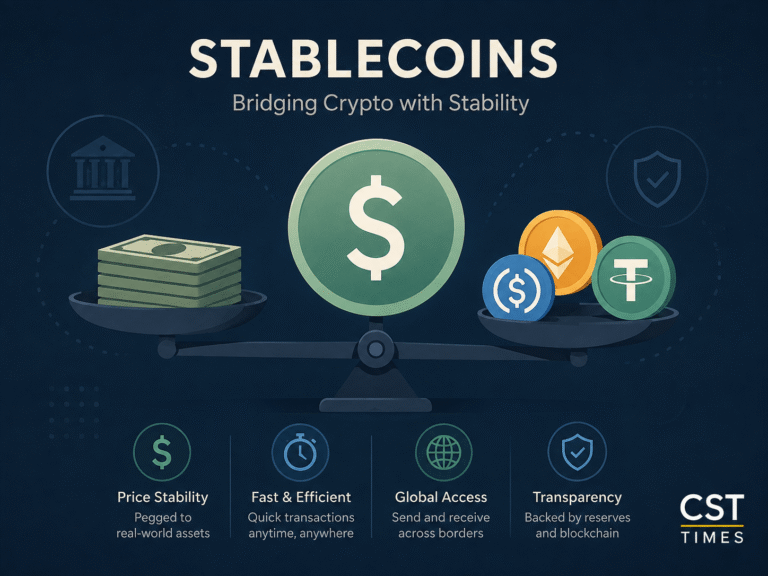
A stablecoin is a type of cryptocurrency designed to hold a stable, predictable price rather than fluctuate the way Bitcoin, Ethereum, or most other tokens do. The vast majority are pegged to the US dollar, so one token is meant to always be worth one dollar. A smaller number track other currencies, gold, or a basket of assets.
The idea exists because ordinary cryptocurrencies are too volatile for everyday use. Bitcoin can swing five or ten percent in a single day, which makes it a poor choice for paying rent, invoicing a client, or holding savings you might need next week. Stablecoins were built to solve that problem: they give people the speed and programmability of blockchain money without the rollercoaster price chart.
In practice, stablecoins function as a digital dollar that moves at internet speed. A trader in Karachi can send $500 worth of USDT to an exchange in Singapore in minutes, at a fraction of the cost of a traditional wire transfer, and the value on the other end is still worth $500 when it arrives.
Tether’s USDT and Circle’s USDC dominate the market. Together they represent well over three-quarters of all stablecoin value in circulation, with USDT alone accounting for close to 60%. Other notable stablecoins include DAI (issued through the Sky Protocol, formerly MakerDAO), PayPal’s PYUSD, and newer entrants like USD1, which is tied to World Liberty Financial.
How Do Stablecoins Work?
Every stablecoin needs a mechanism to keep its price anchored to $1. There are three broad approaches, and the choice of mechanism has a direct bearing on how safe a given stablecoin actually is.
Fiat-collateralized stablecoins
The most common and generally the most stable type. An issuer such as Tether or Circle holds cash, cash equivalents, and short-term government debt equal to the number of tokens in circulation. When someone buys the stablecoin, the issuer receives real dollars and mints an equal number of tokens. When someone redeems it, the tokens are burned and the issuer releases the matching reserve. USDT, USDC, and PYUSD all work this way.
Crypto-collateralized stablecoins
Backed by other cryptocurrencies instead of cash, but they hold more collateral than the value of tokens issued, often 150% or more, to absorb price swings in the underlying crypto. DAI, minted through the Sky Protocol, is the best-known example. Because the backing lives entirely on the blockchain and can be verified by anyone, this model is more decentralized, but it’s also more complex and can come under strain during sharp market crashes.
Algorithmic stablecoins
These try to hold their peg through code and market incentives rather than real collateral, expanding or contracting supply automatically to push the price back to $1. This approach has a poor track record. Terra’s UST, once a top-10 stablecoin, relied on this design and collapsed to near zero in May 2022, erasing roughly $40 billion in value within days. Regulators have grown far more skeptical of purely algorithmic models since then, and several jurisdictions, including Pakistan’s new digital asset framework, now restrict or ban tokens that aren’t adequately collateralized.
Type | How the Peg Is Maintained | Examples | Relative Risk |
|---|---|---|---|
| Fiat-collateralized | Cash and Treasury bills held 1:1 | USDT, USDC, PYUSD | Lower, but depends on issuer transparency and reserve quality |
| Crypto-collateralized | Over-collateralized with crypto assets | DAI / USDS (Sky) | Moderate — more decentralized but exposed to crypto volatility |
| Algorithmic | Code-driven supply expansion and contraction | Mostly discontinued after UST | High — structurally fragile under stress |
Day to day, the peg is enforced through arbitrage. If a stablecoin trades slightly below $1, traders buy it cheaply and redeem it with the issuer for a full dollar, pocketing the difference and pushing the price back up. If it trades above $1, traders mint new tokens at $1 and sell them at the higher market price, pushing the price back down. This constant buying and selling is what keeps most stablecoins trading within a fraction of a cent of their target price under normal conditions.
Why Are Stablecoins Important?
Stablecoins matter because they solve a real problem: moving dollar-equivalent value across borders and across blockchains quickly, cheaply, and without needing a bank account on both ends.
Cross-border payments and remittances.
Sending money internationally through traditional channels can take days and cost a meaningful cut in fees. A stablecoin transfer settles in minutes for a small fraction of that cost. This is especially relevant in South Asia, where remittances are a major part of household income. Pakistan has moved to formally regulate this space: Parliament passed the Virtual Assets Act 2026, creating the Pakistan Virtual Assets Regulatory Authority (PVARA) to license and supervise crypto activity, and the government has separately signed an agreement to explore stablecoin-based cross-border payment rails.
Trading and a safe harbor from volatility.
Stablecoins are the base currency of crypto trading. When a trader wants to lock in profits or sit out a volatile stretch of the market without cashing out to a bank account, they typically move into a stablecoin rather than fiat.
DeFi infrastructure.
Decentralized finance platforms use stablecoins as collateral for loans, as the liquidity in trading pools, and as the unit traders borrow and lend against. Without a stable unit of account, most DeFi lending and trading would be impractical.
A structural presence in government debt markets.
Because issuers park customer reserves almost entirely in short-term US Treasury bills, stablecoin companies have become significant holders of US government debt, with Tether alone ranking among the world’s larger holders of Treasury securities. Central banks and the IMF now study stablecoin reserve demand as a factor that measurably affects short-term Treasury yields.
How Do Stablecoin Issuers Make Money?
This is one of the more counterintuitive parts of the stablecoin business model: issuers don’t charge holders a fee, and under the GENIUS Act they’re barred from paying interest directly on regulated payment stablecoins. So where does the money come from?
The answer is reserve income. When you buy $1,000 of USDT or USDC, the issuer doesn’t just sit on that cash. It invests the pooled reserves of all its customers into short-term, highly liquid instruments, primarily US Treasury bills, along with overnight repurchase agreements and bank deposits. Those instruments earn interest. The issuer keeps that interest; the holder gets price stability and redeemability, but not a yield.
At the interest rates seen through 2025, this turned into an extraordinarily profitable business. Tether reported more than $10 billion in net profit for 2025, generated almost entirely from interest on a Treasury and reserve portfolio exceeding $120 billion. Circle earns similarly from USDC reserves, though it shares a significant portion of that income with distribution partners, which is part of why its reported margins look thinner than Tether’s despite comparable reserve size.
This also means issuer profitability is tied directly to interest rates. When central banks cut rates, the yield on reserves shrinks, and so does issuer income. It’s a large part of why some issuers have started diversifying into other assets and fee-based products rather than relying purely on Treasury yield.
Because regulated issuers can’t pass this yield to ordinary holders, a separate category of yield-bearing stablecoins has emerged specifically to do that, covered below.
Are Stablecoins Safe?
Stablecoins are safer than most cryptocurrencies in the sense that they aren’t designed to be volatile, but “stable” does not mean risk-free. A stablecoin is only as strong as three things: the quality of its reserves, how quickly holders can redeem it for real dollars, and whether the market trusts both of those facts. When any one of those breaks down, the peg can slip.
History offers several instructive examples:
- Terra’s UST (May 2022): An algorithmic stablecoin with no real collateral behind it. When confidence cracked, its stabilization mechanism spiraled out of control, and roughly $40 billion in value was wiped out within days. This remains the largest stablecoin failure to date.
- USDC (March 2023): A fully collateralized, well-audited stablecoin still briefly fell to about $0.87 after Circle disclosed that $3.3 billion of its reserves were temporarily stuck at the failed Silicon Valley Bank. Once regulators guaranteed SVB depositors, USDC recovered its peg within days. It illustrated that even reserve-backed stablecoins carry banking counterparty risk.
- BUSD (February 2023): Regulators ordered Paxos to stop minting new BUSD. The token held its $1 peg because reserves stayed intact and redemptions remained open, but the supply wound down to near zero over the following year as a matter of regulatory decision, not a collapse of backing.
- Smaller DeFi stablecoins (2026): Newer, more exotic designs remain vulnerable. In March 2026, the stablecoin ResolvUSD was exploited and briefly traded as low as $0.14 before recovering, a reminder that newer and smaller stablecoins carry materially more risk than the established, heavily audited names.
Regulation is now catching up. The GENIUS Act, signed into US law in July 2025, requires payment stablecoin issuers to hold 1:1 liquid reserves, publish regular disclosures, and submit to oversight from federal or state banking regulators. Full rules are being finalized through 2026, with the law taking effect no later than January 2027. Pakistan’s Virtual Assets Act 2026 takes a similar approach domestically, explicitly restricting stablecoins that aren’t adequately collateralized.
None of this makes stablecoins immune to failure. They are not covered by FDIC deposit insurance, and if an issuer becomes insolvent or a banking partner fails, holders can face delays or losses during the recovery process. Sticking to large, transparent, frequently audited stablecoins meaningfully reduces, but never fully eliminates, that risk.
Can Stablecoins Increase in Value?
By design, no. A stablecoin’s entire purpose is to stay flat at its peg, usually exactly $1. Unlike Bitcoin or Ethereum, it isn’t meant to appreciate, and if it consistently traded well above $1, that would actually signal something is wrong with the peg, not a gain worth celebrating. Arbitrage traders work continuously to push the price back to par whenever it drifts in either direction.
That said, there is one legitimate way to earn a return while holding dollar-pegged value: yield-bearing stablecoins. Because the GENIUS Act blocks regulated issuers from paying interest directly to holders, a separate category of tokens has grown specifically to pass reserve or strategy yield through to the people holding them. Examples include Sky’s sUSDS, which earns a Treasury-linked savings rate; Ondo’s USDY, which tracks short-term US Treasury yield; and Ethena’s sUSDe, which generates a variable return from a derivatives-based strategy involving staked crypto and short futures positions.
With these products, you don’t hold a token that rises in price. Instead, either the exchange rate between the yield-bearing token and the base stablecoin increases over time, or your token balance grows automatically. The underlying dollar-peg still doesn’t move; the yield is a separate layer sitting on top of it, and it carries its own risks, including smart-contract risk and, in the case of derivatives-based yield like sUSDe, exposure to funding rates that can compress or turn negative during rough markets. Higher advertised yields generally track higher risk, not free money.
How to Buy Stablecoins
Buying a stablecoin for the first time is similar to buying any other cryptocurrency.
- Choose a licensed, regulated exchange. Look for a platform authorized to operate in your country. In Pakistan, that increasingly means a platform registered with PVARA under the Virtual Assets Act 2026; internationally, look for exchanges licensed in major jurisdictions.
- Complete identity verification. Regulated exchanges require standard identity checks before you can deposit or withdraw funds. This is a normal part of using a licensed platform, not an optional step.
- Deposit funds. Most exchanges accept bank transfers, debit cards, or local payment methods to fund your account in your home currency.
- Buy the stablecoin you want. Search for the trading pair (for example, USD/USDT or USD/USDC), and either place a market order for an immediate purchase at the current price or a limit order to buy at a specific price.
- Decide where to hold it. You can leave it on the exchange for convenience, or move it to a personal wallet you control for added security, particularly for larger amounts you don’t plan to trade with soon.
If you already hold one major stablecoin, you can usually swap directly into another (USDT to USDC, for example) on the exchange’s spot market without converting back to fiat first.
With these products, you don’t hold a token that rises in price. Instead, either the exchange rate between the yield-bearing token and the base stablecoin increases over time, or your token balance grows automatically. The underlying dollar-peg still doesn’t move; the yield is a separate layer sitting on top of it, and it carries its own risks, including smart-contract risk and, in the case of derivatives-based yield like sUSDe, exposure to funding rates that can compress or turn negative during rough markets. Higher advertised yields generally track higher risk, not free money.
Quick Checklist Before You Buy
- Confirm the exchange is licensed to operate in your jurisdiction.
- Stick to stablecoins with frequent, publicly available reserve attestations.
- Understand which type of stablecoin you’re buying: fiat-backed, crypto-backed, or a yield-bearing wrapper.
- Never treat a high advertised yield as risk-free; higher returns almost always mean higher underlying risk.
- Keep large holdings in a wallet you control rather than leaving everything on an exchange.
- Diversify across more than one issuer if you’re holding a significant amount for the long term.
Final Thoughts:
Stablecoins have moved from a niche trading tool to a genuine piece of financial infrastructure, used for remittances, trading, savings, and increasingly for everyday payments. The core idea is simple: a digital token that behaves like a dollar. The details, how that peg is maintained, who regulates it, and how much you can trust the reserves behind it, are what actually determine whether a given stablecoin is a reasonable place to park your money.
For most people, sticking to the largest, most transparent, and most heavily regulated stablecoins remains the safer path. Chasing higher yields or newer, less-tested tokens can pay off, but it comes with meaningfully higher risk, and that trade-off deserves a clear-eyed look before committing any real money.
1. Is USDT or USDC safer?
Both are fiat-collateralized and among the most established stablecoins. USDC is generally seen as more transparent, with daily reserve disclosures, while USDT has a longer track record and far deeper liquidity across exchanges. Neither is risk-free.
2. Can a stablecoin lose all its value?
Yes, if it’s poorly collateralized or its mechanism fails, as happened with Terra’s UST. Well-reserved, heavily audited stablecoins have historically recovered quickly from brief depegs, but a total loss is possible in a worst-case scenario.
3. Do stablecoins pay interest?
Regulated payment stablecoins like USDT and USDC don’t pay interest directly to holders under the GENIUS Act. Separate yield-bearing stablecoin products exist specifically to offer a return, but they carry additional risk.
4. What’s the difference between a stablecoin and a central bank digital currency (CBDC)?
A stablecoin is issued by a private company and typically runs on a public blockchain. A CBDC is issued directly by a country’s central bank and represents a digital form of that country’s official currency.
Disclaimer
This article is for educational purposes only and does not constitute financial, investment, or legal advice. Cryptocurrency and stablecoin markets carry risk, including the risk of losing your full investment. Always do your own research and consider speaking with a licensed financial advisor before making investment decisions.
Follow us on Social media :
About The Author

Haseeb Jabbar
Haseeb Jabbar writes about crypto, finance, technology, and AI at CST Times, sharing research-based guides, timely news, and free tools and calculators to help readers make informed decisions.
