
Spot Trading vs Futures Trading: 7 Key Differences
Spot Trading vs Futures Trading: Which Crypto Strategy Fits You?
Quick Summary:
When you open any Trading platform (crypto exchange, Stock broker, Forex broker, Commodity broker/exchange). You’ll usually see two separate sections: Spot and Futures. Both let you trade the same coins, but the mechanics, risks, and outcomes are completely different.
Table of Contents
ToggleWe use a crypto exchange as an example to explain Spot Trading and Futures Trading.
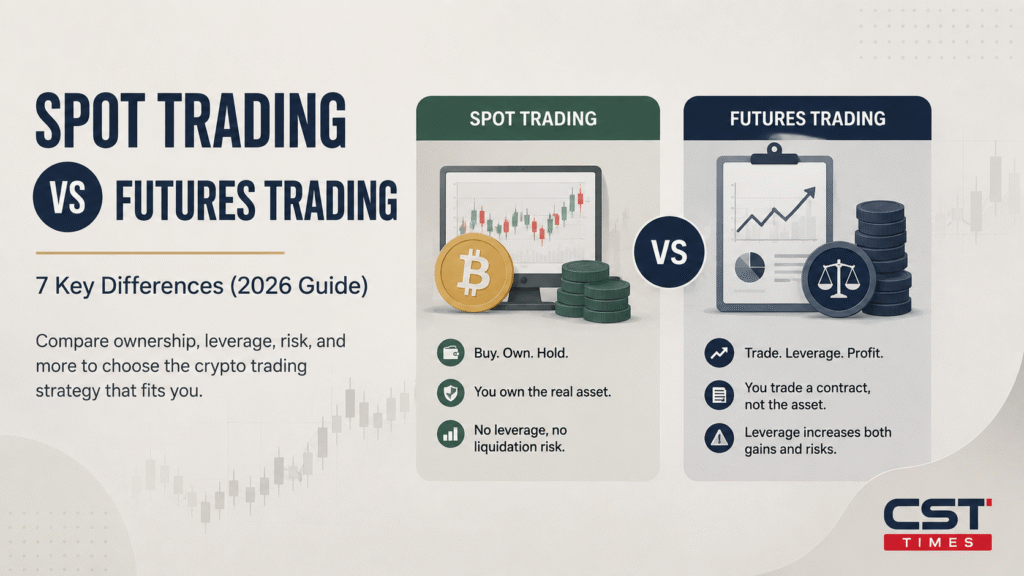
In simple terms: spot trading means buying the actual cryptocurrency and owning it. Futures trading means trading a contract that tracks the coin’s price, usually with borrowed money, without ever owning the coin itself.
That single difference — ownership versus a contract — changes everything else: how much risk you’re exposed to, how much capital you need, and whether you can profit when prices fall as well as when they rise. This guide breaks down exactly how each method works, where the real risks sit, and how to decide which one fits your goals.
Key Takeaways
- Spot trading = you buy and own the real asset. No leverage, no expiry, no liquidation risk.
- Futures trading = you trade a contract on the asset’s price, often using leverage, without owning the coin.
- Futures let you profit from both rising and falling prices; spot only pays off if the price goes up.
- Leverage multiplies both gains and losses, and can trigger liquidation — the forced closure of your position.
- Spot is the more beginner-friendly entry point; futures require active risk management.
Table of Contents
- What Is Spot Trading?
- What Is Futures Trading?
- Spot vs Futures: Side-by-Side Comparison
- Key Differences Explained
- Worked Example: Same Capital, Two Approaches
- Risk Management Basics
- Which One Should You Choose?
- Quick Checklist Before You Trade
- Final Thoughts
What Is Spot Trading?
Spot trading is the most direct form of crypto trading. You buy a cryptocurrency at its current market price, and the asset is transferred to you almost immediately. From that point on, you own it — you can hold it, move it to your own wallet, or sell it whenever you choose.
There’s no leverage and no borrowed money involved in a standard spot trade. You’re only ever exposed to the amount you actually put in.
Example: If you spend $1,000 to buy BNB at the spot price, you own $1,000 worth of BNB. If the price rises, your holdings are worth more. If it falls, they’re worth less. There’s no third possibility — no contract expiring, no margin call, no forced liquidation.
Advantages of spot trading
- Simple to understand — you buy low, hope to sell high, that’s it.
- You actually own the asset, so you can transfer it, stake it, or use it elsewhere.
- No leverage means your maximum loss is what you invested — nothing more.
- Well suited to long-term holding (“HODLing”) and beginners.
Limitations of spot trading
- Your capital is tied up 1:1 — to control $10,000 of exposure, you need $10,000.
- You generally only profit when the price rises.
- It’s slower for traders who want to actively speculate on short-term price swings actively.
What Is Futures Trading?
Futures trading works differently. Instead of buying the coin, you’re trading a contract that follows the coin’s price. You’re speculating on where the price will go, and you can do this with leverage — putting up a fraction of the position’s value as collateral (margin) to control a much larger position.
Crypto exchanges typically offer two types of futures contracts:
- Perpetual futures — the most common type. These have no expiry date, so a position can theoretically be held indefinitely, as long as it isn’t liquidated. A “funding rate” is periodically exchanged between long and short traders to keep the contract price anchored to the spot price.
- Quarterly (fixed-date) futures — these expire on a set date, similar to traditional commodity futures.
Leverage and margin, in plain terms
Say you use 10x leverage with $1,000 of margin. You’re now controlling a $10,000 position. If the price moves 10% in your favor, you make roughly $1,000 — a 100% return on your margin, before fees. But if it moves 10% against you, your $1,000 margin is largely wiped out.
Exchanges track two thresholds: initial margin (what you need to open the position) and maintenance margin (the minimum you must keep in the position to avoid liquidation). If your account equity drops below the maintenance margin, the exchange automatically closes your position — this is liquidation, and it happens regardless of whether you’re watching the market at that moment.
Long and short positions
Unlike spot trading, futures let you profit in two directions: go long if you expect the price to rise, or go short if you expect the price to fall — something spot trading generally doesn’t allow directly.
Advantages of futures trading
- Capital efficient — smaller amounts of money can control larger positions.
- You can profit in both rising and falling markets.
- Useful for hedging an existing spot portfolio against short-term downside.
Limitations of futures trading
- Real liquidation risk — losses can happen quickly and are automatic.
- More complex — requires understanding margin, funding rates, and contract types.
- Requires active monitoring; leveraged positions can move against you fast in a volatile market.
Spot vs Futures: Side-by-Side Comparison
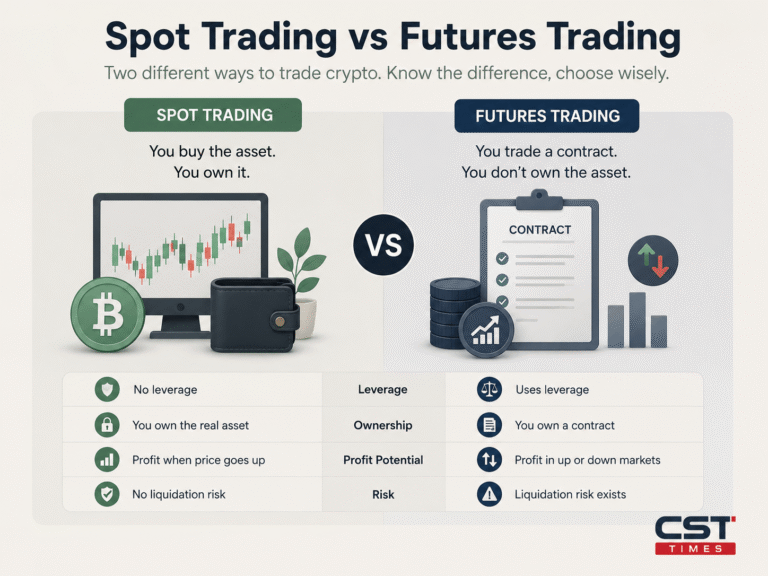
| Feature | Spot Trading | Futures Trading |
|---|---|---|
| Ownership | Yes — you hold the actual asset | No — you hold a contract |
| Leverage | Not used | Commonly available (varies by exchange, often up to 20x–125x) |
| Profit direction | Price increase only | Price increase (long) or decrease (short) |
| Settlement | Immediate | Perpetual (no expiry) or fixed-date contracts |
| Liquidation risk | None | Yes, if margin falls below maintenance level |
| Capital required | Full value of position | A fraction, via margin |
| Complexity | Low | Higher |
| Best suited for | Beginners, long-term holders | Experienced traders with a risk plan |
Key Differences Explained
Ownership
This is the core distinction. Spot trading transfers the actual coin to your wallet. Futures trading never does — you’re holding a derivative contract whose value tracks the coin’s price.
Leverage and capital efficiency
Spot trading requires the full amount up front. Futures trading lets you open a larger position with less capital, which is more capital-efficient but proportionally riskier, since losses scale with the leveraged position size, not just your margin.
Risk and liquidation
Spot trading has a hard floor: your position can only go to zero if the asset’s value goes to zero. Futures positions can be liquidated well before that, because the exchange closes them automatically once your margin can no longer cover potential losses.
Fees and costs
Spot trading typically involves a single trading fee per transaction. Futures trading often adds a recurring funding fee on top of the trading fee, which affects the real cost of holding a leveraged position over time.
Regulatory landscape
Rules around crypto derivatives have been shifting. In the United States, the SEC and CFTC jointly issued interpretive guidance in March 2026 clarifying how federal securities law applies to various crypto assets, and the CFTC approved the first CFTC-regulated crypto perpetual futures contracts for U.S. retail traders in May 2026 — a market that had previously operated almost entirely offshore. Other countries have their own frameworks, and individual exchanges may restrict futures products based on a trader’s location. Always confirm what’s available and permitted where you are before trading derivatives.
Worked Example: Same Capital, Two Approaches
This example is purely illustrative, using round numbers and a hypothetical asset — it’s meant to show the mechanics, not to predict real returns.
Imagine a trader has $1,000 and is deciding how to use it if the asset moves 10% in either direction.
+$100
−$100
position
+~$1,000
The mechanics are identical in direction; the difference is magnitude. A 10% market move is a manageable swing for a spot holder and a potentially account-ending event for a highly leveraged futures trader. This is the trade-off leverage always creates: it doesn’t change the odds of the market moving in your favor, only the size of the outcome in either direction.
Risk Management Basics
- Only risk money you can afford to lose. This applies more, not less, once leverage is involved.
- Understand the fee structure before trading — trading fees, and for futures, funding fees.
- For futures specifically: use stop-loss orders, avoid maximum available leverage, and track your margin ratio rather than waiting for a liquidation warning.
- For spot specifically: volatility risk still applies even without leverage — research the asset and don’t rely on hype or promises of guaranteed returns.
- Secure your account. Use exchange security features like two-factor authentication regardless of which market you trade in.
Which One Should You Choose?
There’s no universally “better” option — the right choice depends on your goals, experience, and risk tolerance.
Spot trading tends to fit better if you’re:
- New to crypto and still learning how markets move.
- Investing with a long-term horizon rather than trying to time short-term price swings.
- Not comfortable with the idea of a position being closed automatically.
Futures trading tends to fit better if you’re:
- Already experienced with how crypto markets behave.
- Looking to hedge an existing spot portfolio against short-term downside.
- Prepared to actively manage margin, leverage, and liquidation risk.
Many traders don’t pick one exclusively — they hold core, long-term positions in spot and use a smaller, separately budgeted allocation in futures for short-term speculation or hedging.
Quick Checklist Before You Sign Up
- ✔ Do I know whether I’m buying the real asset or a contract?
- ✔ If leverage is involved, do I know exactly how much and what that means for my risk?
- ✔ Do I understand how liquidation works on this platform?
- ✔ Do I have a position size and exit plan before I enter the trade?
- ✔ Am I only using money I can afford to lose?
- ✔ Have I checked the trading and funding fees?
- ✔ Have I confirmed that derivatives trading is available and permitted for my situation?
Final Thoughts:
Spot and futures trading solve different problems. Spot trading gives you simple, direct ownership with a capped downside — you can lose what you put in, but never more, and there’s no forced exit. Futures trading trades that simplicity for flexibility: the ability to profit in either direction and control larger positions with less capital, at the cost of real, fast-moving liquidation risk.
If you’re new to crypto, starting with spot trading gives you a chance to understand how the market actually behaves before adding leverage into the mix. If you later move into futures, treat the added complexity seriously — margin, funding rates, and liquidation aren’t optional details, they’re the core mechanics of the product.
Binance Academy — Your Guide to Binance Spot Trading
Binance Academy — What Are Perpetual Futures Contracts?
1. Is futures trading riskier than spot trading?
Generally, yes. The core risk in spot trading is the asset’s price falling. Futures trading carries that same market risk plus leverage risk and liquidation risk, which can close a position and remove most or all of the margin behind it, often faster than the underlying price actually moves.
2. Can you lose more than you invested in futures trading?
It depends on the exchange and market conditions. Most major platforms use mechanisms like insurance funds and auto-deleveraging to prevent balances from going negative, but in extremely volatile conditions, losses can still exceed what a trader expected going in. This is a key reason leverage requires active risk management.
3. Do you own the crypto when you trade futures?
No. A futures position is a contract that tracks the asset’s price. You don’t hold the underlying coin, so you can’t transfer, stake, or spend it the way you could with a spot purchase.
5. Which is better for beginners, spot or futures?
Spot trading is generally recommended first. It’s simpler, carries no liquidation risk, and gives new traders a chance to understand price behavior before introducing leverage.
6. Can you use spot and futures trading together?
Yes. Many traders hold core positions in spot for long-term exposure and use futures separately — often with a smaller, defined budget — for short-term speculation or to hedge their spot holdings against downside risk.
Disclaimer
This article is for general educational purposes only and does not constitute financial, legal, or investment advice. Cryptocurrency prices are volatile, and trading — especially with leverage — carries a high risk of loss, including the possible loss of your entire margin. Availability of spot and futures products varies by exchange and jurisdiction. Always do your own research and consider consulting a qualified financial advisor before trading.
Follow us on Social media :
About The Author

Haseeb Jabbar
Haseeb Jabbar writes about crypto, finance, technology, and AI at CST Times, sharing research-based guides, timely news, and free tools and calculators to help readers make informed decisions.
