
What Is Futures Trading? How It Works, Risks, and Is It Safe (Guide)
What Is Futures Trading? How It Works,
Quick Summary:
Futures trading lets you bet on where the price of an asset — oil, gold, the S&P 500, Bitcoin — is headed, without ever owning that asset. It’s one of the oldest tools in finance, and today it’s also one of the fastest-growing ways people trade crypto.
Table of Contents
ToggleIt’s also one of the easiest ways to win or lose money quickly. Both things are true at once, and this guide is written to help you understand why.
Below, we’ll cover what futures trading actually is, how the mechanics work (margin, leverage, and liquidation), whether it’s safe, how people realistically try to make money with it, and the specific advantages and risks you should weigh before opening a position — in both traditional markets and crypto.
Key Takeaways
- A futures contract is an agreement to buy or sell an asset at a set price on a future date — you’re trading the price movement, not the asset itself.
- Futures trading uses leverage, meaning a small deposit (margin) controls a much larger position. This magnifies both gains and losses.
- “Safe” depends heavily on where you trade. CFTC-regulated exchanges like CME operate under strict oversight; many crypto futures platforms operate offshore with far less protection.
- Independent data consistently shows that most retail futures and leveraged crypto traders lose money over time — not a small minority.
- Futures serve two very different purposes: hedging (reducing risk) and speculation (seeking profit from price direction). They carry very different risk profiles.
- Position sizing, lower leverage, and a stop-loss plan are the main levers traders actually control.
Table of Contents
- What Is Futures Trading?
- How Does Futures Trading Work?
- Is Futures Trading Safe?
- How to Make Money With Futures Trading
- Advantages of Futures Trading
- Risks of Futures Trading
- Quick Checklist Before You Trade
- Final Thoughts
- FAQs
Futures at a Glance
| Futures | Options | Spot Trading | |
|---|---|---|---|
| What you own | A contract on a future price | The right (not obligation) to trade at a set price | The actual asset |
| Leverage | Built in via margin | Built in via premium | None unless borrowed |
| Obligation | Yes, both sides must settle | No, buyer can walk away | N/A — you already own it |
| Max loss (buyer) | Can exceed initial deposit | Limited to the premium paid | Limited to amount invested |
| Typical use | Hedging or short-term speculation | Defined-risk speculation or hedging | Long-term ownership |
What is Futures Trading?
A futures contract is a standardized agreement between two parties to buy or sell a specific quantity of an asset at a fixed price on a set future date. Unlike a handshake deal between neighbors, futures are traded on regulated exchanges, which standardize the contract size, expiry date, and settlement terms so that any buyer or seller can trade them freely.
The important thing to understand: when you trade a futures contract, you’re not buying the underlying wheat, oil barrel, or Bitcoin. You’re trading a contract whose value moves with the price of that asset. Most retail futures positions are cash-settled — closed out for a profit or loss in cash — rather than resulting in an actual truckload of soybeans showing up at your door.
Who Actually Trades Futures
Futures markets exist because different participants want different things from the same contract:
- Hedgers use futures to lock in a price and reduce risk. A wheat farmer might sell wheat futures before harvest to guarantee a price, regardless of what the market does between now and then.
- Speculators — most retail traders fall into this group — take a position because they expect the price to move in a certain direction, aiming to profit from that move.
- Spread traders don’t bet on direction at all. They trade the price difference between two related contracts, such as two delivery months of the same commodity.
Futures vs. Options vs. Forwards
Futures are often confused with two related instruments. An option gives the buyer the right, but not the obligation, to trade at a set price — the most you can lose as an option buyer is the premium you paid. A futures contract is an obligation for both sides; there’s no walking away once you’re in a position, which is a core reason futures carry more open-ended risk. A forward contract is similar to a future but privately negotiated and not traded on an exchange, so it lacks the standardization and clearing-house protection that futures have.
How Does Futures Trading Work?
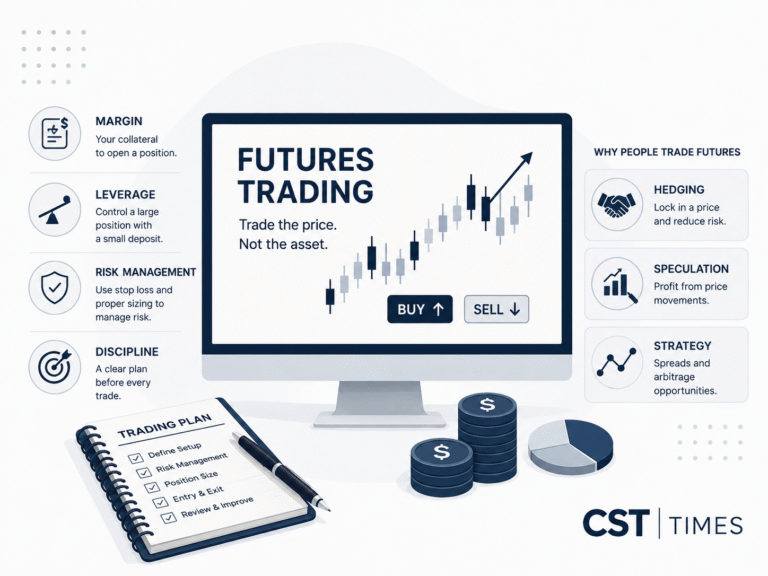
Opening a futures position doesn’t require paying the full value of the contract. Instead, you post margin — a good-faith deposit — and the exchange lets you control a much larger position. This is where leverage comes in.
Margin and Leverage, With a Real Example
Say you want exposure to a $10,000 position, but your broker only requires 10% margin. You’d only need to put up $1,000 to open it — that’s 10x leverage.
- If the position moves up 5%, your position gains $500 — a 50% return on your $1,000 margin.
- If it moves down 5%, you lose $500 — half your margin — from a move that’s a fraction of the asset’s actual price swing.
That asymmetry is the entire story of futures trading. Leverage doesn’t just amplify gains; it amplifies losses at the same rate, and the loss is measured against your smaller deposit, not the full contract size.
There are two figures to know:
- Initial margin — the minimum deposit required to open the position.
- Maintenance margin — the minimum equity you must keep in the account while the position is open. If your losses push your account below this level, you’ll face a margin call or automatic liquidation (the exchange forcibly closes your position).
Going Long vs. Going Short
Futures let you profit from prices falling just as easily as prices rising:
- Going long means buying a contract because you expect the price to rise. You profit if it does.
- Going short means selling a contract you don’t own because you expect the price to fall. You profit if it drops, and lose if it rises instead.
This two-way flexibility is one of the defining features of futures compared to simply buying and holding an asset.
Crypto Futures and Perpetual Contracts
Traditional futures — on oil, gold, stock indices — have a fixed expiry date. Crypto futures introduced a variation called the perpetual contract (or “perp”), which never expires. Instead of an expiry date keeping the contract price tied to the spot market, perpetuals use a funding rate: a small payment exchanged between long and short traders, typically every eight hours. When the perpetual trades above the spot price, longs pay shorts to pull the price back down; when it trades below spot, the payment flows the other way.
Crypto exchanges also tend to offer far higher leverage than traditional futures brokers. Binance, the largest crypto exchange by trading volume, offers leverage up to 125x on select pairs, though the maximum available leverage shrinks as your position size grows and larger positions carry higher maintenance-margin requirements. By comparison, CME’s regulated Bitcoin and Ether futures cap leverage at roughly 5-to-1 — a deliberate design difference between a CFTC-regulated market and an offshore-style crypto exchange.
What Happens at Liquidation
If losses erode your margin down to the maintenance level, the exchange closes your position automatically — you don’t get to choose the exit price or timing. On some crypto platforms, if the market moves so fast that your position can’t be closed at a price that covers the loss, an insurance fund absorbs the shortfall. Binance, for example, maintains an insurance fund that held roughly $1.49 billion in USDT and $844 million in USDC as of mid-August 2026. If that fund is ever insufficient during extreme volatility, exchanges can trigger auto-deleveraging (ADL), which force-closes the most profitable, most highly leveraged opposing positions first — a mechanic that catches many traders off guard, because being right about market direction is exactly what puts you at the front of that queue.
(If you’re comparing platforms, see our [Binance security settings guide] for how to lock down an account before you fund it — 7 Binance Security Settings Every Crypto Investor Should Enable in 2026 .)
Is Futures Trading Safe?
This question really has two separate answers: is the market itself legitimate and regulated, and is futures trading safe for your money? They’re not the same thing.
Regulated vs. Offshore Venues
In the United States, exchange-traded futures are regulated by the Commodity Futures Trading Commission (CFTC), which works alongside the National Futures Association (NFA). Regulated futures commission merchants (FCMs) are required to give retail customers a written risk disclosure statement before opening an account, maintain minimum capital levels, and keep detailed transaction records. CME Group, the largest US futures exchange, lists CFTC-regulated, cash-settled Bitcoin and Ether futures traded through registered FCMs — currently the only fully CFTC-compliant crypto futures products available to US retail traders through traditional channels.
The regulatory picture for crypto perpetual futures is shifting quickly. In mid-2026, the CFTC approved a Bitcoin perpetual futures contract from the prediction-market platform Kalshi and cleared Coinbase to route US customers to offshore perpetual futures trading — a move regulators framed as bringing more crypto derivatives activity under US oversight. CME Group responded by suing the CFTC, arguing the products should instead be classified and regulated as swaps. That dispute was still unresolved as of this writing, which is a useful reminder that “regulated” in crypto futures is an evolving, sometimes contested label rather than a fixed guarantee.
Outside CFTC-regulated products, most large crypto futures volume still happens on offshore exchanges that operate under their own terms of service rather than a national regulator, using internal insurance funds and auto-liquidation systems instead of the clearing-house protections traditional futures traders rely on. That doesn’t automatically make them fraudulent, but it does mean you’re trusting the exchange’s own risk systems rather than an external regulator if something goes wrong.
What the Data Actually Says About Retail Outcomes
Setting aside where you trade, the harder question is whether futures trading is safe for your money — and the independent data here is consistently discouraging for retail traders:
- A peer-reviewed study tracking retail futures day traders who stayed active for more than 300 days found that 97% of them lost money.
- India’s securities regulator, SEBI, documented that 93% of retail futures and options traders lost money across a three-year study period (FY2022–FY2024).
- Research into crypto perpetual futures specifically estimates that somewhere between 70% and 97% of participants lose money, depending on the platform and period studied.
- A 2025 survey of over 1,000 retail crypto traders found 84% lost money in their first year, most often due to a lack of preparation, emotional decision-making, and weak risk management rather than the market being fundamentally unbeatable.
None of this means futures trading is a scam or that no one profits — professional and disciplined traders do. It means the odds, structurally, favor the house of leverage and volatility, not the untrained retail account. Treat any claim of easy or guaranteed futures profits with real skepticism.
How to Make Money With Futures Trading
Given the numbers above, it’s worth being precise about what “making money” in futures actually looks like, because hedgers and speculators are trying to do very different things.
Hedging: Protecting a Position, Not Chasing Profit
Hedging isn’t about generating extra profit — it’s about reducing uncertainty. A fund manager holding a large stock portfolio might sell index futures to offset a potential downturn; if the market drops, gains on the futures position help cushion losses in the portfolio. The “win” for a hedger is stability, not a windfall. This is the original, and arguably the most legitimate, economic purpose of futures markets.
Speculation: Betting on Direction
Speculators open long or short positions expecting to profit from price movement, without an underlying position to protect. This is where most retail futures and crypto-perpetual activity happens, and it’s also where the loss statistics above are concentrated. Profitable speculation requires being right about direction often enough, and by enough margin, to cover trading fees, funding payments, and the inevitable losing trades — a bar that the data suggests most retail traders don’t clear consistently.
Risk Management Habits That Separate Survivors From the Rest
The traders who last tend to share a few habits, regardless of asset class:
- Using low leverage. Many experienced traders keep leverage in the 2x–10x range rather than maxing out what a platform allows, since higher leverage shrinks the price move needed to wipe out your margin.
- Size positions from account equity, not from available leverage. Just because a platform offers 100x doesn’t mean a position should be sized as if it were reasonable.
- Using stop-losses, which close a losing trade at a predetermined level — turning an open-ended loss into a planned, limited one, on your terms rather than the exchange’s.
- Avoiding cross-margin by default. Isolated margin limits risk to the amount allocated to a single position, rather than letting one bad trade draw down an entire account.
- Treating early months as a learning period, not a race — most of the loss statistics above are concentrated among newer, less-prepared traders.
None of this guarantees profit, and CST Times isn’t in a position to promise you an edge the data doesn’t support. What these habits do is control the things you can actually control: how much you risk, and how a losing trade ends.
Advantages of Futures Trading
- Capital efficiency. Margin lets you gain meaningful exposure to an asset’s price without tying up the full value of that asset.
- Ability to profit in both directions. Going short lets you position for falling prices, something ordinary buy-and-hold investing can’t do without borrowing.
- A genuine hedging tool. Businesses and portfolio managers use futures to lock in prices and manage real-world risk, not just to speculate.
- Price discovery and liquidity. Deep futures markets, especially on assets like Bitcoin, Treasury bonds, and crude oil, help set transparent prices that ripple into the broader market.
- 24/7 access for crypto. Unlike traditional futures, which trade within exchange hours, crypto futures and perpetuals trade around the clock, which can be an advantage or a risk depending on how closely you can monitor a position.
Risks of Futures Trading
Leverage cuts both ways. The same mechanism that lets you control a large position with a small deposit can wipe out that deposit on a small adverse price move.
Liquidation can happen without warning to a casual trader. A fast price wick can trigger forced closure at a price worse than expected, especially during high volatility.
Losses can exceed your original deposit on certain contracts, unlike buying an option or spot asset outright, where the most you can lose is what you paid.
Funding and fees compound over time. Holding a leveraged perpetual position for weeks can mean paying — or receiving — funding payments every eight hours, which adds up.
Regulatory protection varies enormously by venue. A CFTC-regulated CME contract and an offshore perpetual-futures exchange are not offering the same level of protection if something goes wrong.
Round-the-clock crypto markets remove natural breaks. There’s no closing bell to pause a losing position overnight, which raises the emotional and financial stakes of holding leveraged crypto trades.
Quick Checklist Before You Trade
- I understand the difference between initial margin and maintenance margin on this platform.
- I know exactly what leverage I’m using and what price move would trigger liquidation.
- I’m trading on a regulated exchange, or I’ve accepted the trade-offs of an offshore one.
- I have a stop-loss level decided before opening the position, not after it starts losing.
- I’m only risking money I can afford to lose completely.
- I understand funding rates if I’m trading crypto perpetuals.
Final Thoughts:
Futures trading is a legitimate, centuries-old financial tool — originally built so farmers and manufacturers could lock in prices, and now used just as heavily by speculators chasing short-term price moves in everything from crude oil to Bitcoin. The mechanics are genuinely useful, and the leverage that makes futures capital-efficient is the same leverage that makes them dangerous for anyone trading without a plan.
CST Times honest summary: futures markets themselves are safe in the sense that regulated exchanges are legitimate, audited institutions. Futures trading, especially with high leverage and little risk management, is statistically unsafe for most retail accounts. Whether it’s right for you depends less on the instrument and more on your leverage discipline, your position sizing, and whether you’re hedging a real exposure or speculating with money you can’t afford to lose.
FAQs
Is futures trading gambling?
Not structurally — futures serve a real economic purpose in hedging and price discovery. But because many retail traders use high leverage with little risk management, the outcomes often resemble gambling more than investing, which is reflected in the loss statistics cited above.
Can you lose more money than you put in with futures?
Yes, on many futures contracts, your losses aren’t capped at your initial margin the way they are with buying an option outright. This is a key difference from spot trading or options buying, where your maximum loss is fixed upfront.
What’s the minimum amount needed to start futures trading?
It varies by broker and contract. Traditional futures brokers often require several thousand dollars in account minimums for standard contracts, though micro contracts have lowered that bar. Crypto futures exchanges often let you start with far smaller amounts, sometimes $50–$100, though a small account doesn’t reduce the underlying leverage risk.
Is crypto futures trading legal in the United States?
CME’s CFTC-regulated Bitcoin and Ether futures are fully legal and available through registered brokers. Offshore crypto perpetual-futures exchanges occupy a greyer area for US residents; some restrict US customers outright, while the regulatory landscape for domestically approved crypto perpetuals was actively evolving and contested as of mid-2026.
Which is riskier, futures or options?
As a buyer, options generally cap your maximum loss at the premium you paid, while a futures position can lose more than your initial margin. As an options seller, however, risk can be just as open-ended as futures — the comparison depends heavily on which side of the contract you’re on.
Disclaimer
This article is for educational purposes only and does not constitute financial, investment, or trading advice. Futures trading, including crypto futures and perpetual contracts, involves substantial risk of loss and is not suitable for all investors. Leverage can result in losses that exceed your initial deposit. CST Times is not a licensed financial advisor. Always do your own research and consider consulting a licensed professional before trading.
References
- CFTC — Basics of Futures Trading
- Investor.gov — Commodities
- Binance Academy — What Are Forward and Futures Contracts
Follow us on Social media :
About The Author

Haseeb Jabbar
Haseeb Jabbar writes about crypto, finance, technology, and AI at CST Times, sharing research-based guides, timely news, and free tools and calculators to help readers make informed decisions.

Pingback: Spot Trading vs Futures Trading: 7 Key Differences (Guide)
Pingback: CFTC Crypto Rules Explained: Regulation CTX and CAM