
What Is Revolut? How It Works, Is It a Bank, and Is It Safe to Use
What Is Revolut? How It Works?
Quick Summary:
If you’ve ever asked “what is Revolut?”, you’re not alone. This UK-founded app has grown from a simple travel card into one of the world’s biggest digital banking platforms, used by more than 70 million people.
Table of Contents
ToggleBut it still confuses a lot of new users. Is it a bank or just an app? Is your money actually protected? And how does it make money if half its features are free?
This guide answers all of that in plain English — what Revolut is, how it works, where it is (and isn’t) a licensed bank, and how safe it really is to use in 2026.
Key Takeaways
- Revolut is a UK-founded fintech “super-app” for spending, saving, and investing in one place — not just a prepaid card.
- It became a fully licensed bank in the UK on 11 March 2026, and has held a full EU banking licence (via Lithuania) since December 2021.
- In the US and most other countries, Revolut still runs on partner-bank or e-money licences — its own US bank charter is still pending.
- UK bank deposits are FSCS-protected up to £120,000; EU bank deposits up to €100,000 — but crypto, stocks, and standard e-money balances are not covered by any deposit protection scheme.
- Revolut offers five personal plans, from a free Standard plan to Ultra at roughly £55/month.
- With 70+ million customers in 40+ countries, Revolut is one of the most valuable private fintech companies in the world.
- Revolut is not currently available to residents of Pakistan, though its card can be used for spending while travelling there.
Table of Contents
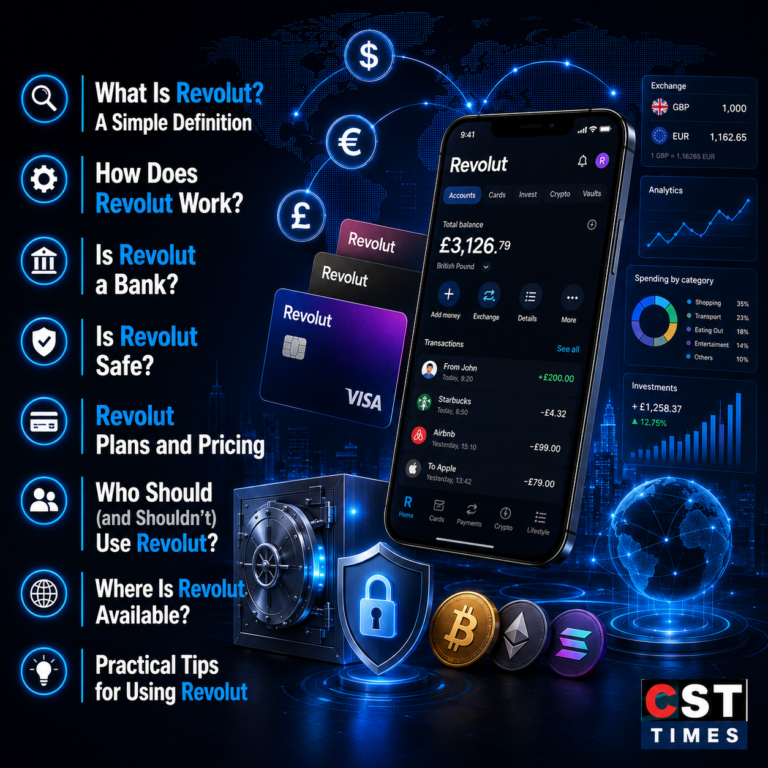
- What Is Revolut? A Simple Definition
- How Does Revolut Work?
- Is Revolut a Bank?
- Is Revolut Safe?
- Revolut Plans and Pricing
- Who Should (and Shouldn’t) Use Revolut?
- Where Is Revolut Available?
- Practical Tips for Using Revolut
- Quick Checklist Before You Sign Up
- Final Thoughts
- FAQs
Revolut at a Glance
| Category | Details |
|---|---|
| Founded | 2015, London, by Nik Storonsky and Vlad Yatsenko |
| Customers | 70+ million worldwide, across 40+ countries |
| Is it a bank? | Yes, in the UK (since March 2026) and the EU (since 2021). Not yet in the US. |
| UK regulator | Prudential Regulation Authority (PRA) and Financial Conduct Authority (FCA) |
| EU regulator | European Central Bank, via the Bank of Lithuania |
| UK deposit protection | FSCS, up to £120,000 per person |
| EU deposit protection | EU Deposit Guarantee Scheme, up to €100,000 per person |
| Core features | Multi-currency account, debit card, budgeting, savings, stock and crypto trading |
| Personal plans | Standard (free) to Ultra (around £55/month) |
| Estimated valuation | Roughly $75–115 billion (private share sales, 2025–2026) |
What is Revolut? A Simple Definition
Revolut is a UK-based financial technology (fintech) company that offers everyday banking, currency exchange, and investing through a single mobile app. It was founded in London in 2015 by Nik Storonsky and Vlad Yatsenko.
It started out solving one specific problem: traditional banks charged high fees to exchange currency or spend abroad. Revolut’s first product was a prepaid card that let travellers spend in different currencies at near-market exchange rates.
Since then, it has grown into what’s often called a “financial super-app.” A single Revolut account can now hold and exchange dozens of currencies, pay for things in shops, send money abroad, set savings goals, buy stocks, trade cryptocurrency, and more.
Revolut now serves more than 70 million customers in over 40 countries, making it one of the largest digital banks in the world by user base.
How Does Revolut Work?
Signing up and getting verified
Opening an account takes a few minutes in the app. You provide your phone number, basic personal details, and a photo ID (like a passport), plus a quick selfie for identity verification. This is standard “Know Your Customer” (KYC) checking, required of every regulated bank and fintech.
Once verified, you get a virtual card immediately and can order a physical card to be delivered to you.
Topping up and holding money
You add money to your account by bank transfer, debit or credit card, or (in some markets) by mobile wallet. Once funded, you can hold your balance in whichever currencies you use most — the app supports 30+ currencies for holding and spending.
Spending and exchanging currency
This is Revolut’s original strength. You can convert between currencies inside the app at competitive exchange rates and spend abroad without the markups a traditional bank card usually adds. Free plans have a monthly “fair usage” limit on currency exchange (currently around £1,000 combined per month); paid plans raise or remove that limit.
Sending and receiving money
You can send free instant transfers to other Revolut users, and international transfers to bank accounts in other currencies, usually faster and cheaper than a traditional bank wire.
Extra features layered on top
Beyond everyday spending, Revolut has added:
- Budgeting and analytics — automatic spending categories and insights
- Savings (“Vaults”) — round-up savings and interest-earning pots
- Stock trading — commission-free trades (limited number per month, depending on plan)
- Crypto trading — buy, sell, and hold major cryptocurrencies inside the app, with a separate platform called Revolut X for more active traders
- Commodities — buy and sell gold and other commodities
- Business accounts — a separate product line for freelancers and companies
- Junior and teen accounts — for under-18s, linked to a parent’s account
How does Revolut make money?
This is worth understanding, because it explains why the app can offer so much for free. Revolut earns revenue from several sources at once:
- Subscription fees from Plus, Premium, Metal, and Ultra plans
- Interchange fees — a small cut every time you pay with your card, paid by the merchant’s bank, not you
- Fees on exchanges above your free monthly limit, and small markups on weekend or exotic-currency trades
- Interest income on loans and deposits, now that it holds full banking licences in the UK and EU
- Business account fees, which have become a significant and fast-growing part of revenue
Revolut reported around $6 billion in revenue for 2025, up 46% year-on-year, with $2.3 billion in profit before tax, according to its own company reporting. It was valued at roughly $75 billion after a November 2025 share sale, and by mid-2026 later private trading reportedly pushed that figure higher still — though as a private company, Revolut’s valuation shifts with each funding round and isn’t fixed like a public stock price.
Is Revolut a Bank?
Short answer: it depends on where you live. Revolut is a genuine, licensed bank in some markets and an e-money institution (not a bank) in others — and that distinction actually matters for how protected your money is.
The UK: Yes, since March 2026
Revolut first applied for a UK banking licence back in January 2021. It received a restricted licence in July 2024 and spent over 18 months in what regulators call a “mobilisation phase” — a standard probation period for new banks, though Revolut’s ran longer than most while the Prudential Regulation Authority (PRA) sought stronger assurances on risk controls and reporting.
On 11 March 2026, the PRA lifted those restrictions. Revolut Bank UK Ltd is now a fully authorised bank, supervised by both the PRA and the Financial Conduct Authority (FCA) — the same regulators that oversee Barclays, HSBC, and every other UK high-street bank. Existing customers are being migrated to the new bank entity in phases.
The EU: Yes, since 2021
Revolut’s European banking licence actually came first. Revolut Bank UAB has held a full banking licence from the European Central Bank, issued via the Bank of Lithuania, since December 2021 (upgraded from a more limited “specialised bank” licence granted in 2018). This licence is “passported,” meaning it covers customers across the entire European Economic Area, not just Lithuania.
The United States: Not yet
Here, Revolut is still in the same position the UK was in before 2024. It operates through a partnership with Lead Bank, a US partner bank that holds customer deposits and issues cards on Revolut’s behalf. In March 2026, Revolut filed with the Office of the Comptroller of the Currency (OCC) and the Federal Deposit Insurance Corporation (FDIC) for its own national bank charter, to be called Revolut Bank US, N.A. That application is still under regulatory review.
Other markets
Revolut has also launched full banking operations in Mexico — its first bank outside Europe — and is pursuing further licences, including in Peru and France, as part of a stated goal to become “the world’s first truly global bank.”
The part people miss: not every Revolut product is “the bank”
Even in the UK and EU, only your core account balance sits inside the licensed bank entity. Stocks, crypto, and commodities are held in separate, regulated but non-bank entities — they were never covered by banking rules in the first place, because investments always carry risk and were never meant to be treated like cash in a deposit account.
Is Revolut Safe?
Revolut is regulated in every market where it operates, but “safe” means different things depending on which product you’re using. Here’s the direct breakdown.
Regulation
- In the UK, Revolut Ltd (e-money side) is authorised by the FCA, and Revolut Bank UK Ltd is authorised by the PRA and FCA.
- In the EU, Revolut Bank UAB is authorised by the European Central Bank via the Bank of Lithuania.
- In the US, deposits are currently held via Lead Bank, an FDIC-member institution.
Deposit protection vs. “safeguarding” — know the difference
This is the single most important safety concept to understand, and it’s rarely explained clearly.
- Deposit protection (FSCS in the UK, the Deposit Guarantee Scheme in the EU) is a government-backed compensation scheme. If a bank fails, you get your money back automatically, up to the limit, no matter what the bank did with it.
- Safeguarding is the rule that applies to e-money accounts (not banks). It requires the company to keep customer funds separate from its own operating money, usually parked in ring-fenced accounts at other banks. It’s a real protection, but it isn’t the same as deposit insurance — there’s no compensation scheme standing behind it, and getting your money back after a company failure can take longer.
In practice, this means:
| Where your money sits | Protection |
|---|---|
| Revolut Bank UK Ltd (UK bank accounts) | FSCS-protected up to £120,000 |
| Revolut Bank UAB (EU bank accounts) | EU Deposit Guarantee Scheme, up to €100,000 |
| Revolut Ltd e-money accounts (not yet migrated to the bank) | Safeguarded, but not deposit-insured |
| Crypto, stocks, and commodities | Not covered by any deposit protection — value can go up or down |
| US accounts (via Lead Bank) | FDIC pass-through insurance on eligible deposits |
Everyday security features
Separately from regulation, the app itself has strong built-in security tools:
- Biometric login (Face ID / fingerprint)
- Instant push notifications for every transaction
- One-tap card freezing and unfreezing
- Disposable virtual card numbers for online shopping
- The ability to switch off contactless, online, ATM, or magnetic-stripe payments individually
- 3D Secure verification on card payments
A fair, balanced note
Revolut’s five-year wait for a UK banking licence wasn’t just bureaucratic delay — regulators specifically wanted more assurance around financial crime controls and reporting at Revolut’s scale before granting full status. That’s now resolved with the March 2026 licence, but it’s a reasonable data point if you’re weighing Revolut against a long-established high-street bank.
Revolut Plans and Pricing
Revolut runs on a freemium model: one free plan, plus four paid tiers that unlock more benefits.
Plan | Approx. monthly price (UK) | Best for |
|---|---|---|
| Standard | Free | Casual users, occasional travellers |
| Plus | ~£3.99 | Slightly higher limits, purchase protection |
| Premium | ~£7.99 | Frequent travellers, higher exchange limits |
| Metal | ~£14.99 | Heavy travellers, higher savings rates, lifestyle perks |
| Ultra | ~£55 | Frequent flyers who’ll use the full perks bundle (lounge access, travel insurance, subscriptions) |
Prices, limits, and included perks vary by country and change periodically, so always check the current numbers in the Revolut app or on revolut.com before comparing.
Who Should (and Shouldn't) Use Revolut?
Revolut tends to work well for:
- Frequent travellers who want to avoid foreign transaction fees
- People who get paid or spend in more than one currency
- Freelancers and small businesses needing simple multi-currency invoicing
- Anyone who wants budgeting tools and spending insights built into their banking app
Revolut may not be the best fit for:
- People who rely heavily on cash and in-branch banking
- Those who want a single provider for mortgages and complex lending (still limited compared to major banks, though this is expanding post-licence)
- Residents of countries where Revolut isn’t yet available
Where Is Revolut Available?
Revolut currently supports personal accounts in:
- All EEA countries (the EU plus Iceland, Liechtenstein, and Norway)
- The United Kingdom
- Switzerland, Australia, Japan, Singapore, Brazil, New Zealand, and the United States
- Mexico (recently launched as a full bank)
It is not yet available for residents of Pakistan, along with a number of other countries across Asia, Africa, and the Middle East. Revolut does support the Pakistani Rupee as a travel currency for account holders from supported countries visiting Pakistan, but that’s different from being able to open an account as a Pakistani resident.
Practical Tips for Using Revolut
- Travelling soon? Top up before your trip and use the in-app exchange rate rather than letting a foreign ATM convert for you — always choose to be charged in the local currency, not your home currency.
- Watch your free exchange limit. If you regularly move more than the fair-usage threshold, a paid plan often pays for itself in saved fees.
- Use disposable virtual cards for one-off online purchases or free trials, so a compromised card number can’t be reused.
- Know which entity holds your money. If you’re in the UK or EU and unsure whether you’ve been migrated to the bank entity yet, check the app or ask support — it affects your deposit protection.
- Don’t treat crypto or stock balances like savings. They sit outside deposit protection and can lose value.
Quick Checklist Before You Sign Up
- ✔ Confirm Revolut is available in your country.
- ✔ Decide whether you need everyday banking, travel spending, investing, or all three.
- ✔ Check whether your balance will sit in a bank entity (protected) or an e-money entity (safeguarded, not insured).
- ✔ Compare the free Standard plan against your likely monthly exchange volume.
- ✔ Compare fees briefly against your current bank or an alternative like Wise or a local digital bank.
- ✔ Turn on biometric login and review card controls after signup.
Final Thoughts:
So, what is Revolut, really? It’s a fast-growing global fintech that has evolved from a travel card into a genuine bank in its two biggest markets, the UK and the EU — while still operating as a non-bank e-money service in many others.
How safe it is depends entirely on which product you’re using: bank deposits now carry real government-backed protection in the UK and EU, while e-money balances, crypto, and investments do not.
For most everyday users — spending abroad, holding multiple currencies, or budgeting in one place — Revolut is a well-regulated, mainstream option. Just check your own country’s status and product type before relying on it the way you would a traditional bank.
FAQs
1. What is Revolut?
Revolut is a UK-based fintech company, founded in 2015, that offers a multi-currency account, debit card, and app covering everyday spending, saving, and investing. It now serves over 70 million customers worldwide.
2. How does Revolut make money if so much of it is free?
Through paid subscription plans, card interchange fees, currency exchange fees above the free monthly limit, interest on loans and deposits, and business account fees.
3. Is Revolut a real bank?
Yes, in the UK (since 11 March 2026) and the EU (since December 2021), Revolut operates through fully licensed bank entities. In the US and several other markets, it still runs on partner-bank or e-money arrangements while its own bank charter applications are pending.
4. Is Revolut safe to use?
Yes, for the vast majority of everyday users. It’s regulated in every market it operates in, and bank-entity deposits in the UK and EU carry government-backed protection. Crypto, stocks, and e-money balances carry different, lower levels of protection, so it’s worth knowing which product you’re using.
5. Is my money protected if Revolut ever went out of business?
It depends on the product. UK bank deposits are FSCS-protected up to £120,000; EU bank deposits are protected up to €100,000. E-money balances are “safeguarded” (kept separate from company funds) but not covered by a compensation scheme. Crypto and investments aren’t protected at all.
6. Does Revolut charge fees for currency exchange?
Exchanges are fee-free up to a monthly limit (around £1,000 combined on the free plan), after which a small fair-usage fee applies. Paid plans raise or remove this limit.
7. Is Revolut better than a traditional bank?
It depends on your needs. Revolut is generally cheaper and faster for currency exchange, international transfers, and budgeting tools. Traditional banks still tend to lead on complex products like mortgages, in-branch service, and long banking history. Many people use both.
Disclaimer
This article is for general information only and does not constitute financial, investment, or legal advice. Revolut’s fees, interest rates, plan benefits, and country availability change frequently — always confirm current terms on the official Revolut app or website before making a decision. CST Times is not affiliated with or endorsed by Revolut.
References
- Revolut — “It’s official: Revolut is now a bank in the UK” — Revolut official blog
- Revolut — “Revolut number of customers: from 50m to 70m+ worldwide” — Revolut official blog
- Bank of Lithuania — “Banking licence granted to Revolut Bank UAB” — Bank of Lithuania
- FSCS — “Deposit limit protection increase” — Financial Services Compensation Scheme
- Bank of England — PRA proposal on FSCS deposit protection limit — Bank of England / PRA
Follow us on Social media :
About The Author

Haseeb Jabbar
Haseeb Jabbar writes about crypto, finance, technology, and AI at CST Times, sharing research-based guides, timely news, and free tools and calculators to help readers make informed decisions.

Pingback: Revolut Supported Countries 2026 - Full Eligibility List & Requirements