
The 4 Types of Market Risk Every Investor Must Know (2026)
Introduction :
Every investment carries risk. Whether you invest in stocks, crypto, bonds, real estate, or a business — there is always a chance that the market moves against you.
Table of Contents
ToggleMarket risk is the possibility of financial loss caused by changes in the overall financial markets. It does not only affect one company or one country. It affects all investors at the same time, across all markets.
Global financial institutions, including the International Monetary Fund (IMF), the Bank for International Settlements (BIS), and the U.S. Securities and Exchange Commission (SEC), consistently identify market risk as one of the most critical factors every investor must understand.
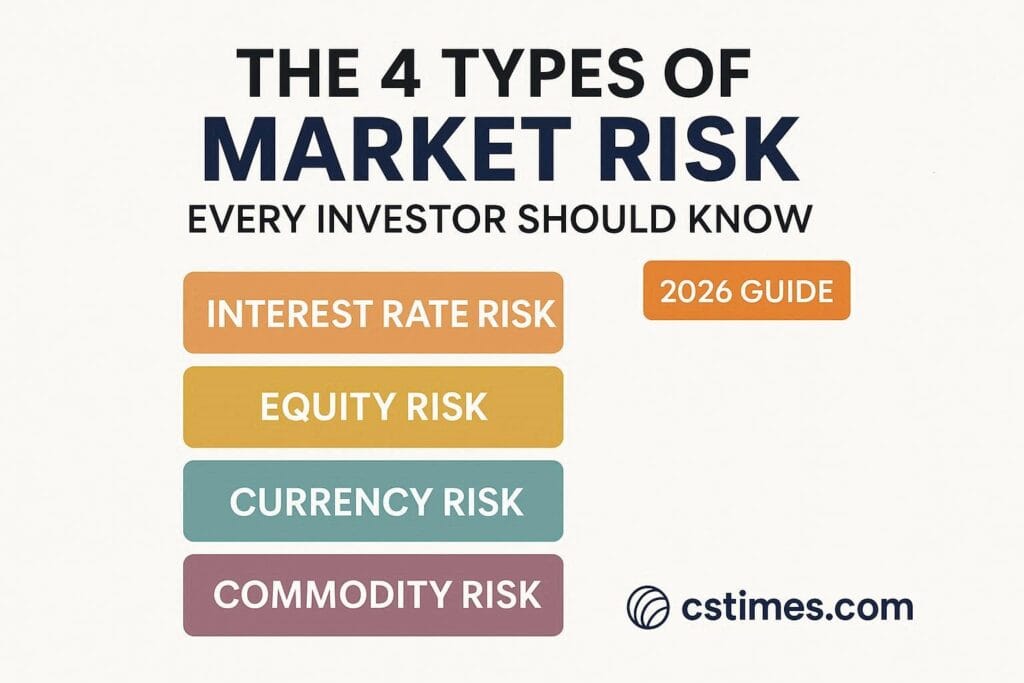
There are 4 main types of market risk. This article explains each one in simple English, with real-world examples and practical insights for investors in 2026.
1. Equity Risk — The Risk That Stock Prices Fall
Equity risk is the risk that the value of stocks or shares will decline, reducing the value of an investor’s portfolio. It is the most widely recognized form of market risk and affects investors in every country.
Stock prices are sensitive to a wide range of factors — company earnings, economic data, central bank decisions, geopolitical events, and shifts in investor confidence. Even financially strong companies can see their share prices fall sharply during a broad market downturn.
According to the SEC, equity markets can experience significant volatility in short periods of time, driven by both fundamental changes and shifts in market sentiment.
In 2026, equity risk has become more concentrated. A small number of large technology companies now represent a disproportionately large share of major global stock indexes. If these companies report weak earnings or face regulatory action, the impact on overall market performance can be substantial.
Why Equity Risk Matters:
• Stock prices can fall sharply even when a company’s business fundamentals remain strong
• Market-wide corrections affect nearly all stocks simultaneously, regardless of sector
• Technology and growth stocks are especially sensitive to changes in interest rates and investor sentiment
• Long-term investors should be prepared for short-term drawdowns of 20% or more
Example:
An investor buys shares in a leading technology company. The company continues to perform well operationally. However, rising interest rates cause the broader technology sector to sell off by 30%. The investor suffers a significant loss — not because the company failed, but because the overall market shifted.
2. Interest Rate Risk — The Hidden Factor Behind the Market
Interest rate risk is the risk that changes in interest rates will reduce the value of investments or increase borrowing costs across the economy.
Central banks — including the US Federal Reserve, the European Central Bank (ECB), and the Bank of England — adjust interest rates to manage inflation and economic growth. These decisions have far-reaching consequences across equity markets, bond markets, real estate, and currencies.
The IMF notes that unexpected shifts in interest rate policy can trigger significant volatility across multiple asset classes simultaneously, making this one of the most systemic forms of market risk.
For bond investors, the relationship between interest rates and prices is direct. When rates rise, newly issued bonds offer higher returns. This makes existing bonds — which pay lower fixed rates — less attractive to buyers. Their market price falls as a result.
Key Effects of Interest Rate Risk:
• Rising interest rates reduce the market value of existing bonds and fixed-income assets
• Higher borrowing costs slow business investment and compress corporate profit margins
• Rate increases often trigger equity market corrections, particularly in growth and technology sectors
• Interest rate differentials between countries drive capital flows and currency movements
Example:
An investor purchases a government bond paying 3% annual interest. One year later, the central bank raises rates to 6%. Newly issued bonds now offer 6% returns. The investor’s 3% bond becomes far less attractive in the secondary market. If sold before maturity, the investor will receive significantly less than the original purchase price.
3. Currency Risk — When Exchange Rates Reduce Your Returns
Currency risk — also known as foreign exchange (FX) risk — is the risk that fluctuations in exchange rates will reduce the value of international investments or increase the costs of cross-border business operations.
This type of risk affects anyone who invests in foreign markets, holds assets denominated in other currencies, or runs a business that imports or exports goods internationally.
The BIS identifies currency volatility as a major source of financial instability, particularly for emerging market economies where local currencies can depreciate sharply during periods of global uncertainty or when the US dollar strengthens significantly.
In 2026, ongoing geopolitical tensions and diverging monetary policies between the US Federal Reserve and other major central banks have created elevated volatility across global currency markets.
Who Is Most Exposed to Currency Risk:
• Investors holding foreign stocks, bonds, or real estate denominated in other currencies
• Businesses that import raw materials or finished goods from other countries
• Exporters whose products become more or less competitive depending on exchange rate movements
• Governments and corporations carrying large amounts of foreign-currency-denominated debt
Example:
A European investor purchases US stocks. Over one year, the stocks gain 10% in US dollar terms. However, during the same period, the US dollar weakens significantly against the euro. When the investor converts returns back into euros, the actual gain is far lower than 10% — or potentially even a loss. The investment performed well on paper, but currency movements eroded the real return.
4. Commodity Risk — When Raw Material Prices Affect the Economy
Commodity risk is the risk of financial loss caused by changes in the prices of raw materials, including oil, gold, natural gas, wheat, copper, and industrial metals.
Commodities are the foundation of the global economy. They power transportation, supply food systems, and provide the inputs for virtually all manufactured goods. When commodity prices shift sharply — whether rising or falling — the effects ripple through businesses, governments, consumers, and financial markets worldwide.
The IMF and the World Bank have both identified commodity price volatility as a primary driver of inflation and economic instability, especially in economies that are heavily dependent on commodity imports or exports.
In 2026, disruptions to key global shipping routes — including the Red Sea corridor — and ongoing tensions in major energy-producing regions have placed sustained upward pressure on energy and food prices globally.
Main Reasons Why Commodity Prices Change
• Geopolitical conflicts that disrupt supply routes, pipelines, or production facilities
• Extreme weather events such as droughts, floods, or hurricanes affecting agricultural output
• Shifts in global industrial demand, particularly from large economies such as China and India
• Changes in trade policies, export restrictions, or international sanctions
Example:
An international airline sells tickets several months in advance at fixed prices. A sudden geopolitical crisis causes jet fuel prices to spike by 40% within weeks. The airline’s operating costs increase dramatically, but ticket revenue is already locked in at lower prices. Profit margins are severely compressed — not due to poor management, but because of direct exposure to commodity risk.
5. How to Manage Market Risk
Market risk cannot be completely eliminated. However, it can be significantly reduced through disciplined investment strategies and careful portfolio management.
Financial regulators and leading investment institutions consistently recommend the following approaches:
Simple Ways to Manage Risk
• Diversification — Spread investments across multiple asset classes, sectors, and geographic regions so that a single market event does not wipe out the entire portfolio
• Hedging — Use financial instruments such as options, futures contracts, or currency forwards to offset potential losses from adverse market movements
• Asset Allocation — Regularly adjust the balance between equities, bonds, cash, and alternative assets based on market conditions and personal risk tolerance
• Continuous Monitoring — Track economic indicators, central bank policy decisions, and geopolitical developments that can materially impact portfolio performance
Conclusion :
The four main types of market risk — equity risk, interest rate risk, currency risk, and commodity risk — are present across every global financial market. They affect individual investors, large institutions, multinational businesses, and national economies alike.
Reports from the IMF, BIS, SEC, and World Bank consistently confirm that these risks are growing in complexity as global markets become more interconnected and geopolitical uncertainty remains elevated throughout 2026.
For every investor, the key principle remains the same: understanding risk is more important than chasing returns.
By learning how these four risks operate, and by building a well-diversified and actively monitored investment strategy, investors at every level can protect their capital and make more confident, informed financial decisions.
Related Topic:
Follow us on Social media :
About The Author

Haseeb Jabbar
Haseeb Jabbar writes about crypto, finance, technology, and AI at CST Times, sharing research-based guides, timely news, and free tools and calculators to help readers make informed decisions.
