
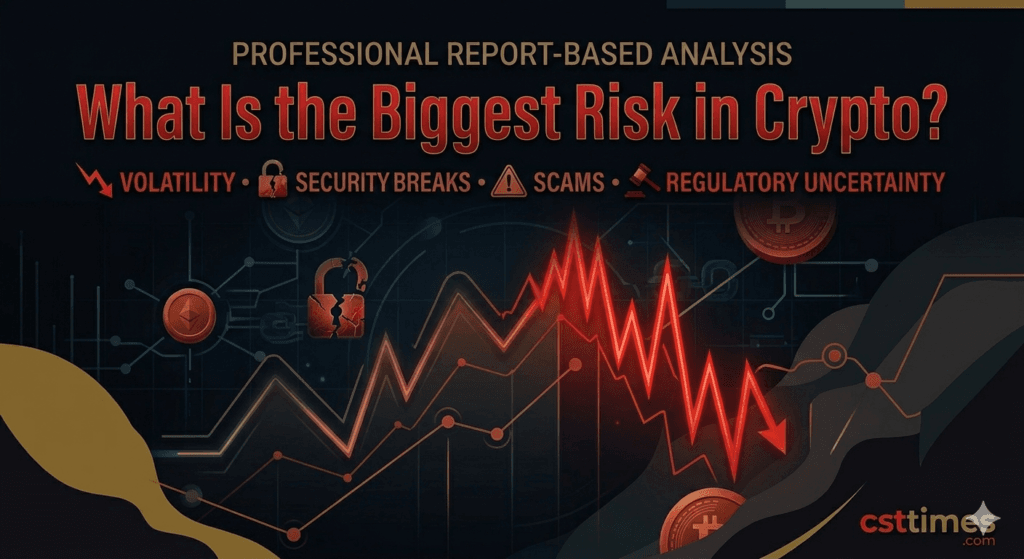
What Is the Biggest Risks in Crypto? (Professional Report-Based Analysis)
Introduction :
Cryptocurrency has emerged as one of the most disruptive financial innovations of the last decade. It offers high returns, global accessibility, and decentralized control. However, alongside these advantages, crypto markets also carry significant risks.
Table of Contents
ToggleAmong all risks, the most critical and dominant biggest risks in crypto is price volatility, which directly affects investor capital. Global financial regulators, including the U.S. Securities and Exchange Commission (SEC), International Monetary Fund (IMF), and Bank for International Settlements (BIS), consistently identify volatility and market instability as key concerns in the crypto ecosystem.
This article provides a structured, professional analysis of the biggest risks in crypto based on regulatory and financial reports.
1. The Biggest Risk: Price Volatility
Price volatility refers to the rapid and unpredictable changes in the value of cryptocurrencies over short periods of time.
Unlike traditional financial assets such as bank deposits or government bonds, crypto assets can experience extreme price fluctuations within hours or even minutes. A strong upward trend can quickly reverse into a sharp decline, resulting in significant capital loss for investors.
According to the SEC, crypto asset markets are highly speculative and exposed to major valuation swings, making them unsuitable for risk-averse investors. Volatility remains the primary factor responsible for both rapid gains and severe losses in the market.
Why Volatility Matters
- Prices are influenced by market sentiment rather than intrinsic value
- Lack of centralized price stabilization mechanisms
- High sensitivity to news, regulation, and social media trends
- Low liquidity in certain altcoins increases price instability
2. Security Risks: Hacking and Asset Theft
Beyond volatility, cybersecurity risk is another major concern in the crypto industry.
Crypto assets are stored in digital wallets that rely on private keys. If these keys are lost, stolen, or compromised, the assets become permanently inaccessible.
The SEC highlights hacking incidents, private key theft, and platform security failures as significant risks for investors. Unlike traditional banking systems, crypto transactions are irreversible, which increases the severity of security breaches.
Key Security Risks Include:
- Exchange hacks and wallet breaches
- Phishing attacks targeting investors
- Loss of private keys or recovery phrases
- Smart contract vulnerabilities
3. Fraud and Scams in the Crypto Market
Fraud remains one of the most persistent risks in the cryptocurrency ecosystem.
The U.S. Federal Trade Commission (FTC) has repeatedly warned that scammers frequently use cryptocurrency as a payment method due to its irreversible nature. Fraudulent schemes often include fake investment platforms, impersonation scams, and Ponzi-style projects.
Once funds are transferred in crypto, recovery is extremely difficult, making users highly vulnerable to financial loss.
Common Scam Patterns:
- Guaranteed return investment schemes
- Fake crypto trading platforms
- Social media impersonation scams
- Rug pull projects in DeFi and tokens
4. Regulatory and Legal Uncertainty
Cryptocurrency operates in a rapidly evolving regulatory environment. Different countries apply different rules, and in many regions, regulations are still developing.
The IMF and BIS have both highlighted that regulatory uncertainty can increase systemic risk in crypto markets. Sudden policy changes, taxation updates, or trading restrictions can significantly impact market prices and investor confidence.
Key Regulatory Risks:
- Sudden bans or restrictions in certain countries
- Taxation uncertainty on crypto gains
- Legal classification changes of digital assets
- Compliance issues for exchanges and users
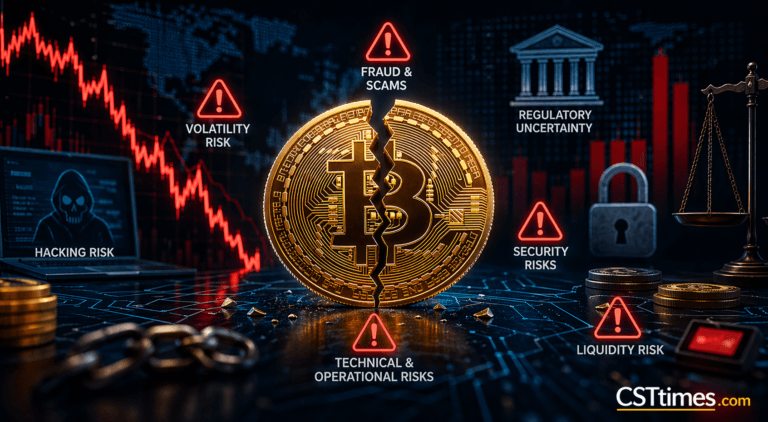
5. Market Structure and Liquidity Risks
Crypto markets are still relatively young compared to traditional financial systems. As a result, they often suffer from low liquidity in smaller assets and high dependence on large traders.
The BIS notes that crypto markets may experience liquidity shocks, where assets cannot be easily sold without affecting prices. This can amplify losses during market downturns.
6. Operational and Technical Risks
Technical failures also play a significant role in crypto risk exposure. These include exchange downtime, software bugs, network congestion, and smart contract errors.
Since blockchain systems rely on code, any vulnerability in the system can lead to financial losses or network disruptions.
7. Systemic Financial Risk
Global institutions such as the IMF have warned that as crypto markets grow and integrate with traditional finance, they may introduce broader systemic risks.
This means that instability in crypto markets could potentially impact wider financial systems, especially if adoption continues to increase without strong regulatory frameworks.
Conclusion
The most significant risk in cryptocurrency is price volatility, as it directly affects investor capital and creates unpredictable market conditions. However, it is not the only risk.
Security vulnerabilities, scams, regulatory uncertainty, liquidity challenges, and technical failures also contribute to the overall risk profile of the crypto ecosystem.
Reports from the SEC, IMF, BIS, and FTC consistently highlight that cryptocurrency should be approached with caution and strong risk management strategies.
For investors, the key principle remains clear: understanding risk is more important than chasing profit.
About The Author

Haseeb Jabbar
Haseeb Jabbar writes about crypto, finance, technology, and AI at CST Times, sharing research-based guides, timely news, and free tools and calculators to help readers make informed decisions.
