

Will Bitcoin Replace Gold ? Which One Will Stay Strong in the Future?
Introduction :
Many people ask this question: Will Bitcoin replace gold?
This is an interesting topic because gold and Bitcoin are both seen as ways to protect value, but they are very different from each other. Gold has been used for thousands of years, while Bitcoin is a digital asset that started in 2009.Both gold and Bitcoin are often called stores of value. Gold is a physical metal trusted as an investment for thousands of years. Bitcoin is a digital currency created in 2009, with a fixed supply of 21 million coins. It works on a peer-to-peer computer network (no single bank controls it). People sometimes call Bitcoin “digital gold,” but these assets have very different features and risks.
Table of Contents
ToggleWhat Is Gold?
Gold is a shiny yellow metal that you can hold or see. It’s used in jewelry, electronics, and by governments. For centuries, gold has been a “safe-haven” in crises. During wars or inflation, people buy gold because it keeps value when paper money falls. Central banks still store a lot of gold as reserves. In fact, all the gold ever mined in history is worth on the order of tens of trillions of dollars. Gold doesn’t rust or decay, so it lasts a very long time.
What Is Bitcoin?
Bitcoin is a cryptocurrency – a kind of money that only exists in computers. It was launched by someone named Satoshi Nakamoto in 2009. You cannot touch it; it lives on the internet. Bitcoin has some key features:
- Limited supply: There will only ever be 21 million Bitcoins. This fixed cap makes it scarce, similar to how there’s a limited amount of gold in the Earth.
- Decentralized: No government or bank issues Bitcoin. Instead, a global network of computers maintains the Bitcoin ledger. Anyone can verify transactions, so no single authority is needed.
- Digital wallet: You keep Bitcoin in a “wallet” on your phone or computer, protected by a secret key. You can send any amount to someone else anywhere in minutes.
- Volatility: Bitcoin’s price can jump up or down very fast. It’s much more volatile than gold.
Even the U.S. government has recognized Bitcoin’s special status. In 2025 an executive order called Bitcoin’s 21-million cap “digital gold”, highlighting its scarcity. But Bitcoin is still a new technology (only about 15 years old), and its value can change quickly based on what people believe it is worth.
Why Compare Bitcoin and Gold?
Limited supply:
Gold is rare, and no one can just make more easily. Bitcoin’s supply is also fixed at 21 million.Inflation hedge:
Many see both as ways to protect against inflation (rising prices). You cannot “print” unlimited gold or Bitcoin, unlike paper money.Store of value:
Neither is backed by a government. Gold’s value comes from history and demand; Bitcoin’s comes from technology and belief in it.Safe asset:
In theory, both can serve as a safe place to keep wealth instead of cash.
Because of these similarities, Bitcoin is often called “digital gold.” As one expert put it, Bitcoin could potentially become a 21st-century version of gold. However, in practice today they behave quite differently.
Key Differences Between Gold and Bitcoin
Stability vs. volatility:
Gold’s price usually changes slowly, so it’s considered stable. Bitcoin’s price swings a lot. For example, analysts note Bitcoin is “too volatile to be a reliable store of value” right now. In one week Bitcoin might jump 10%, and another week drop 20%. Gold rarely moves so wildly.
History:
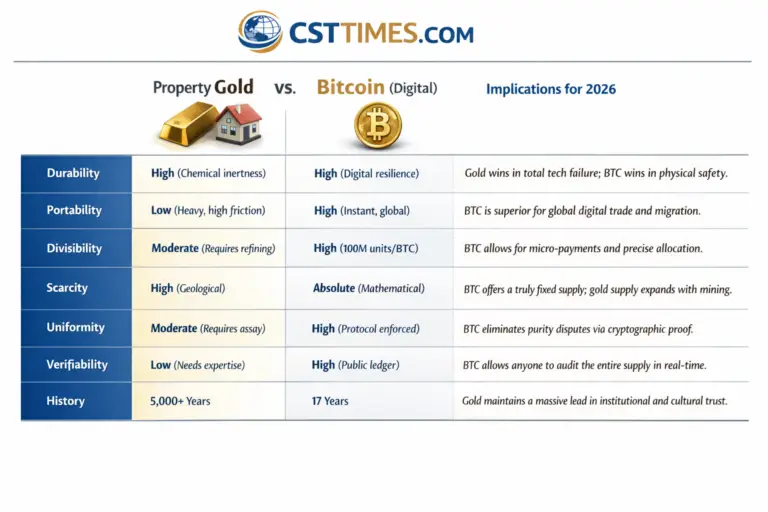
Gold has been trusted for over 5,000 years. It’s been used as money and jewelry by many civilizations. Bitcoin is only about 15 years old, which is a blink of an eye by comparison.
Risk vs. reward:
Gold is seen as a low-risk asset (though its price can still fall a bit). Bitcoin is high-risk but also high-reward. People have made huge gains in Bitcoin’s price, but they’ve also lost a lot when it crashed.
Usage:
Gold is used in real life (necklaces, electronics) and kept in vaults by banks. Central banks buy gold to stabilize their currencies. Bitcoin is used mostly online – for trading, or as a (controversial) form of digital payment. Major companies are starting to hold Bitcoin, and platforms like PayPal let people buy or send Bitcoin more easily.
Form and portability:
Gold is physical and heavy. Carrying a lot of gold requires strong security. By contrast, Bitcoin is digital. You could carry millions of dollars of Bitcoin on a small USB stick or just remember a 12-word code. Bitcoin transfers across countries are nearly instant and cheap, whereas moving gold overseas is slow and expensive.
Divisibility:
Bitcoin can be divided down to tiny units (0.00000001 BTC, called a satoshi). Gold can be divided, but it usually involves cutting or melting, which costs time and money.
Verifiability:
Gold’s purity must be tested with special tools. Bitcoin’s supply and transactions are fully transparent on its public blockchain, so anyone can verify exactly how many Bitcoins exist and where they went.
Scarcity:
Both are scarce, but differently. Gold’s annual new supply grows slowly (mined yearly). Bitcoin’s supply is fixed by code – after 21 million are mined, no more will ever exist. This absolute cap gives Bitcoin a unique predictability. (Gold’s supply could hypothetically increase if new mining techniques or sources are found.)
Recent Market Trends (2025–2026)
Lately, global events have shown their different roles. In early 2026, gold’s price jumped as investors fled to safety. For example, in January 2026 gold topped $5,000 per ounce for the first time. That month gold gained about 18% overall, due to geopolitical tensions. By contrast, Bitcoin did not rally with gold. Bitcoin hovered around $90–97K in the same period. Its connection to gold has been weak – one report notes Bitcoin’s price correlation with gold is still very low. In plain terms, when gold spiked, Bitcoin mostly traded flat or even dipped.
Institutionally, gold remains the bigger asset. By late 2025, the total value of all gold on Earth was roughly 10–12 times higher than Bitcoin’s market cap (gold was worth about $20–28 trillion vs. Bitcoin about $2+ trillion). Central banks continued buying gold into 2025–2026. Meanwhile, some big companies accumulated Bitcoin: for example, MicroStrategy added over 37,000 BTC (~$3.5 billion) in January 2026, bringing its holding above 700,000 BTC.
Crypto experts now say Bitcoin acts more like a risky growth asset than a classic safe-haven. It tends to do well when market liquidity is high, but can fall quickly when investors need cash. Gold, on the other hand, rose rapidly during recent crises – reinforcing its “bunker” role.
What Experts Say: Gold and Bitcoin Together
Most experts today do not see Bitcoin completely replacing gold in the near future. Bitcoin still needs more stability and trust. Its price is influenced by news and sentiment, and it needs clear regulation to gain broader adoption. Gold already has government and central bank backing; Bitcoin mostly has tech investors. A Deutsche Bank analyst noted, “Bitcoin could potentially become … digital gold,” but warned it is “too volatile” for that role today.
Rather than an either-or choice, many analysts suggest using both. Gold and Bitcoin serve different purposes: gold for safety, Bitcoin for growth. As one investment note puts it, combining the two “creates valuable synergies” in a portfolio. In practice, some people hold a certain percent in gold for stability, and a smaller percent in Bitcoin for potential high returns. This balances overall risk: gold buffers against crashes, while Bitcoin can boost gains in good times.
In summary, Bitcoin is not expected to fully replace gold soon. Gold remains the trusted “anchor” in the financial system. Bitcoin has become a permanent new asset class – a fast-moving digital asset with potential upside. The future isn’t “Bitcoin vs. Gold” but Bitcoin + Gold: each will coexist and play different roles.
Conclusion:
Gold will likely remain a safe store of value in crises, and Bitcoin will continue as a modern high-tech asset. Both can be part of investment strategies – gold for preservation and Bitcoin for growth.
More About:
About The Author

Haseeb Jabbar
Haseeb Jabbar writes about crypto, finance, technology, and AI at CST Times, sharing research-based guides, timely news, and free tools and calculators to help readers make informed decisions.
