
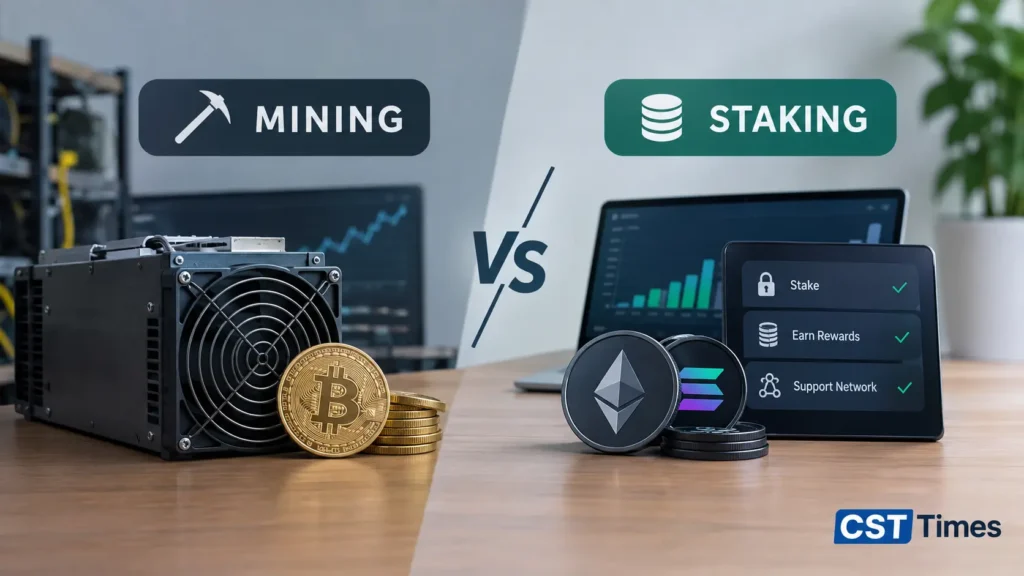
Crypto Mining vs Crypto Staking: Which One Actually Pays?
Crypto Mining vs Crypto Staking
Quick Summary:
Crypto mining uses computing hardware to solve mathematical puzzles and earn new coins on proof-of-work (PoW) networks like Bitcoin. Crypto staking locks up coins to help validate transactions on proof-of-stake (PoS) networks like Ethereum and Solana, earning rewards without any hardware.
Table of Contents
ToggleThis guide compares how each actually works, what they cost, what they currently pay, and which risks come with each, so you can judge which one fits your budget and goals.
Key Takeaways
- Mining secures PoW blockchains using hardware and electricity; staking secures PoS blockchains by locking up coins as collateral.
- A single competitive ASIC miner now costs roughly $2,750–$9,000, and profitability generally needs electricity under about $0.07/kWh.
- Ethereum’s native staking APR has compressed to roughly 2.7–3% in 2026 as more ETH joins the validator set, down from over 5% in 2023.
- Both mining and staking rewards count as ordinary income for US tax purposes the moment you receive them, with a separate capital-gains event when you sell.
- Staking carries slashing and lock-up risk; mining carries hardware depreciation and electricity-price risk.
Table of Contents
- What is Crypto Mining?
- What is Crypto Staking?
- Key Differences
- Which Coins Can You Mine vs Stake?
- Which One Should You Choose?
- Quick Checklist
- Is Crypto Mining or Staking Halal for Muslims?
- Final Thoughts
- FAQs
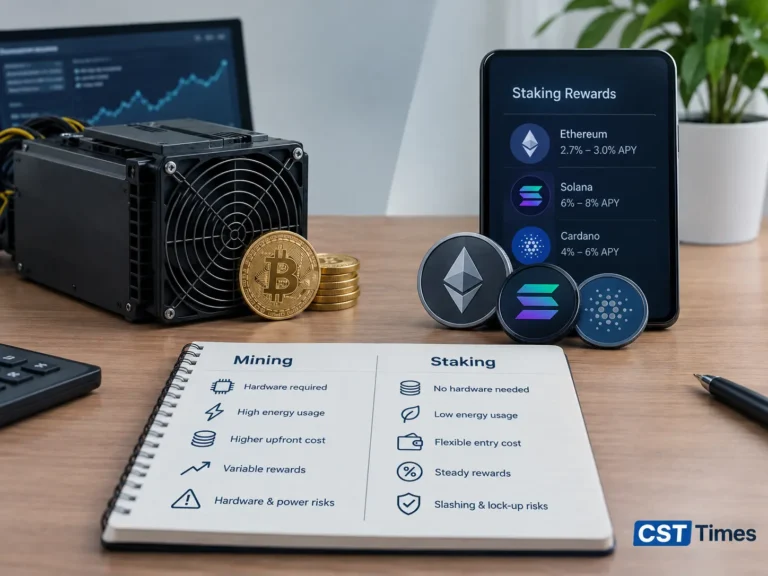
Mining vs Staking at a Glance
| Factor | Crypto Mining | Crypto Staking |
|---|---|---|
| Consensus model | Proof of Work (PoW) | Proof of Stake (PoS) |
| What you need | ASIC/GPU hardware + electricity | Coins to lock up |
| Typical entry cost (2026) | ~$2,750+ for one ASIC | Any amount, via pools or exchanges |
| Energy use | High — Bitcoin alone draws an estimated 138 TWh/year | Minimal — a validator node runs on ordinary hardware |
| 2026 typical yield | Depends on BTC price, difficulty, and electricity cost | Roughly 2.7% (ETH) to 6–8% headline (SOL) |
| Main risk | Hardware depreciation, rising difficulty, power costs | Slashing, lock-ups, smart-contract risk |
| Can’t-stake / can’t-mine example | Bitcoin (PoW only) | Ethereum (PoS only, since 2022) |
What is Crypto Mining?
Mining is how proof-of-work blockchains like Bitcoin add new blocks and issue new coins. Miners run specialized hardware that repeatedly guesses a number until it finds one that satisfies the network’s current difficulty target. The first miner to find a valid answer gets to add the next block and collects the block reward plus transaction fees.
This process is deliberately expensive. Burning real electricity is what makes it costly to rewrite Bitcoin’s history, since an attacker would need to out-spend the entire honest network. Bitcoin’s network now runs at roughly 878 exahashes per second, meaning miners worldwide make close to a billion trillion guesses every second just to keep the network secure.
Modern Bitcoin mining runs almost entirely on ASICs (application-specific integrated circuits) built only to compute this one puzzle; GPUs are still used for some smaller PoW coins. Rewards shrink over time by design. Bitcoin’s block subsidy halves roughly every four years, and the April 2024 halving cut it from 6.25 BTC to 3.125 BTC per block, which squeezed margins across the entire mining industry.
What is Crypto Staking?
Staking is how proof-of-stake blockchains validate transactions without mining hardware. Instead of computing power, validators lock up (stake) coins as collateral and are chosen, roughly in proportion to their stake, to propose and confirm new blocks. Correct participation earns rewards drawn from new coin issuance and, on some networks, a share of transaction fees.
Ethereum is the clearest example of this shift. It ran as a PoW, mineable coin until “The Merge” in September 2022 moved it to PoS, a change Ethereum’s own developers say cut the network’s energy use by about 99.95%. Running a solo Ethereum validator requires 32 ETH, but most people stake through exchanges, staking pools, or liquid staking protocols like Lido or Rocket Pool, which accept far smaller amounts and issue a tradable token (such as stETH) representing the staked position.
Crypto Mining vs Crypto Staking: Key Differences
1. Energy Consumption
| Crypto Mining | Crypto Staking |
|---|---|
| Mining is energy-intensive by design. Cambridge Centre for Alternative Finance researchers put Bitcoin’s annual electricity draw at a central estimate of about 138 TWh, roughly 0.5% of global electricity use. | Staking needs only enough power to run a validator node or laptop, which is why Ethereum’s move away from mining produced such a dramatic energy drop. |
2. Startup Costs and Barriers to Entry
| Crypto Mining | Crypto Staking |
|---|---|
| Mining requires real capital before you earn anything. A mid-tier ASIC like the Antminer S21 (200 TH/s) runs around $2,750, while top-efficiency hydro-cooled units cost $9,000 or more, and that’s before hosting, cooling, and electricity contracts. | Staking has a much lower floor: a solo Ethereum validator still needs 32 ETH, worth roughly $80,000 at current prices, but pooled and exchange staking let people start with whatever they already hold. |
3. Rewards and Profitability in 2026
| Crypto Mining | Crypto Staking |
|---|---|
| Mining profit depends on three moving parts: coin price, network difficulty, and your electricity rate. Industry estimates put the 2026 breakeven point around $0.06–$0.07 per kWh for current-generation hardware, since electricity typically eats 60–80% of a mining operation’s running costs. At that rate, a mid-tier ASIC clears a modest few dollars a day; the most efficient hydro-cooled machines can net well over $15 a day under favorable power contracts. | Staking yields have compressed as more coins get locked up. Ethereum’s native staking APR sits at roughly 2.7% as of mid-2026, with MEV rewards adding another 0.5–1% on top, down from more than 5% in 2023 — a direct result of over 41 million ETH, about 34% of supply, now being staked. Other proof-of-stake coins post higher headline numbers: Solana staking typically advertises 6–8% APY, though Solana’s own token inflation of roughly 5–6% eats most of that, leaving a real return closer to 0–3%. Cardano offers a steadier 3–5% APY with no lock-up period at all. |
4. Risk Profile
| Crypto Mining | Crypto Staking |
|---|---|
| Mining risk centers on hardware and electricity. ASICs lose value as newer, more efficient models launch, network difficulty keeps climbing, and a spike in your power bill can turn a profitable rig unprofitable overnight. Several countries, including China, Bangladesh, Egypt, Nepal, Qatar, Algeria, and Iraq, have banned mining outright, and some US states and Canadian provinces now restrict it over strain on the local power grid. | Staking risk centers on lock-ups and validator behavior. Validators that double-sign a block or go offline for extended periods can be “slashed,” losing a portion of their staked coins. Withdrawing staked funds isn’t always instant either: Ethereum’s exit queue stretched to roughly 62 days in May 2026 as institutional demand surged. Liquid staking adds a further layer of smart-contract risk, since your coins sit inside a protocol you don’t fully control. |
5. Regulation and Taxes
| Crypto Mining | Crypto Staking |
|---|---|
| In the US, both mining and staking rewards count as ordinary income at their fair market value the moment you gain control over them, according to IRS guidance, including Revenue Ruling 2023-14 for staking. Selling those coins later triggers a separate capital-gains event. Running either activity at commercial scale can also shift your reporting from casual “other income” to Schedule C self-employment income. In March 2025, the SEC stated that proof-of-work mining generally isn’t a securities activity. | In the US, both mining and staking rewards count as ordinary income at their fair market value the moment you gain control over them, according to IRS guidance, including Revenue Ruling 2023-14 for staking. Selling those coins later triggers a separate capital-gains event. A joint SEC/CFTC interpretation issued in spring 2026 went further, classifying staking, mining, and a named list of tokens as digital commodities rather than securities, though the SEC’s newly proposed “Regulation Crypto Assets” framework from August 2026 could still adjust parts of this picture as it moves through the rulemaking process. |
Which Coins Can You Mine vs Stake?
Bitcoin is proof-of-work only and can never be staked under its current design. Ethereum is the reverse: since 2022 it’s proof-of-stake only and can no longer be mined. Many large newer networks, including Solana, Cardano, Avalanche, and Polkadot, launched as proof-of-stake from day one. Proof-of-work coins still represent a majority of total crypto market value, but proof-of-stake’s share keeps growing as new projects choose staking over mining.
Which One Should You Choose?
There’s no universal winner; the right choice depends on what you already have and how you want to spend your time. Mining tends to suit people with access to genuinely cheap, stable electricity and the willingness to manage physical hardware, cooling, and maintenance. Staking tends to suit people who already hold a proof-of-stake coin and would rather earn a modest, passive yield than run equipment.
Quick Checklist
- Do you have access to electricity at roughly $0.07/kWh or lower?
- Are you comfortable managing hardware, cooling, and noise?
- Would you rather hold coins passively than run equipment?
- Can you accept a lock-up or unbonding period before you can sell?
- Do you already hold the specific coin you’d want to stake?
Is Crypto Mining or Staking Halal for Muslims?
For Muslims, whether crypto mining or staking is halal depends on how the activity is structured and what the cryptocurrency represents. Crypto mining generally involves providing computing power to secure a proof-of-work network in exchange for rewards, while staking involves locking cryptocurrency to support a proof-of-stake network and earn rewards. Neither activity is automatically halal or haram in every situation; Muslims should consider whether the specific cryptocurrency and earning method comply with Islamic principles, avoid interest (riba), excessive uncertainty (gharar), and prohibited activities. Because Islamic scholars may differ on cryptocurrency and staking, Muslims should consult a qualified Islamic finance scholar before participating.
Final Thoughts:
Mining and staking solve the same problem, securing a blockchain, from opposite directions. Mining trades capital and electricity for a shot at network rewards; staking trades locked-up coins and patience for a steadier, usually smaller, yield. Neither is guaranteed to be profitable: mining margins move with coin prices, difficulty, and power costs, while staking yields shrink as more people join in. Whichever path you’re weighing, treat the numbers above as a starting point for your own research, not a promise of returns.
U.S. Energy Information Administration — Tracking electricity use from crypto mining
CoinLaw — ETH Staking Statistics 2026
CoinLaw — Crypto Mining Regulations by Country
FAQs
Can you mine and stake the same coin?
No. A blockchain uses one consensus method at a time. Bitcoin is mining-only, and Ethereum has been staking-only since 2022.
Do you need 32 ETH to stake Ethereum?
Only for a solo validator. Staking pools, liquid staking protocols, and exchange staking let you participate with far less.
Is staking safer than mining?
They carry different risks rather than one being universally safer — mining exposes you to hardware and power-cost risk, while staking exposes you to slashing and lock-up risk.
Is Bitcoin mining still profitable in 2026?
It can be, but mainly for operations with electricity around $0.06–$0.07/kWh or lower and current-generation hardware; higher power costs generally erase the margin.
Disclaimer
This article is for educational purposes only and isn’t financial advice. Cryptocurrency mining and staking both carry real financial risk, rewards are not guaranteed, and past performance doesn’t predict future results. Consult a licensed financial or tax professional before making investment decisions.

Pingback: What is Liquidity Risk? Definition, Types & Real Examples
Pingback: What is a Bitcoin ETF? How It Works, Costs, Benefits & Risks
Pingback: If the CLARITY Act Becomes Law: What Changes for Exchanges