

What is Spot Trading? How It Works, Advantages &Risks
What Is Spot Trading? How It Works
Quick Summary:
If you are new to cryptocurrency trading, spot trading is one of the simplest ways to buy and sell digital assets. It involves purchasing or selling an asset at the current market price without borrowing funds or using leverage.
Table of Contents
ToggleFor example, if Bitcoin is trading at $100,000 and you buy $500 worth of Bitcoin in the spot market, you are directly purchasing the asset. If the price later rises and you sell it at a higher price, you may make a profit. If the price falls, you can lose money.
Unlike futures or margin trading, spot trading normally does not involve borrowed money or leverage. This can make the trading process easier to understand, but it does not make cryptocurrency trading safe or risk-free. Crypto assets can experience large price movements, and investors can also face platform, custody, security, and fraud risks.
Key Takeaways
- Spot trading means buying or selling an asset at the current market price.
- In crypto spot trading, you normally pay for the asset directly rather than borrowing money to open a leveraged position.
- You can potentially make money if the asset increases in value and you sell at a higher price, but losses are also possible.
- Spot trading generally has simpler mechanics than futures or margin trading.
- Crypto prices can be highly volatile, so spot trading can still result in significant losses.
- Exchange security, custody, fees, scams, and the quality of the trading platform are important risks to consider.
- Never treat spot trading as guaranteed income or risk money you cannot afford to lose.
Table of Contents
- What Is Spot Trading?
- How Does Spot Trading Work?
- Example of Spot Trading
- What Are Spot Trading Orders?
- Is Spot Trading Safe?
- How to Make Money With Spot Trading
- Advantages of Spot Trading
- Risks of Spot Trading
- Spot Trading vs Futures Trading
- Tips for Spot Trading Beginners
- Final Thoughts
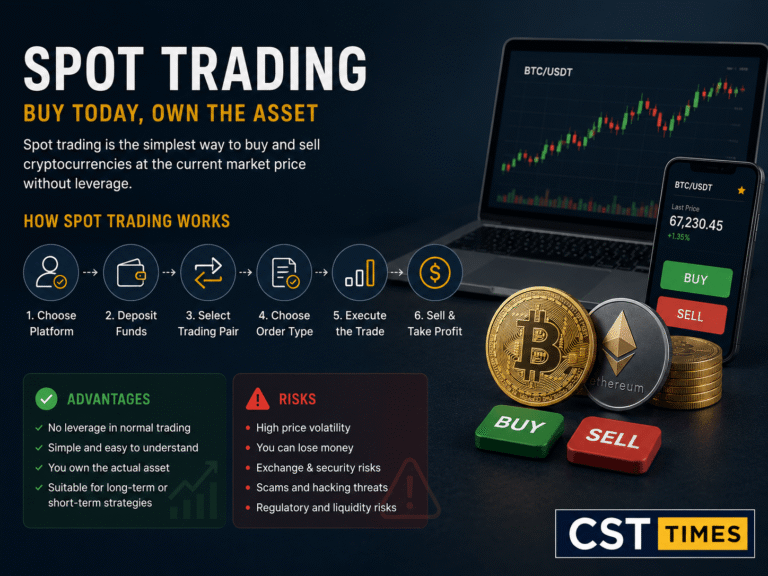
What is Spot Trading?
Spot trading is the buying or selling of an asset at its current market price, known as the spot price.
In cryptocurrency markets, a trader can use an exchange to buy assets such as Bitcoin, Ethereum, or other cryptocurrencies. When the order is completed, the purchased asset is credited to the trader’s account according to the exchange’s settlement and custody system.
Spot markets are not limited to cryptocurrency. Spot trading also exists in traditional financial markets, including stocks, currencies, and commodities. In crypto, however, the term is commonly used to describe directly buying and selling digital assets.
Simple Example
Suppose Bitcoin is trading at $100,000.
You decide to spend $1,000 to buy Bitcoin through a spot market.
If Bitcoin rises to $110,000 and you sell your holdings, the value of your position would be approximately $1,100 before trading fees and other costs.
If Bitcoin instead falls to $90,000, the same position would be worth approximately $900 before fees.
This simple example shows the basic idea: your potential gain or loss comes from the change in the asset’s price.
How Does Spot Trading Work?
Spot trading usually follows a simple process.
1. Choose a Trading Platform
First, a trader selects a cryptocurrency exchange or another platform that offers spot markets. (Binance, Coinbase)
Before depositing money or crypto, it is important to understand the platform’s fees, security practices, custody arrangements, withdrawal rules, and regulatory status where applicable.
2. Deposit Funds
The trader deposits funds supported by the platform.
Depending on the exchange, this could involve fiat currency such as USD or another cryptocurrency such as USDT.
3. Select a Trading Pair
A trading pair shows which assets are being exchanged.
For example:
- BTC/USDT
- ETH/USDT
- SOL/USDT
In a BTC/USDT pair, BTC is the asset being bought or sold, while USDT is the asset used to quote its price.
4. Choose an Order Type
The trader decides how the trade should be executed.
Common order types include market orders and limit orders. Some exchanges also provide stop-limit and other advanced order types.
5. Execute the Trade
Once the order is matched, the transaction is executed.
If you buy Bitcoin, your account receives the corresponding BTC amount, subject to the platform’s settlement and custody arrangements.
6. Sell the Asset
A trader can later sell the asset.
If the selling price is higher than the effective purchase price, the trader may have a profit. If the selling price is lower, the trader has a loss.
Trading fees and other costs should be included when calculating the actual result.
Example of Spot Trading
Imagine you buy $500 of Ethereum when ETH is priced at $2,500.
Your $500 would represent approximately 0.2 ETH, before fees.
If ETH rises to $3,000 and you sell 0.2 ETH, the position would be worth approximately $600 before fees.
Your approximate gross gain would be:
$600 − $500 = $100
But if ETH falls to $2,000, the same 0.2 ETH would be worth approximately $400.
That would represent an approximate $100 loss before fees.
This is why spot trading should not be viewed as a guaranteed way to make money.
What Are Spot Trading Orders?
Different order types can help traders control how their trades are executed.
Market Order
A market order attempts to buy or sell an asset immediately at the best available prices in the market.
It is generally useful when execution speed is more important than getting a specific price.
Limit Order
A limit order lets the trader specify the price at which they are willing to buy or sell.
For example, if Bitcoin is currently trading at $100,000, a trader could place a limit order to buy at $98,000.
The order will only execute if the market reaches the required price and sufficient liquidity is available.
Stop-Limit Order
A stop-limit order combines a trigger price with a limit order. It can be used as part of a risk-management strategy, although it does not guarantee execution in every market condition.
The exact order types and rules vary between exchanges.
Is Spot Trading Safe?
Spot trading can be simpler than leveraged trading, but it is not risk-free.
One important difference is that ordinary spot trading does not require borrowed funds or leverage. Binance describes spot trading as direct buying and selling without borrowed funds, which can make it a lower-risk entry point compared with leveraged products.
However, the underlying cryptocurrency can still lose substantial value.
Investor.gov warns that crypto asset investments can be highly volatile and speculative and that investors may face risks involving platform failures, hacking, fraud, withdrawal problems, regulatory changes, and lack of certain investor protections.
What Makes Spot Trading Risky?
Some major risks include:
- Cryptocurrency price volatility
- Losing money when prices fall
- Trading fees
- Low liquidity in some assets
- Exchange or platform failure
- Hacking and cybersecurity threats
- Phishing and other scams
- Loss of access to crypto assets
- Regulatory changes
- Poor trading decisions caused by emotions
The safety of a spot trade therefore depends on more than simply whether the trade uses leverage.
How to Make Money With Spot Trading
There is no guaranteed method to make money with spot trading.
The basic idea behind profitable spot trading is simple: buy an asset at one price and sell it later at a higher effective price after considering fees and other costs.
However, consistently doing this is difficult because cryptocurrency prices can move quickly and unpredictably.
1. Buy at a Price You Consider Attractive
Some traders analyze market trends, support and resistance levels, trading volume, or other indicators before deciding where to enter a trade.
Technical analysis can help organize a trading plan, but it cannot predict future prices with certainty.
2. Sell at a Higher Price
If the market moves in your favor, selling at a higher price can create a gross gain.
For example:
Buy: $1,000
Sell: $1,150
Gross gain: $150
The actual result would be lower after applicable trading fees and other costs.
3. Use a Trading Plan
A trading plan can define:
- Why you are entering a trade
- How much capital you are risking
- Where you would take profit
- Where you would exit if the trade moves against you
- Which assets you are willing to trade
A plan can help reduce emotional decisions.
4. Manage Risk
Risk management is often more important than trying to predict every price movement.
A trader can consider:
- Using only money they can afford to lose
- Avoiding excessive concentration in one asset
- Setting clear entry and exit conditions
- Keeping position sizes reasonable
- Avoiding emotional trading
Investor.gov similarly advises investors to understand the risks of crypto assets and only put money at risk that they can afford to lose entirely.
5. Avoid FOMO
FOMO means “fear of missing out.”
It can happen when a cryptocurrency rises quickly, and traders rush to buy because they believe the price will continue rising.
This can lead to buying at an inflated price without a proper plan.
A better approach is to make decisions based on your strategy and risk tolerance rather than social-media hype
Advantages of Spot Trading
Spot trading has several features that make it attractive to beginners.
No Leverage in Normal Spot Trading
Unlike leveraged futures or margin trading, ordinary spot trading does not require borrowed funds.
This means a trader is not exposed to the additional liquidation mechanics associated with leveraged positions.
Simple to Understand
The basic concept is straightforward:
Buy → Hold → Sell
A trader buys an asset and later decides whether to sell it.
Direct Ownership or Custody Exposure
With spot trading, the transaction is for the underlying crypto asset rather than a futures contract.
However, how the asset is actually held and controlled depends on the platform and custody arrangement. Investor.gov notes that crypto wallets generally store the private keys used to access crypto assets rather than storing the assets themselves.
Suitable for Different Strategies
Spot traders can use different approaches, including:
- Long-term holding
- Short-term trading
- Dollar-cost averaging
- Swing trading
Each strategy has different risks and requires its own plan.
Risks of Spot Trading
Understanding the risks is essential before trading cryptocurrency.
1. Market Volatility
Crypto prices can change significantly over short periods.
The CFTC notes that virtual currencies can be more volatile than traditional fiat currencies, while Investor.gov describes crypto investments as highly volatile and speculative.
2. You Can Lose Money
If you buy a cryptocurrency and its price falls, the value of your holdings falls as well.
There is no guarantee that the price will recover.
3. Exchange and Custody Risk
If you keep crypto on a third-party platform, you also depend on that platform’s security and ability to provide access to your assets.
Investor.gov recommends researching custodians, understanding how assets are safeguarded, and checking what happens if a custodian fails.
4. Hacking and Scams
Crypto users can face phishing attacks, hacking, malware, fake investment platforms, and other scams.
Investor.gov specifically advises users to protect their accounts with strong passwords and multi-factor authentication, and never share private keys or seed phrases.
5. Liquidity Risk
Some cryptocurrencies have relatively low trading volume.
If there are not enough buyers or sellers, it can become harder to execute a trade at the price you want.
6. Regulatory Risk
Rules governing crypto assets and trading platforms can vary across countries and over time.
Regulatory changes can affect how assets can be traded, held, transferred, or offered.
7. Emotional Trading
Fear and greed can cause traders to buy. Prices are rising, or they sell because prices are falling.
Emotional decisions can turn a planned trade into an impulsive one.
Spot Trading vs Futures Trading
| Feature | Spot Trading | Futures Trading |
|---|---|---|
| Basic concept | Buy or sell the asset | Trade a contract linked to an asset |
| Leverage | Normally no | Often available |
| Borrowed funds | Normally no | May be used through margin/leverage |
| Liquidation risk | Generally not applicable in the same way | Can occur with leveraged positions |
| Complexity | Generally simpler | More complex |
| Main risk | Asset price can fall | Price movement plus leverage can magnify losses |
The key difference is leverage. In leveraged futures trading, a relatively small movement in the underlying
asset can have a much larger effect on the trader’s position. The CFTC warns
that leverage can amplify both gains and losses and, in some futures
situations, losses can exceed the initial amount deposited.
Tips for Spot Trading Beginners
If you are new to spot trading, consider these basic practices:
- Learn the market before risking money.
- Start with a small amount.
- Understand trading fees.
- Research the asset before buying it.
- Do not trade based only on social-media posts.
- Avoid using money you need for essential expenses.
- Use strong account security and MFA.
- Never share your seed phrase or private keys.
- Have an exit plan before entering a trade.
- Keep a record of your trades and results.
Investor.gov recommends carefully researching crypto custodians and protecting accounts with strong passwords and multi-factor authentication.
Quick Checklist Before Your First Spot Trade
- ✅ I know when I would exit the trade.
- ✅ I am not buying simply because of FOMO.
- ✅ I understand that I can lose money.
- ✅ I have checked the trading fees.
- ✅ I have researched the cryptocurrency.
- ✅ I understand the platform’s withdrawal and custody rules.
- ✅ I have enabled strong account security.
- ✅ I am not using money needed for essential expenses.
- ✅ I have a clear reason for entering the trade.
Final Thoughts:
Spot trading is one of the simplest ways to participate in cryptocurrency markets because it involves directly buying and selling assets rather than using leverage or complex derivatives.
That simplicity, however, should not be confused with safety. Cryptocurrency prices can be highly volatile, and traders can also face platform, custody, cybersecurity, liquidity, regulatory, and fraud risks.
You can potentially make money through spot trading when an asset is sold for more than its effective purchase price, but there is no guaranteed strategy for making consistent profits.
For beginners, the most important goal should be to understand the market, manage risk, protect your account, and avoid risking money you cannot afford to lose.
FAQs
What is spot trading in simple words?
Spot trading means buying or selling an asset at its current market price. In crypto, you can buy an asset such as Bitcoin or Ethereum and later sell it if you choose.
Is spot trading better than futures?
Neither is automatically better for everyone. Spot trading is generally simpler and does not normally use leverage, while futures can involve leverage and more complex risks. Beginners may find spot trading easier to understand.
Can you make money with spot trading?
Yes, a trader can potentially make a profit by buying an asset at a lower effective price and selling it at a higher price. However, profits are not guaranteed, and traders can lose money when prices fall.
Is spot trading safe for beginners?
Spot trading is generally simpler than leveraged trading, but crypto spot trading still carries significant risks. Beginners should understand volatility, platform risk, custody, fees, and security before trading.
Do you need leverage for spot trading?
No. Normal spot trading does not require leverage. You purchase or sell the underlying asset directly rather than using borrowed funds.
What is the biggest risk of spot trading?
For cryptocurrency spot trading, major risks include sharp price declines, volatility, platform or custody problems, hacking, scams, liquidity issues, and regulatory changes.
Can I lose all my money in spot trading?
Yes. A cryptocurrency can lose most or potentially all of its value, and other events such as fraud, platform failure, or loss of access can create additional risks. Investors should only risk money they can afford to lose entirely.
Disclaimer
This article is for educational and informational purposes only. It is not financial, investment, legal, or tax advice. Cryptocurrency trading involves significant risk, and past performance does not guarantee future results. Always conduct your own research and consider your financial situation and risk tolerance before making investment decisions.
References
- Binance Academy — Your Guide to Binance Spot Trading
- Binance Academy — Binance Spot Trading Rules: A Comprehensive Guide
- U.S. Commodity Futures Trading Commission — Customer Advisory: Understand the Risks of Virtual Currency Trading
Follow us on Social media :
About The Author

Haseeb Jabbar
Haseeb Jabbar writes about crypto, finance, technology, and AI at CST Times, sharing research-based guides, timely news, and free tools and calculators to help readers make informed decisions.

Pingback: Spot Trading vs Futures Trading: 7 Key Differences (Guide)