
Emerging Markets in 2026 — Growth, Risks, and What to Watch
Introduction :
Emerging markets will remain a major part of the world economy in 2026. This article explains, how fast they are likely to grow, the main risks they face (like higher debt, trade problems and geopolitics), and the key opportunities from technology and domestic demand. It uses trusted data from global institutions and recent market events so you can understand the facts and make better decisions.
Table of Contents
ToggleThe 2026 growth picture — steady but uneven
The overall global economy is projected to grow around 3.3% in 2026 — a modest, steady pace driven by private investment and technology adoption. International Monetary Fund estimates this resilience even as trade and policy uncertainty remain.
Emerging and developing economies still grow faster than advanced economies. Many official forecasts show emerging market growth near or above 4% for 2026, though growth is uneven across regions. Countries with strong domestic demand and investment plans tend to do better, while those with heavy debt or structural weaknesses lag behind.
Recent shock: energy prices and market reactions (March 2026)
A sharp rise in oil prices in early March 2026 showed how geopolitics can quickly change the outlook. Market reports recorded large jumps in Brent crude after a Middle East escalation, with clear effects on stock markets and inflation expectations. This kind of shock hits energy-importing emerging markets hardest by increasing import bills and domestic inflation. Reuters.
Main challenges for emerging markets in 2026
Geopolitical and trade risk: Conflicts or new tariffs can slow exports and raise costs.
Debt and fiscal limits: Many countries entered 2026 with high debt; this limits what governments can spend during shocks.
Inflation and food prices: In some regions food or energy price spikes keep inflation above central-bank targets.
Uneven recovery: Not all countries recovered equally after earlier crises — some still have per-person incomes below 2019 levels.
These problems mean policy choices matter: countries with clear fiscal rules and credible monetary policy find it easier to attract investment and manage shocks.
Big opportunity — technology and the energy challenge
Artificial intelligence and data-intensive services are now a major growth engine. The rising demand for data centers and computing power increases electricity needs worldwide. The International Energy Agency reports that energy use by data centers has been growing fast and is an important factor for future grid planning. International Energy Agency.
That creates a two-fold opportunity for emerging markets:
Countries that invest in reliable, low-carbon power and grid modernization can attract tech investment (data centers, cloud services).
Those that fail to upgrade energy and digital infrastructure risk missing the AI-driven growth wave.
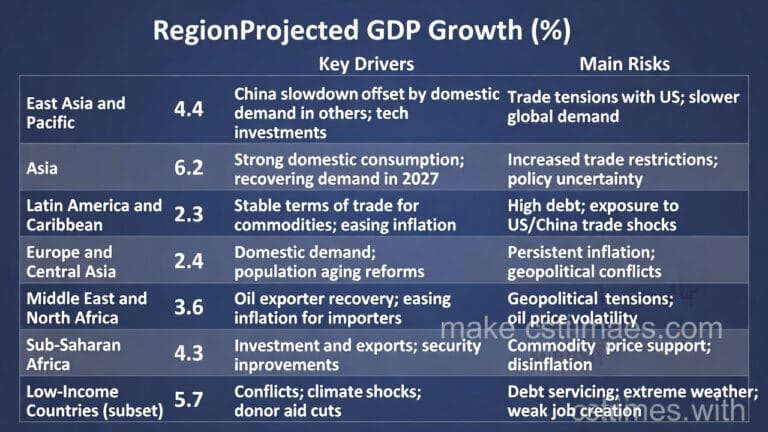
Regional highlights
India is a top growth story in 2026: forecasts and official data point to very strong growth driven by domestic demand and investment. India.
China continues to be a major influence — slower than before but still central to regional trade and supply chains. China
Latin America offers important mineral resources (for EVs and green tech) but growth is modest; policy and commodity prices matter. Brazil
Sub-Saharan Africa shows resilience in parts, but job creation and debt remain urgent issues.
(Note: each country name above is shown once as an entity for clarity. Later mentions are plain text.)
Practical takeaways — for investors, businesses, and policymakers
For investors:
Check which countries borrow mostly in local currency — this reduces currency risk.
Prefer economies investing in power, digital infrastructure, and human capital.
Watch energy exposure: oil-importing economies are more vulnerable to price spikes.
For policymakers:
Rebuild fiscal buffers and keep clear fiscal rules.
Prioritize grid modernization, renewable energy, and broadband to capture AI-led investment.
Strengthen education and vocational training so workers can benefit from new tech jobs.
summary
In 2026 emerging markets remain a key engine of world growth, but the story is mixed. Technology and strong domestic demand create major opportunities, while debt limits, trade tensions, and geopolitical shocks (like sudden oil price jumps) can slow progress. Countries that combine fiscal discipline with investments in energy and digital infrastructure are best placed to benefit.
Sources
IMF — World Economic Outlook Update, Jan 2026 (global growth 3.3%).
World Bank — Global Economic Prospects / EMDE outlook (2026 projections).
Reuters — March 2026 market and oil coverage (Brent crude and market reaction).
Reuters — India growth forecast (IMF and official figures).
About The Author

Haseeb Jabbar
Haseeb Jabbar writes about crypto, finance, technology, and AI at CST Times, sharing research-based guides, timely news, and free tools and calculators to help readers make informed decisions.
